Mapping 3-D Explosive Nucleosynthesis with Type II Supernova Infrared Emission Lines
Pith reviewed 2026-05-20 08:26 UTC · model grok-4.3
pith:AQBJX4W4 Add to your LaTeX paper
What is a Pith Number?\usepackage{pith}
\pithnumber{AQBJX4W4}
Prints a linked pith:AQBJX4W4 badge after your title and writes the identifier into PDF metadata. Compiles on arXiv with no extra files. Learn more
The pith
Infrared emission lines from SN 2024ggi reveal nickel mixing that only energetic three-dimensional explosion models of high-mass progenitors can reproduce.
A machine-rendered reading of the paper's core claim, the machinery that carries it, and where it could break.
Core claim
The paper shows that a simple mapping between elemental mass distribution and projected velocity reproduces the infrared line profiles produced by detailed CMFGEN radiative transfer calculations. When this mapping is used on three-dimensional neutrino-driven explosion models, only energetic simulations of high-mass progenitors generate the observed nickel mixing extent traced by double-peaked [Ni I], [Fe II], and [Co I] profiles in SN 2024ggi. This conflicts with the 12 to 15.2 solar mass progenitor range favored by non-LTE modeling of the spectra.
What carries the argument
the simple mapping between elemental mass distribution and projected velocity that reproduces full radiative transfer line profiles
Load-bearing premise
The assumption that a simple mapping of elemental mass to projected velocity accurately reproduces line profiles from detailed radiative transfer calculations without significant effects from optical depth variations or ionization structure.
What would settle it
A three-dimensional explosion simulation of a lower-mass progenitor that, when mapped to velocity space, produces double-peaked nickel infrared line profiles matching the observed shapes in SN 2024ggi would falsify the requirement for high-mass energetic models.
Figures


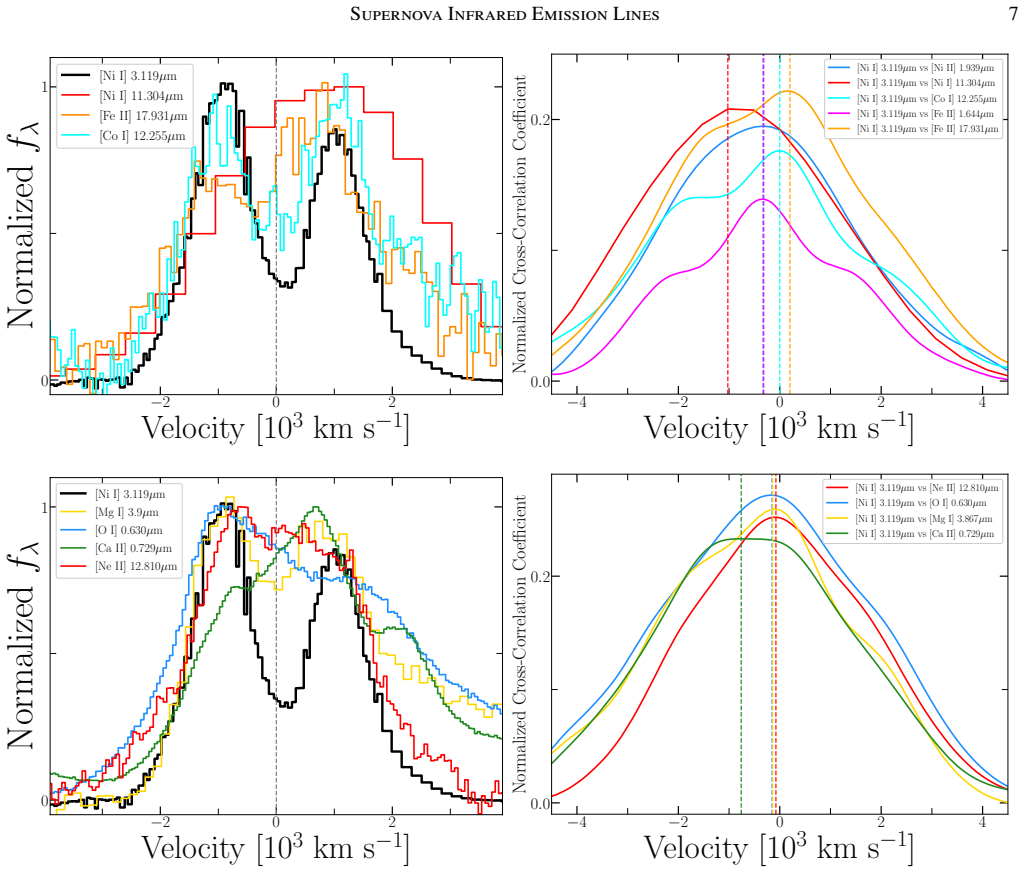
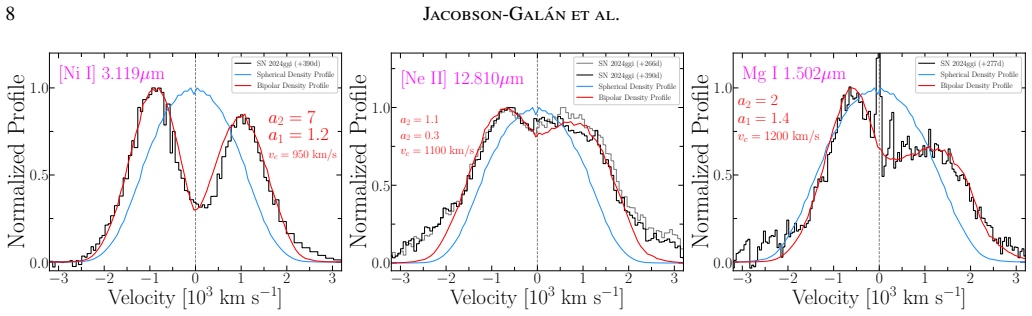
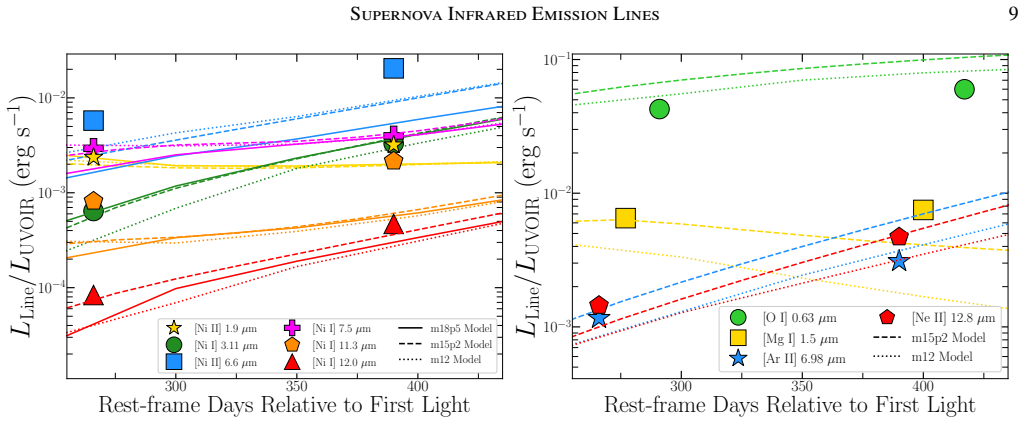


read the original abstract
We present analysis and modeling of optical and infrared (IR) spectroscopy of the Type II supernova (SN II) 2024ggi obtained with ground-based instruments and the James Webb Space Telescope (JWST) at phases of ~265 - 400 days. The near- and mid-IR spectra reveal diverse iron-group emission-line morphologies, including double-peaked profiles in [Ni I] 3.119 and 11.998 $\mu$m, [Fe II] 1.644 and 17.931 $\mu$m, and [Co I] 12.255 $\mu$m, alongside Gaussian profiles in [Ni II] 1.939 $\mu$m, [Co II] 10.520 $\mu$m, and [Ni I] 7.505 and 11.304 $\mu$m. These differences imply both chemical inhomogeneity and aspherical ionization of inner ejecta, consistent with expectations from the $^{56}$Ni bubble effect. Modeling of double-peaked profiles supports an ejecta distribution with polar enhancements as large as ~7 for Ni/Co/Fe-rich material and ~2 for intermediate-mass elements. LTE estimates imply a stable Ni mass of $M_{\rm Ni}\approx1.3\times10^{-3}$ M$_{\odot}$, but electron densities near critical values indicate departures from LTE. Comparisons to non-LTE radiative transfer models favor a progenitor mass of ~12 - 15.2 M$_{\odot}$. We show that a simple mapping between elemental mass distribution and projected velocity reproduces line profiles produced in a CMFGEN radiative transfer calculation. We apply this property to 3-D neutrino-driven explosion simulations and predict Ni emission profiles for varying viewing angles. We find that only energetic 3-D explosion models of high-mass progenitors reproduce the observed extent of Ni mixing in SN 2024ggi, conflicting with progenitor masses inferred from radiative transfer models. These results demonstrate the utility of resolved nebular IR lines as direct probes of the 3-D distribution of explosively synthesized material in core-collapse SNe.
Editorial analysis
A structured set of objections, weighed in public.
Referee Report
Summary. The manuscript analyzes optical and IR spectra of SN 2024ggi at phases ~265-400 days, identifying double-peaked profiles in lines such as [Ni I] 3.119 μm, [Fe II] 1.644 μm, and [Co I] 12.255 μm alongside Gaussian profiles in others. These are modeled to infer polar enhancements of ~7 for Ni/Co/Fe-rich material and ~2 for intermediate-mass elements, with an LTE stable Ni mass of ~1.3×10^{-3} M_⊙ (noting departures from LTE). Non-LTE RT models favor a progenitor mass of 12-15.2 M_⊙. A simple mapping from elemental mass distribution to projected velocity is shown to reproduce CMFGEN line profiles and is applied to 3D neutrino-driven explosion simulations, leading to the claim that only energetic high-mass progenitor models match the observed Ni mixing extent, in tension with the RT-inferred masses.
Significance. If the velocity mapping is robust, the work offers a promising method to directly constrain 3D explosive nucleosynthesis using resolved nebular IR lines, potentially resolving or highlighting inconsistencies between progenitor masses derived from radiative transfer versus explosion simulations. The explicit treatment of asphericity via the 56Ni bubble effect and the reproduction of CMFGEN profiles with a simplified mapping are strengths that could make IR line morphology a standard diagnostic for core-collapse SN geometry.
major comments (2)
- [Section describing the simple mapping and its validation against CMFGEN] The central claim that only energetic 3-D high-mass progenitor models reproduce the observed Ni mixing (abstract and simulation comparison section) rests on the simple mass-to-projected-velocity mapping. However, the manuscript reports electron densities near critical values, explicit LTE departures, and aspherical ionization from the 56Ni bubble effect; these raise the possibility that optical-depth variations and ionization gradients contribute to the double-peaked profiles and intensity ratios, which the mapping does not explicitly include. A direct test against additional CMFGEN models with varied ionization structure would be needed to confirm the mapping's accuracy for the inferred polar enhancements of ~7.
- [Discussion of progenitor mass estimates and 3D model comparisons] The reported tension between the high-mass progenitor requirement from the 3D simulation comparison and the 12-15.2 M_⊙ range from non-LTE radiative transfer models is load-bearing for the paper's interpretation. The manuscript should quantify how uncertainties in the polar enhancement factors and viewing-angle predictions propagate into the mixing extent, and whether adjustments within the RT modeling uncertainties could reconcile the two mass estimates.
minor comments (3)
- [Abstract and observational data section] Specify the precise observation epochs for each spectrum and line profile shown in the figures, rather than the broad ~265-400 day range.
- [Modeling of double-peaked profiles] Include uncertainty estimates or sensitivity tests on the derived polar enhancement factors (~7 and ~2) and the LTE Ni mass.
- [Mapping validation subsection] Clarify whether the mapping assumes optically thin conditions throughout or includes any correction for the reported near-critical densities.
Simulated Author's Rebuttal
We thank the referee for their thorough and constructive review. We address each major comment point by point below, providing our strongest honest defense while indicating revisions where the manuscript can be improved.
read point-by-point responses
-
Referee: The central claim that only energetic 3-D high-mass progenitor models reproduce the observed Ni mixing rests on the simple mass-to-projected-velocity mapping. However, the manuscript reports electron densities near critical values, explicit LTE departures, and aspherical ionization from the 56Ni bubble effect; these raise the possibility that optical-depth variations and ionization gradients contribute to the double-peaked profiles and intensity ratios, which the mapping does not explicitly include. A direct test against additional CMFGEN models with varied ionization structure would be needed to confirm the mapping's accuracy for the inferred polar enhancements of ~7.
Authors: We thank the referee for this careful observation. The mapping is a simplified representation of the dominant velocity projection effect, but its validity is demonstrated by direct reproduction of the full CMFGEN line profiles, which already incorporate optical-depth variations, non-LTE effects, and the aspherical ionization structure arising from the 56Ni bubble. Because the CMFGEN calculation includes these physics and the mapping matches its output, the approximation effectively captures the net impact on the observed morphologies for the reported polar enhancements. We agree that additional CMFGEN tests with varied ionization would further strengthen the result. In revision we will expand the relevant section with an explicit discussion of these limitations and the implicit inclusion of the effects via the validation, and we will add one supplementary comparison if feasible. revision: partial
-
Referee: The reported tension between the high-mass progenitor requirement from the 3D simulation comparison and the 12-15.2 M_⊙ range from non-LTE radiative transfer models is load-bearing for the paper's interpretation. The manuscript should quantify how uncertainties in the polar enhancement factors and viewing-angle predictions propagate into the mixing extent, and whether adjustments within the RT modeling uncertainties could reconcile the two mass estimates.
Authors: We agree that quantifying these uncertainties is important for assessing the robustness of the reported tension. In the revised manuscript we will add a sensitivity study that varies the polar enhancement factors over a plausible range (approximately 4–10) and explores multiple viewing angles to determine how these choices affect the minimum mixing extent required in the 3D models to match the data. We will also discuss how uncertainties in the RT modeling (e.g., assumptions about spherical averaging or ionization balance) could shift the inferred progenitor mass range. While such adjustments might narrow the apparent discrepancy, the direct geometric information encoded in the resolved IR line shapes remains a complementary and independent constraint; we will present the tension as a key finding while clearly stating the quantified uncertainties. revision: yes
Circularity Check
No significant circularity; derivation remains self-contained
full rationale
The paper's core chain begins with independent JWST and ground-based IR spectra of SN 2024ggi, proceeds to LTE and non-LTE modeling of observed line profiles to infer polar enhancements, validates a simple mass-to-velocity mapping against separate CMFGEN radiative-transfer calculations, and then applies that mapping to external 3-D neutrino-driven explosion grids. None of these steps reduces by construction to a prior fit or self-citation; the 3-D simulations and the full CMFGEN runs are distinct inputs, the observed line profiles are external data, and the mapping is presented as an empirical check rather than a tautology. No uniqueness theorem, ansatz smuggling, or renaming of known results is invoked in a load-bearing way. The derivation is therefore self-contained against external benchmarks.
Axiom & Free-Parameter Ledger
free parameters (2)
- polar enhancement factor for Ni/Co/Fe-rich material =
~7
- polar enhancement factor for intermediate-mass elements =
~2
axioms (2)
- domain assumption LTE conditions hold sufficiently for stable Ni mass estimate of 1.3e-3 solar masses
- domain assumption Simple projected-velocity mapping reproduces full radiative-transfer line profiles
Lean theorems connected to this paper
-
IndisputableMonolith/Foundation/RealityFromDistinction.leanreality_from_one_distinction unclear?
unclearRelation between the paper passage and the cited Recognition theorem.
We show that a simple mapping between elemental mass distribution and projected velocity reproduces line profiles produced in a CMFGEN radiative transfer calculation. We apply this property to 3-D neutrino-driven explosion simulations...
What do these tags mean?
- matches
- The paper's claim is directly supported by a theorem in the formal canon.
- supports
- The theorem supports part of the paper's argument, but the paper may add assumptions or extra steps.
- extends
- The paper goes beyond the formal theorem; the theorem is a base layer rather than the whole result.
- uses
- The paper appears to rely on the theorem as machinery.
- contradicts
- The paper's claim conflicts with a theorem or certificate in the canon.
- unclear
- Pith found a possible connection, but the passage is too broad, indirect, or ambiguous to say the theorem truly supports the claim.
Reference graph
Works this paper leans on
-
[1]
J., Indebetouw, R., Marcaide, J
Abell´an, F. J., Indebetouw, R., Marcaide, J. M., et al. 2017, ApJl, 842, L24, doi: 10.3847/2041-8213/aa784c
-
[2]
Arnett, W. D. 1989, Astrophysical Journal Letters, 341, L63, doi: 10.1086/185468 14Jacobson-Gal ´an et al. Table 1.SN 2024ggi Emission Line Properties Ion𝜆Δ𝐸 𝐴 𝑢𝑙 Temp. Sensitivity𝑛 𝑎 crit Profile Shape Line Lum. Phase𝑓 𝑏 𝐵 𝑓 𝑐 𝑅 (𝜇m) (eV) (s −1) (cm −3) (10 37 erg s−1) (days) Ni I 3.120 0.397 7.8×10 −2 Medium 4.5×10 6 Double-peaked 2.23±0.12 286 0.51±0.0...
-
[3]
2025, ApJ, 994, 266, doi: 10.3847/1538-4357/ae1d69
Aryan, A., Higgins, E., Nicholl, M., Chen, T.-W., & Liu, Y.-H. 2025, ApJ, 994, 266, doi: 10.3847/1538-4357/ae1d69
-
[4]
2024, MNRAS, 533, 1251, doi: 10.1093/mnras/stae1811
Barmentloo, S., Jerkstrand, A., Iwamoto, K., et al. 2024, MNRAS, 533, 1251, doi: 10.1093/mnras/stae1811
-
[5]
Baron, E., Ashall, C., DerKacy, J. M., et al. 2025, ApJ, 994, 249, doi: 10.3847/1538-4357/ae0e15
-
[6]
Storey, P. J. 2023, A&A, 678, A170, doi: 10.1051/0004-6361/202347147
-
[7]
Bostroem, K. A., Valenti, S., Sand, D. J., et al. 2025, arXiv e-prints, arXiv:2508.11756, doi: 10.48550/arXiv.2508.11756
-
[8]
2021, Nature, 589, 29, doi: 10.1038/s41586-020-03059-w
Burrows, A., & Vartanyan, D. 2021, Nature, 589, 29, doi: 10.1038/s41586-020-03059-w
-
[9]
2025, ApJ, 983, 86, doi: 10.3847/1538-4357/adb428
Chen, T.-W., Yang, S., Srivastav, S., et al. 2025, ApJ, 983, 86, doi: 10.3847/1538-4357/adb428
-
[10]
Chupp, E. L., Forrest, D. J., Ryan, J. M., et al. 1989, Astrophysical Journal Letters, 341, L1, doi: 10.1086/185450
-
[11]
M., Ashall, C., Hoeflich, P., et al
DerKacy, J. M., Ashall, C., Hoeflich, P., et al. 2023, ApJl, 945, L2, doi: 10.3847/2041-8213/acb8a8
-
[12]
M., Ashall, C., Baron, E., et al
DerKacy, J. M., Ashall, C., Baron, E., et al. 2026, ApJ, 997, 179, doi: 10.3847/1538-4357/ae1f87
-
[13]
2025, A&A, 703, A287, doi: 10.1051/0004-6361/202555664
Dessart, L. 2025, A&A, 703, A287, doi: 10.1051/0004-6361/202555664
-
[14]
Filippenko, A. V. 2023, A&A, 675, A33, doi: 10.1051/0004-6361/202345969 Supernova Infrared Emission Lines15
-
[15]
Dessart, L., & Hillier, D. J. 2011, MNRAS, 410, 1739, doi: 10.1111/j.1365-2966.2010.17557.x
-
[16]
Dessart, L., Hillier, D. J., Sukhbold, T., Woosley, S. E., & Janka, H.-T. 2021, A&A, 652, A64, doi: 10.1051/0004-6361/202140839
-
[17]
2025, A&A, 704, L6, doi: 10.1051/0004-6361/202556304
Dessart, L., Kotak, R., Jacobson-Gal´an, W., et al. 2025, A&A, 704, L6, doi: 10.1051/0004-6361/202556304
-
[18]
Ertini, K., Regna, T. A., Ferrari, L., et al. 2025, A&A, 699, A60, doi: 10.1051/0004-6361/202554333
-
[19]
Fang, Q., Moriya, T. J., & Maeda, K. 2025, ApJ, 986, 39, doi: 10.3847/1538-4357/adceae
-
[20]
Zimmerman, E. A. 2026, ApJ, 1001, 26, doi: 10.3847/1538-4357/ae4ec6
-
[21]
2025, A&A, 703, A12, doi: 10.1051/0004-6361/202556652
Ferrari, L., Folatelli, G., Ertini, K., et al. 2025, A&A, 703, A12, doi: 10.1051/0004-6361/202556652
-
[22]
2021, MNRAS, 502, 3264, doi: 10.1093/mnras/stab116
Gabler, M., Wongwathanarat, A., & Janka, H.-T. 2021, MNRAS, 502, 3264, doi: 10.1093/mnras/stab116
-
[23]
2025, arXiv e-prints, arXiv:2511.11796, doi: 10.48550/arXiv.2511.11796
Giudici, B., Gabler, M., & Janka, H.-T. 2025, arXiv e-prints, arXiv:2511.11796, doi: 10.48550/arXiv.2511.11796
-
[24]
Grefenstette, B. W., Harrison, F. A., Boggs, S. E., et al. 2014, Nature, 506, 339, doi: 10.1038/nature12997
-
[25]
Hanuschik, R. W., Thimm, G., & Dachs, J. 1988, MNRAS, 234, 41P, doi: 10.1093/mnras/234.1.41P Hueichap´an, E., Cartier, R., Prieto, J. L., et al. 2026, ApJ, 1000, 80, doi: 10.3847/1538-4357/ae4500 Jacobson-Gal´an, W. V., Davis, K. W., Kilpatrick, C. D., et al. 2024, ApJ, 972, 177, doi: 10.3847/1538-4357/ad5c64 Jacobson-Gal´an, W. V., Dessart, L., Kilpatric...
-
[26]
Janka, H.-T. 2012, Annual Review of Nuclear and Particle Science, 62, 407, doi: 10.1146/annurev-nucl-102711-094901
-
[27]
Janka, H.-T., Melson, T., & Summa, A. 2016, Annual Review of Nuclear and Particle Science, 66, 341, doi: 10.1146/annurev-nucl-102115-044747
-
[28]
2017, in Handbook of Supernovae, ed
Jerkstrand, A. 2017, in Handbook of Supernovae, ed. A. W. Alsabti & P. Murdin, 795, doi: 10.1007/978-3-319-21846-5 29 —. 2025, Living Reviews in Computational Astrophysics, 11, 1, doi: 10.1007/s41115-025-00022-2
-
[29]
2012, A&A, 546, A28, doi: 10.1051/0004-6361/201219528
Jerkstrand, A., Fransson, C., Maguire, K., et al. 2012, A&A, 546, A28, doi: 10.1051/0004-6361/201219528
-
[30]
Jerkstrand, A., Smartt, S. J., Fraser, M., et al. 2014, MNRAS, 439, 3694, doi: 10.1093/mnras/stu221
-
[31]
Jerkstrand, A., Timmes, F. X., Magkotsios, G., et al. 2015, ApJ, 807, 110, doi: 10.1088/0004-637X/807/1/110
-
[32]
Jones, O. C., Kavanagh, P. J., Barlow, M. J., et al. 2023, ApJ, 958, 95, doi: 10.3847/1538-4357/ad0036
-
[33]
Kasen, D., Thomas, R. C., & Nugent, P. 2006, ApJ, 651, 366, doi: 10.1086/506190
-
[34]
The evolution of the mid-infrared spectrum of SN 1987A observed with the JWST/MIRI-MRS
Kavanagh, P. J., Barlow, M. J., Fransson, C., et al. 2026, arXiv e-prints, arXiv:2604.09211, doi: 10.48550/arXiv.2604.09211
work page internal anchor Pith review Pith/arXiv arXiv doi:10.48550/arxiv.2604.09211 2026
-
[35]
2000, ApJL, 531, L123, doi: 10.1086/312541
Kifonidis, K., Plewa, T., Janka, H.-T., & M¨ uller, E. 2000, ApJL, 531, L123, doi: 10.1086/312541
-
[36]
2003, Astronomy and Astrophysics, 408, 621, doi: 10.1051/0004-6361:20030863
Kifonidis, T., Plewa, T., Janka, H.-T., & M¨ uller, E. 2003, Astronomy and Astrophysics, 408, 621, doi: 10.1051/0004-6361:20030863
-
[37]
2006, Astronomy and Astrophysics, 453, 661, doi: 10.1051/0004-6361:20054512
Kifonidis, T., Plewa, T., Scheck, L., Janka, H.-T., & M¨ uller, E. 2006, Astronomy and Astrophysics, 453, 661, doi: 10.1051/0004-6361:20054512
-
[38]
Kotak, R., Meikle, W. P. S., Farrah, D., et al. 2009, ApJ, 704, 306, doi: 10.1088/0004-637X/704/1/306
-
[39]
Kwok, L. A., Jha, S. W., Temim, T., et al. 2023, ApJl, 944, L3, doi: 10.3847/2041-8213/acb4ec
-
[40]
Kwok, L. A., Siebert, M. R., Johansson, J., et al. 2024, ApJ, 966, 135, doi: 10.3847/1538-4357/ad2c0d
-
[41]
Exploring the central region of SNR 0540-69.3 with JWST I: 3D morphology
Larsson, J., Tegkelidis, C., Fransson, C., et al. 2026, arXiv e-prints, arXiv:2604.19367, doi: 10.48550/arXiv.2604.19367
work page internal anchor Pith review Pith/arXiv arXiv doi:10.48550/arxiv.2604.19367 2026
-
[42]
2023, ApJL, 949, L27, doi: 10.3847/2041-8213/acd555
Larsson, J., Fransson, C., Sargent, B., et al. 2023, ApJL, 949, L27, doi: 10.3847/2041-8213/acd555
-
[43]
Li, H., McCray, R., & Sunyaev, R. A. 1993, ApJ, 419, 824, doi: 10.1086/173534
-
[44]
Optical spectra and spectral energy distribution modelling
Maguire, K., Jerkstrand, A., Smartt, S. J., et al. 2012, MNRAS, 420, 3451, doi: 10.1111/j.1365-2966.2011.20276.x
-
[45]
Matz, S. M., Share, G. H., Leising, M. D., et al. 1988, Nature, 331, 416, doi: 10.1038/331416a0
-
[46]
1993, Annual Review of Astronomy and Astrophysics, 31, 175, doi: 10.1146/annurev.aa.31.090193.001135
McCray, R. 1993, Annual Review of Astronomy and Astrophysics, 31, 175, doi: 10.1146/annurev.aa.31.090193.001135
-
[47]
2025, arXiv e-prints, arXiv:2507.19727
Medler, K., Ashall, C., Hoeflich, P., et al. 2025, arXiv e-prints, arXiv:2507.19727. https://arxiv.org/abs/2507.19727
-
[48]
2026, ApJ, 997, 330, doi: 10.3847/1538-4357/ae317e
Mera, T., Ashall, C., Hoeflich, P., et al. 2026, ApJ, 997, 330, doi: 10.3847/1538-4357/ae317e
-
[49]
Milisavljevic, D., & Fesen, R. A. 2015, Science, 347, 526, doi: 10.1126/science.1261949
-
[50]
2024, ApJL, 965, L27, doi: 10.3847/2041-8213/ad324b M¨ uller, E., Fryxell, B., & Arnett, D
Milisavljevic, D., Temim, T., De Looze, I., et al. 2024, ApJL, 965, L27, doi: 10.3847/2041-8213/ad324b M¨ uller, E., Fryxell, B., & Arnett, D. 1991, Astronomy and Astrophysics, 251, 505
-
[51]
Osterbrock, D. E., & Ferland, G. J. 2006, Astrophysics of gaseous nebulae and active galactic nuclei
work page 2006
-
[52]
H., Rho, J., Yoon, S.-C., et al
Park, S. H., Rho, J., Yoon, S.-C., et al. 2025, arXiv e-prints, arXiv:2507.11877, doi: 10.48550/arXiv.2507.11877
-
[53]
2024, A&A, 688, L28, doi: 10.1051/0004-6361/202450608
Pessi, T., Cartier, R., Hueichapan, E., et al. 2024, A&A, 688, L28, doi: 10.1051/0004-6361/202450608
-
[54]
Saha, A., Thim, F., Tammann, G. A., Reindl, B., & Sandage, A. 2006, ApJS, 165, 108, doi: 10.1086/503800
-
[55]
Seitenzahl, I. R., Timmes, F. X., & Magkotsios, G. 2014, ApJ, 792, 10, doi: 10.1088/0004-637X/792/1/10 16Jacobson-Gal ´an et al
-
[56]
2024, arXiv e-prints, arXiv:2401.14474, doi: 10.48550/arXiv.2401.14474
Shahbandeh, M., Ashall, C., Hoeflich, P., et al. 2024, arXiv e-prints, arXiv:2401.14474, doi: 10.48550/arXiv.2401.14474
-
[57]
1988, Astrophysical Journal Letters, 334, L73, doi: 10.1086/185323
Shigeyama, T., Nomoto, K., Hashimoto, M., & Sugimoto, D. 1988, Astrophysical Journal Letters, 334, L73, doi: 10.1086/185323
-
[58]
Shrestha, M., Bostroem, K. A., Sand, D. J., et al. 2024, ApJL, 972, L15, doi: 10.3847/2041-8213/ad6907
-
[59]
Sukhbold, T., Ertl, T., Woosley, S. E., Brown, J. M., & Janka, H.-T. 2016, ApJ, 821, 38, doi: 10.3847/0004-637X/821/1/38
work page internal anchor Pith review doi:10.3847/0004-637x/821/1/38 2016
-
[60]
Utrobin, V. P., Chugai, N. N., & Andronova, A. A. 1995, A&A, 295, 129 van Baal, B. F. A., & Jerkstrand, A. 2025, arXiv e-prints, arXiv:2511.07539, doi: 10.48550/arXiv.2511.07539 van Baal, B. F. A., Jerkstrand, A., Wongwathanarat, A., & Janka, H.-T. 2023, MNRAS, 523, 954, doi: 10.1093/mnras/stad1488
work page internal anchor Pith review Pith/arXiv arXiv doi:10.48550/arxiv.2511.07539 1995
-
[61]
2025a, arXiv e-prints, arXiv:2509.16314, doi: 10.48550/arXiv.2509.16314
Vartanyan, D., Burrows, A., Teryoshin, L., et al. 2025a, arXiv e-prints, arXiv:2509.16314, doi: 10.48550/arXiv.2509.16314
-
[62]
Vartanyan, D., Tsang, B. T.-H., Kasen, D., et al. 2025b, ApJ, 982, 9, doi: 10.3847/1538-4357/adb1e4
-
[63]
Wang, L., Wheeler, J. C., H¨oflich, P., et al. 2002, ApJ, 579, 671, doi: 10.1086/342824
-
[64]
2026, MNRAS, doi: 10.1093/mnras/stag325
Wesson, R., Gabler, M., Lyons, M., et al. 2026, MNRAS, doi: 10.1093/mnras/stag325
-
[65]
Three-Dimensional Simulations of Core-Collapse Supernovae: From Shock Revival to Shock Breakout
Wongwathanarat, A., Mueller, E., & Janka, H.-T. 2015, A&A, 577, A48. https://arxiv.org/abs/1409.5431
work page internal anchor Pith review Pith/arXiv arXiv 2015
-
[66]
Wooden, D. H., Rank, D. M., Bregman, J. D., et al. 1993, ApJs, 88, 477, doi: 10.1086/191830
-
[67]
2005, Nature Physics, 1, 147, doi: 10.1038/nphys172
Woosley, S., & Janka, T. 2005, Nature Physics, 1, 147, doi: 10.1038/nphys172
-
[68]
Woosley, S. E., Heger, A., & Weaver, T. A. 2002, Reviews of Modern Physics, 74, 1015, doi: 10.1103/RevModPhys.74.1015
-
[69]
2024, ApJL, 969, L15, doi: 10.3847/2041-8213/ad54b3
Xiang, D., Mo, J., Wang, X., et al. 2024, ApJL, 969, L15, doi: 10.3847/2041-8213/ad54b3
-
[70]
2025, Science Advances, 11, 24.2925, doi: 10.1126/sciadv.adx2925
Yang, Y., Wen, X., Wang, L., et al. 2025, Science Advances, 11, 24.2925, doi: 10.1126/sciadv.adx2925
-
[71]
2024, ApJL, 970, L18, doi: 10.3847/2041-8213/ad5da4
Zhang, J., Dessart, L., Wang, X., et al. 2024, ApJL, 970, L18, doi: 10.3847/2041-8213/ad5da4
discussion (0)
Sign in with ORCID, Apple, or X to comment. Anyone can read and Pith papers without signing in.