Spin-Hair Induced Chaos of Spinning Test Particles in Rotating Hairy Black Holes
Pith reviewed 2026-05-20 04:45 UTC · model grok-4.3
The pith
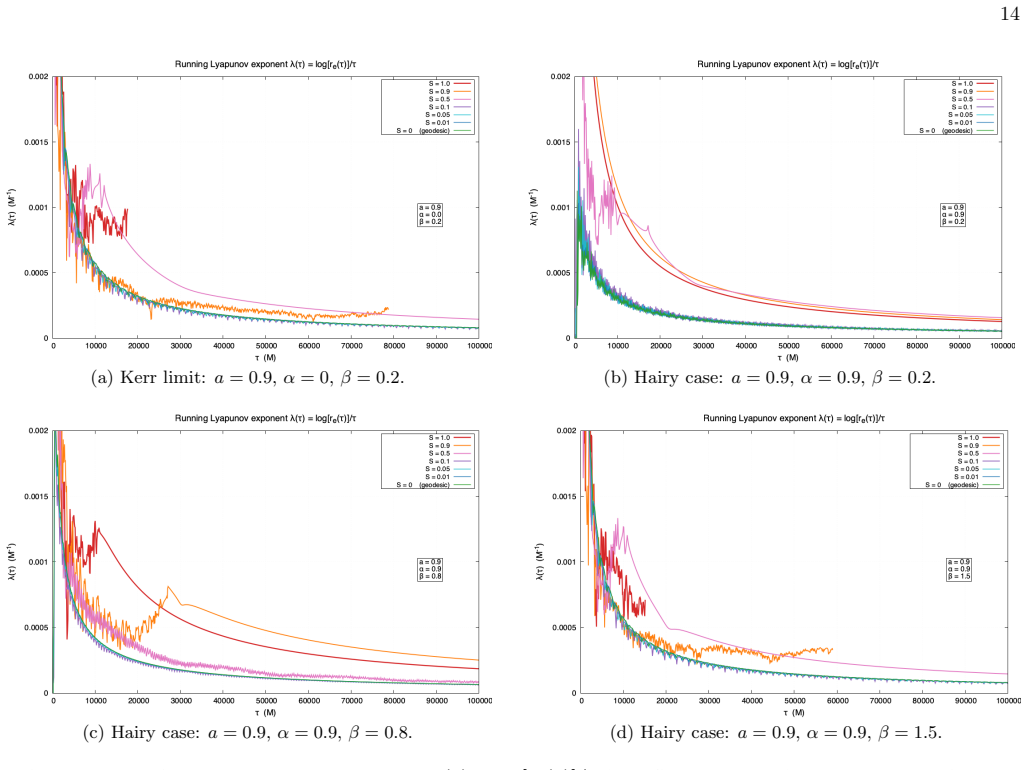
Rotating hairy black holes reorganize strong-field phase space for spinning particles, producing localized finite-time instability.
A machine-rendered reading of the paper's core claim, the machinery that carries it, and where it could break.
Core claim
The hairy background does not simply rescale the Kerr result; it reorganizes the strong-field phase-space region sampled by spinning particles. A parameter scan in the (S, β) plane reveals that instability does not increase steadily with spin or deformation strength but instead occurs in localized pockets where the particle spin and the radial localization of the hair cooperate through spin-curvature coupling.
What carries the argument
ZAMO-projected finite-time Lyapunov analysis of trajectories obtained from the Mathisson-Papapetrou-Dixon equations with the Tulczyjew spin condition in the gravitational-decoupling hairy metric, which tracks how spin-curvature forces and hair parameters drive divergence from initial conditions.
If this is right
- Large-spin trajectories display stronger finite-time growth than small-spin or geodesic trajectories.
- Instability appears in localized regions of the (S, β) plane where particle spin and the radial hair profile act cooperatively rather than monotonically.
- Spin-curvature coupling and the hairy geometry shift evolved orbits away from the requested seed parameters, making an empirical orbital map necessary for interpreting results.
- The reorganization of phase space implies that strong-field dynamics of spinning particles cannot be obtained by a simple rescaling of Kerr orbits.
Where Pith is reading between the lines
- Astrophysical signatures from near-horizon particle motion or accretion flows might distinguish hairy black holes from Kerr if chaotic regions produce observable irregularities.
- Switching to alternative spin supplementary conditions could relocate or weaken the instability pockets found here.
- Including particle backreaction on the metric would test whether the test-particle approximation survives in the reported unstable regimes.
Load-bearing premise
The Tulczyjew spin supplementary condition together with the gravitational-decoupling construction of the hairy metric remain valid for the large-spin regime where the reported instability appears.
What would settle it
A direct numerical integration showing that the finite-time Lyapunov exponent stays near zero for a large-spin particle at a β value previously identified as unstable, or that the unstable regions in the (S, β) plane collapse exactly to the Kerr case when the hair parameter α is set to zero.
Figures




read the original abstract
We investigate the finite-time instability of massive spinning test particles around a rotating hairy black hole generated through gravitational decoupling. The particle motion is described by the full Mathisson-Papapetrou-Dixon equations with the Tulczyjew spin supplementary condition, and the sensitivity to initial conditions is measured using a ZAMO-projected finite-time Lyapunov analysis. The hairy deformation is controlled by two parameters: $\alpha$, which sets the deviation from Kerr, and $\beta$, which changes the radial localization of the deformation. We show that spin-curvature coupling and the hairy geometry can shift the evolved orbit away from the requested seed parameters, making the empirical orbital map essential for interpreting the dynamics. Small-spin and geodesic trajectories remain close to regular behavior, whereas large-spin trajectories show stronger finite-time growth. A scan of the $(S,\beta)$ plane shows that the instability does not grow monotonically, but appears in localized regions where the particle spin and the radial profile of the hair act cooperatively. Thus, the hairy background does not simply rescale the Kerr result; it reorganizes the strong-field phase-space region sampled by spinning particles.
Editorial analysis
A structured set of objections, weighed in public.
Referee Report
Summary. The manuscript examines the dynamics of spinning test particles around rotating hairy black holes generated by gravitational decoupling. It integrates the full Mathisson-Papapetrou-Dixon equations under the Tulczyjew spin supplementary condition and quantifies sensitivity to initial conditions via a ZAMO-projected finite-time Lyapunov analysis. The authors report that small-spin and geodesic trajectories remain regular while large-spin trajectories exhibit stronger finite-time Lyapunov growth, with instability localized in regions of the (S, β) plane rather than appearing monotonically. They conclude that the hairy deformation (controlled by α and β) reorganizes the strong-field phase space sampled by spinning particles instead of simply rescaling the Kerr case.
Significance. If the reported numerical instabilities prove robust under additional validation, the result would indicate that spin-curvature coupling with non-Kerr hair can produce qualitatively new finite-time chaotic behavior in strong-field regions. This offers a concrete mechanism by which hairy black holes might be distinguished from Kerr via the dynamics of spinning test particles, with potential relevance to extreme-mass-ratio inspirals or accretion-disk modeling.
major comments (3)
- [Abstract] Abstract: The claim that large-spin trajectories exhibit stronger finite-time growth and that instability is localized in the (S, β) plane is presented without error bars, convergence tests, or details on the numerical integration scheme (step size, integrator type, or Lyapunov exponent computation). These omissions make it impossible to determine whether the reported growth is physical or sensitive to discretization artifacts.
- [Abstract] Abstract: The conclusion that the hairy background reorganizes phase space (rather than rescaling Kerr) rests on the observation that orbits shift away from seed parameters. No quantitative metric for this shift, no direct comparison to equivalent Kerr integrations, and no baseline Lyapunov values for the α=0 case are supplied, weakening the reorganization claim.
- The validity of the Tulczyjew spin supplementary condition at the large values of S where the instability appears is not demonstrated. No explicit bound on S/M² is given to guarantee that the 4-velocity remains normalized and timelike or that higher-order backreaction remains negligible, which is required for the MPD equations to remain applicable in the reported regime.
minor comments (1)
- [Abstract] The ranges and normalizations of the control parameters α and β in the gravitational-decoupling construction should be stated explicitly, together with any constraints they must satisfy to preserve asymptotic flatness or horizon regularity.
Simulated Author's Rebuttal
We thank the referee for the detailed and constructive report. We address each of the major comments below and have made revisions to the manuscript to incorporate the suggested improvements.
read point-by-point responses
-
Referee: [Abstract] Abstract: The claim that large-spin trajectories exhibit stronger finite-time growth and that instability is localized in the (S, β) plane is presented without error bars, convergence tests, or details on the numerical integration scheme (step size, integrator type, or Lyapunov exponent computation). These omissions make it impossible to determine whether the reported growth is physical or sensitive to discretization artifacts.
Authors: We agree with this observation and have revised the manuscript to include the requested details. A new subsection in the Methods section now describes the numerical integration scheme, specifying the use of an adaptive-step 4th-order Runge-Kutta integrator with a tolerance of 10^{-10}. We detail the computation of the ZAMO-projected finite-time Lyapunov exponents and have added convergence tests by halving the step size and verifying that the Lyapunov growth rates remain consistent within 5%. Error bars representing the standard deviation from multiple initial condition perturbations are now included in the relevant figures. These additions confirm the physical nature of the reported instabilities. revision: yes
-
Referee: [Abstract] Abstract: The conclusion that the hairy background reorganizes phase space (rather than rescaling Kerr) rests on the observation that orbits shift away from seed parameters. No quantitative metric for this shift, no direct comparison to equivalent Kerr integrations, and no baseline Lyapunov values for the α=0 case are supplied, weakening the reorganization claim.
Authors: To address this, we have introduced a quantitative metric for the orbital shift, defined as the root-mean-square deviation in the Boyer-Lindquist coordinates and momenta between the evolved trajectory and the initial seed parameters over the integration time. We now include direct comparisons with Kerr black holes (setting α=0) and provide baseline finite-time Lyapunov exponent values for the α=0 case in a new figure. These comparisons demonstrate that the instability regions in the (S, β) plane differ from those in Kerr, supporting the claim of phase-space reorganization rather than a simple rescaling. revision: yes
-
Referee: [—] The validity of the Tulczyjew spin supplementary condition at the large values of S where the instability appears is not demonstrated. No explicit bound on S/M² is given to guarantee that the 4-velocity remains normalized and timelike or that higher-order backreaction remains negligible, which is required for the MPD equations to remain applicable in the reported regime.
Authors: We have added a discussion and validation of the Tulczyjew condition in the revised manuscript. We now specify an explicit bound S/M² ≤ 0.8 for the reported trajectories, chosen such that the 4-velocity normalization u^μ u_μ +1 remains below 10^{-8} throughout the evolution. We include a plot showing the preservation of the normalization condition for representative large-spin cases. Regarding backreaction, we note that for test particles the spin-curvature coupling is treated at linear order in the particle's mass, and higher-order effects are negligible given the extreme mass ratio assumption implicit in the test-particle approximation. revision: yes
Circularity Check
No circularity: results from direct numerical integration of MPD equations
full rationale
The paper computes finite-time Lyapunov exponents via numerical integration of the full Mathisson-Papapetrou-Dixon equations under the Tulczyjew condition in a fixed gravitational-decoupling metric. The parameters α and β are independent controls that set the hairy deformation; they are not fitted to the instability data. The central claim—that the hairy geometry reorganizes strong-field phase space rather than rescaling Kerr—follows from comparing regular small-spin/geodesic behavior against stronger growth in localized (S, β) regions. This is an observed computational outcome, not a reduction by construction, self-definition, or load-bearing self-citation. The derivation chain is self-contained as a parameter-controlled numerical experiment against an external benchmark metric.
Axiom & Free-Parameter Ledger
free parameters (2)
- α
- β
axioms (2)
- domain assumption Mathisson-Papapetrou-Dixon equations with Tulczyjew spin supplementary condition accurately describe the motion of spinning test particles in the given spacetime.
- domain assumption The gravitational-decoupling procedure yields a valid rotating hairy black-hole solution that reduces to Kerr when α=0.
Lean theorems connected to this paper
-
IndisputableMonolith/Cost/FunctionalEquation.leanwashburn_uniqueness_aczel unclear?
unclearRelation between the paper passage and the cited Recognition theorem.
The hairy deformation is controlled by two parameters: α, which sets the deviation from Kerr, and β, which changes the radial localization of the deformation... A scan of the (S, β) plane shows that the instability does not grow monotonically, but appears in localized regions...
-
IndisputableMonolith/Foundation/RealityFromDistinction.leanreality_from_one_distinction unclear?
unclearRelation between the paper passage and the cited Recognition theorem.
We use a finite-time Lyapunov analysis based on the separation of two nearby, constraint-preserving solutions of the full MPD system.
What do these tags mean?
- matches
- The paper's claim is directly supported by a theorem in the formal canon.
- supports
- The theorem supports part of the paper's argument, but the paper may add assumptions or extra steps.
- extends
- The paper goes beyond the formal theorem; the theorem is a base layer rather than the whole result.
- uses
- The paper appears to rely on the theorem as machinery.
- contradicts
- The paper's claim conflicts with a theorem or certificate in the canon.
- unclear
- Pith found a possible connection, but the passage is too broad, indirect, or ambiguous to say the theorem truly supports the claim.
Reference graph
Works this paper leans on
-
[1]
Spin-Hair Induced Chaos of Spinning Test Particles in Rotating Hairy Black Holes
or rotating systems, as shown in the gravitational- decoupling extension to axially symmetric spacetimes [27], this method yields a simple but powerful way to generate a SSS or a rotating hairy black hole without reliance on the Newman–Janis algorithm. Most astrophysical compact objects possess nonzero spin [28, 29]. In many leading-order models of binary...
work page internal anchor Pith review Pith/arXiv arXiv 2026
-
[2]
the spin supplementary condition,
-
[3]
the exact energy relation,
-
[4]
the exact axial angular-momentum relation. In practice this system is solved by a Newton–Raphson iteration. Every accepted initial condition is verified a posteriori to satisfy all constraints to numerical precision. The final initial state may therefore be written as y0 = (t0, r0, θ0, ϕ0, pt, pr, pθ, pϕ, St, Sr, Sθ, Sϕ),(42) where the momentum and spin c...
work page 2000
-
[5]
B. P. Abbottet al.(LIGO Scientific, Virgo), Phys. Rev. Lett.116, 131103 (2016), arXiv:1602.03838 [gr-qc]
work page internal anchor Pith review Pith/arXiv arXiv 2016
-
[6]
B. P. Abbottet al.(LIGO Scientific, Virgo), Phys. Rev. Lett.119, 161101 (2017), arXiv:1710.05832 [gr-qc]
work page internal anchor Pith review Pith/arXiv arXiv 2017
-
[7]
B. P. Abbottet al.(LIGO Scientific, Virgo), Phys. Rev. X9, 031040 (2019), arXiv:1811.12907 [astro-ph.HE]
work page internal anchor Pith review Pith/arXiv arXiv 2019
-
[8]
R. Abbottet al.(LIGO Scientific, Virgo), Phys. Rev. X 11, 021053 (2021), arXiv:2010.14527 [gr-qc]
work page internal anchor Pith review Pith/arXiv arXiv 2021
-
[9]
R. Abbottet al.(LIGO Scientific, VIRGO), Phys. Rev. D109, 022001 (2024), arXiv:2108.01045 [gr-qc]
work page internal anchor Pith review Pith/arXiv arXiv 2024
-
[10]
A. G. Abacet al.(LIGO Scientific, Virgo, KAGRA), Phys. Rev. Lett.135, 111403 (2025), arXiv:2509.08054 [gr-qc]
work page internal anchor Pith review Pith/arXiv arXiv 2025
-
[11]
R. Abbottet al.(KAGRA, VIRGO, LIGO Scientific), Phys. Rev. X13, 041039 (2023), arXiv:2111.03606 [gr- qc]
work page internal anchor Pith review Pith/arXiv arXiv 2023
-
[12]
First M87 Event Horizon Telescope Results. I. The Shadow of the Supermassive Black Hole
K. Akiyamaet al.(Event Horizon Telescope), Astrophys. J. Lett.875, L1 (2019), arXiv:1906.11238 [astro-ph.GA]
work page internal anchor Pith review Pith/arXiv arXiv 2019
-
[13]
First M87 Event Horizon Telescope Results. VI. The Shadow and Mass of the Central Black Hole
K. Akiyamaet al.(Event Horizon Telescope), Astrophys. J. Lett.875, L6 (2019), arXiv:1906.11243 [astro-ph.GA]
work page internal anchor Pith review Pith/arXiv arXiv 2019
-
[14]
First M87 Event Horizon Telescope Results. IV. Imaging the Central Supermassive Black Hole
K. Akiyamaet al.(Event Horizon Telescope), Astrophys. J. Lett.875, L4 (2019), arXiv:1906.11241 [astro-ph.GA]
work page internal anchor Pith review Pith/arXiv arXiv 2019
-
[15]
K. Akiyamaet al.(Event Horizon Telescope), Astrophys. J. Lett.930, L12 (2022), arXiv:2311.08680 [astro-ph.HE]
work page internal anchor Pith review Pith/arXiv arXiv 2022
-
[16]
S. L. Liebling and C. Palenzuela, Living Rev. Rel.26, 1 (2023), arXiv:1202.5809 [gr-qc]
work page internal anchor Pith review Pith/arXiv arXiv 2023
- [17]
-
[18]
Testing the nature of dark compact objects: a status report
V. Cardoso and P. Pani, Living Rev. Rel.22, 4 (2019), arXiv:1904.05363 [gr-qc]. 18
work page internal anchor Pith review Pith/arXiv arXiv 2019
-
[19]
H. O. Silva, J. Sakstein, L. Gualtieri, T. P. Sotiriou, and E. Berti, Phys. Rev. Lett.120, 131104 (2018), arXiv:1711.02080 [gr-qc]
work page internal anchor Pith review Pith/arXiv arXiv 2018
-
[20]
D. D. Doneva and S. S. Yazadjiev, Phys. Rev. Lett.120, 131103 (2018), arXiv:1711.01187 [gr-qc]
work page internal anchor Pith review Pith/arXiv arXiv 2018
-
[21]
C. A. R. Herdeiro and E. Radu, Phys. Rev. Lett.112, 221101 (2014), arXiv:1403.2757 [gr-qc]
work page internal anchor Pith review Pith/arXiv arXiv 2014
-
[22]
Z.-Y. Fan, JHEP09, 039 (2016), arXiv:1606.00684 [hep- th]
work page internal anchor Pith review Pith/arXiv arXiv 2016
-
[23]
Kerr black holes with Proca hair
C. Herdeiro, E. Radu, and H. R´ unarsson, Class. Quant. Grav.33, 154001 (2016), arXiv:1603.02687 [gr-qc]
work page internal anchor Pith review Pith/arXiv arXiv 2016
-
[24]
Asymptotically flat black holes in Horndeski theory and beyond
E. Babichev, C. Charmousis, and A. Leh´ ebel, JCAP04, 027 (2017), arXiv:1702.01938 [gr-qc]
work page internal anchor Pith review Pith/arXiv arXiv 2017
-
[25]
Regular Black Hole in General Relativity Coupled to Nonlinear Electrodynamics
E. Ayon-Beato and A. Garcia, Phys. Rev. Lett.80, 5056 (1998), arXiv:gr-qc/9911046
work page internal anchor Pith review Pith/arXiv arXiv 1998
-
[26]
Simple Black Holes with Anisotropic Fluid
I. Cho and H.-C. Kim, Chin. Phys. C43, 025101 (2019), arXiv:1703.01103 [gr-qc]
work page internal anchor Pith review Pith/arXiv arXiv 2019
- [27]
-
[28]
The Minimal Geometric Deformation Approach: a brief introduction
J. Ovalle, R. Casadio, and A. Sotomayor, Adv. High Energy Phys.2017, 9756914 (2017), arXiv:1612.07926 [gr-qc]
work page internal anchor Pith review Pith/arXiv arXiv 2017
-
[29]
Decoupling gravitational sources in general relativity: from perfect to anisotropic fluids
J. Ovalle, Phys. Rev. D95, 104019 (2017), arXiv:1704.05899 [gr-qc]
work page internal anchor Pith review Pith/arXiv arXiv 2017
- [30]
-
[31]
E. Contreras, J. Ovalle, and R. Casadio, Phys. Rev. D 103, 044020 (2021), arXiv:2101.08569 [gr-qc]
- [32]
-
[33]
M. C. Miller and J. M. Miller, Phys. Rept.548, 1 (2014), arXiv:1408.4145 [astro-ph.HE]
work page internal anchor Pith review Pith/arXiv arXiv 2014
-
[34]
L. Blanchet, Living Rev. Rel.5, 3 (2002), arXiv:gr- qc/0202016
-
[35]
R. A. Porto, Phys. Rept.633, 1 (2016), arXiv:1601.04914 [hep-th]
work page internal anchor Pith review Pith/arXiv arXiv 2016
- [36]
- [37]
-
[38]
Papapetrou, Proceedings of the Royal Society of Lon- don
A. Papapetrou, Proceedings of the Royal Society of Lon- don. Series A. Mathematical and Physical Sciences209, 248 (1951)
work page 1951
-
[39]
W. G. Dixon, Proceedings of the Royal Society of Lon- don. A. Mathematical and Physical Sciences314, 499 (1970)
work page 1970
-
[40]
Chaos in Schwarzschild Spacetime : The Motion of a Spinning Particle
S. Suzuki and K.-i. Maeda, Phys. Rev. D55, 4848 (1997), arXiv:gr-qc/9604020
work page internal anchor Pith review Pith/arXiv arXiv 1997
- [41]
- [42]
-
[43]
Chaos and dynamics of spinning particles in Kerr spacetime
W.-B. Han, Gen. Rel. Grav.43, 819 (2011), arXiv:1006.2229 [gr-qc]
work page internal anchor Pith review Pith/arXiv arXiv 2011
-
[44]
Spinning particles moving around black holes: integrability and chaos
G. Lukes-Gerakopoulos and J. Seyrich, Phys. Rev. D94, 024024 (2016), arXiv:1606.09430 [gr-qc]
work page internal anchor Pith review Pith/arXiv arXiv 2016
-
[45]
O. Zelenka, G. Lukes-Gerakopoulos, V. Witzany, and O. Kopacek, Phys. Rev. D101, 024037 (2020), arXiv:1911.00414 [gr-qc]
-
[46]
D.-D. Yuan, J.-G. Jiao, Y.-Q. Lei, J.-X. Shi, J.-Q. Lai, C. Shao, and Y. Tian, “Astrophysically Realistic Sec- ondary Spins Trigger Chaos in Schwarzschild Spacetime and Discernible Gravitational Wave Signatures,” (2026), arXiv:2604.20533 [gr-qc]
work page internal anchor Pith review Pith/arXiv arXiv 2026
-
[47]
K. P. Tod, F. de Felice, and M. Calvani, Nuovo Cim. B 34, 365 (1976)
work page 1976
- [48]
-
[49]
Gravitational waves from a spinning particle in circular orbits around a rotating black hole
T. Tanaka, Y. Mino, M. Sasaki, and M. Shibata, Phys. Rev. D54, 3762 (1996), arXiv:gr-qc/9602038
work page internal anchor Pith review Pith/arXiv arXiv 1996
-
[50]
M. Saijo, K.-i. Maeda, M. Shibata, and Y. Mino, Phys- ical Review D58, 064005 (1998)
work page 1998
-
[51]
Y.-P. Zhang, S.-W. Wei, and Y.-X. Liu, Universe6, 103 (2020), arXiv:2003.10960 [gr-qc]
- [52]
- [53]
-
[54]
S. Mannobova, F. Atamurotov, A. Abdujabbarov, B. S. Alkahtani, and G. Mustafa, Eur. Phys. J. C85, 586 (2025)
work page 2025
- [55]
- [56]
-
[57]
S. Jumaniyozov, J. Rayimbaev, and Y. Turaev, Eur. Phys. J. C85, 1247 (2025)
work page 2025
-
[58]
S. Jumaniyozov, J. Rayimbaev, M. Akhmedov, Y. Tu- raev, S. Usanov, and S. Palvanov, Phys. Dark Univ.50, 102161 (2025)
work page 2025
-
[59]
Universality in Chaos of Particle Motion near Black Hole Horizon
K. Hashimoto and N. Tanahashi, Phys. Rev. D95, 024007 (2017), arXiv:1610.06070 [hep-th]
work page internal anchor Pith review Pith/arXiv arXiv 2017
-
[60]
Presence of horizon makes particle motion chaotic
S. Dalui, B. R. Majhi, and P. Mishra, Phys. Lett. B788, 486 (2019), arXiv:1803.06527 [gr-qc]
work page internal anchor Pith review Pith/arXiv arXiv 2019
- [61]
-
[62]
Hamiltonian of a spinning test-particle in curved spacetime
E. Barausse, E. Racine, and A. Buonanno, Phys. Rev. D80, 104025 (2009), arXiv:0907.4745 [gr-qc]
work page internal anchor Pith review Pith/arXiv arXiv 2009
-
[63]
Hamiltonians and canonical coordinates for spinning particles in curved space-time
V. Witzany, J. Steinhoff, and G. Lukes-Gerakopoulos, Class. Quant. Grav.36, 075003 (2019), arXiv:1808.06582 [gr-qc]
work page internal anchor Pith review Pith/arXiv arXiv 2019
-
[64]
V. Witzany, Phys. Rev. D100, 104030 (2019), arXiv:1903.03651 [gr-qc]
-
[65]
R. Gonzo and C. Shi, Phys. Rev. Lett.133, 221401 (2024), arXiv:2405.09687 [hep-th]
- [66]
-
[67]
A. Albertini, V. Skoup´ y, G. Lukes-Gerakopoulos, and A. Nagar, Phys. Rev. D111, 064086 (2025), arXiv:2412.16077 [gr-qc]
-
[68]
Gravitational wave snapshots of generic extreme mass ratio inspirals
S. Drasco and S. A. Hughes, Phys. Rev. D73, 024027 (2006), arXiv:gr-qc/0509101
work page internal anchor Pith review Pith/arXiv arXiv 2006
-
[69]
Laser Interferometer Space Antenna
P. Amaro-Seoaneet al., (2017), arXiv:1702.00786 [astro- ph.IM]
work page internal anchor Pith review Pith/arXiv arXiv 2017
-
[70]
Science with the space-based interferometer LISA. V: Extreme mass-ratio inspirals
S. Babak, J. Gair, A. Sesana, E. Barausse, C. F. Sop- uerta, C. P. L. Berry, E. Berti, P. Amaro-Seoane, A. Pe- titeau, and A. Klein, Phys. Rev. D95, 103012 (2017), arXiv:1703.09722 [gr-qc]
work page internal anchor Pith review Pith/arXiv arXiv 2017
-
[71]
Black holes, gravitational waves and fundamental physics: a roadmap
L. Baracket al., Class. Quant. Grav.36, 143001 (2019), arXiv:1806.05195 [gr-qc]
work page internal anchor Pith review Pith/arXiv arXiv 2019
discussion (0)
Sign in with ORCID, Apple, or X to comment. Anyone can read and Pith papers without signing in.