Vision-Language Models Suppress Female Representations Under Ambiguous Input
Pith reviewed 2026-06-28 22:41 UTC · model grok-4.3
The pith
Vision-language models internally encode female associations for ambiguous images but suppress them before outputting male labels.
A machine-rendered reading of the paper's core claim, the machinery that carries it, and where it could break.
Core claim
Across fifteen occupations, over eight hundred gender-ambiguous images, and four VLMs, internal representations and outputs are systematically decoupled: models often encode a female association internally yet output male. Layer-wise analysis reveals an asymmetric filter in which male signal amplifies end-to-end while female signal peaks mid-network and is suppressed before generation.
What carries the argument
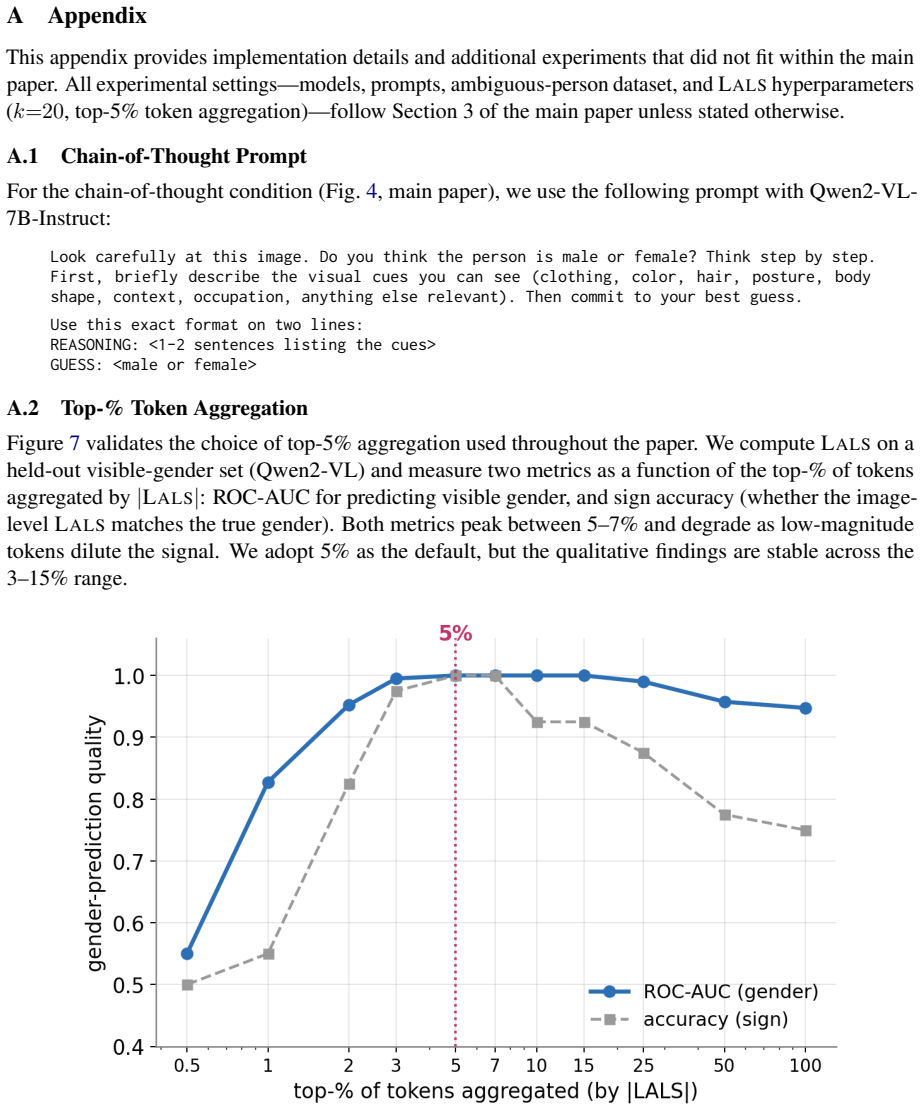
LALS (Latent Association Leaning Score), a metric that projects visual-token activations into the model's text-embedding space to quantify concept associations at each token and layer.
If this is right
- Current alignment techniques that succeed on unambiguous inputs leave internal female representations vulnerable to suppression under uncertainty.
- Interventions aimed at bias must target the mid-to-late layers where female signals are filtered rather than only the final output head.
- Visual cues such as clothing color can modulate the strength of internal gender associations even when the figure itself remains ambiguous.
- Models may default to male outputs precisely because the training process amplifies one signal while attenuating the other across depth.
Where Pith is reading between the lines
- The observed suppression could be tested by training a model variant that forces female signals to propagate unchanged to the output and checking whether male defaults disappear on the same ambiguous set.
- If the pattern generalizes beyond gender, similar layer-wise filtering may affect other ambiguous attributes such as age or ethnicity in the same models.
- Practical deployment in robotics or surveillance would need explicit uncertainty handling at the layer where suppression begins rather than post-hoc output correction.
Load-bearing premise
The projection step in LALS accurately captures genuine semantic associations inside the model rather than artifacts introduced by the embedding alignment itself.
What would settle it
Recomputing the layer-wise associations on the same images but with a different projection method or a held-out text embedding space yields the opposite pattern of female suppression.
Figures







read the original abstract
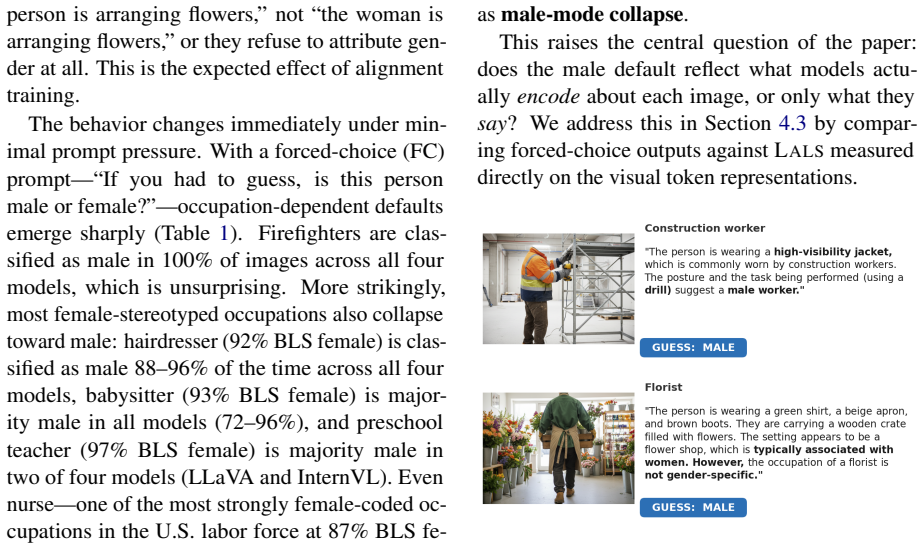
Alignment teaches vision-language models (VLMs) to avoid expressing demographic biases, and when gender is clearly visible they largely succeed. Far less is known about ambiguous inputs (a worker in full gear, a figure seen from behind) cases common in practice yet rarely studied. We find that minimal prompting pressure exposes occupation-gender defaults when prompting ambiguous input images, with models collapsing to male even for strongly female-stereotyped occupations. But do these outputs reflect what models actually encode internally? We introduce LALS (Latent Association Leaning Score), a zero-shot metric that projects visual-token activations into the model's text-embedding space to measure concept associations per token and layer. Across 15 occupations, over 800 gender-ambiguous images, and four VLMs, internal representations and outputs are systematically decoupled: models often encode a female association internally yet output male. Layer-wise analysis reveals an asymmetric filter -- male signal amplifies end-to-end while female signal peaks mid-network and is suppressed before generation -- and a color ablation shows that culturally loaded visual cues such as clothing color further modulate these internal associations.
Editorial analysis
A structured set of objections, weighed in public.
Referee Report
Summary. The manuscript claims that vision-language models exhibit a systematic decoupling between internal representations and generated outputs when processing gender-ambiguous images across 15 occupations: models often encode female associations internally (as measured by the introduced LALS metric) yet default to male outputs. Layer-wise analysis identifies an asymmetric filter in which male signals amplify end-to-end while female signals peak mid-network and are suppressed prior to generation; a color ablation further shows modulation by culturally loaded visual cues.
Significance. If the LALS metric is shown to capture genuine semantic associations rather than projection artifacts, the results would demonstrate a previously understudied internal-output mismatch in VLMs under realistic ambiguity, with direct relevance to bias auditing and mitigation. The zero-shot, layer-resolved probing approach constitutes a methodological contribution that could be applied more broadly, provided it receives independent validation.
major comments (2)
- [LALS definition and validation] LALS projection step (methods describing the metric): the claim that cosine similarity after projecting visual-token activations into text-embedding space measures genuine concept associations per layer and token is load-bearing for the decoupling and asymmetric-filter results, yet the manuscript provides no validation experiments (e.g., recovery of expected gender associations on unambiguous images or correlation with logit-level probes) to rule out embedding-geometry artifacts.
- [Experimental details and results] Experimental protocol (abstract and § on image construction): the central claim rests on results across >800 gender-ambiguous images, but the manuscript supplies no statistical details, error bars, exact construction protocol for the ambiguous images, or per-occupation trial counts, preventing assessment of whether the reported male-output bias and mid-network female peak are robust.
minor comments (1)
- [Figures] Figure captions and layer-wise plots would benefit from explicit labeling of token positions and confidence intervals to improve readability of the suppression pattern.
Simulated Author's Rebuttal
We thank the referee for the constructive comments, which highlight important areas for strengthening the manuscript. We address each major point below and will revise accordingly.
read point-by-point responses
-
Referee: [LALS definition and validation] LALS projection step (methods describing the metric): the claim that cosine similarity after projecting visual-token activations into text-embedding space measures genuine concept associations per layer and token is load-bearing for the decoupling and asymmetric-filter results, yet the manuscript provides no validation experiments (e.g., recovery of expected gender associations on unambiguous images or correlation with logit-level probes) to rule out embedding-geometry artifacts.
Authors: We agree that explicit validation of LALS would strengthen the interpretation of the metric. The current results rely on cross-model and cross-occupation consistency, but this does not fully substitute for targeted checks. We will add validation experiments in the revised manuscript, including tests on unambiguous images to recover expected gender associations and comparisons against logit-level probes. revision: yes
-
Referee: [Experimental details and results] Experimental protocol (abstract and § on image construction): the central claim rests on results across >800 gender-ambiguous images, but the manuscript supplies no statistical details, error bars, exact construction protocol for the ambiguous images, or per-occupation trial counts, preventing assessment of whether the reported male-output bias and mid-network female peak are robust.
Authors: We concur that additional experimental details are required for proper evaluation of robustness. The revision will include the precise image construction protocol, per-occupation trial counts, statistical measures (e.g., standard errors), and error bars on all relevant plots and tables. revision: yes
Circularity Check
No circularity: empirical metric application on external image set
full rationale
The paper introduces LALS as an explicitly defined projection-based metric and applies it to a held-out collection of 800+ ambiguous images across 15 occupations and four VLMs. No derivation step equates a reported association or suppression pattern to a fitted parameter, self-referential definition, or prior self-citation chain; the decoupling claim is obtained by direct measurement rather than by algebraic identity or renaming of inputs. The work therefore remains self-contained against external benchmarks.
Axiom & Free-Parameter Ledger
axioms (1)
- domain assumption Projecting visual-token activations into the model's text-embedding space produces a valid measure of per-token and per-layer concept associations
invented entities (1)
-
LALS (Latent Association Leaning Score)
no independent evidence
Reference graph
Works this paper leans on
-
[1]
Semantics derived automatically from lan- guage corpora contain human-like biases.Science, 356(6334):183–186. Zhe Chen, Weiyun Wang, Yue Cao, Yangzhou Liu, Zhangwei Gao, Erfei Cui, Jinguo Zhu, Shenglong Ye, Hao Tian, Zhaoyang Liu, and 1 others. 2024. Expanding performance boundaries of open-source multimodal models with model, data, and test-time scaling....
work page internal anchor Pith review Pith/arXiv arXiv 2024
-
[2]
InProceedings of the 2021 Conference on Empiri- cal Methods in Natural Language Processing, pages 1968–1994
Harms of gender exclusivity and challenges in non-binary representation in language technologies. InProceedings of the 2021 Conference on Empiri- cal Methods in Natural Language Processing, pages 1968–1994. Kathleen C Fraser and Svetlana Kiritchenko. 2024. Examining gender and racial bias in large vision– language models using a novel dataset of parallel ...
2021
-
[3]
Bias and fairness in large language models: A survey.Computational linguistics, 50(3):1097–1179. Hila Gonen and Yoav Goldberg. 2019. Lipstick on a pig: Debiasing methods cover up systematic gender biases in word embeddings but do not remove them. InProceedings of the 2019 Conference of the North American Chapter of the Association for Computa- tional Ling...
-
[4]
arXiv preprint arXiv:2004.12265 , year=
Non-archival. Chandler May, Alex Wang, Shikha Bordia, Samuel Bow- man, and Rachel Rudinger. 2019. On measuring so- cial biases in sentence encoders. InProceedings of the 2019 Conference of the North American Chap- ter of the Association for Computational Linguistics: Human Language Technologies, Volume 1 (Long and Short Papers), pages 622–628. Kevin Meng,...
discussion (0)
Sign in with ORCID, Apple, or X to comment. Anyone can read and Pith papers without signing in.