Civilizational Metamaterials: Engineering Coordination Under Capability Gradients and Structural Turbulence
Pith reviewed 2026-06-28 19:27 UTC · model grok-4.3
The pith
A metamaterial-inspired model shows institutional coordination undergoes a phase transition to a freezing equilibrium as AI accelerates decisions beyond verification capacity.
A machine-rendered reading of the paper's core claim, the machinery that carries it, and where it could break.
Core claim
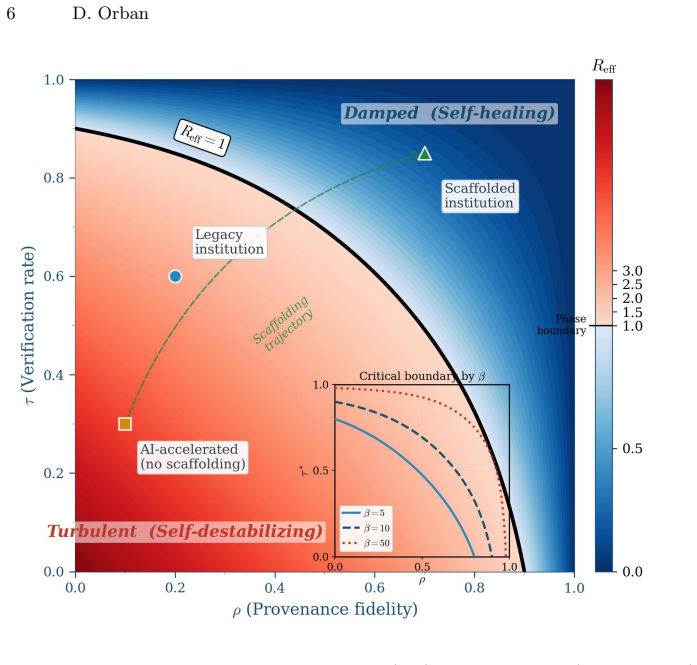
Civilizational coordination dynamics can be captured by a phenomenological constitutive law R_eff = β · (1-ρ) · (1-τ) · (1-γρτ) that exhibits a phase transition between self-healing and self-destabilizing behavior; when effective reproduction number exceeds one due to increased decision branching from AGI outpacing provenance and verification, rational agents enter a Freezing Equilibrium of inaction, and the framework provides a three-class provenance taxonomy to engineer against this outcome.
What carries the argument
The constitutive law R_eff = β · (1-ρ) · (1-τ) · (1-γρτ) that quantifies the effective reproduction of coordination failures or successes in institutions, with parameters for branching factor, provenance fidelity, verification rate, and their interaction.
If this is right
- If R_eff remains below 1, institutions self-correct coordination issues without external intervention.
- If R_eff exceeds 1, the system enters a self-amplifying destabilization leading to a stable but catastrophic equilibrium of inaction.
- Improving provenance fidelity through cryptographic, institutional, or context-binding mechanisms can lower R_eff and shift the phase transition threshold.
- Verification rate increases provide another control parameter to maintain self-healing regimes under higher decision velocities.
Where Pith is reading between the lines
- Micro-level behavioral models of agents could be developed to derive the constitutive law from individual decisions rather than assuming it phenomenologically.
- The framework might extend to non-governmental domains such as corporate governance or decentralized online platforms facing similar AI-induced velocity increases.
- Empirical data from the proposed trial could allow calibration of the parameters β, ρ, τ, and γ for specific institutional contexts.
Load-bearing premise
The four-parameter phenomenological constitutive law accurately represents the macro-level coordination dynamics of real institutions without derivation from micro-level agent behaviors or empirical calibration.
What would settle it
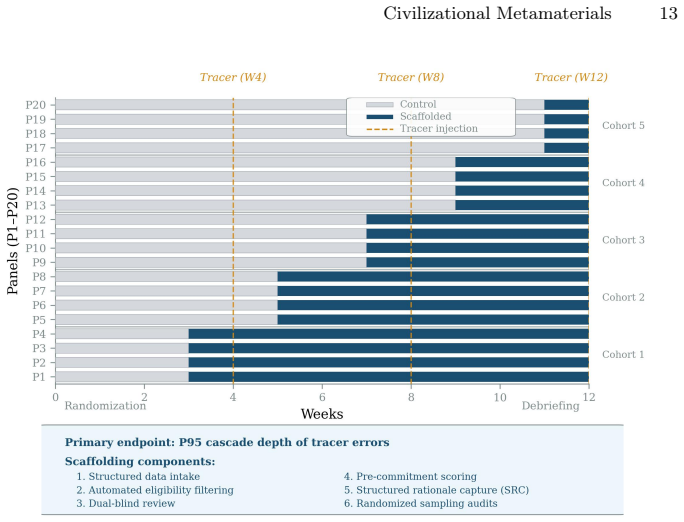
Running the proposed 12-week stepped-wedge cluster-randomized trial in government grant review panels and measuring whether interventions on provenance and verification shift the observed coordination from destabilizing to self-healing behavior.
Figures


read the original abstract
We argue that governance must transition from a normative discipline to an engineering discipline, and we develop a formal framework, inspired by the physics of metamaterials, to make this transition quantitative and testable. Artificial General Intelligence affects civilization primarily by increasing decision velocity while human verification capacity remains bounded. When the cost of validating AI-generated outputs exceeds the expected utility of acting on them, rational agents default to inaction: a stable but catastrophic Nash equilibrium we term the Freezing Equilibrium. Drawing on metamaterials, where emergent macro-properties arise from designed microstructure, we develop a phenomenological constitutive law for institutional coordination: $R_{\mathrm{eff}} = \beta \cdot (1-\rho) \cdot (1-\tau) \cdot (1-\gamma \rho \tau)$, where $\beta$ is the decision branching factor, $\rho$ is provenance fidelity, $\tau$ is the verification rate, and $\gamma \in [0,1]$ captures correlated-detection synergy between provenance and verification failures. The model predicts a sharp phase transition between self-healing ($R_{\mathrm{eff}} < 1$) and self-destabilizing ($R_{\mathrm{eff}} > 1$) regimes. We introduce a three-class provenance taxonomy: cryptographic, institutional, and context binding, and derive four falsifiable hypotheses with a proposed 12-week stepped-wedge cluster-randomized trial in government grant review panels. The framework bridges AI alignment theory and institutional design.
Editorial analysis
A structured set of objections, weighed in public.
Referee Report
Summary. The paper argues that governance should be treated as an engineering discipline and develops a metamaterials-inspired phenomenological constitutive law for institutional coordination under AI-driven decision velocity: R_eff = β · (1-ρ) · (1-τ) · (1-γρτ). It predicts a sharp phase transition at R_eff = 1 between self-healing and self-destabilizing regimes, introduces a three-class provenance taxonomy (cryptographic, institutional, context binding), and derives four falsifiable hypotheses with a proposed 12-week stepped-wedge cluster-randomized trial in government grant review panels.
Significance. If the constitutive law receives micro-foundations or empirical calibration, the framework could provide a novel quantitative lens for engineering AI-resilient institutions, bridging alignment theory and institutional design. The explicit proposal of falsifiable hypotheses and a concrete trial design is a constructive element that could enable progress if the parameters prove operationalizable.
major comments (2)
- [Abstract] Abstract (R_eff equation): The multiplicative constitutive law R_eff = β · (1-ρ) · (1-τ) · (1-γρτ) is introduced phenomenologically with no derivation from bounded-verification agent behaviors and no calibration or error analysis against existing institutional cases. The phase transition at R_eff = 1 is therefore an algebraic consequence of varying the defining parameters rather than an independent prediction.
- [Abstract] Abstract: The four falsifiable hypotheses are stated to be derived from the model, yet the manuscript provides neither their explicit statements nor a demonstration that the proposed trial can test the coordination dynamics independently of the model's own parameter definitions.
minor comments (1)
- [Abstract] Abstract: The interpretation of the synergy parameter γ and the provenance taxonomy would benefit from one additional sentence clarifying how they map to observable institutional quantities.
Simulated Author's Rebuttal
We thank the referee for the constructive feedback. We address the two major comments point by point below, acknowledging the phenomenological character of the model and the need for greater explicitness regarding the hypotheses and trial design.
read point-by-point responses
-
Referee: [Abstract] Abstract (R_eff equation): The multiplicative constitutive law R_eff = β · (1-ρ) · (1-τ) · (1-γρτ) is introduced phenomenologically with no derivation from bounded-verification agent behaviors and no calibration or error analysis against existing institutional cases. The phase transition at R_eff = 1 is therefore an algebraic consequence of varying the defining parameters rather than an independent prediction.
Authors: We agree that the constitutive law is presented phenomenologically without derivation from micro-level bounded-verification agent behaviors and without calibration or error analysis on historical cases. This approach is intentional: the framework is offered as an initial quantitative lens inspired by metamaterials to generate testable predictions rather than a fully micro-founded theory. The phase transition at R_eff = 1 is indeed an algebraic feature of the chosen multiplicative form, which encodes the compounding effects of provenance and verification failures. We will revise the abstract and the model section to state this phenomenological status and algebraic origin more explicitly, while retaining the emphasis on the law's utility for motivating the proposed trial. No new derivation or calibration will be added at this stage, as that would require a separate empirical project. revision: yes
-
Referee: [Abstract] Abstract: The four falsifiable hypotheses are stated to be derived from the model, yet the manuscript provides neither their explicit statements nor a demonstration that the proposed trial can test the coordination dynamics independently of the model's own parameter definitions.
Authors: The full manuscript states the four hypotheses explicitly in Section 4 and maps each to observable coordination metrics (e.g., review completion rates, inter-rater agreement shifts, and downstream policy stability) within the stepped-wedge design. However, the abstract omits the explicit statements, and the independence of the trial from direct parameter fitting could be clarified further. We will revise the abstract to include concise versions of the four hypotheses and add a short subsection showing how the cluster-randomized stepped-wedge structure measures emergent coordination outcomes (such as changes in decision velocity and verification load) that are not tautological with the model's parameter definitions. This will strengthen the demonstration of falsifiability. revision: yes
Circularity Check
Phase transition prediction reduces by construction to algebraic crossing of the posited constitutive law
specific steps
-
self definitional
[Abstract]
"we develop a phenomenological constitutive law for institutional coordination: $R_{\mathrm{eff}} = \beta \cdot (1-\rho) \cdot (1-\tau) \cdot (1-\gamma \rho \tau)$, where $\beta$ is the decision branching factor, $\rho$ is provenance fidelity, $\tau$ is the verification rate, and $\gamma \in [0,1]$ captures correlated-detection synergy between provenance and verification failures. The model predicts a sharp phase transition between self-healing ($R_{\mathrm{eff}} < 1$) and self-destabilizing ($R_{\mathrm{eff}} > 1$) regimes."
The phase transition is defined exactly as the surface where the product equals 1. Declaring that the model 'predicts' self-healing vs. self-destabilizing regimes when parameters cross this surface is therefore equivalent to the definition of the expression; the transition location and sharpness are forced by the functional form adopted.
full rationale
The paper introduces R_eff as a phenomenological constitutive law and states that the model predicts a sharp phase transition at R_eff = 1. This transition is the direct algebraic consequence of setting the product expression to unity and varying its parameters; no separate derivation, micro-foundation, or external benchmark locates or sharpens the transition. The central claim therefore reduces to the modeling choice itself. No self-citation chains, uniqueness theorems, or other patterns are evident in the provided text. The circularity is partial because the law is explicitly labeled phenomenological rather than derived.
Axiom & Free-Parameter Ledger
free parameters (4)
- β
- ρ
- τ
- γ
axioms (2)
- domain assumption Institutions exhibit emergent macro-properties arising from designed microstructure analogous to metamaterials
- domain assumption Rational agents default to inaction when validation cost exceeds expected utility, producing a stable Nash equilibrium
invented entities (3)
-
Freezing Equilibrium
no independent evidence
-
R_eff
no independent evidence
-
three-class provenance taxonomy (cryptographic, institutional, context binding)
no independent evidence
Reference graph
Works this paper leans on
-
[1]
Concrete Problems in AI Safety
Amodei, D., Olah, C., Steinhardt, J., Christiano, P., Schulman, J., Mané, D.: Con- crete problems in AI safety (2016). https://doi.org/10.48550/arXiv.1606.06565
work page internal anchor Pith review Pith/arXiv arXiv doi:10.48550/arxiv.1606.06565 2016
-
[2]
Oxford University Press (1991)
Anderson, R.M., May, R.M.: Infectious Diseases of Humans: Dynamics and Control. Oxford University Press (1991)
1991
-
[3]
Internet-Draft draft-ietf-scitt-architecture-22, Internet Engineering Task Force (2025)
Birkholz, H., Delignat-Lavaud, A., Fournet, C., Deshpande, Y., Lasker, S.: An architecture for trustworthy and transparent digital supply chains. Internet-Draft draft-ietf-scitt-architecture-22, Internet Engineering Task Force (2025)
2025
-
[4]
Measuring Progress on Scalable Oversight for Large Language Models
Bowman, S.R., et al.: Measuring progress on scalable oversight for large language models (2022). https://doi.org/10.48550/arXiv.2211.03540
work page internal anchor Pith review Pith/arXiv arXiv doi:10.48550/arxiv.2211.03540 2022
-
[5]
Widely circulated; archived at https://www.dnipogo.org/boyd/essence_of_ winning_losing.htm
Boyd, J.R.: The essence of winning and losing (1996), unpublished brief- ing. Widely circulated; archived at https://www.dnipogo.org/boyd/essence_of_ winning_losing.htm
1996
-
[6]
Nature464(7291), 1025–1028 (2010)
Buldyrev, S.V., Parshani, R., Paul, G., Stanley, H.E., Havlin, S.: Catastrophic cas- cade of failures in interdependent networks. Nature464(7291), 1025–1028 (2010). https://doi.org/10.1038/nature08932 18 D. Orban
-
[7]
Lawrence Erlbaum Associates (1983)
Card, S.K., Moran, T.P., Newell, A.: The Psychology of Human–Computer Inter- action. Lawrence Erlbaum Associates (1983)
1983
-
[8]
Superintelligence paths, dangers, strategies
Carlsmith, J.: Is power-seeking AI an existential risk? (2022). https://doi.org/10. 48550/arXiv.2206.13353
-
[9]
Chan, A., Ezell, C., Kaufmann, M., Wei, K., Hammond, L., Bradley, H., Bluemke, E., Rajkumar, N., Krueger, D., Kolt, N., Heim, L., Anderljung, M.: Visibility into AIagents.In:Proceedingsofthe2024ACMConferenceonFairness,Accountability, and Transparency (FAccT ’24) (2024). https://doi.org/10.1145/3630106.3658948
-
[10]
Deep reinforcement learning from human preferences
Christiano, P.F., Leike, J., Brown, T., Martic, M., Amodei, D., et al.: Deep rein- forcement learning from human preferences. In: Advances in Neural Information Processing Systems. vol. 30 (2017). https://doi.org/10.48550/arXiv.1706.03741
work page internal anchor Pith review Pith/arXiv arXiv doi:10.48550/arxiv.1706.03741 2017
-
[11]
Coalition for Content Provenance and Authenticity: Content credentials: C2PA technical specification, version 2.0. Tech. rep. (2024), https://c2pa.org/ specifications/specifications/2.0/specs/C2PA_Specification.html
2024
-
[12]
Critch, A., Krueger, D.: AI research considerations for human existential safety (ARCHES). Tech. rep., Center for Human-Compatible AI, UC Berkeley (2020). https://doi.org/10.48550/arXiv.2006.04948
-
[13]
Dafoe, A.: AI governance: A research agenda. Tech. rep., Future of Humanity Insti- tute, University of Oxford (2018), https://web.archive.org/web/20250830194432/ https://www.fhi.ox.ac.uk/wp-content/uploads/GovAI-Agenda.pdf, original host (fhi.ox.ac.uk) defunct; cited via Internet Archive snapshot
-
[14]
Dobson, I.: Analyzing cascading failures and blackouts using utility outage data. In: Sun, K. (ed.) Cascading Failures in Power Grids. Springer, Cham (2024). https: //doi.org/10.1007/978-3-031-48000-3_2
-
[15]
Drexler, K.E.: Reframing superintelligence: Comprehensive AI services as general intelligence. Technical Report 2019-1, Future of Humanity Institute, Univer- sity of Oxford (2019), https://web.archive.org/web/20250905024310/https: //www.fhi.ox.ac.uk/wp-content/uploads/Reframing_Superintelligence_ FHI-TR-2019-1.1-1.pdf, original host (fhi.ox.ac.uk) defunct...
-
[16]
https://doi.org/10.1007/s11023-020-09539-2
Gabriel,I.:Artificialintelligence,values,andalignment.MindsandMachines30(3), 411–437 (2020). https://doi.org/10.1007/s11023-020-09539-2
work page internal anchor Pith review doi:10.1007/s11023-020-09539-2 2020
-
[17]
Hemming, K., Haines, T.P., Chilton, P.J., Girling, A.J., Lilford, R.J.: The stepped wedge cluster randomised trial: Rationale, design, analysis, and reporting. BMJ 350, h391 (2015). https://doi.org/10.1136/bmj.h391
-
[18]
An Overview of Catastrophic AI Risks
Hendrycks, D., Mazeika, M., Woodside, T.: An overview of catastrophic AI risks (2023). https://doi.org/10.48550/arXiv.2306.12001
work page internal anchor Pith review Pith/arXiv arXiv doi:10.48550/arxiv.2306.12001 2023
-
[19]
SIAM Review42(4), 599– 653 (2000)
Hethcote, H.W.: The mathematics of infectious diseases. SIAM Review42(4), 599– 653 (2000). https://doi.org/10.1137/S0036144500371907
-
[20]
Holmström, B., Milgrom, P.: Multitask principal-agent analyses: Incentive con- tracts, asset ownership, and job design. Journal of Law, Economics, & Organization 7, 24–52 (1991). https://doi.org/10.1093/jleo/7.special_issue.24
-
[21]
Contemporary Clinical Trials28(2), 182–191 (2007)
Hussey, M.A., Hughes, J.P.: Design and analysis of stepped wedge cluster random- ized trials. Contemporary Clinical Trials28(2), 182–191 (2007). https://doi.org/ 10.1016/j.cct.2006.05.007
-
[22]
International Organization for Standardization: ISO/IEC 42001:2023 information technology – artificial intelligence – management system. Tech. rep. (2023)
2023
-
[23]
Irving, G., Christiano, P., Amodei, D.: AI safety via debate (2018). https://doi. org/10.48550/arXiv.1805.00899 Civilizational Metamaterials 19
work page internal anchor Pith review Pith/arXiv arXiv doi:10.48550/arxiv.1805.00899 2018
-
[24]
Kittel, C., Siemens, C., et al.: AI agent orchestration patterns. Tech. rep., Microsoft Azure Architecture Center (2025), https://learn.microsoft.com/en-us/ azure/architecture/ai-ml/guide/ai-agent-design-patterns
2025
-
[25]
Internet-Draft draft-narvaneni-agent-uri-02, IETF (2025)
Narvaneni, Y.: The agent:// protocol – a URI-based framework for interoperable agents. Internet-Draft draft-narvaneni-agent-uri-02, IETF (2025)
2025
-
[26]
National Institute of Standards and Technology: Security and privacy controls for information systems and organizations (NIST SP 800-53 rev. 5). Tech. rep., U.S. Department of Commerce (2020). https://doi.org/10.6028/NIST.SP.800-53r5
-
[27]
National Institute of Standards and Technology: AI risk management framework (AI RMF 1.0). Tech. rep., U.S. Department of Commerce (2023), https://www. nist.gov/itl/ai-risk-management-framework
2023
-
[28]
National Institute of Standards and Technology: NIST-AI-600-1, artificial intelli- gence risk management framework: Generative artificial intelligence profile. Tech. rep., U.S. Department of Commerce (2024). https://doi.org/10.6028/NIST.AI. 600-1, https://nvlpubs.nist.gov/nistpubs/ai/NIST.AI.600-1.pdf
-
[29]
Research Report (2025), https://aiparadox.davidorban.com/
Orban, D.: The AI paradox report: Early adopters love AI but fear its future. Research Report (2025), https://aiparadox.davidorban.com/
2025
-
[30]
https://doi.org/10.48550/arXiv.2507.06398
Orban, D.: Jolting technologies: Superexponential acceleration in AI capabilities and implications for AGI (2025). https://doi.org/10.48550/arXiv.2507.06398
-
[31]
Cambridge University Press (1990)
Ostrom, E.: Governing the Commons: The Evolution of Institutions for Collective Action. Cambridge University Press (1990)
1990
-
[32]
Yale University Press (1998)
Scott, J.C.: Seeing Like a State: How Certain Schemes to Improve the Human Condition Have Failed. Yale University Press (1998)
1998
-
[33]
OpenAI Research (2023), https://openai.com/ research/practices-for-governing-agentic-ai-systems
Shavit, Y., Agarwal, S., Brundage, M., Adler, S., O’Keefe, C., Campbell, R., Lee, T., Mishkin, P., Eloundou, T., Heidecke, A., Lama, K., Krueger, D.: Practices for governing agentic AI systems. OpenAI Research (2023), https://openai.com/ research/practices-for-governing-agentic-ai-systems
2023
-
[34]
Proceedings of the National Academy of Sciences99(9), 5766–5771 (2002)
Watts, D.J.: A simple model of global cascades on random networks. Proceedings of the National Academy of Sciences99(9), 5766–5771 (2002). https://doi.org/10. 1073/pnas.082090499
2002
-
[35]
Archives of Internal Medicine164(6), 597–600 (2004)
Wendler, D., Miller, F.G.: Deception in the pursuit of science. Archives of Internal Medicine164(6), 597–600 (2004). https://doi.org/10.1001/archinte.164.6.597
-
[36]
W3c rec- ommendation, World Wide Web Consortium (2024), https://www.w3.org/TR/ vc-data-model-2.0/
World Wide Web Consortium: Verifiable credentials data model v2.0. W3c rec- ommendation, World Wide Web Consortium (2024), https://www.w3.org/TR/ vc-data-model-2.0/
2024
discussion (0)
Sign in with ORCID, Apple, or X to comment. Anyone can read and Pith papers without signing in.