Bayesian Inference of Nonlinear Malaria Dynamics in Ghana via an Ensemble Markov Chain Monte Carlo Sampler
Pith reviewed 2026-06-28 17:49 UTC · model grok-4.3
The pith
Bayesian nonlinear modeling with ensemble MCMC fits Ghana malaria data to R² above 0.995 and projects gradual case increases through 2026.
A machine-rendered reading of the paper's core claim, the machinery that carries it, and where it could break.
Core claim
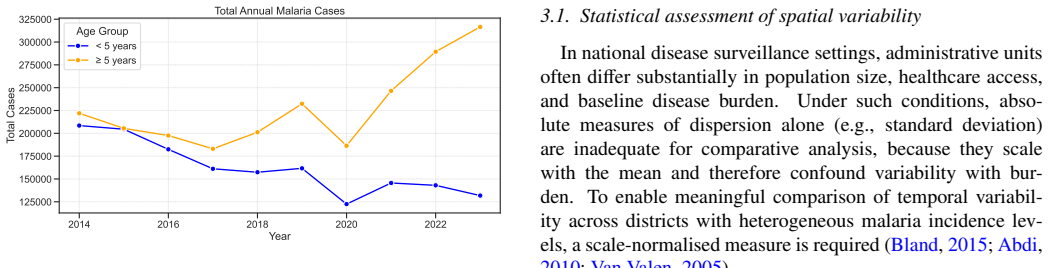
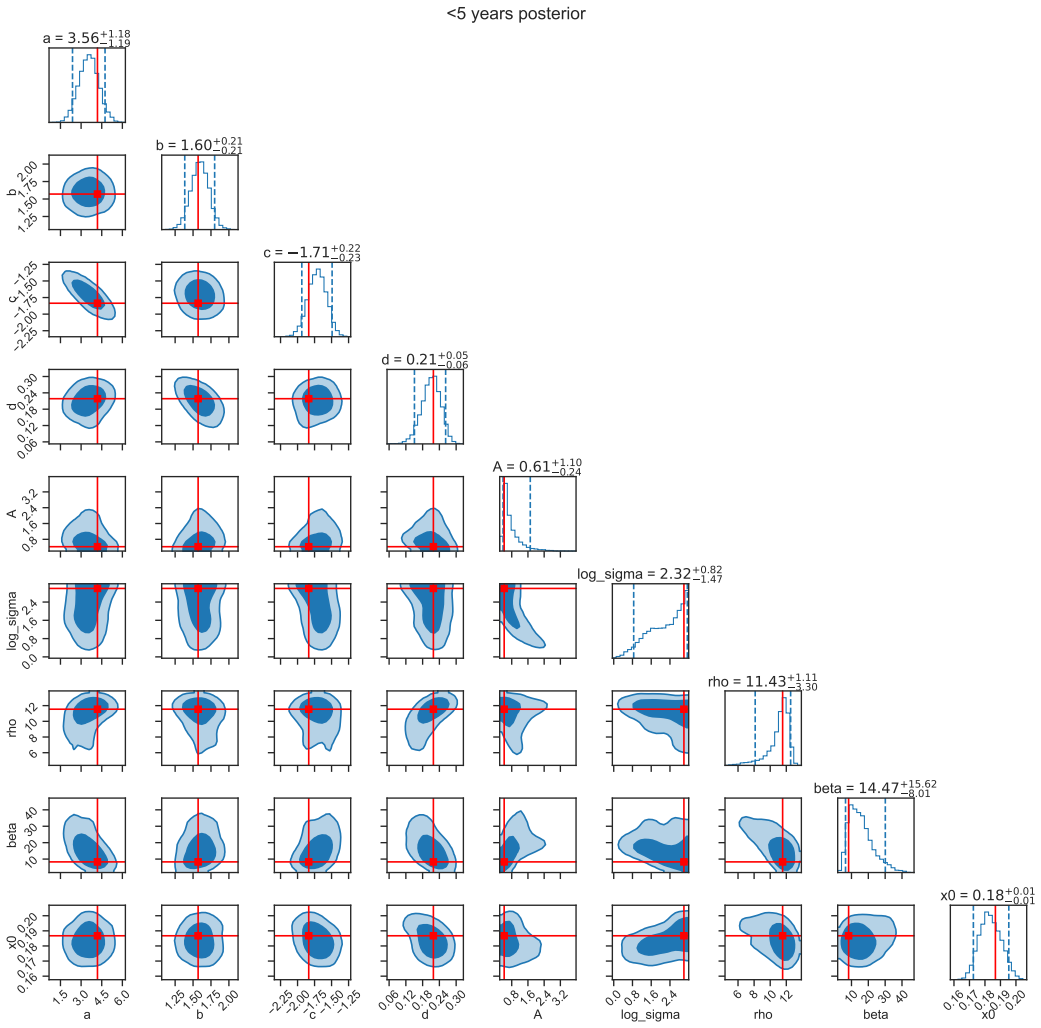
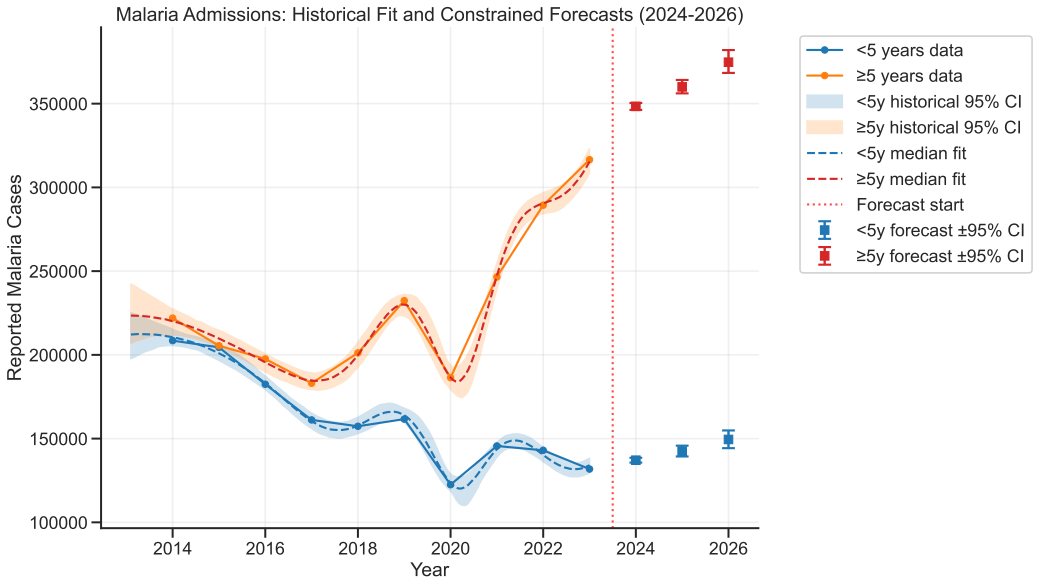
The framework integrates a cubic baseline with a damped oscillatory kernel estimated via affine-invariant ensemble MCMC, achieving R² of 0.9958 for under-five cases and 0.9956 for older cases with residuals below 2 percent and well-mixed posteriors; district-level coefficients of variation range from under 0.07 in urban centers to over 3.3 in peripheral districts; forecasts indicate gradual resurgence from 137000 to 149000 cases under five and from 348000 to 375000 cases for those five and older between 2024 and 2026, with widening uncertainty.
What carries the argument
Cubic baseline plus damped oscillatory kernel estimated by affine-invariant ensemble Markov Chain Monte Carlo sampler
If this is right
- The model accommodates limited noisy data while producing credible probabilistic forecasts for national planning.
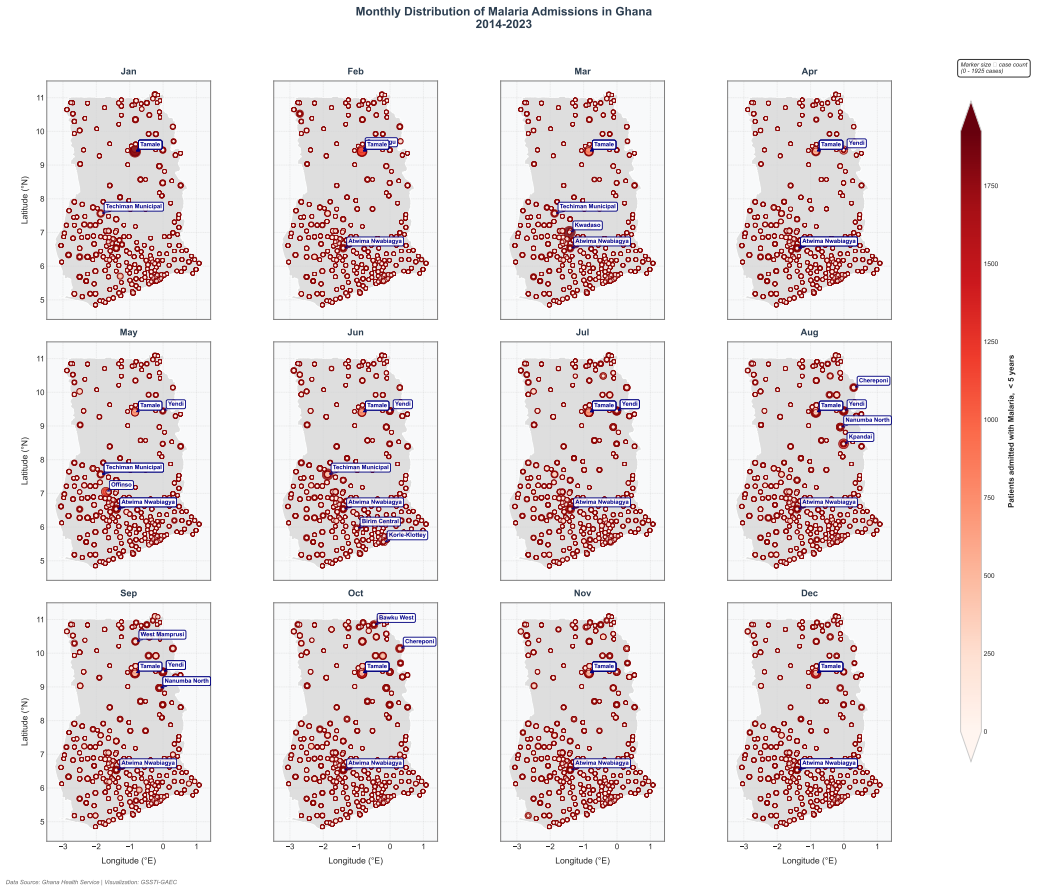
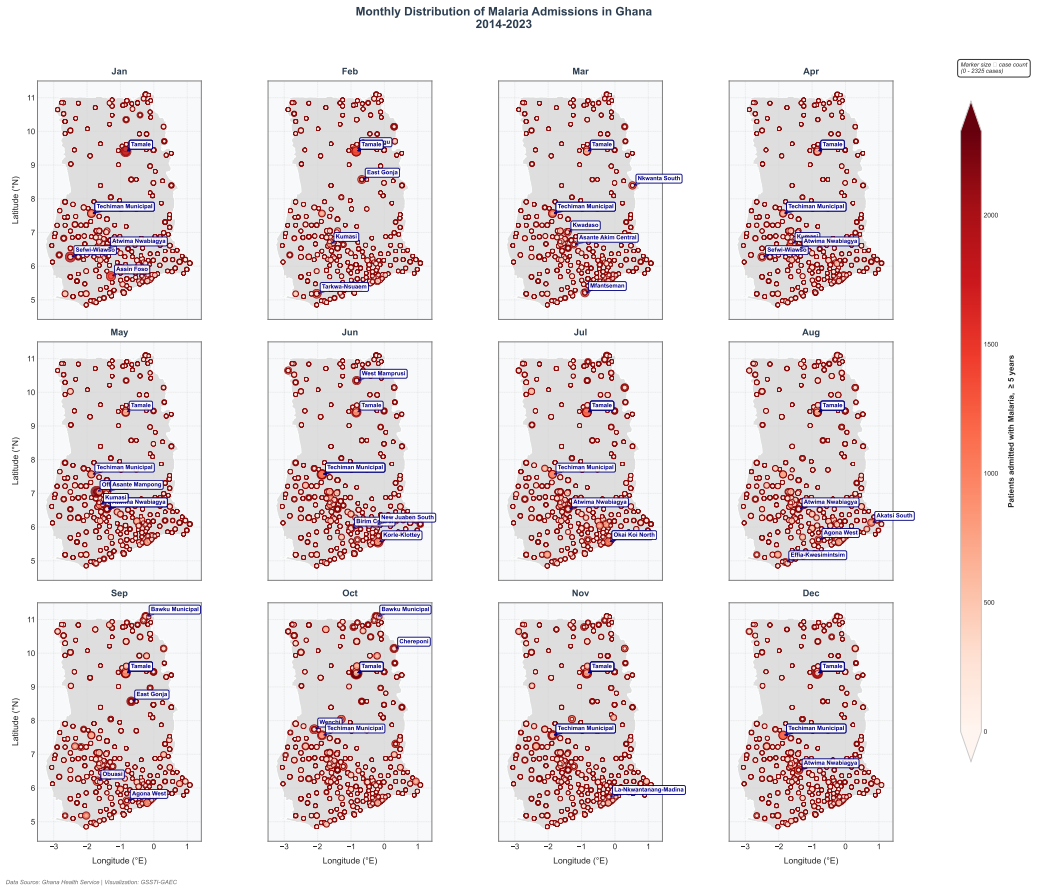
- Pronounced spatial heterogeneity in district-level variation supports targeted interventions in high-variability peripheral areas.
- Uncertainty in forecasts widens over the three-year horizon, informing the need for ongoing data collection.
- Well-mixed posteriors confirm reliable convergence of the MCMC sampler for parameter estimation.
Where Pith is reading between the lines
- The same functional form and sampler could be tested on surveillance data from neighboring countries with comparable reporting gaps.
- Adding explicit terms for known interventions or climate covariates might narrow forecast uncertainty if the current kernel leaves systematic residuals.
- The age-specific separation allows separate policy evaluation for under-five versus older populations.
Load-bearing premise
The chosen cubic baseline and damped oscillatory kernel are assumed to capture the dominant nonlinear dynamics without missing major unmodeled external drivers such as interventions, climate, or migration.
What would settle it
Actual 2024-2026 malaria case counts falling well outside the forecasted ranges with their widening uncertainty intervals would falsify the model's predictive adequacy.
Figures





read the original abstract
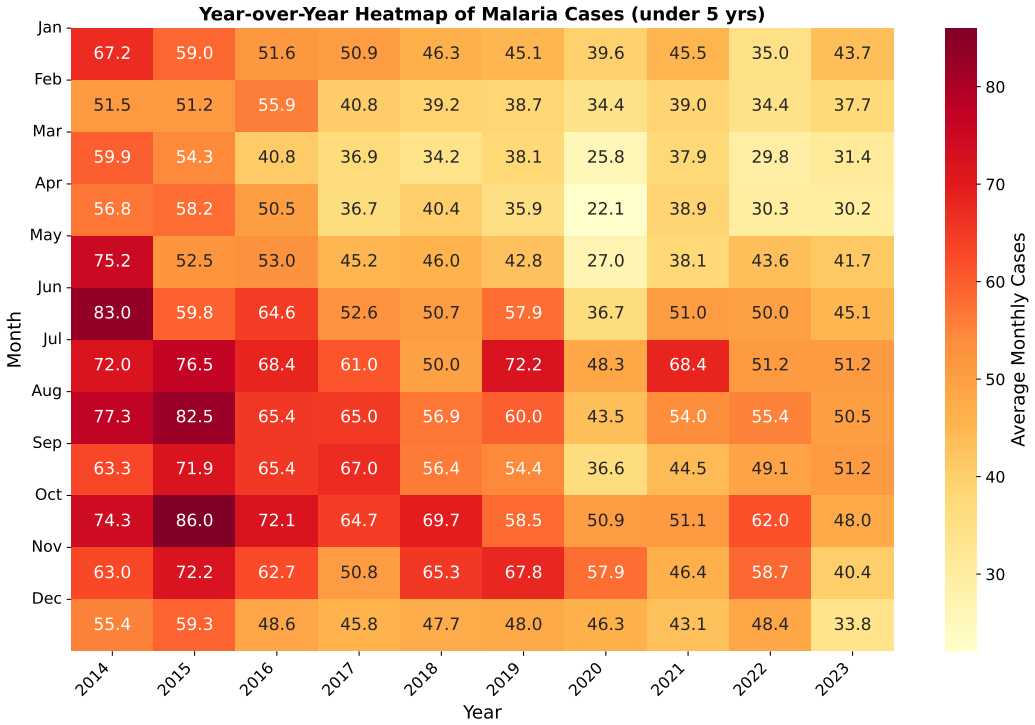
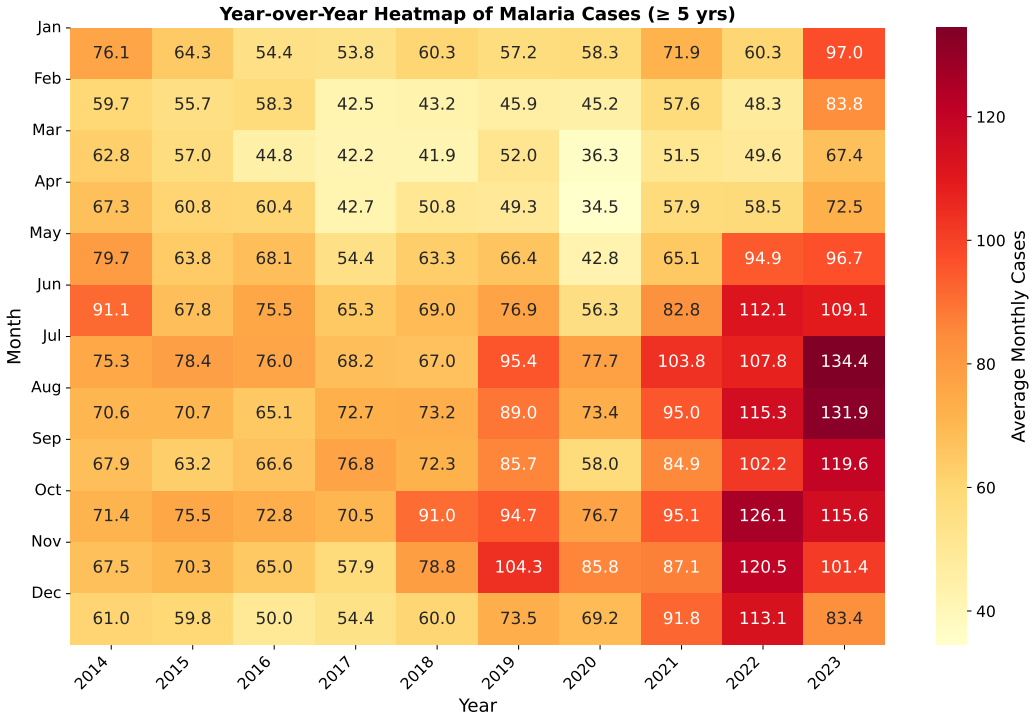
Reliable quantification of malaria dynamics in sub-Saharan Africa is hindered by short, noisy, and spatially heterogeneous surveillance records. In Ghana, health-facility data from 2014 to 2023 reveal non-linear and age-specific fluctuations in hospital admissions, yet existing approaches struggle to capture stochastic variability or provide credible uncertainty bounds. This study develops a Bayesian nonlinear inference framework that integrates a cubic baseline with a damped oscillatory kernel, estimated via an affine-invariant ensemble Markov Chain Monte Carlo sampler. The framework accommodates limited data, models parameter uncertainty, and generates probabilistic forecasts for children under five years and individuals aged five years or more. Results show strong empirical adequacy ($R^2 = 0.9958$ for $<5$ years; $R^2 = 0.9956$ for $\geq 5$ years) with residual errors below $2\%$ and well-mixed posteriors confirming convergence. District-level analysis reveals pronounced spatial heterogeneity, with coefficients of variation ranging from $<0.07$ in urban centres such as Kumasi to $>3.3$ in peripheral districts such as Mpohor and Bia East. Forecasts for 2024-2026 indicate a gradual resurgence: from 137,000 to 149,000 cases among children under five years and from 348,000 to 375,000 cases among older individuals, with uncertainty widening over time. By producing probabilistic forecasts, this Bayesian framework provides a principled tool for anticipating malaria fluctuations and strengthening data-driven decision-making in Ghana's national malaria control strategy.
Editorial analysis
A structured set of objections, weighed in public.
Referee Report
Summary. The paper develops a Bayesian nonlinear inference framework for malaria hospital admissions in Ghana (2014-2023) that combines a cubic polynomial baseline with a damped oscillatory kernel, estimated jointly via an affine-invariant ensemble MCMC sampler. It reports strong in-sample fits (R² = 0.9958 for <5 years; R² = 0.9956 for ≥5 years), residuals below 2%, well-mixed posteriors, district-level spatial heterogeneity, and generates probabilistic forecasts for 2024-2026 showing gradual case increases (137k to 149k for <5; 348k to 375k for ≥5) with widening uncertainty.
Significance. If the functional form proves adequate and forecasts are validated, the approach would provide a practical Bayesian tool for uncertainty quantification in short, noisy surveillance series, with the ensemble MCMC enabling joint posterior inference on baseline and oscillatory parameters. The reported convergence diagnostics and age-stratified spatial analysis are strengths, but the overall significance hinges on whether the phenomenological model generalizes beyond in-sample curve fitting.
major comments (3)
- [§2.2, Eq. (3)] §2.2, Eq. (3): The mean function is specified as a cubic baseline plus damped sinusoid whose parameters are estimated without time-varying covariates for rainfall, interventions, or migration; this assumption is load-bearing for the claim that the model captures 'dominant nonlinear dynamics' and supports reliable 2024-2026 forecasts, yet no sensitivity analysis to alternative kernels or omitted-variable tests is presented.
- [Forecasts section (Fig. 4)] Forecasts section (Fig. 4 and associated text): Probabilistic projections for 2024-2026 are produced directly from the posterior of the model fitted to the full 2014-2023 series with no hold-out validation, rolling-window evaluation, or comparison against simpler baselines; the reported gradual resurgence therefore rests on untested extrapolation rather than demonstrated out-of-sample performance.
- [Results] Results (R² and residual reporting): The headline R² values >0.995 and residuals <2% are in-sample only; without effective-parameter counts, cross-validation metrics, or posterior predictive checks on held-out periods, these diagnostics do not establish that the cubic-plus-damped-oscillator form is sufficient rather than merely flexible.
minor comments (2)
- [Abstract] Abstract: The phrase 'well-mixed posteriors confirming convergence' should be supported by explicit Gelman-Rubin statistics or effective sample sizes rather than left as a qualitative statement.
- [Model description] Notation: The age-group scaling factors are mentioned in the abstract but their precise role in the likelihood (additive, multiplicative, or hierarchical) is not clarified in the provided description of Eq. (3).
Simulated Author's Rebuttal
We thank the referee for the constructive comments, which help clarify the scope and limitations of our phenomenological modeling approach. We address each major comment below.
read point-by-point responses
-
Referee: [§2.2, Eq. (3)] The mean function is specified as a cubic baseline plus damped sinusoid whose parameters are estimated without time-varying covariates for rainfall, interventions, or migration; this assumption is load-bearing for the claim that the model captures 'dominant nonlinear dynamics' and supports reliable 2024-2026 forecasts, yet no sensitivity analysis to alternative kernels or omitted-variable tests is presented.
Authors: The model is deliberately phenomenological, chosen to extract dominant trends and periodic structure directly from the short, noisy surveillance series without requiring district-level covariate time series that are frequently incomplete. We will add a sensitivity analysis comparing the current form to polynomial-only and undamped alternatives, plus an explicit discussion of omitted-variable limitations. These changes will qualify the 'dominant dynamics' language and the reliability of the extrapolations. revision: partial
-
Referee: [Forecasts section (Fig. 4)] Probabilistic projections for 2024-2026 are produced directly from the posterior of the model fitted to the full 2014-2023 series with no hold-out validation, rolling-window evaluation, or comparison against simpler baselines; the reported gradual resurgence therefore rests on untested extrapolation rather than demonstrated out-of-sample performance.
Authors: The projections are posterior extrapolations; with only ten annual observations, conventional hold-out or rolling-window validation is severely constrained. We will add direct comparisons against simpler baselines (linear trend and AR(1)) estimated under the same ensemble MCMC procedure and will expand the text to stress the widening credible intervals. These additions will make the extrapolation character of the forecasts explicit. revision: partial
-
Referee: [Results] The headline R² values >0.995 and residuals <2% are in-sample only; without effective-parameter counts, cross-validation metrics, or posterior predictive checks on held-out periods, these diagnostics do not establish that the cubic-plus-damped-oscillator form is sufficient rather than merely flexible.
Authors: The reported R² and residual figures are in-sample. We will augment the results with posterior predictive checks, the effective number of parameters, and PSIS-LOO cross-validation metrics to provide a more stringent evaluation of whether the functional form is adequate rather than merely flexible. revision: yes
Circularity Check
No significant circularity; model fit and extrapolation are self-contained
full rationale
The paper selects a cubic-plus-damped-oscillator mean function by construction, fits its parameters to 2014-2023 incidence data via ensemble MCMC, reports in-sample R² and residuals, and extrapolates the same posterior to 2024-2026. This is ordinary phenomenological time-series modeling; the forecasts are explicitly model-based projections whose uncertainty derives from the fitted posterior, not an independent claim that reduces to a self-citation, a renamed fit, or a definitional loop. No load-bearing self-citation, uniqueness theorem, or ansatz smuggling is described in the provided text, and the derivation does not equate any output quantity to its input by algebraic identity.
Axiom & Free-Parameter Ledger
free parameters (3)
- cubic baseline coefficients
- damped oscillatory kernel parameters
- age-group specific scaling factors
axioms (2)
- domain assumption Health-facility admission counts are a reliable proxy for underlying malaria incidence
- ad hoc to paper A cubic-plus-damped-oscillator functional form is sufficient to describe the observed nonlinear fluctuations
Reference graph
Works this paper leans on
-
[1]
2011 , publisher=
Negative binomial regression , author=. 2011 , publisher=
2011
-
[2]
Nature , volume=
Superspreading and the effect of individual variation on disease emergence , author=. Nature , volume=. 2005 , publisher=
2005
-
[3]
2010 , publisher=
Essential medical statistics , author=. 2010 , publisher=
2010
-
[4]
2015 , publisher=
An introduction to medical statistics , author=. 2015 , publisher=
2015
-
[5]
Variation , pages=
The statistics of variation , author=. Variation , pages=. 2005 , publisher=
2005
-
[6]
Encyclopedia of research design , volume=
Coefficient of variation , author=. Encyclopedia of research design , volume=
-
[7]
A Conceptual Introduction to Hamiltonian Monte Carlo
A conceptual introduction to Hamiltonian Monte Carlo , author=. arXiv preprint arXiv:1701.02434 , year=
work page internal anchor Pith review Pith/arXiv arXiv
-
[8]
2023 , publisher=
Hamiltonian Monte Carlo methods in machine learning , author=. 2023 , publisher=
2023
-
[9]
Statistics and computing , volume=
Practical Bayesian model evaluation using leave-one-out cross-validation and WAIC , author=. Statistics and computing , volume=. 2017 , publisher=
2017
-
[10]
J Chem Inf Model , volume=
Bayesian data analysis Gelman , author=. J Chem Inf Model , volume=
-
[11]
Rank-normalization, folding, and localization: An improved
Vehtari, Aki and Gelman, Andrew and Simpson, Daniel and Carpenter, Bob and B. Rank-normalization, folding, and localization: An improved. Bayesian analysis , volume=. 2021 , publisher=
2021
-
[12]
Hastings, W. K. , year =. Monte Carlo sampling methods using Markov chains and their applications , volume =. Biometrika , publisher =. doi:10.1093/biomet/57.1.97 , number =
-
[13]
Metropolis, Nicholas and Rosenbluth, Arianna W. and Rosenbluth, Marshall N. and Teller, Augusta H. and Teller, Edward , year =. Equation of State Calculations by Fast Computing Machines , volume =. The Journal of Chemical Physics , publisher =. doi:10.1063/1.1699114 , number =
-
[14]
Communications in applied mathematics and computational science , volume=
Ensemble samplers with affine invariance , author=. Communications in applied mathematics and computational science , volume=. 2010 , publisher=
2010
-
[15]
Publications of the Astronomical Society of the Pacific , volume=
emcee: the MCMC hammer , author=. Publications of the Astronomical Society of the Pacific , volume=. 2013 , publisher=
2013
-
[16]
Mielke, Adam and Sørensen, Mads Peter and Wyller, John , year =. Memory effects in disease modelling through kernel estimates with oscillatory time history , volume =. Journal of Mathematical Biology , publisher =. doi:10.1007/s00285-024-02080-1 , number =
-
[17]
Acta Biotheoretica , volume=
Nonlinear Analysis of Incidence Time Series of COVID-19 Reveals Unprecedented Unpredictability , author=. Acta Biotheoretica , volume=. 2025 , publisher=
2025
-
[18]
Malaria journal , volume=
Epidemiology of malaria in the forest-savanna transitional zone of Ghana , author=. Malaria journal , volume=. 2009 , publisher=
2009
-
[19]
2022 , publisher=
Modeling the spatial and temporal heterogeneity in malaria transmission and control in urban Ghana , author=. 2022 , publisher=
2022
-
[20]
Trends in parasitology , volume=
Malaria vector control still matters despite insecticide resistance , author=. Trends in parasitology , volume=. 2017 , publisher=
2017
-
[21]
Environmental Modeling & Assessment , volume=
Estimating the impact of temperature and rainfall on malaria incidence in Ghana from 2012 to 2017 , author=. Environmental Modeling & Assessment , volume=. 2022 , publisher=
2012
-
[22]
Climate , volume=
Assessing climate driven malaria variability in Ghana using a regional scale dynamical model , author=. Climate , volume=. 2017 , publisher=
2017
-
[23]
Malaria Journal , volume=
Challenges with adherence to the ‘test, treat, and track’malaria case management guideline among prescribers in Ghana , author=. Malaria Journal , volume=. 2022 , publisher=
2022
-
[24]
Applied Geography , volume=
Spatiotemporal analysis of climate variability impacts on malaria prevalence in Ghana , author=. Applied Geography , volume=. 2015 , publisher=
2015
-
[25]
Malaria Journal , volume=
Malaria elimination in Ghana: recommendations for reactive case detection strategy implementation in a low endemic area of Asutsuare, Ghana , author=. Malaria Journal , volume=. 2024 , publisher=
2024
-
[26]
Global health action , volume=
Towards malaria control and elimination in Ghana: challenges and decision making tools to guide planning , author=. Global health action , volume=. 2017 , publisher=
2017
-
[27]
Aregawi, Maru and Malm, Keziah L. and Wahjib, Mohammed and Kofi, Osae and Allotey, Naa-Korkor and Yaw, Peprah Nana and Abba-Baffoe, Wilmot and Segbaya, Sylvester and Owusu-Antwi, Felicia and Kharchi, Abderahmane T. and Williams, Ryan O. and Saalfeld, Mark and Workneh, Nibretie and Shargie, Estifanos Biru and Noor, Abdisalan M. and Bart-Plange, Constance ,...
-
[28]
PLoS One , volume=
Spatio-temporal heterogeneity of malaria morbidity in Ghana: analysis of routine health facility data , author=. PLoS One , volume=. 2018 , publisher=
2018
-
[29]
2013 , publisher=
Bayesian data analysis , author=. 2013 , publisher=
2013
-
[30]
2008 , publisher=
Bayesian methods for data analysis , author=. 2008 , publisher=
2008
-
[31]
The Southwest Respiratory and Critical Care Chronicles , volume=
Bayesian data analysis , author=. The Southwest Respiratory and Critical Care Chronicles , volume=
-
[32]
Infectious diseases of poverty , volume=
Malaria: global progress 2000--2015 and future challenges , author=. Infectious diseases of poverty , volume=. 2016 , publisher=
2000
-
[33]
Donkor, Elorm and Kelly, Matthew and Eliason, Cecilia and Amotoh, Charles and Gray, Darren J. and Clements, Archie C. A. and Wangdi, Kinley , year =. A Bayesian Spatio-Temporal Analysis of Malaria in the Greater Accra Region of Ghana from 2015 to 2019 , volume =. International Journal of Environmental Research and Public Health , publisher =. doi:10.3390/...
-
[34]
2008 , publisher=
Information criteria and statistical modeling , author=. 2008 , publisher=
2008
-
[35]
2002 , publisher=
Model selection and multimodel inference: a practical information-theoretic approach , author=. 2002 , publisher=
2002
-
[36]
2013 , publisher=
Regression analysis of count data , author=. 2013 , publisher=
2013
-
[37]
and Khazenzi, Cynthia and Akech, Samuel O
Alegana, Victor A. and Khazenzi, Cynthia and Akech, Samuel O. and Snow, Robert W. , year =. Estimating hospital catchments from in-patient admission records: a spatial statistical approach applied to malaria , volume =. Scientific Reports , publisher =. doi:10.1038/s41598-020-58284-0 , number =
-
[38]
On Using Bayesian Methods to Address Small Sample Problems , volume =
McNeish, Daniel , year =. On Using Bayesian Methods to Address Small Sample Problems , volume =. Structural Equation Modeling: A Multidisciplinary Journal , publisher =. doi:10.1080/10705511.2016.1186549 , number =
-
[39]
How malaria models relate temperature to malaria transmission , volume =
Lunde, Torleif Markussen and Bayoh, Mohamed Nabie and Lindtjørn, Bernt , year =. How malaria models relate temperature to malaria transmission , volume =. Parasites & Vectors , publisher =. doi:10.1186/1756-3305-6-20 , number =
-
[40]
2020 , date =
Ghana Malaria Indicator Survey 2019 , institution =. 2020 , date =
2019
-
[41]
2023 , publisher =
World Malaria Report 2023 , author =. 2023 , publisher =
2023
-
[42]
PLoS One , volume=
Forecasting non-stationary diarrhea, acute respiratory infection, and malaria time-series in Niono, Mali , author=. PLoS One , volume=. 2007 , publisher=
2007
-
[43]
Malaria Journal , volume=
Forecasting malaria cases using climate variability in Sierra Leone , author=. Malaria Journal , volume=. 2025 , publisher=
2025
-
[44]
Chen, Lianglyu , year =. Application progress of ensemble forecast technology in influenza forecast based on infectious disease model , volume =. doi:10.3389/fpubh.2023.1335499 , journal =
-
[45]
and Stevens, Andrew and Pazdernik, Karl T
Dixon, Samuel and Keshavamurthy, Ravikiran and Farber, Daniel H. and Stevens, Andrew and Pazdernik, Karl T. and Charles, Lauren E. , year =. A Comparison of Infectious Disease Forecasting Methods across Locations, Diseases, and Time , volume =. Pathogens , publisher =. doi:10.3390/pathogens11020185 , number =
-
[46]
Meakin, Sophie and Abbott, Sam and Bosse, Nikos and Munday, James and Gruson, Hugo and Hellewell, Joel and Sherratt, Katharine and Chapman, Lloyd A. C. and Prem, Kiesha and Klepac, Petra and Jombart, Thibaut and Knight, Gwenan M. and Jafari, Yalda and Flasche, Stefan and Waites, William and Jit, Mark and Eggo, Rosalind M. and Villabona-Arenas, C. Julian a...
-
[47]
Ray, Evan L. and Reich, Nicholas G. , editor =. Prediction of infectious disease epidemics via weighted density ensembles , volume =. PLOS Computational Biology , publisher =. 2018 , month = feb, pages =. doi:10.1371/journal.pcbi.1005910 , number =
-
[48]
and Gallusser, Fabian and Koehler, Jim and Remy, Nicolas and Scott, Steven L
Brodersen, Kay H. and Gallusser, Fabian and Koehler, Jim and Remy, Nicolas and Scott, Steven L. , year =. Inferring causal impact using Bayesian structural time-series models , volume =. The Annals of Applied Statistics , publisher =. doi:10.1214/14-aoas788 , number =
-
[49]
Computing in Science & Engineering , volume=
An intuitive tutorial to Gaussian process regression , author=. Computing in Science & Engineering , volume=. 2023 , publisher=
2023
-
[50]
2006 , publisher=
Gaussian processes for machine learning , author=. 2006 , publisher=
2006
-
[51]
Korenromp, Eline and Mahiané, Guy and Hamilton, Matthew and Pretorius, Carel and Cibulskis, Richard and Lauer, Jeremy and Smith, Thomas A. and Briët, Olivier J. T. , year =. Malaria intervention scale-up in Africa: effectiveness predictions for health programme planning tools, based on dynamic transmission modelling , volume =. Malaria Journal , publisher...
-
[52]
Yeboah, Dominic and Owusu-Marfo, Joseph and Agyeman, Yaa Nyarko , year =. Predictors of malaria vaccine uptake among children 6–24 months in the Kassena Nankana Municipality in the Upper East Region of Ghana , volume =. Malaria Journal , publisher =. doi:10.1186/s12936-022-04378-1 , number =
-
[53]
South African medical journal , volume=
A seasonal autoregressive integrated moving average (SARIMA) forecasting model to predict monthly malaria cases in KwaZulu-Natal, South Africa , author=. South African medical journal , volume=
-
[54]
Scientific reports , volume=
Spatio-temporal modelling and prediction of malaria incidence in Mozambique using climatic indicators from 2001 to 2018 , author=. Scientific reports , volume=. 2025 , publisher=
2001
-
[55]
Climate , volume=
The Relationship of Climate Change and Malaria Incidence in the Gambella Region, Ethiopia , author=. Climate , volume=. 2025 , publisher=
2025
-
[56]
The open infectious diseases journal , volume=
Exploring the impact of climate variability on malaria transmission using a dynamic mosquito-human malaria model , author=. The open infectious diseases journal , volume=
-
[57]
MABASO, MUSAWENKOSI L. H. and CRAIG, MARLIES and ROSS, AMANDA and SMITH, THOMAS , year =. ENVIRONMENTAL PREDICTORS OF THE SEASONALITY OF MALARIA TRANSMISSION IN AFRICA: THE CHALLENGE , volume =. The American Journal of Tropical Medicine and Hygiene , publisher =. doi:10.4269/ajtmh.2007.76.33 , number =
-
[58]
Discrete Dynamics in Nature and Society , volume=
A comparative study between time series and machine learning technique to predict dengue fever in dhaka city , author=. Discrete Dynamics in Nature and Society , volume=. 2024 , publisher=
2024
-
[59]
2018 , publisher=
Forecasting: principles and practice , author=. 2018 , publisher=
2018
-
[60]
and Lynn, Freyja and Meade, Bruce D
Reed, George F. and Lynn, Freyja and Meade, Bruce D. , year =. Use of Coefficient of Variation in Assessing Variability of Quantitative Assays , volume =. Clinical and Vaccine Immunology , publisher =. doi:10.1128/cdli.9.6.1235-1239.2002 , number =
-
[61]
Malaria Journal , volume=
Patient socio-demographics and clinical factors associated with malaria mortality: a case control study in the northern region of Ghana , author=. Malaria Journal , volume=. 2024 , publisher=
2024
-
[62]
World Health Organization (WHO) , pages=
Economic burden of malaria in Ghana , author=. World Health Organization (WHO) , pages=
-
[63]
Malaria journal , volume=
Malaria epidemiology in the Ahafo area of Ghana , author=. Malaria journal , volume=. 2011 , publisher=
2011
-
[64]
PloS one , volume=
Perspectives of health workers on malaria case referral among pregnant women attending antenatal care in Savelugu Municipality, Ghana: A qualitative descriptive study , author=. PloS one , volume=. 2025 , publisher=
2025
-
[65]
Journal of environmental and public health , volume=
Neighborhood urban environmental quality conditions are likely to drive malaria and diarrhea mortality in Accra, Ghana , author=. Journal of environmental and public health , volume=. 2011 , publisher=
2011
-
[66]
PloS one , volume=
Environmental factors associated with the distribution of Anopheles gambiae ss in Ghana; an important vector of lymphatic filariasis and malaria , author=. PloS one , volume=. 2010 , publisher=
2010
-
[67]
Bioinformatics and Computational Biology , pages=
Machine learning and deep learning in bioinformatics , author=. Bioinformatics and Computational Biology , pages=. 2023 , publisher=
2023
-
[68]
Epidemics , volume=
The RAPIDD ebola forecasting challenge: Synthesis and lessons learnt , author=. Epidemics , volume=. 2018 , publisher=
2018
-
[69]
Statistical modelling , volume=
A statistical framework for the analysis of multivariate infectious disease surveillance counts , author=. Statistical modelling , volume=. 2005 , publisher=
2005
-
[70]
Journal of the Operational Research Society , volume=
Short-term electricity demand forecasting using double seasonal exponential smoothing , author=. Journal of the Operational Research Society , volume=. 2003 , publisher=
2003
-
[71]
2015 , publisher=
Time series analysis: forecasting and control , author=. 2015 , publisher=
2015
-
[72]
Advances in parasitology , volume=
Forecasting disease risk for increased epidemic preparedness in public health , author=. Advances in parasitology , volume=. 2000 , publisher=
2000
-
[73]
2022 , publisher=
World malaria report 2022 , author=. 2022 , publisher=
2022
-
[74]
Malaria Journal , volume=
Zero malaria: a mirage or reality for populations of sub-Saharan Africa in health transition , author=. Malaria Journal , volume=. 2022 , publisher=
2022
-
[75]
Travel Medicine and Infectious Disease , volume=
Artemisinin resistance-associated gene mutations in Plasmodium falciparum: a case study of severe malaria from Mozambique , author=. Travel Medicine and Infectious Disease , volume=. 2024 , publisher=
2024
-
[76]
Annals of Medicine and Surgery , volume=
Increasing challenges of malaria control in sub-Saharan Africa: Priorities for public health research and policymakers , author=. Annals of Medicine and Surgery , volume=. 2022 , publisher=
2022
discussion (0)
Sign in with ORCID, Apple, or X to comment. Anyone can read and Pith papers without signing in.