Mapping the nuclear environments of extreme coronal line emitting galaxies
Pith reviewed 2026-06-28 09:05 UTC · model grok-4.3
The pith
Gas distances in extreme coronal line galaxies correlate with black hole mass following a square-root dependence.
A machine-rendered reading of the paper's core claim, the machinery that carries it, and where it could break.
Core claim
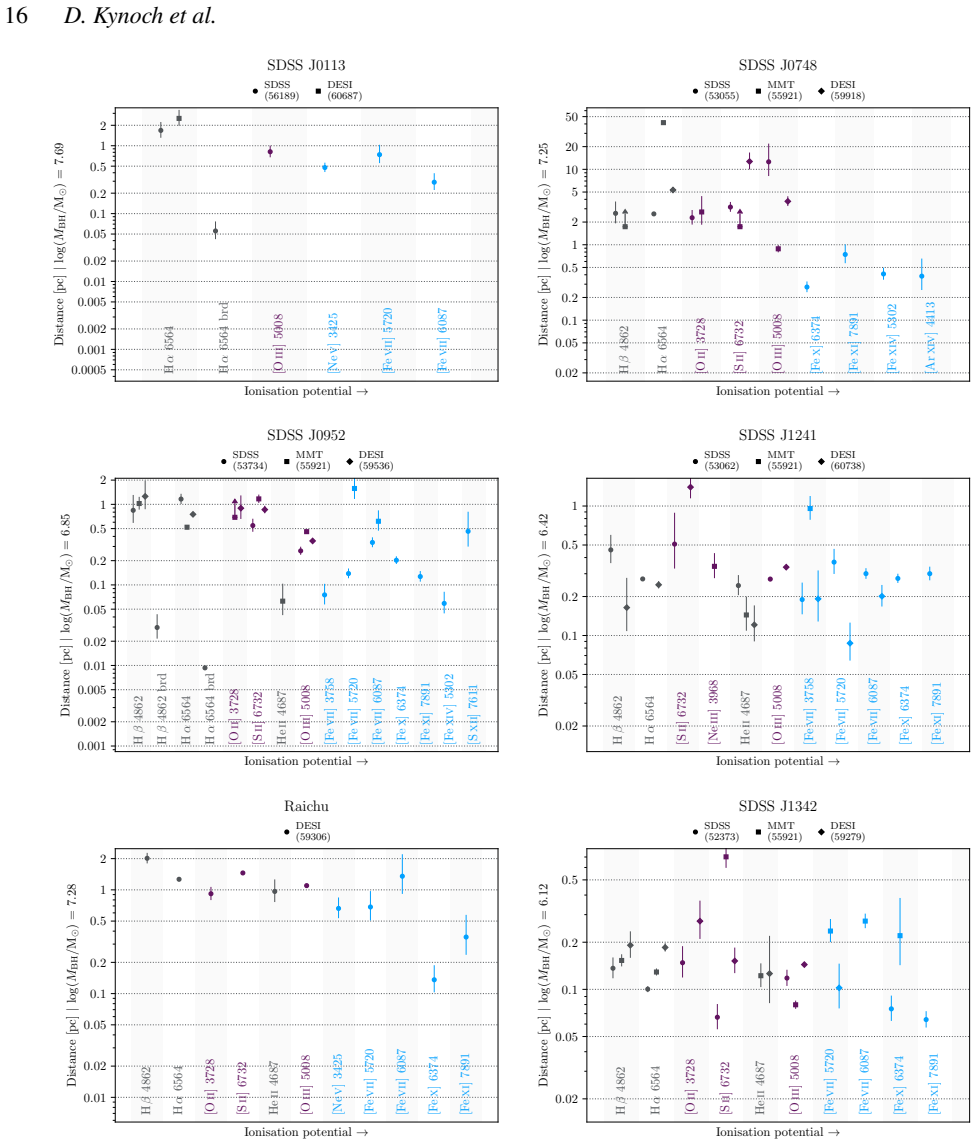
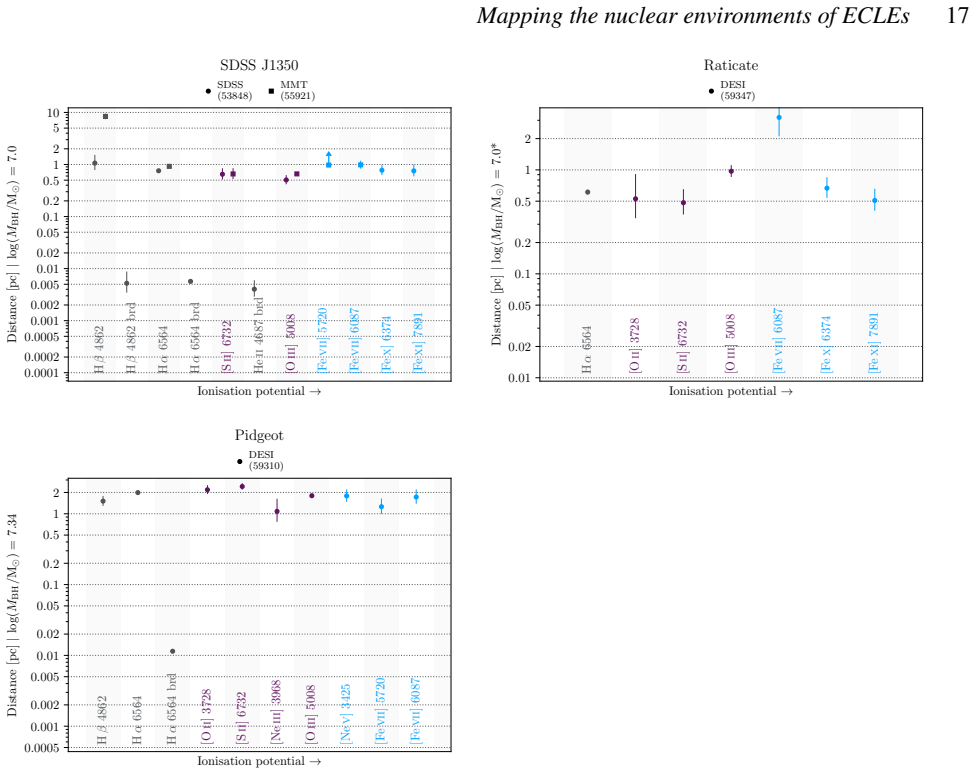
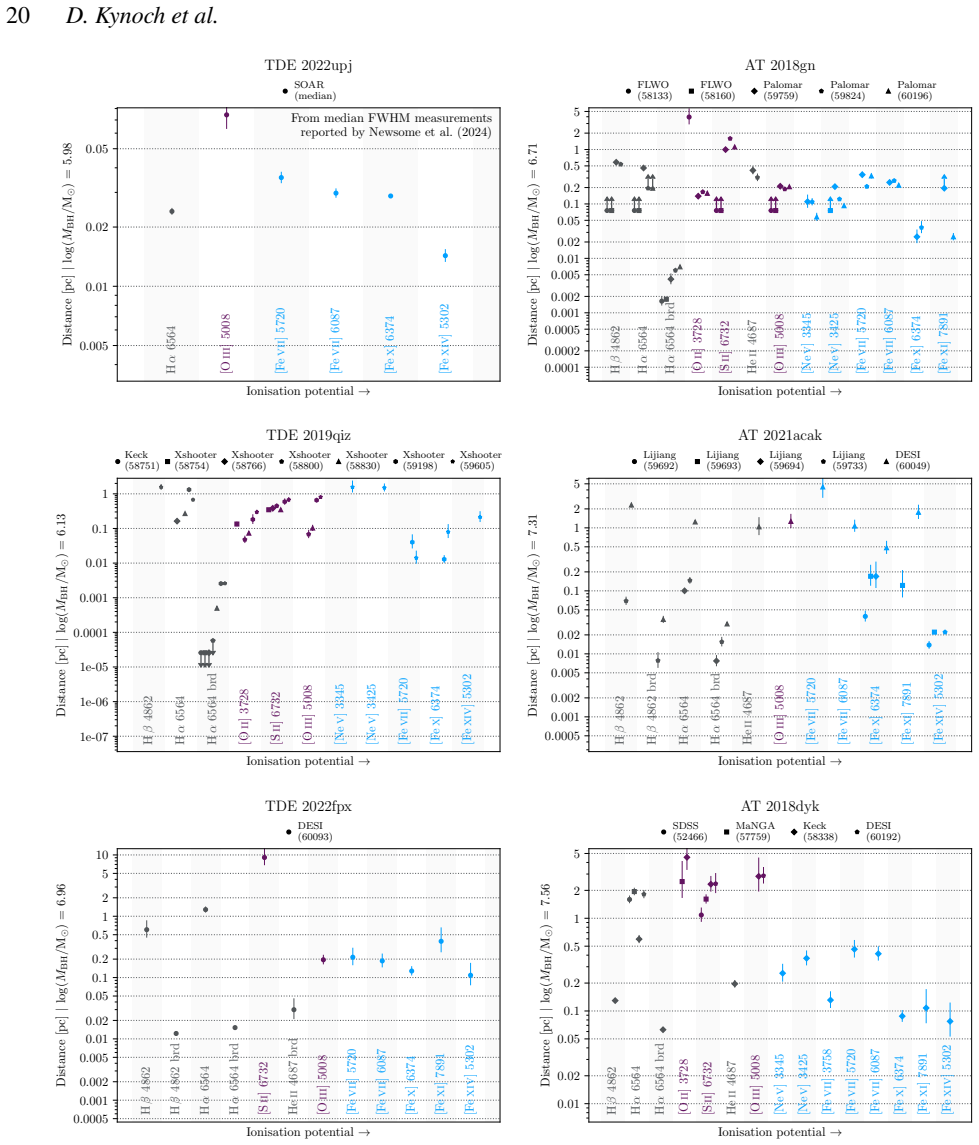
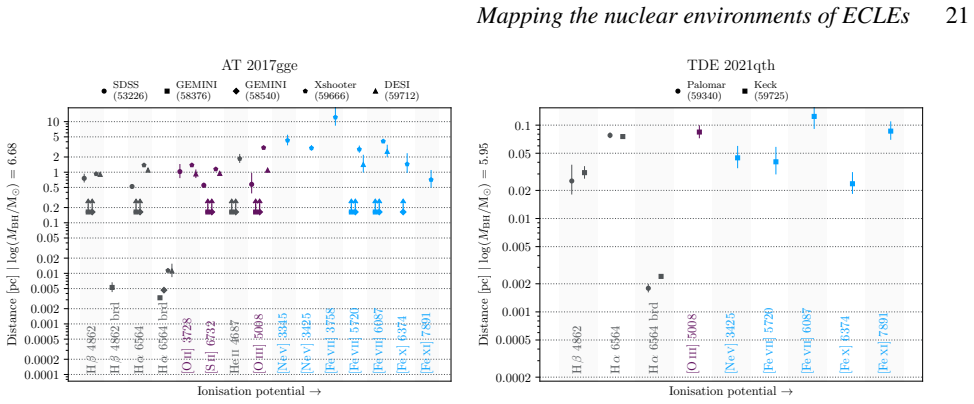
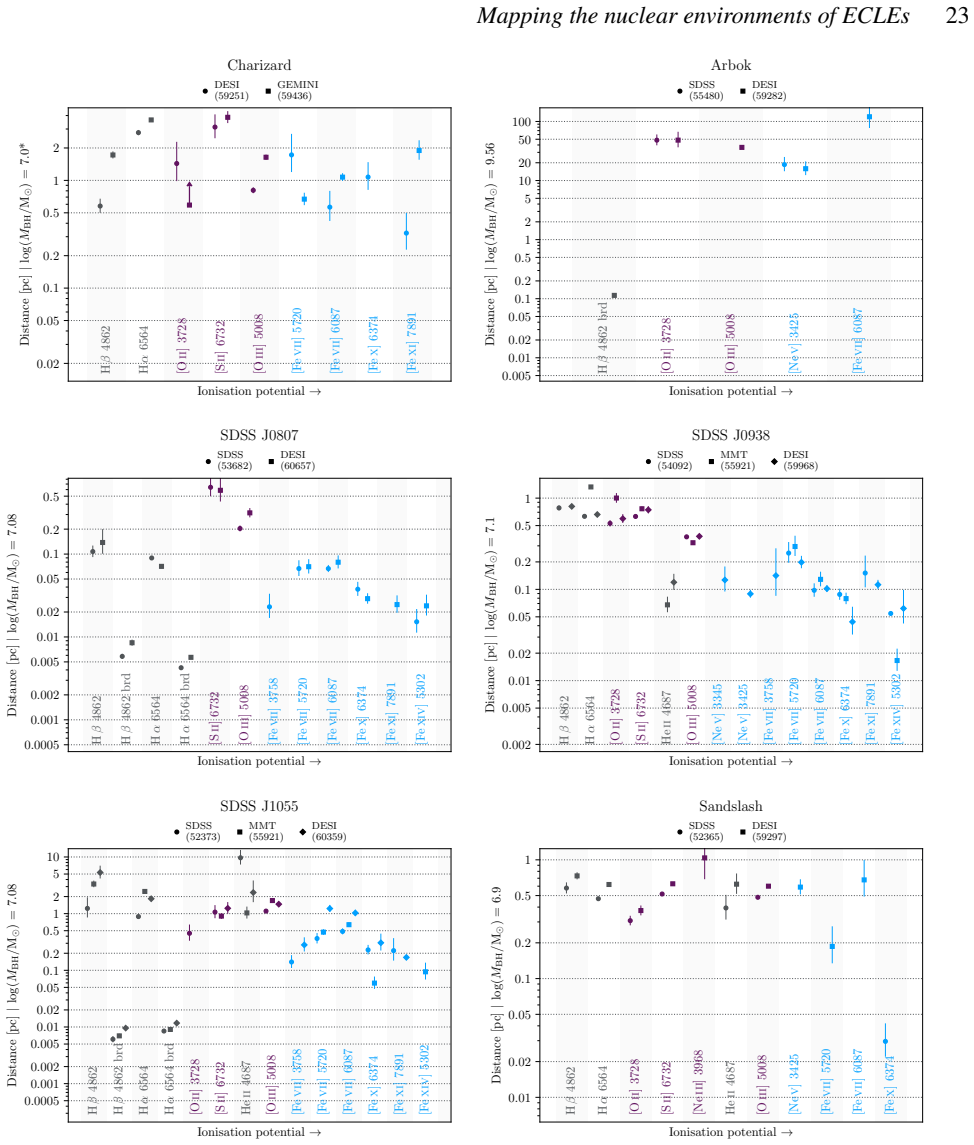
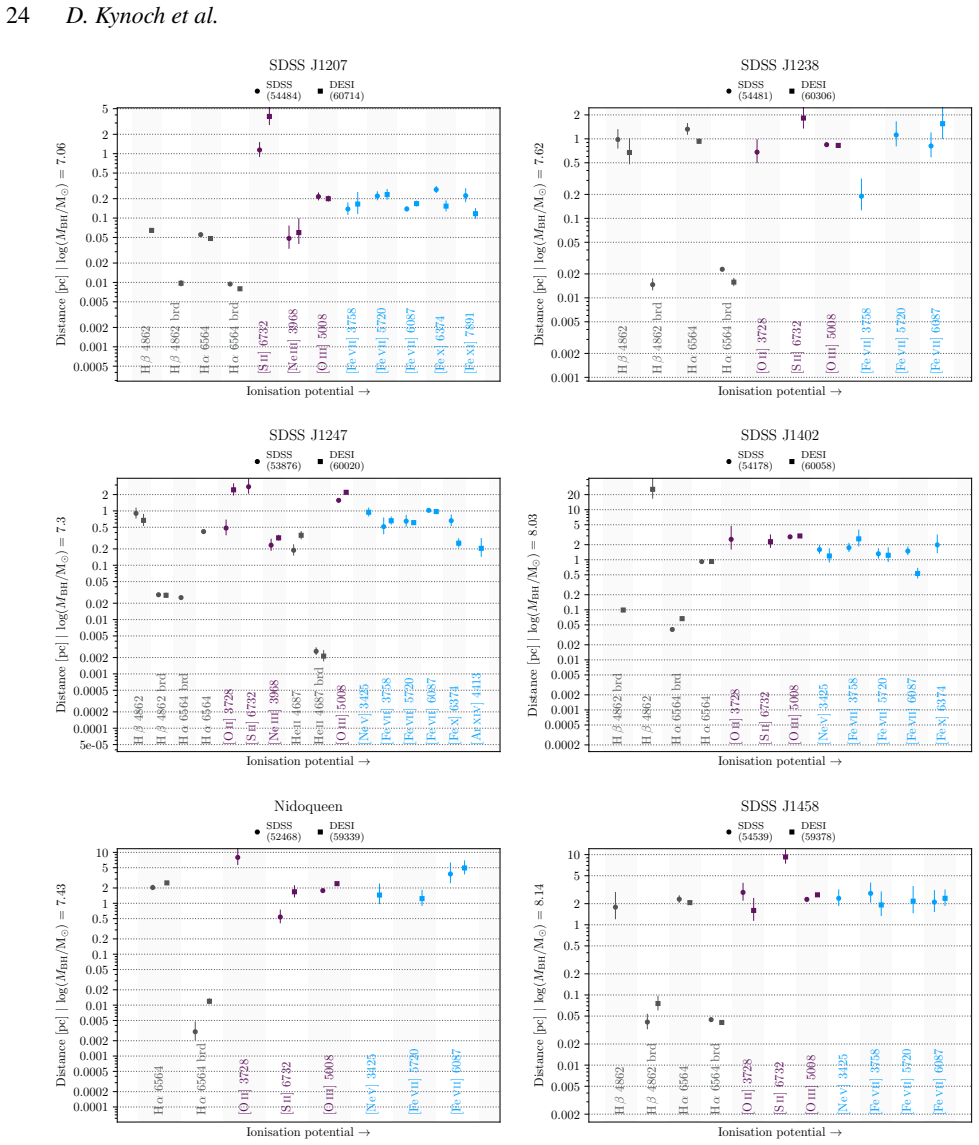
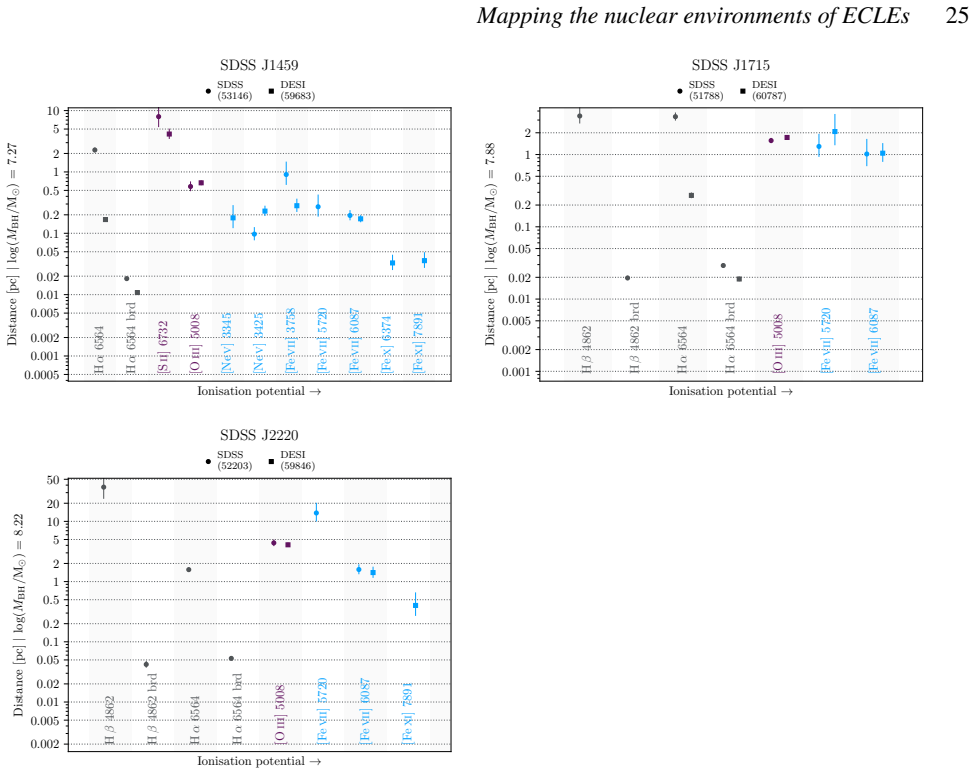
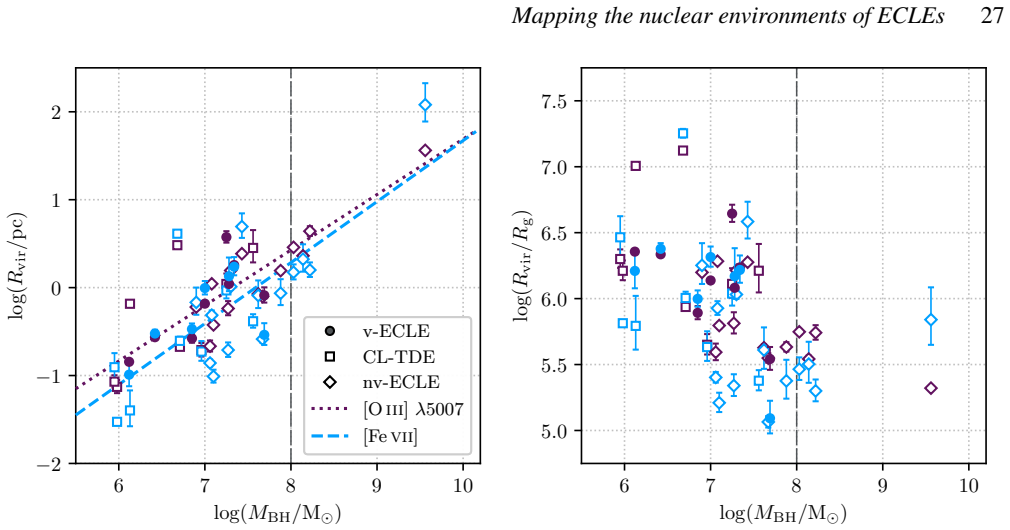
We find positive correlations between gas distance and black hole mass for both [O III] and [Fe VII]: the log(Distance)-log(Mass) relations have slopes 0.63±0.08 and 0.69±0.12, respectively, broadly consistent with a Mass^{0.5} dependence and with characteristic radii set primarily by photoionisation.
What carries the argument
Virial-motion assumption that converts measured emission-line widths into characteristic radial distances of the line-emitting gas.
If this is right
- Coronal lines are emitted at radii intermediate between the broad line region and the low-ionisation narrow line region.
- Ionisation stratification appears with similar incidence in both variable TDE-linked and non-variable AGN-linked ECLEs.
- Characteristic radii are set primarily by photoionisation rather than dynamical or other effects.
- Highest-ionisation lines fade first in variable sources, followed by [Fe VII] and brightening of [O III].
Where Pith is reading between the lines
- The lack of difference in gas distributions between active and quiescent nuclei suggests that a recent TDE does not rearrange the circumnuclear material on observable scales.
- If the mass-distance relation holds, it could be used to estimate black hole masses from single-epoch spectra of other high-ionisation sources.
- Future monitoring of more ECLEs would test whether the observed stratification evolves differently in TDE versus steady AGN environments.
Load-bearing premise
The gas motions must be virial so that line widths can be converted directly into radial distances.
What would settle it
Finding no correlation, or slopes far from 0.5, between line-emitting gas distance and black hole mass in a larger sample of ECLEs would falsify the claimed scaling.
Figures

read the original abstract
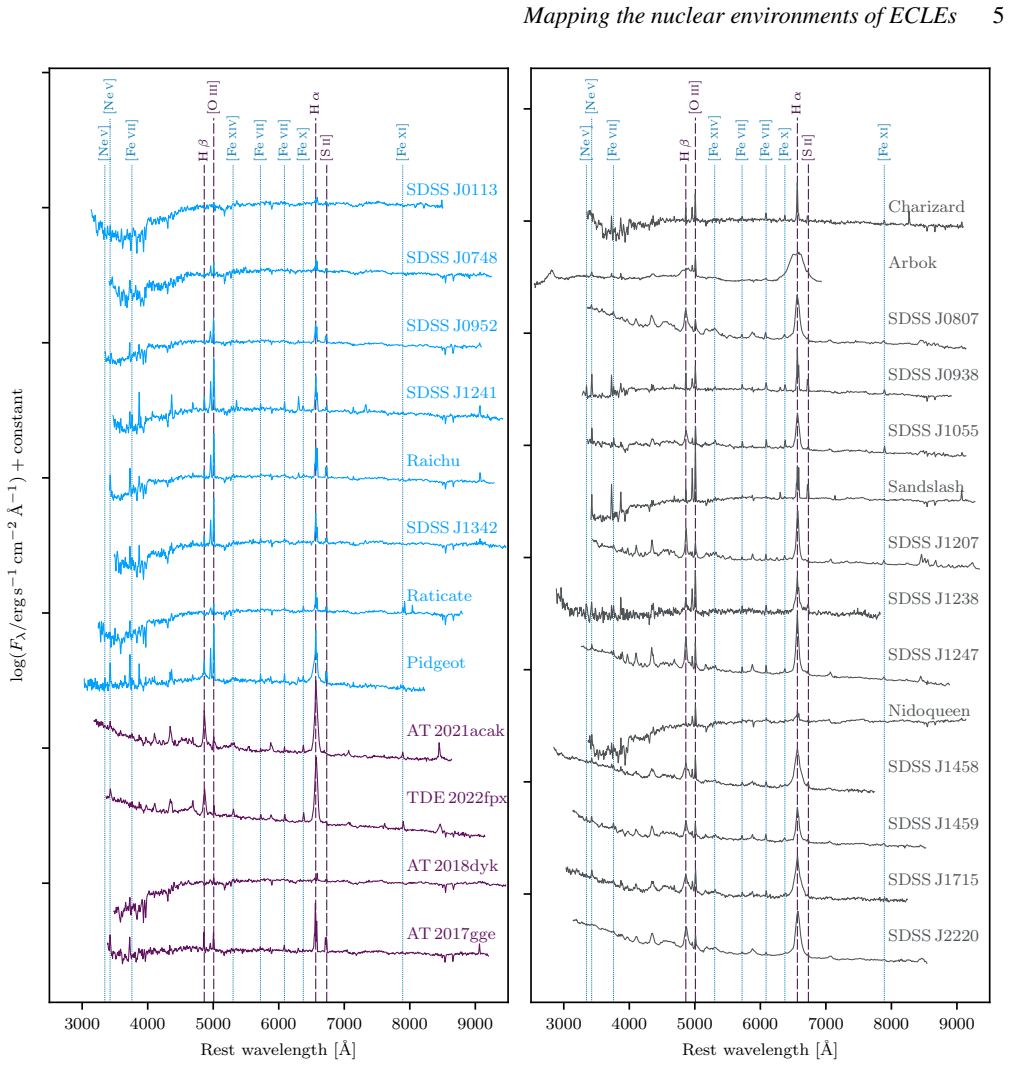
Extreme coronal line emitters (ECLEs) are a rare class of galactic nuclei exhibiting unusually strong high-ionisation forbidden emission lines, and several ECLEs have been linked to tidal disruption events (TDEs). In this work, we compile and analyse optical spectra of 33 ECLEs, dividing them into variable, TDE-linked sources and non-variable, AGN-linked systems. Using multi-epoch spectroscopy from the Sloan Digital Sky Survey, Dark Energy Spectroscopic Instrument, and other facilities, we investigate the evolution of the emission line spectra and measure emission line profiles. Many variable ECLEs have changing spectra in which the highest-ionisation lines (e.g., [Fe X]-[Fe XIV]) appear and fade first, followed by [Fe VII], accompanied by brightening of [O III]. These changes may reflect a softening ionising continuum, the outward propagation of the ionisation front following the TDE flare, or both. Assuming virial motion, we translate line widths into characteristic radial distances, reconstructing the spatial distribution of line-emitting gas. Coronal lines are generally emitted at radii intermediate between the broad line region and the low-ionisation narrow line region. This ionisation stratification is seen in many sources, with similar incidence in variable and non-variable ECLEs, suggesting no apparent difference in circumnuclear gas distributions between active and quiescent nuclei. We find positive correlations between gas distance and black hole mass for both [O III] and [Fe VII]: the log(Distance)-log(Mass) relations have slopes $0.63\pm0.08$ and $0.69\pm0.12$, respectively, broadly consistent with a Mass$^{0.5}$ dependence and with characteristic radii set primarily by photoionisation.
Editorial analysis
A structured set of objections, weighed in public.
Referee Report
Summary. The manuscript compiles and analyzes optical spectra of 33 extreme coronal line emitters (ECLEs), separating variable TDE-linked sources from non-variable AGN-linked systems. It examines multi-epoch spectral evolution of high-ionization lines, measures emission-line profiles, derives characteristic radial distances for the emitting gas by assuming virial motion from observed line widths, and reports positive correlations between these distances and black-hole mass with fitted slopes of 0.63±0.08 ([O III]) and 0.69±0.12 ([Fe VII]), interpreted as consistent with a photoionization origin and M^{0.5} scaling.
Significance. If the derived distances prove reliable, the results would map ionization stratification in ECLE nuclei, demonstrate that coronal lines arise at radii intermediate between the BLR and NLR, and provide empirical support for photoionization setting characteristic radii in both TDE and AGN environments.
major comments (2)
- [distance derivation and correlation analysis] The central Distance–Mass correlations (Abstract and the section on reconstruction of spatial distribution) are obtained by converting measured line widths directly into radii via the virial relation R = f G M_BH / v². No cross-check against reverberation-mapping lags, resolved imaging, or kinematic modeling that could test the pure-gravitational assumption is presented; coronal-line kinematics in other AGN samples often show non-virial contributions, which would render the reported slopes (0.63±0.08 and 0.69±0.12) and the claimed consistency with M^{0.5} photoionization scaling dependent on an unverified premise.
- [results on stratification and correlations] The sample is divided into variable and non-variable ECLEs, yet the incidence of ionization stratification is stated to be similar in both subsets. The manuscript does not quantify how the virial-derived radii for the two subsets separately affect the overall log D–log M fits or whether the slope uncertainties incorporate possible systematic differences in line-profile measurement between the subsets.
minor comments (2)
- [Abstract] The abstract states the slopes are “broadly consistent with a Mass^{0.5} dependence” but does not show the formal statistical test or the exact functional form assumed for the comparison.
- [methods] Notation for the geometric factor f in the virial relation is introduced without a table of adopted values or discussion of its range across sources.
Simulated Author's Rebuttal
We thank the referee for their thoughtful comments on our manuscript. We respond point-by-point to the major comments below, acknowledging limitations where appropriate and outlining planned revisions.
read point-by-point responses
-
Referee: The central Distance–Mass correlations (Abstract and the section on reconstruction of spatial distribution) are obtained by converting measured line widths directly into radii via the virial relation R = f G M_BH / v². No cross-check against reverberation-mapping lags, resolved imaging, or kinematic modeling that could test the pure-gravitational assumption is presented; coronal-line kinematics in other AGN samples often show non-virial contributions, which would render the reported slopes (0.63±0.08 and 0.69±0.12) and the claimed consistency with M^{0.5} photoionization scaling dependent on an unverified premise.
Authors: We agree that the virial assumption is fundamental to our distance estimates and that no direct cross-checks (e.g., reverberation mapping or resolved imaging) are presented, as such data are unavailable for this rare sample of ECLEs. This method follows standard practice in AGN emission-line studies where independent radius measurements are lacking. We will revise the manuscript to include an expanded discussion of possible non-virial contributions to coronal-line widths, citing relevant AGN literature, and will qualify the interpretation of the slopes as indirect support for photoionization rather than definitive proof. The observed slopes near 0.5 remain consistent with the expected scaling under the assumption, but we acknowledge the premise is unverified. revision: partial
-
Referee: The sample is divided into variable and non-variable ECLEs, yet the incidence of ionization stratification is stated to be similar in both subsets. The manuscript does not quantify how the virial-derived radii for the two subsets separately affect the overall log D–log M fits or whether the slope uncertainties incorporate possible systematic differences in line-profile measurement between the subsets.
Authors: We will add a quantitative analysis separating the variable (TDE-linked) and non-variable (AGN-linked) subsets, including separate log(D)–log(M) fits for each to show their individual slopes, contributions to the combined relation, and any differences. This will also address potential systematic differences in line-profile measurements between subsets and clarify how they impact the reported uncertainties. The statement on similar incidence of stratification was qualitative; the new analysis will provide the requested quantification. revision: yes
Circularity Check
No significant circularity; distances from standard virial method yield empirical correlations
full rationale
The paper derives characteristic gas radii from measured line widths via the standard virial relation R = f G M_BH / v^2 (abstract and methods). The reported log(Distance)-log(Mass) slopes of 0.63±0.08 and 0.69±0.12 are direct empirical fits to these independently measured quantities. The slopes are not forced by construction, as they depend on the observed velocity dispersions; a slope near 0.5 emerges only if the data exhibit a specific v-M relation, which is not assumed. No self-citations, uniqueness theorems, or ansatzes from prior author work are invoked as load-bearing steps. The central claims rest on external benchmarks (standard AGN virial methods and photoionization scaling) rather than reducing to the paper's own inputs.
Axiom & Free-Parameter Ledger
axioms (1)
- domain assumption Virial motion of line-emitting gas allows line widths to be converted to characteristic radii
Reference graph
Works this paper leans on
-
[1]
The Eighteenth Data Release of the Sloan Digital Sky Surveys: Targeting and First Spectra from SDSS-V. , keywords =. doi:10.3847/1538-4365/acda98 , archivePrefix =. 2301.07688 , primaryClass =
-
[2]
A Continuum of H- to He-Rich Tidal Disruption Candidates With a Preference for E+A Galaxies
A Continuum of H- to He-rich Tidal Disruption Candidates With a Preference for E+A Galaxies. , keywords =. doi:10.1088/0004-637X/793/1/38 , archivePrefix =. 1405.1415 , primaryClass =
work page internal anchor Pith review Pith/arXiv arXiv doi:10.1088/0004-637x/793/1/38
-
[3]
The Astronomer's Telegram , keywords =
FLOYDS Classification of AT 2018dyk/ZTF18aajupnt as a Possible Tidal Disruption Event. The Astronomer's Telegram , keywords =
-
[4]
Classification parameters for the emission-line spectra of extragalactic objects. , keywords =. doi:10.1086/130766 , adsurl =
-
[5]
The Zwicky Transient Facility: System Overview, Performance, and First Results
The Zwicky Transient Facility: System Overview, Performance, and First Results. , keywords =. doi:10.1088/1538-3873/aaecbe , archivePrefix =. 1902.01932 , primaryClass =
work page internal anchor Pith review Pith/arXiv arXiv doi:10.1088/1538-3873/aaecbe 1902
-
[6]
The Radius-Luminosity Relationship for Active Galactic Nuclei: The Effect of Host-Galaxy Starlight on Luminosity Measurements. II. The Full Sample of Reverberation-Mapped AGNs. , keywords =. doi:10.1088/0004-637X/697/1/160 , archivePrefix =. 0812.2283 , primaryClass =
work page internal anchor Pith review Pith/arXiv arXiv doi:10.1088/0004-637x/697/1/160
-
[7]
Transient Name Server Discovery Report , keywords =
ASAS-SN Transient Discovery Report for 2018-04-27. Transient Name Server Discovery Report , keywords =
2018
-
[8]
NYU-VAGC: a galaxy catalog based on new public surveys
New York University Value-Added Galaxy Catalog: A Galaxy Catalog Based on New Public Surveys. , keywords =. doi:10.1086/429803 , archivePrefix =. astro-ph/0410166 , primaryClass =
work page internal anchor Pith review Pith/arXiv arXiv doi:10.1086/429803
-
[9]
Sloan Digital Sky Survey IV: Mapping the Milky Way, Nearby Galaxies, and the Distant Universe
Sloan Digital Sky Survey IV: Mapping the Milky Way, Nearby Galaxies, and the Distant Universe. , keywords =. doi:10.3847/1538-3881/aa7567 , archivePrefix =. 1703.00052 , primaryClass =
work page internal anchor Pith review Pith/arXiv arXiv doi:10.3847/1538-3881/aa7567
-
[10]
Frontiers in Astronomy and Space Sciences , keywords =
Ratios of forbidden [OIII] 4959,5007 and [NII] 6548,6583 lines in nearby narrow emission line galaxies. Frontiers in Astronomy and Space Sciences , keywords =. doi:10.3389/fspas.2025.1540522 , adsurl =
-
[11]
The physical properties of star-forming galaxies in the low-redshift Universe. , keywords =. doi:10.1111/j.1365-2966.2004.07881.x , archivePrefix =. astro-ph/0311060 , primaryClass =
-
[12]
Las Cumbres Observatory Global Telescope Network
Las Cumbres Observatory Global Telescope Network. , keywords =. doi:10.1086/673168 , archivePrefix =. 1305.2437 , primaryClass =
work page internal anchor Pith review Pith/arXiv arXiv doi:10.1086/673168
-
[13]
The rate of extreme coronal line emitting galaxies in the Sloan Digital Sky Survey and their relation to tidal disruption events. , keywords =. doi:10.1093/mnras/stae2384 , archivePrefix =. 2402.16951 , primaryClass =
-
[14]
The rate of extreme coronal line emitters in the Baryon Oscillation Spectroscopic Survey LOWZ sample. , keywords =. doi:10.1093/mnras/staf496 , archivePrefix =. 2501.14022 , primaryClass =
-
[15]
The Relationship between Infrared, Optical, and Ultraviolet Extinction. , keywords =. doi:10.1086/167900 , adsurl =
-
[16]
Physical properties of the emission-line regions
Coronal-line forest active galactic nuclei - I. Physical properties of the emission-line regions. , keywords =. doi:10.1093/mnras/staa3320 , archivePrefix =. 2010.12595 , primaryClass =
-
[17]
Discovery of Quasiperiodic Eruptions in the Tidal Disruption Event and Extreme Coronal Line Emitter AT2022upj: Implications for the QPE/TDE Fraction and a Connection to ECLEs. , keywords =. doi:10.3847/2041-8213/adc2f8 , archivePrefix =. 2503.19013 , primaryClass =
-
[18]
Long-term follow-up observations of extreme coronal line emitting galaxies. , keywords =. doi:10.1093/mnras/stae460 , archivePrefix =. 2307.03182 , primaryClass =
-
[19]
AT 2018dyk: tidal disruption event or active galactic nucleus? Follow-up observations of an extreme coronal line emitter with the Dark Energy Spectroscopic Instrument. , keywords =. doi:10.1093/mnras/staf724 , archivePrefix =. 2502.04080 , primaryClass =
-
[20]
arXiv e-prints , keywords =
Early results in the search for extreme coronal line emitters with the Dark Energy Spectroscopic Instrument. arXiv e-prints , keywords =
-
[21]
A Grid of Composite Models for the Simulation of the Emission-Line Spectra from the Narrow-Line Regions of Active Galaxies. , keywords =. doi:10.1086/318956 , archivePrefix =. astro-ph/0009084 , primaryClass =
work page internal anchor Pith review Pith/arXiv arXiv doi:10.1086/318956
-
[22]
The Baryon Oscillation Spectroscopic Survey of SDSS-III. , keywords =. doi:10.1088/0004-6256/145/1/10 , archivePrefix =. 1208.0022 , primaryClass =
work page internal anchor Pith review Pith/arXiv arXiv doi:10.1088/0004-6256/145/1/10
-
[23]
The DESI Experiment Part I: Science,Targeting, and Survey Design
The DESI Experiment Part I: Science,Targeting, and Survey Design. arXiv e-prints , keywords =. doi:10.48550/arXiv.1611.00036 , archivePrefix =. 1611.00036 , primaryClass =
work page internal anchor Pith review Pith/arXiv arXiv doi:10.48550/arxiv.1611.00036
-
[24]
The DESI Experiment Part II: Instrument Design
The DESI Experiment Part II: Instrument Design. arXiv e-prints , keywords =. doi:10.48550/arXiv.1611.00037 , archivePrefix =. 1611.00037 , primaryClass =
work page internal anchor Pith review Pith/arXiv arXiv doi:10.48550/arxiv.1611.00037
-
[25]
The Early Data Release of the Dark Energy Spectroscopic Instrument. , keywords =. doi:10.3847/1538-3881/ad3217 , archivePrefix =. 2306.06308 , primaryClass =
-
[26]
Data Release 1 of the Dark Energy Spectroscopic Instrument
Data Release 1 of the Dark Energy Spectroscopic Instrument. , keywords =. doi:10.3847/1538-3881/ae4c43 , archivePrefix =. 2503.14745 , primaryClass =
work page internal anchor Pith review Pith/arXiv arXiv doi:10.3847/1538-3881/ae4c43
-
[27]
DESI 2024 VII: Cosmological Constraints from the Full-Shape Modeling of Clustering Measurements
DESI 2024 VII: cosmological constraints from the full-shape modeling of clustering measurements. , keywords =. doi:10.1088/1475-7516/2025/07/028 , archivePrefix =. 2411.12022 , primaryClass =
work page internal anchor Pith review Pith/arXiv arXiv doi:10.1088/1475-7516/2025/07/028 2024
-
[28]
DESI DR2 results. I. Baryon acoustic oscillations from the Lyman alpha forest. , keywords =. doi:10.1103/2wwn-xjm5 , archivePrefix =. 2503.14739 , primaryClass =
work page internal anchor Pith review Pith/arXiv arXiv doi:10.1103/2wwn-xjm5
-
[29]
DESI DR2 results. II. Measurements of baryon acoustic oscillations and cosmological constraints. , keywords =. doi:10.1103/tr6y-kpc6 , archivePrefix =. 2503.14738 , primaryClass =
work page internal anchor Pith review Pith/arXiv arXiv doi:10.1103/tr6y-kpc6
-
[30]
Overview of the Instrumentation for the Dark Energy Spectroscopic Instrument
Overview of the Instrumentation for the Dark Energy Spectroscopic Instrument. , keywords =. doi:10.3847/1538-3881/ac882b , archivePrefix =. 2205.10939 , primaryClass =
work page internal anchor Pith review Pith/arXiv arXiv doi:10.3847/1538-3881/ac882b
-
[31]
The flux ratio of the [OIII] 5007, 4959 lines in AGN: comparison with theoretical calculations. , keywords =. doi:10.1111/j.1365-2966.2006.11238.x , archivePrefix =. astro-ph/0610848 , primaryClass =
-
[32]
The Nordic Optical Telescope. Highlights of Spanish Astrophysics V , year = 2010, editor =. doi:10.1007/978-3-642-11250-8_21 , archivePrefix =. 0901.4015 , primaryClass =
work page internal anchor Pith review Pith/arXiv arXiv doi:10.1007/978-3-642-11250-8_21 2010
-
[33]
SDSS-III: Massive Spectroscopic Surveys of the Distant Universe, the Milky Way, and Extra-Solar Planetary Systems. , keywords =. doi:10.1088/0004-6256/142/3/72 , archivePrefix =. 1101.1529 , primaryClass =
work page internal anchor Pith review Pith/arXiv arXiv doi:10.1088/0004-6256/142/3/72
-
[34]
The Tidal Disruption of a Star by a Massive Black Hole. , keywords =. doi:10.1086/185567 , adsurl =
-
[35]
The Astronomer's Telegram , keywords =
Spectroscopic Classification of ASASSN-18am, ASASSN-18ao, and ASASSN-18ap. The Astronomer's Telegram , keywords =
-
[36]
A Fundamental Relation between Supermassive Black Holes and Their Host Galaxies.Astrophys
A Fundamental Relation between Supermassive Black Holes and Their Host Galaxies. , keywords =. doi:10.1086/312838 , archivePrefix =. astro-ph/0006053 , primaryClass =
work page internal anchor Pith review Pith/arXiv arXiv doi:10.1086/312838
-
[37]
Supermassive Black Holes in Galactic Nuclei: Past, Present and Future Research
Supermassive Black Holes in Galactic Nuclei: Past, Present and Future Research. , keywords =. doi:10.1007/s11214-005-3947-6 , archivePrefix =. astro-ph/0411247 , primaryClass =
work page internal anchor Pith review Pith/arXiv arXiv doi:10.1007/s11214-005-3947-6
-
[38]
Transient Name Server Discovery Report , keywords =
ALeRCE/ZTF Transient Discovery Report for 2021-02-21. Transient Name Server Discovery Report , keywords =
2021
-
[39]
The Astronomer's Telegram , keywords =
ePESSTO spectroscopic classification of optical transients. The Astronomer's Telegram , keywords =
-
[40]
A New Class of Changing-look LINERs. , keywords =. doi:10.3847/1538-4357/ab3a38 , archivePrefix =. 1904.10973 , primaryClass =
-
[41]
Transient Name Server Discovery Report , keywords =
ZTF Transient Discovery Report for 2018-07-15. Transient Name Server Discovery Report , keywords =
2018
-
[42]
Transient Name Server Discovery Report , keywords =
ZTF Transient Discovery Report for 2022-09-18. Transient Name Server Discovery Report , keywords =
2022
-
[43]
Monthly Notices of the Royal Astronomical Society , keywords =
AGN with strong forbidden high-ionization lines selected from the Sloan Digital Sky Survey. , keywords =. doi:10.1111/j.1365-2966.2009.14961.x , archivePrefix =. 0904.3156 , primaryClass =
-
[44]
2021, ARA&A, 59, 21, doi: 10.1146/annurev-astro-111720-030029
Tidal Disruption Events. , keywords =. doi:10.1146/annurev-astro-111720-030029 , archivePrefix =. 2104.14580 , primaryClass =
-
[45]
The M-sigma Relation in Local Active Galaxies
The M _ BH - _ * Relation in Local Active Galaxies. , keywords =. doi:10.1086/500507 , archivePrefix =. astro-ph/0512461 , primaryClass =
work page internal anchor Pith review Pith/arXiv arXiv doi:10.1086/500507
-
[46]
Intermediate-Mass Black Holes. , keywords =. doi:10.1146/annurev-astro-032620-021835 , archivePrefix =. 1911.09678 , primaryClass =
work page internal anchor Pith review Pith/arXiv arXiv doi:10.1146/annurev-astro-032620-021835 1911
-
[47]
MOSFiT: Modular Open-Source Fitter for Transients
MOSFiT: Modular Open Source Fitter for Transients. , keywords =. doi:10.3847/1538-4365/aab761 , archivePrefix =. 1710.02145 , primaryClass =
work page internal anchor Pith review Pith/arXiv arXiv doi:10.3847/1538-4365/aab761
-
[48]
The M-sigma and M-L Relations in Galactic Bulges and Determinations of their Intrinsic Scatter
The M- and M-L Relations in Galactic Bulges, and Determinations of Their Intrinsic Scatter. , keywords =. doi:10.1088/0004-637X/698/1/198 , archivePrefix =. 0903.4897 , primaryClass =
work page internal anchor Pith review Pith/arXiv arXiv doi:10.1088/0004-637x/698/1/198
-
[49]
The Spectroscopic Data Processing Pipeline for the Dark Energy Spectroscopic Instrument. , keywords =. doi:10.3847/1538-3881/acb212 , archivePrefix =. 2209.14482 , primaryClass =
-
[50]
Possible power source of Seyfert galaxies and QSOs. , keywords =. doi:10.1038/254295a0 , adsurl =
-
[51]
Coronal line emitters are tidal disruption events in gas-rich environments. , keywords =. doi:10.1093/mnras/stae022 , archivePrefix =. 2303.05525 , primaryClass =
-
[52]
Mid-infrared echoes of ambiguous nuclear transients reveal high dust covering fractions: evidence for dusty tori. , keywords =. doi:10.1093/mnras/stae1229 , archivePrefix =. 2210.15681 , primaryClass =
-
[53]
The Gemini-North Multi-Object Spectrograph: Performance in Imaging, Long-Slit, and Multi-Object Spectroscopic Modes. , keywords =. doi:10.1086/383624 , adsurl =
-
[54]
AT2018dyk revisited: a tidal disruption event candidate with prominent infrared echo and delayed X-ray emission in a LINER galaxy. , keywords =. doi:10.1093/mnras/stad2541 , archivePrefix =. 2308.09867 , primaryClass =
-
[55]
Discovery of a Fast Iron Low-ionization Outflow in the Early Evolution of the Nearby Tidal Disruption Event AT 2019qiz. , keywords =. doi:10.3847/1538-4357/abf4c3 , archivePrefix =. 2011.01593 , primaryClass =
-
[56]
Mid-infrared Outbursts in Nearby Galaxies (MIRONG). I. Sample Selection and Characterization. , keywords =. doi:10.3847/1538-4365/abd1dc , archivePrefix =. 2012.06806 , primaryClass =
-
[57]
Monthly Notice of the Royal Astronomical Society , keywords =
Stellar masses and star formation histories for 10 ^ 5 galaxies from the Sloan Digital Sky Survey. , keywords =. doi:10.1046/j.1365-8711.2003.06291.x , archivePrefix =. astro-ph/0204055 , primaryClass =
-
[58]
The All-Sky Automated Survey for Supernovae (ASAS-SN) Light Curve Server v1.0
The All-Sky Automated Survey for Supernovae (ASAS-SN) Light Curve Server v1.0. , keywords =. doi:10.1088/1538-3873/aa80d9 , archivePrefix =. 1706.07060 , primaryClass =
work page internal anchor Pith review Pith/arXiv arXiv doi:10.1088/1538-3873/aa80d9
-
[59]
The extreme coronal line emitter AT 2022fpx: varying optical polarization properties and late-time X-ray flare. , keywords =. doi:10.1093/mnras/stae1466 , archivePrefix =. 2403.04877 , primaryClass =
-
[60]
Sloan Digital Sky Survey. V. Pioneering Panoptic Spectroscopy. , keywords =. doi:10.3847/1538-3881/ae0576 , archivePrefix =. 2507.06989 , primaryClass =
-
[61]
Discovery of Superstrong, Fading, Iron Line Emission and Double-peaked Balmer Lines of the Galaxy SDSS J095209.56+214313.3: The Light Echo of a Huge Flare. , keywords =. doi:10.1086/588281 , archivePrefix =. 0804.2670 , primaryClass =
work page internal anchor Pith review Pith/arXiv arXiv doi:10.1086/588281
-
[62]
NTT, Spitzer, and Chandra Spectroscopy of SDSSJ095209.56+214313.3: The Most Luminous Coronal-line Supernova Ever Observed, or a Stellar Tidal Disruption Event?. , keywords =. doi:10.1088/0004-637X/701/1/105 , archivePrefix =. 0902.3248 , primaryClass =
work page internal anchor Pith review Pith/arXiv arXiv doi:10.1088/0004-637x/701/1/105
-
[63]
Coevolution (Or Not) of Supermassive Black Holes and Host Galaxies
Coevolution (Or Not) of Supermassive Black Holes and Host Galaxies. , keywords =. doi:10.1146/annurev-astro-082708-101811 , archivePrefix =. 1304.7762 , primaryClass =
work page internal anchor Pith review Pith/arXiv arXiv doi:10.1146/annurev-astro-082708-101811
-
[64]
Multiple locations of near-infrared coronal lines in NGC 5548. , keywords =. doi:10.1093/mnras/stac2443 , archivePrefix =. 2208.12821 , primaryClass =
-
[65]
The SOUX AGN sample: SDSS-XMM-Newton optical, ultraviolet, and X-ray selected active galactic nuclei spanning a wide range of parameter space - sample definition. , keywords =. doi:10.1093/mnras/stad221 , archivePrefix =. 2301.07724 , primaryClass =
-
[66]
Zenodo , publisher =
Supplementary data for: Mapping the nuclear environments of extreme coronal line emitting galaxies , author =. Zenodo , publisher =
-
[67]
The Spectral Evolution of AT 2018dyb and the Presence of Metal Lines in Tidal Disruption Events. , keywords =. doi:10.3847/1538-4357/ab5792 , archivePrefix =. 1903.03120 , primaryClass =
-
[68]
Research in Astronomy and Astrophysics , keywords =
AT2021acak: a Candidate Tidal Disruption Event Found in the Zwicky Transient Facility Survey. Research in Astronomy and Astrophysics , keywords =. doi:10.1088/1674-4527/acae6f , archivePrefix =. 2206.13148 , primaryClass =
-
[69]
Revisiting the Scaling Relations of Black Hole Masses and Host Galaxy Properties.Astrophys
Revisiting the Scaling Relations of Black Hole Masses and Host Galaxy Properties. , keywords =. doi:10.1088/0004-637X/764/2/184 , archivePrefix =. 1211.2816 , primaryClass =
work page internal anchor Pith review Pith/arXiv arXiv doi:10.1088/0004-637x/764/2/184
-
[70]
Why Are Optical Coronal Lines Faint in Active Galactic Nuclei?. , keywords =. doi:10.3847/1538-4357/ad7a79 , archivePrefix =. 2408.15229 , primaryClass =
-
[71]
Active galactic nuclei at z~1.5: II. Black Hole Mass estimation by means of broad emission lines
Active galactic nuclei at z 1.5 - II. Black hole mass estimation by means of broad emission lines. , keywords =. doi:10.1093/mnras/stw568 , archivePrefix =. 1603.03437 , primaryClass =
work page internal anchor Pith review Pith/arXiv arXiv doi:10.1093/mnras/stw568
-
[72]
The Optical Corrector for the Dark Energy Spectroscopic Instrument. , keywords =. doi:10.3847/1538-3881/ad45fe , archivePrefix =. 2306.06310 , primaryClass =
-
[73]
Center for Astrophysics Optical Infrared Science Archive. I. FAST Spectrograph. , keywords =. doi:10.3847/1538-3881/abc06e , archivePrefix =. 2012.03470 , primaryClass =
-
[74]
Weighing Black Holes using Tidal Disruption Events
Weighing Black Holes Using Tidal Disruption Events. , keywords =. doi:10.3847/1538-4357/ab010f , archivePrefix =. 1801.08221 , primaryClass =
work page internal anchor Pith review Pith/arXiv arXiv doi:10.3847/1538-4357/ab010f
-
[75]
FastSpecFit: Fast spectral synthesis and emission-line fitting of DESI spectra
-
[76]
Outflows from AGN: Kinematics of the Narrow-Line and Coronal-Line Regions in Seyfert Galaxies
Outflows from Active Galactic Nuclei: Kinematics of the Narrow-line and Coronal-line Regions in Seyfert Galaxies. , keywords =. doi:10.1088/0004-637X/739/2/69 , archivePrefix =. 1107.3140 , primaryClass =
work page internal anchor Pith review Pith/arXiv arXiv doi:10.1088/0004-637x/739/2/69
-
[77]
Fundamental scaling relationships revealed in the optical light curves of tidal disruption events. , keywords =. doi:10.1093/mnras/stad3001 , archivePrefix =. 2308.08255 , primaryClass =
-
[78]
, year = 2008, month = aug, volume =
Ionized gas in active galactic nuclei. , year = 2008, month = aug, volume =. doi:10.1016/j.newar.2008.06.009 , adsurl =
-
[79]
To TDE or not to TDE: the luminous transient ASASSN-18jd with TDE-like and AGN-like qualities. , keywords =. doi:10.1093/mnras/staa859 , archivePrefix =. 1910.01142 , primaryClass =
-
[80]
Transient Name Server AstroNote , keywords =
AT 2022upj / ZTF22abegjtx Discovery of extreme coronal lines in nuclear transient. Transient Name Server AstroNote , keywords =
discussion (0)
Sign in with ORCID, Apple, or X to comment. Anyone can read and Pith papers without signing in.