When Surveys Become Conversations: Adaptive Matrix Validation for AI-Assisted Interviews
Pith reviewed 2026-06-25 22:48 UTC · model grok-4.3
The pith
A small randomized set of structured questions calibrates AI-mapped survey responses from open interviews.
A machine-rendered reading of the paper's core claim, the machinery that carries it, and where it could break.
Core claim
Adaptive Matrix Validation separates calibration of AI mapping errors into a cross-respondent step that uses validation answers from the rest of the sample and a within-respondent step that uses the target's own validation answers, yielding consistent estimators for item means, subgroup means, and regression coefficients under the stated mapping process.
What carries the argument
Adaptive Matrix Validation estimator that first calibrates mapped values with other respondents' validation answers then corrects remaining error with the target's validation answers.
If this is right
- Estimators for means and regressions remain consistent when only a fraction of items are directly observed through validation questions.
- Sample-size formulas show how many validation questions per respondent are needed to achieve a target precision for a given mapping error level.
- The method applies whether the outcome, the predictors, or both are produced by the AI mapping step.
- Design-calibration simulations identify regimes where sparse validation improves precision over pure mapping and regimes where it does not.
Where Pith is reading between the lines
- The approach could extend to longitudinal surveys if the same respondent is re-interviewed and the validation set is rotated across waves.
- If mapping error varies strongly by topic, the randomized validation questions could be stratified by topic rather than drawn uniformly.
- The two-step correction resembles calibration in survey sampling and could be combined with existing weighting procedures for nonresponse.
Load-bearing premise
AI mapping errors can be removed by a linear or low-dimensional adjustment that uses a small randomized set of structured validation questions representative across respondents and subgroups.
What would settle it
Run the American Time Use Survey emulation with the validation questions removed; if the mean squared error of the mapped estimates is no higher than the AMV estimates, the adjustment step adds no value.
Figures


read the original abstract
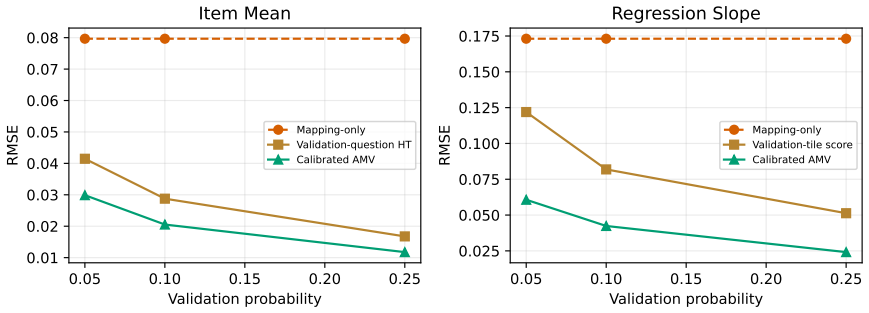
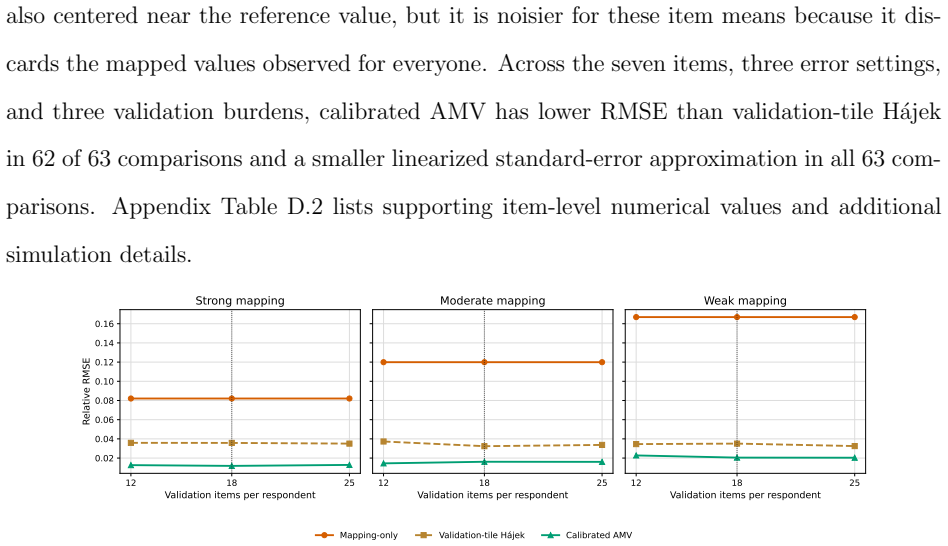
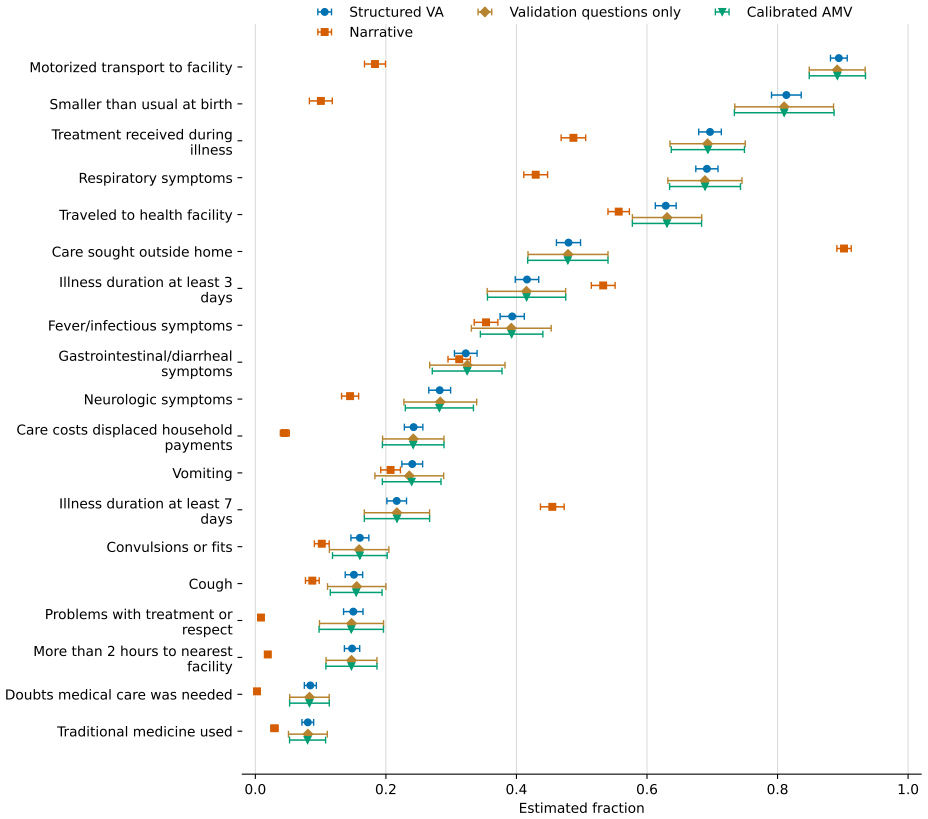
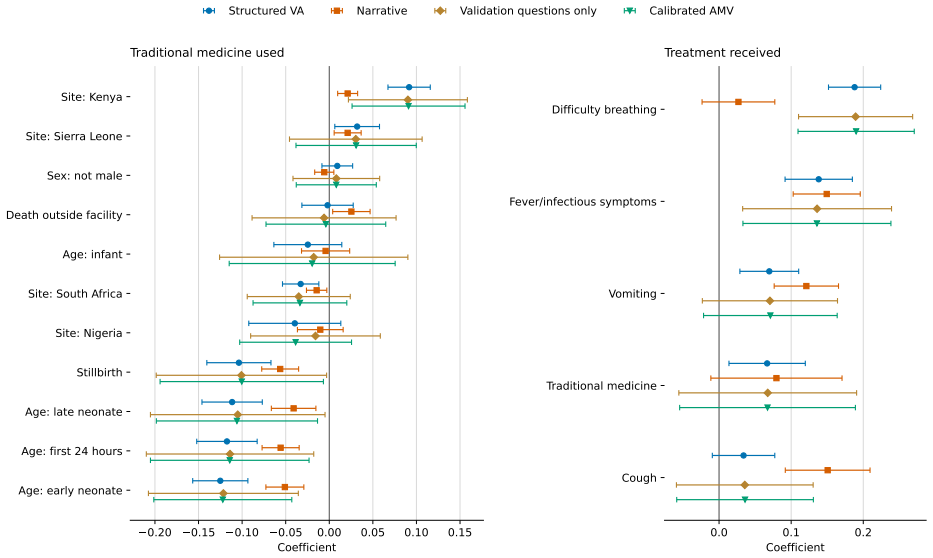
AI-assisted interviews promise to reduce respondent burden in surveys by allowing respondents to describe experiences naturally while an AI system noisily maps those accounts into structured survey variables. That mapping is a measurement process that is fallible, versioned, adaptive, and potentially behaves differently across subgroups. This paper proposes Adaptive Matrix Validation (AMV), a design in which each respondent completes an AI-assisted interview, which is then mapped into tabular data by the AI. Respondents are also asked a small, randomized set of structured questions, which are used for statistical adjustment. The estimator first calibrates the mapped values using validation answers from other respondents, then corrects the remaining error with the validation answers observed for the target respondent. The paper develops estimators for item means, subgroup estimates, and regression coefficients when outcomes, predictors, or both are mapped from interviews. It also gives planning formulas the number of validation questions required and the sample size. A design-calibration simulation, an American Time Use Survey emulation, and a CHAMPS verbal-autopsy narrative study show when sparse validation can improve precision and when it cannot
Editorial analysis
A structured set of objections, weighed in public.
Referee Report
Summary. The paper proposes Adaptive Matrix Validation (AMV) for AI-assisted interviews in which narrative responses are mapped by AI into structured variables; each respondent also answers a small randomized set of structured validation questions. The two-step estimator first calibrates the mapped values using validation answers from other respondents and then corrects remaining error using the target respondent's validations. Estimators are derived for item means, subgroup estimates, and regression coefficients (when outcomes, predictors, or both are AI-mapped), along with planning formulas for the number of validation questions and sample size. Performance is assessed via a design-calibration simulation, an American Time Use Survey emulation, and a CHAMPS verbal-autopsy narrative study.
Significance. If the low-dimensional linear correction assumption holds, AMV could meaningfully reduce respondent burden while preserving design-based inference in surveys that incorporate AI mapping. The provision of planning formulas and the three simulation/emulation studies constitute concrete, falsifiable contributions that allow practitioners to assess when sparse validation improves precision.
major comments (2)
- [Section 4] The two-step estimator's validity rests on the claim that mapping errors are sufficiently exchangeable and low-rank to permit calibration from other respondents followed by per-respondent correction. The design-calibration simulation (Section 4) does not report diagnostics (e.g., effective rank of the error matrix or residual bias after the first step) for cases with respondent-by-item interactions or nonlinear dependence on narrative content; without these, it is unclear whether the calibration step leaves removable bias or merely inflates variance in the second step.
- [Section 5] The planning formulas for the number of validation questions and sample size (Section 5) are presented without explicit finite-population or design-based variance derivations that incorporate the uncertainty from the cross-respondent calibration matrix; the reported precision gains in the ATUS and CHAMPS emulations may therefore be optimistic if the calibration matrix itself is estimated with high variability.
minor comments (2)
- [Section 3] Notation for the mapped variable, validation indicator, and calibration matrix should be introduced with a single consistent table or display equation early in the methods section to aid readability.
- [Introduction] The abstract states that the estimator 'first calibrates... then corrects'; this ordering and the precise role of the randomized validation subset should be restated verbatim in the introduction for emphasis.
Simulated Author's Rebuttal
Thank you for the detailed review. We appreciate the focus on the assumptions underlying the two-step estimator and the planning formulas. Below we respond to each major comment.
read point-by-point responses
-
Referee: [Section 4] The two-step estimator's validity rests on the claim that mapping errors are sufficiently exchangeable and low-rank to permit calibration from other respondents followed by per-respondent correction. The design-calibration simulation (Section 4) does not report diagnostics (e.g., effective rank of the error matrix or residual bias after the first step) for cases with respondent-by-item interactions or nonlinear dependence on narrative content; without these, it is unclear whether the calibration step leaves removable bias or merely inflates variance in the second step.
Authors: We agree that reporting additional diagnostics on the error structure would help readers assess the conditions under which the calibration step is effective. In the revised manuscript, we will include the effective rank of the error matrix and plots of residual bias after the first calibration step for the simulated scenarios, including those with potential interactions. This will clarify whether the remaining error is removable by the second step. revision: yes
-
Referee: [Section 5] The planning formulas for the number of validation questions and sample size (Section 5) are presented without explicit finite-population or design-based variance derivations that incorporate the uncertainty from the cross-respondent calibration matrix; the reported precision gains in the ATUS and CHAMPS emulations may therefore be optimistic if the calibration matrix itself is estimated with high variability.
Authors: The planning formulas in Section 5 are derived under a large-sample approximation where the calibration matrix is treated as fixed, given the use of many other respondents for calibration. However, we acknowledge that incorporating the variability of the estimated calibration matrix would provide a more complete finite-population variance expression. We will add a derivation or bound for this additional variance component in the revised Section 5 and discuss its implications for the reported precision gains in the emulations. revision: yes
Circularity Check
No circularity; estimator is a proposed two-step adjustment with external validation
full rationale
The paper proposes Adaptive Matrix Validation as a statistical procedure that first calibrates AI-mapped values from cross-respondent validation answers and then applies per-respondent corrections. This construction is presented as a design-based estimator whose performance is assessed via simulations and emulations rather than derived from self-referential definitions or fitted quantities renamed as predictions. No load-bearing self-citations, uniqueness theorems, or ansatz smuggling appear in the abstract or described method; the central claim rests on the exchangeability and low-rank assumptions of mapping errors, which are treated as testable modeling choices rather than tautological inputs. The derivation chain therefore remains self-contained against external benchmarks.
Axiom & Free-Parameter Ledger
axioms (1)
- domain assumption AI mapping errors can be corrected by a two-stage procedure that first uses validation answers from other respondents for calibration and then applies the target's own validation answers for individual correction.
Reference graph
Works this paper leans on
-
[1]
and Heeringa, Steven G
Groves, Robert M. and Heeringa, Steven G. , title =. Journal of the Royal Statistical Society: Series A (Statistics in Society) , year =
-
[2]
American Time Use Survey: ATUS 2003--2024 Multi-Year Microdata Files , year =
2003
-
[3]
American Community Survey: Informational Copy , year =
-
[4]
and Frazis, Harley and Stewart, Jay , title =
Hamermesh, Daniel S. and Frazis, Harley and Stewart, Jay , title =. Journal of Economic Perspectives , year =
-
[5]
and Rotnitzky, Andrea and Zhao, Lue Ping , title =
Robins, James M. and Rotnitzky, Andrea and Zhao, Lue Ping , title =. Journal of the American Statistical Association , year =
-
[6]
, title =
Bang, Heejung and Robins, James M. , title =. Biometrics , year =
-
[7]
, title =
Tsiatis, Anastasios A. , title =
-
[8]
Radford, Alec and Kim, Jong Wook and Xu, Tao and Brockman, Greg and McLeavey, Christine and Sutskever, Ilya , title =. arXiv preprint , year =. 2212.04356 , archivePrefix =
-
[9]
Ridoy, Md Sazzadul Islam and Akter, Sumi and Rahman, Md. Aminur , title =. arXiv preprint , year =. 2507.01931 , archivePrefix =
-
[10]
Weighted Cross-entropy for Low-Resource Languages in Multilingual Speech Recognition , journal =
Pi. Weighted Cross-entropy for Low-Resource Languages in Multilingual Speech Recognition , journal =. 2024 , eprint =
2024
-
[11]
de Zuazo, Xabier and Navas, Eva and Saratxaga, Ibon and Rioja, Inma Hern. arXiv preprint , year =. 2503.23542 , archivePrefix =
-
[12]
Rakib, Fazle Rabbi and Dip, Souhardya Saha and Alam, Samiul and Tasnim, Nazia and Shihab, Md. Istiak Hossain and Ansary, Md. Nazmuddoha and Hossen, Syed Mobassir and Meghla, Marsia Haque and Mamun, Mamunur and Sadeque, Farig and Chowdhury, Sayma Sultana and Reasat, Tahsin and Sushmit, Asif and Humayun, Ahmed Imtiaz , title =. arXiv preprint , year =. 2305...
-
[13]
and Jurafsky, Dan and Goel, Sharad , title =
Koenecke, Allison and Nam, Andrew and Lake, Emily and Nudell, Joe and Quartey, Minnie and Mengesha, Zion and Toups, Connor and Rickford, John R. and Jurafsky, Dan and Goel, Sharad , title =. Proceedings of the National Academy of Sciences , year =
-
[14]
Shao, Zeman and Han, Yue and He, Jiangpeng and Mao, Runyu and Wright, Janine and Kerr, Deborah and Boushey, Carol and Zhu, Fengqing , title =. arXiv preprint , year =. 2110.01754 , archivePrefix =
-
[15]
Tahir, Ghalib and Loo, Chu Kiong , title =. arXiv preprint , year =. 2106.11776 , archivePrefix =
-
[16]
2016 , month = apr, url =
Baker, David , title =. 2016 , month = apr, url =
2016
-
[17]
Perspectives on Politics , year =
Fishkin, James and Bolotnyy, Valentin and Lerner, Joshua and Siu, Alice and Bradburn, Norman , title =. Perspectives on Politics , year =
-
[18]
2024 , month = nov, url =
Barari, Soubhik and Slowinski, Zoe and Wang, Natalie and Angbazo, Jarret and Sepulvado, Brandon and Christian, Leah and Dean, Elizabeth , title =. 2024 , month = nov, url =
2024
-
[19]
and Liao, Q
Xiao, Ziang and Zhou, Michelle X. and Liao, Q. Vera and Mark, Gloria and Chi, Changyan and Chen, Wenxi and Yang, Huahai , title =. ACM Transactions on Computer-Human Interaction , year =
-
[20]
Wuttke, Alexander and A. Proceedings of the 9th Joint SIGHUM Workshop on Computational Linguistics for Cultural Heritage, Social Sciences, Humanities and Literature , year =. doi:10.18653/v1/2025.latechclfl-1.17 , url =
-
[21]
and Dean, Elizabeth and Slowinski, Zoe and Sepulvado, Brandon , title =
Barari, Soubhik and Angbazo, Jarret and Wang, Natalie and Christian, Leah M. and Dean, Elizabeth and Slowinski, Zoe and Sepulvado, Brandon , title =. arXiv preprint , year =. doi:10.48550/arXiv.2504.13908 , url =. 2504.13908 , archivePrefix =
-
[22]
Zhang, He and Liu, Yueyan and Guan, Xin and Cai, Jie and Carroll, John M. , title =. arXiv preprint , year =. doi:10.48550/arXiv.2509.12709 , url =. 2509.12709 , archivePrefix =
-
[23]
and Lyberg, Lars , title =
Groves, Robert M. and Lyberg, Lars , title =. Public Opinion Quarterly , year =
-
[24]
, title =
Biemer, Paul P. , title =. Public Opinion Quarterly , year =
-
[25]
Survey methodology , volume=
Optimizing quality of response through adaptive survey designs , author=. Survey methodology , volume=. 2012 , publisher=
2012
-
[26]
Michael and Lohr, Sharon and Li, Jane , title =
Tourangeau, Roger and Brick, J. Michael and Lohr, Sharon and Li, Jane , title =. Journal of the Royal Statistical Society: Series A (Statistics in Society) , year =
-
[27]
Survey Methodology , year =
Schouten, Barry and Cobben, Fannie and Bethlehem, Jelke , title =. Survey Methodology , year =
-
[28]
Journal of Official Statistics , year =
Schouten, Barry and Shlomo, Natalie and Skinner, Chris , title =. Journal of Official Statistics , year =
-
[29]
Public Opinion Quarterly , year =
Wagner, James , title =. Public Opinion Quarterly , year =
-
[30]
and Grizzle, James E
Raghunathan, Trivellore E. and Grizzle, James E. , title =. Journal of the American Statistical Association , year =
-
[31]
, author=
Planned missing data designs in psychological research. , author=. Psychological methods , volume=. 2006 , publisher=
2006
-
[32]
Proceedings of the Section on Survey Research Methods, American Statistical Association , pages=
Multiple matrix sampling: A review , author=. Proceedings of the Section on Survey Research Methods, American Statistical Association , pages=. 2007 , organization=
2007
-
[33]
Survey Methodology , volume=
An evaluation of matrix sampling methods using data from the National Health and Nutrition Examination Survey , author=. Survey Methodology , volume=
-
[34]
and Blom, Annelies G
Axenfeld, Julian B. and Blom, Annelies G. and Bruch, Christian and Wolf, Christof , title =. Journal of Survey Statistics and Methodology , year =
-
[35]
and Cutler, Josh , title =
Montgomery, Jacob M. and Cutler, Josh , title =. Political Analysis , year =
-
[36]
The Annals of Applied Statistics , volume=
Active matrix factorization for surveys , author=. The Annals of Applied Statistics , volume=. 2020 , publisher=
2020
-
[37]
and Wu, Zhenke and Li, Zehang Richard , title =
Yoshida, Toshiya and Fan, Trinity Shuxian and McCormick, Tyler H. and Wu, Zhenke and Li, Zehang Richard , title =. Proceedings of the Conference on Health, Inference, and Learning , series =. 2023 , volume =
2023
-
[38]
2026 , url =
Responsible. 2026 , url =
2026
-
[39]
Halterman, Andrew and Keith, Katherine , title =. Political Analysis , year =. doi:10.1017/pan.2025.10017 , url =
-
[40]
Mellon, Jonathan and Bailey, Jack and Scott, Ralph and Breckwoldt, James and Miori, Marta and Schmedeman, Phillip , journal=. Do. 2024 , publisher=
2024
-
[41]
DiGiuseppe, Matthew R. and Flynn, Michael E. , title =. Public Opinion Quarterly , year =. doi:10.1093/poq/nfag013 , url =
-
[42]
and Conrad, Frederick G
Schober, Michael F. and Conrad, Frederick G. , title =. Public Opinion Quarterly , year =
-
[43]
and Schober, Michael F
Conrad, Frederick G. and Schober, Michael F. , title =. Public Opinion Quarterly , year =
-
[44]
Public Opinion Quarterly , year =
Frisbie, Bruce and Sudman, Seymour , title =. Public Opinion Quarterly , year =
-
[45]
Public Opinion Quarterly , year =
Kreuter, Frauke , title =. Public Opinion Quarterly , year =
-
[46]
Public Opinion Quarterly , year =
Han, Ze and Truex, Rory and Liu, Naijia , title =. Public Opinion Quarterly , year =
-
[47]
, title =
Landesvatter, Camille and Behnert, Jan and Bauer, Paul C. , title =. Public Opinion Quarterly , year =
-
[48]
and Rasinski, Kenneth , title =
Tourangeau, Roger and Rips, Lance J. and Rasinski, Kenneth , title =
-
[49]
, title =
Cochran, William G. , title =
-
[50]
Chen, Y. H. and Chen, H. , title =. Journal of the Royal Statistical Society: Series B (Statistical Methodology) , year =
-
[51]
Recent experiments in statistical sampling in the
Mahalanobis, Prasanta Chandra , journal=. Recent experiments in statistical sampling in the. 1958 , publisher=
1958
-
[52]
Model Assisted Survey Sampling , publisher =
S. Model Assisted Survey Sampling , publisher =
-
[53]
and Bates, Stephen and Fannjiang, Clara and Jordan, Michael I
Angelopoulos, Anastasios N. and Bates, Stephen and Fannjiang, Clara and Jordan, Michael I. and Zrnic, Tijana , title =. Science , year =
-
[54]
Cross-Prediction-Powered Inference , journal =
Zrnic, Tijana and Cand. Cross-Prediction-Powered Inference , journal =. 2024 , volume =
2024
-
[55]
and Leek, Jeffrey T
Wang, Siruo and McCormick, Tyler H. and Leek, Jeffrey T. , title =. Proceedings of the National Academy of Sciences , year =
-
[56]
arXiv preprint arXiv:2512.05456 , year=
Salerno, Stephen and Hoffman, Kentaro and Afiaz, Awan and Neufeld, Anna and McCormick, Tyler H. and Leek, Jeffrey T. , title =. arXiv preprint , year =. doi:10.48550/arXiv.2512.05456 , url =. 2512.05456 , archivePrefix =
-
[57]
Salerno, Stephen and Hoffman, Kentaro and Afiaz, Awan and Neufeld, Anna and McCormick, Tyler H. and Leek, Jeffrey T. , title =. arXiv preprint , year =. doi:10.48550/arXiv.2507.09119 , url =. 2507.09119 , archivePrefix =
-
[58]
Salerno, Stephen and Wu, Zhenke and McCormick, Tyler H. , title =. arXiv preprint , year =. doi:10.48550/arXiv.2603.11368 , url =. 2603.11368 , archivePrefix =
-
[59]
Visokay, A. and Hoffman, K. and Salerno, S. and McCormick, T. H. and Johfre, S. , title =. medRxiv preprint , year =. doi:10.1101/2025.04.01.25325037 , url =
-
[60]
Fan, Shuxian and Visokay, Adam and Hoffman, Kentaro and Salerno, Stephen and Liu, Li and Leek, Jeffrey T. and McCormick, Tyler H. , title =. Proceedings of the Conference on Language Modeling , year =. doi:10.48550/arXiv.2404.02438 , url =. 2404.02438 , archivePrefix =
-
[61]
and Wei, Hanying , title =
Egami, Naoki and Hinck, Musashi and Stewart, Brandon M. and Wei, Hanying , title =. 2023 , eprint =
2023
-
[62]
Clinical Infectious Diseases , volume=
Overview and development of the child health and mortality prevention surveillance determination of cause of death (DeCoDe) process and DeCoDe diagnosis standards , author=. Clinical Infectious Diseases , volume=. 2019 , publisher=
2019
-
[63]
The Lancet Global Health , volume=
Initial findings from a novel population-based child mortality surveillance approach: a descriptive study , author=. The Lancet Global Health , volume=. 2020 , publisher=
2020
-
[64]
The Anthropological Demography of Health , editor =
Surek-Clark, Clarissa , title =. The Anthropological Demography of Health , editor =. 2020 , pages =
2020
-
[65]
American Time Use Survey Data Files: 2003--2024 , year =
2003
-
[66]
Verbal Autopsy Standards: Ascertaining and Attributing Causes of Death Tool , year =
-
[67]
Li, Zehang Richard and Thomas, Jason and Choi, Eungang and McCormick, Tyler H. and Clark, Samuel J. , title =. The R Journal , year =. doi:10.32614/RJ-2023-020 , url =
-
[68]
and Razavi, Farid M
Basner, Mathias and Fomberstein, Kenneth M. and Razavi, Farid M. and Banks, Siobhan and William, Jeffrey H. and Rosa, Roger R. and Dinges, David F. , title =. Sleep , year =
-
[69]
Journal of Economic Perspectives , year =
Guryan, Jonathan and Hurst, Erik and Kearney, Melissa , title =. Journal of Economic Perspectives , year =
-
[70]
and Wang, Wendy , title =
Raley, Sara and Bianchi, Suzanne M. and Wang, Wendy , title =. American Journal of Sociology , year =
-
[71]
and Sayer, Liana C
Pepin, Joanna R. and Sayer, Liana C. and Casper, Lynne M. , title =. Demography , year =
-
[72]
Review of Economics of the Household , year =
Pabilonia, Sabrina Wulff and Vernon, Victoria , title =. Review of Economics of the Household , year =
-
[73]
Journal of Time Use Research , year =
Frazis, Harley , title =. Journal of Time Use Research , year =
-
[74]
, title =
Sturm, Roland and Cohen, Deborah A. , title =. Preventing Chronic Disease , year =
-
[75]
Social Science & Medicine , year =
Colman, Gregory and Dave, Dhaval , title =. Social Science & Medicine , year =
-
[76]
JAMA Network Open , year =
Bassat, Quique and others , title =. JAMA Network Open , year =
-
[77]
Gronsbell, Jessica and Gao, Jianhui and McCaw, Zachary R. and Shi, Yaqi and Cheng, David , title =. arXiv preprint , year =. doi:10.48550/arXiv.2411.19908 , url =. 2411.19908 , archivePrefix =
-
[78]
arXiv preprint arXiv:2508.15162 , year=
Chen, Xingran and McCormick, Tyler H. and Mukherjee, Bhramar and Wu, Zhenke , title =. arXiv preprint , year =. doi:10.48550/arXiv.2508.15162 , url =. 2508.15162 , archivePrefix =
-
[79]
Bose, Chameli , title =. Sankhy. 1943 , volume =
1943
discussion (0)
Sign in with ORCID, Apple, or X to comment. Anyone can read and Pith papers without signing in.