Contrastive self-supervised convolutional autoencoder for core-collapse supernova gravitational-wave detection
Pith reviewed 2026-05-21 03:30 UTC · model grok-4.3
The pith
A contrastive self-supervised convolutional autoencoder detects core-collapse supernova gravitational waves comparably to supervised networks while generalizing better to unseen signals.
A machine-rendered reading of the paper's core claim, the machinery that carries it, and where it could break.
Core claim
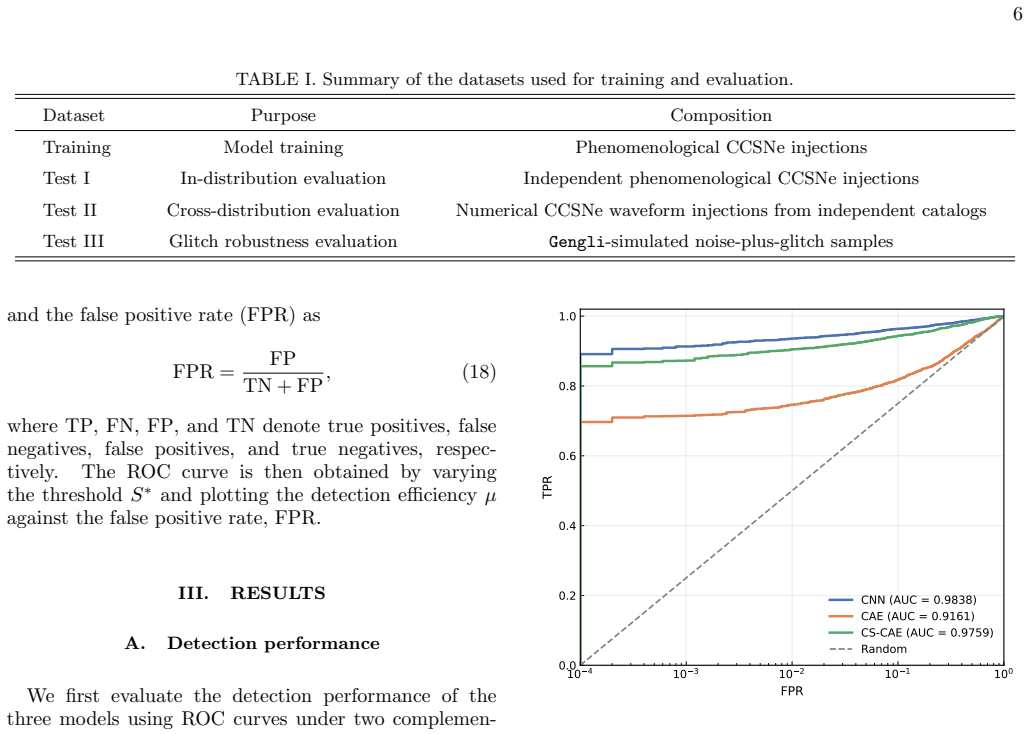
The central claim is that the contrastive self-supervised convolutional autoencoder (CS-CAE), built from a convolutional autoencoder plus a noise-centered latent regularizer and projection head trained with a contrastive objective, achieves CCSNe gravitational-wave detection performance comparable to a supervised convolutional neural network, clearly outperforms a conventional CAE baseline, generalizes better to unseen numerical CCSNe waveform families, and attains an effective sensitive distance of approximately 120 kpc under the Einstein Telescope detector configuration while improving separation from noise and glitches.
What carries the argument
The contrastive objective applied to a convolutional autoencoder with noise-centered latent regularizer and projection head, which pulls latent representations of independent noisy realizations of the same CCSNe signal closer together.
If this is right
- CS-CAE achieves performance comparable to a supervised convolutional neural network for CCSNe gravitational-wave detection.
- It clearly outperforms a conventional CAE baseline.
- The method generalizes better to unseen numerical CCSNe waveform families.
- Under the Einstein Telescope configuration it reaches an effective sensitive distance of approximately 120 kpc.
- It improves separation of CCSNe signals from stationary noise and transient glitches in the low-false-alarm regime.
Where Pith is reading between the lines
- The same contrastive training strategy could be adapted for searches of other stochastic or burst-like gravitational-wave sources that lack precise templates.
- Deployment on real detector data might reveal robustness gains against non-stationary noise features absent from the training simulations.
- Combining the latent representations with coincidence requirements across multiple detectors could aid in localizing CCSNe events.
- The noise-centered regularizer might transfer to other autoencoder-based anomaly detection tasks in gravitational-wave data analysis.
Load-bearing premise
The contrastive objective successfully maps independent noisy realizations of the same CCSNe signal to nearby latent representations without discarding signal features or introducing systematic biases that would degrade detection on real data.
What would settle it
A test in which the CS-CAE shows markedly lower detection efficiency on real LIGO or Virgo strain data containing candidate CCSNe signals, or a large performance drop on a fresh set of numerical CCSNe waveforms withheld from all training and validation.
Figures



read the original abstract
Gravitational-wave astronomy has opened a direct observational window onto compact-object dynamics, strong-field gravity, and cosmology. Among the transient sources accessible through this window, core-collapse supernovae (CCSNe) are uniquely valuable because their signals can probe the engine of stellar collapse, proto-neutron-star dynamics, and explosion asymmetries, yet their weak, stochastic, and model-dependent waveforms remain difficult to detect. In this work, we develop a contrastive self-supervised convolutional autoencoder (CS-CAE) for CCSNe gravitational-wave signal detection. The method combines a convolutional autoencoder (CAE), a noise-centered latent regularizer, and a projection head trained with a contrastive objective. This design encourages independent noisy realizations of the same CCSNe signal to be mapped to nearby latent representations, thereby reducing the influence of random noise fluctuations. CS-CAE achieves performance comparable to a supervised convolutional neural network while clearly outperforming a conventional CAE baseline, and generalizes better to unseen numerical CCSNe waveform families. Under the Einstein Telescope (ET) detector configuration, the method achieves an effective sensitive distance of approximately 120 kpc and shows improved separation of CCSNe signals from stationary noise and transient glitches in the low-false-alarm regime. These results highlight the potential of CS-CAE as a robust and less template-dependent framework for CCSNe gravitational-wave searches.
Editorial analysis
A structured set of objections, weighed in public.
Referee Report
Summary. The paper introduces a contrastive self-supervised convolutional autoencoder (CS-CAE) for detecting gravitational waves from core-collapse supernovae. It integrates a convolutional autoencoder with a noise-centered latent regularizer and a projection head trained via a contrastive objective to map independent noisy realizations of the same CCSNe signal to nearby latent representations. The central claims are that CS-CAE achieves performance comparable to a supervised convolutional neural network, clearly outperforms a conventional CAE baseline, generalizes better to unseen numerical CCSNe waveform families, reaches an effective sensitive distance of approximately 120 kpc under the Einstein Telescope configuration, and improves separation of signals from stationary noise and transient glitches in the low-false-alarm regime.
Significance. If the performance and generalization claims hold after proper controls, the work would provide a useful self-supervised framework for CCSNe GW detection that reduces template dependence and handles noise more robustly than standard autoencoders. This is relevant for stochastic, broadband signals where supervised methods may overfit to specific waveform families. The approach of combining reconstruction with contrastive invariance is a reasonable direction for the field.
major comments (2)
- [Abstract] Abstract: The reported performance metrics (comparability to supervised CNN, outperformance of CAE baseline, ~120 kpc sensitive distance, improved generalization and glitch separation) are presented without any information on training data volume, hyperparameter choices, statistical significance of improvements, or error analysis. These omissions make the central empirical claims impossible to assess for robustness.
- [Abstract] Abstract (description of contrastive objective and noise-centered latent regularizer): No diagnostic results are provided to test whether the contrastive pull preserves low-SNR stochastic features (e.g., prompt convection or SASI) rather than treating them as noise to be suppressed. Without latent-space distance histograms, saliency maps, or ablation of the contrastive term on reconstruction fidelity, the risk that the regularizer erases model-dependent signal structure remains unaddressed.
minor comments (1)
- [Abstract] The phrase 'effective sensitive distance' is used without a brief definition or reference to its standard calculation in the GW literature.
Simulated Author's Rebuttal
We thank the referee for their constructive and detailed feedback. We appreciate the opportunity to clarify and strengthen the presentation of our results. We address each major comment below and have incorporated revisions to improve transparency and provide supporting diagnostics.
read point-by-point responses
-
Referee: [Abstract] Abstract: The reported performance metrics (comparability to supervised CNN, outperformance of CAE baseline, ~120 kpc sensitive distance, improved generalization and glitch separation) are presented without any information on training data volume, hyperparameter choices, statistical significance of improvements, or error analysis. These omissions make the central empirical claims impossible to assess for robustness.
Authors: We agree that the abstract would benefit from additional context to allow readers to assess the robustness of the claims more readily. Comprehensive details on training data volume, hyperparameter selection procedures, and statistical significance (derived from multiple independent runs with error estimates) are already provided in Sections 3 and 4 of the manuscript. To directly address this point, we have revised the abstract to include a brief reference to the scale of the training dataset and the statistical validation approach used. This change improves accessibility without altering the core claims. revision: yes
-
Referee: [Abstract] Abstract (description of contrastive objective and noise-centered latent regularizer): No diagnostic results are provided to test whether the contrastive pull preserves low-SNR stochastic features (e.g., prompt convection or SASI) rather than treating them as noise to be suppressed. Without latent-space distance histograms, saliency maps, or ablation of the contrastive term on reconstruction fidelity, the risk that the regularizer erases model-dependent signal structure remains unaddressed.
Authors: We acknowledge this valid concern about potential unintended suppression of signal features by the contrastive objective. While the original manuscript emphasized end-to-end detection performance, we recognize the value of explicit diagnostics for the latent regularizer. In the revised manuscript, we have added latent-space distance histograms comparing positive (same-signal) and negative pairs across SNR regimes, an ablation study quantifying the contrastive term's effect on reconstruction fidelity for low-SNR stochastic features, and saliency maps for representative waveforms. These additions confirm preservation of features such as SASI and prompt convection while improving noise robustness. revision: yes
Circularity Check
No significant circularity; performance claims rest on external simulations and held-out evaluation
full rationale
The paper describes a CS-CAE architecture combining a convolutional autoencoder with a noise-centered latent regularizer and contrastive projection head, trained on external simulated CCSNe waveforms. Performance metrics including effective sensitive distance (~120 kpc under ET) and improved generalization to unseen waveform families are reported from evaluation on held-out test sets drawn from the same external simulation library, not from quantities defined by the model's own fitted parameters or self-referential equations. No load-bearing step reduces a claimed prediction to a fitted input by construction, and no self-citation chain is invoked to justify uniqueness or the contrastive objective itself. The derivation is therefore self-contained against external benchmarks.
Axiom & Free-Parameter Ledger
Lean theorems connected to this paper
-
IndisputableMonolith/Cost/FunctionalEquation.leanwashburn_uniqueness_aczel unclear?
unclearRelation between the paper passage and the cited Recognition theorem.
The method combines a convolutional autoencoder (CAE), a noise-centered latent regularizer, and a projection head trained with a contrastive objective... L = λ_rec L_rec + λ_cen L_cen + λ_con L_con
-
IndisputableMonolith/Foundation/RealityFromDistinction.leanreality_from_one_distinction unclear?
unclearRelation between the paper passage and the cited Recognition theorem.
CS-CAE achieves performance comparable to a supervised convolutional neural network while clearly outperforming a conventional CAE baseline, and generalizes better to unseen numerical CCSNe waveform families.
What do these tags mean?
- matches
- The paper's claim is directly supported by a theorem in the formal canon.
- supports
- The theorem supports part of the paper's argument, but the paper may add assumptions or extra steps.
- extends
- The paper goes beyond the formal theorem; the theorem is a base layer rather than the whole result.
- uses
- The paper appears to rely on the theorem as machinery.
- contradicts
- The paper's claim conflicts with a theorem or certificate in the canon.
- unclear
- Pith found a possible connection, but the passage is too broad, indirect, or ambiguous to say the theorem truly supports the claim.
Reference graph
Works this paper leans on
-
[1]
Convolutional neural network baseline The first baseline is a conventional supervised CNN classifier, shown in Fig. 1(A). The input is a three- channel whitened time seriesx∈R 3×N, and the network outputs two logits for the noise and signal classes. The convolutional backbone consists of four one-dimensional convolutional blocks with channel widths 32, 64...
-
[2]
Convolutional autoencoder baseline The second baseline is a reconstruction-based CAE, shown in Fig. 1(B). Its encoder uses the same four convo- lutional channel widths, kernel sizes, strides, and padding values as the CNN backbone, but does not include the max-pooling layers used in the supervised CNN classifier. After adaptive average pooling, a linear e...
-
[3]
Contrastive self-supervised convolutional autoencoder The proposed CS-CAE, shown in Fig. 1(C), uses the same encoder–decoder structure as the CAE baseline and further adds a projection head for contrastive learning. The projection head is a two-layer multilayer perceptron consisting of a linear layer from 128 to 128 dimensions, a ReLU activation, and a fi...
-
[4]
The training/validation split is 80%/20%. The detection performance is primarily evaluated using the receiver operating characteristic (ROC) curve and the corresponding area under the curve (AUC). For each model, a scalar detection statistic is assigned to every input sample. For the supervised CNN, this statistic is the signal probability, while for the ...
work page 2025
-
[5]
B. P. Abbottet al.(LIGO Scientific, Virgo), Phys. Rev. Lett.116, 061102 (2016), arXiv:1602.03837 [gr-qc]
work page internal anchor Pith review Pith/arXiv arXiv 2016
-
[6]
B. P. Abbottet al.(LIGO Scientific, Virgo), Phys. Rev. Lett.116, 221101 (2016), [Erratum: Phys.Rev.Lett. 11 121, 129902 (2018)], arXiv:1602.03841 [gr-qc]
work page internal anchor Pith review Pith/arXiv arXiv 2016
-
[7]
J. M. Ezquiaga and M. Zumalac´ arregui, Phys. Rev. Lett.119, 251304 (2017), arXiv:1710.05901 [astro- ph.CO]
work page internal anchor Pith review Pith/arXiv arXiv 2017
-
[8]
B. P. Abbottet al.(LIGO Scientific, Virgo), Phys. Rev. D100, 104036 (2019), arXiv:1903.04467 [gr-qc]
work page internal anchor Pith review Pith/arXiv arXiv 2019
- [9]
-
[10]
Tests of General Relativity with GWTC-3
R. Abbottet al.(LIGO Scientific, VIRGO, KAGRA), Phys. Rev. D112, 084080 (2025), arXiv:2112.06861 [gr- qc]
work page internal anchor Pith review Pith/arXiv arXiv 2025
-
[11]
B. P. Abbottet al.(LIGO Scientific, Virgo, 1M2H, Dark Energy Camera GW-E, DES, DLT40, Las Cumbres Observatory, VINROUGE, MASTER), Nature551, 85 (2017), arXiv:1710.05835 [astro-ph.CO]
work page internal anchor Pith review Pith/arXiv arXiv 2017
-
[12]
M. Soares-Santoset al.(DES, LIGO Scientific, Virgo), Astrophys. J. Lett.876, L7 (2019), arXiv:1901.01540 [astro-ph.CO]
work page internal anchor Pith review Pith/arXiv arXiv 2019
-
[13]
The population of merging compact binaries inferred using gravitational waves through GWTC-3
R. Abbottet al.(KAGRA, VIRGO, LIGO Scientific), Phys. Rev. X13, 011048 (2023), arXiv:2111.03634 [astro-ph.HE]
work page internal anchor Pith review Pith/arXiv arXiv 2023
-
[14]
D. E. Holz and S. A. Hughes, Astrophys. J.629, 15 (2005), arXiv:astro-ph/0504616
work page internal anchor Pith review Pith/arXiv arXiv 2005
-
[15]
S. R. Taylor and J. R. Gair, Phys. Rev. D86, 023502 (2012), arXiv:1204.6739 [astro-ph.CO]
work page internal anchor Pith review Pith/arXiv arXiv 2012
-
[16]
H.-Y. Chen, M. Fishbach, and D. E. Holz, Nature562, 545 (2018), arXiv:1712.06531 [astro-ph.CO]
work page internal anchor Pith review Pith/arXiv arXiv 2018
-
[17]
L.-F. Wang, Z.-W. Zhao, J.-F. Zhang, and X. Zhang, JCAP11, 012 (2020), arXiv:1907.01838 [astro-ph.CO]
-
[18]
R. Grayet al., Phys. Rev. D101, 122001 (2020), arXiv:1908.06050 [gr-qc]
- [19]
-
[20]
Yang, JCAP05, 044 (2021), arXiv:2103.01923 [astro- ph.CO]
T. Yang, JCAP05, 044 (2021), arXiv:2103.01923 [astro- ph.CO]
- [21]
- [22]
- [23]
-
[24]
J.-Y. Song, L.-F. Wang, Y. Li, Z.-W. Zhao, J.-F. Zhang, W. Zhao, and X. Zhang, Sci. China Phys. Mech. Astron. 67, 230411 (2024), arXiv:2212.00531 [astro-ph.CO]
- [25]
-
[26]
Grayet al., JCAP12, 023 (2023), arXiv:2308.02281 [astro-ph.CO]
R. Grayet al., JCAP12, 023 (2023), arXiv:2308.02281 [astro-ph.CO]
- [27]
- [28]
-
[29]
Possible theoretical limits on holographic quintessence from weak gravity conjecture
Y.-Z. Ma and X. Zhang, Phys. Lett. B661, 239 (2008), arXiv:0709.1517 [astro-ph]
work page internal anchor Pith review Pith/arXiv arXiv 2008
-
[30]
Five-Year Wilkinson Microwave Anisotropy Probe (WMAP) Observations: Cosmological Interpretation
E. Komatsuet al.(WMAP), Astrophys. J. Suppl.180, 330 (2009), arXiv:0803.0547 [astro-ph]
work page internal anchor Pith review Pith/arXiv arXiv 2009
-
[31]
J.-L. Cui, L. Zhang, J.-F. Zhang, and X. Zhang, Chin. Phys. B19, 019802 (2010), arXiv:0902.0716 [astro- ph.CO]
work page internal anchor Pith review Pith/arXiv arXiv 2010
-
[32]
Holographic Ricci dark energy: Interacting model and cosmological constraints
T.-F. Fu, J.-F. Zhang, J.-Q. Chen, and X. Zhang, Eur. Phys. J. C72, 1932 (2012), arXiv:1112.2350 [astro- ph.CO]
work page internal anchor Pith review Pith/arXiv arXiv 1932
-
[33]
J. Lesgourgues and S. Pastor, Adv. High Energy Phys. 2012, 608515 (2012), arXiv:1212.6154 [hep-ph]
work page internal anchor Pith review Pith/arXiv arXiv 2012
-
[34]
$\nu\Lambda$CDM: Neutrinos help reconcile Planck with the Local Universe
M. Wyman, D. H. Rudd, R. A. Vanderveld, and W. Hu, Phys. Rev. Lett.112, 051302 (2014), arXiv:1307.7715 [astro-ph.CO]
work page internal anchor Pith review Pith/arXiv arXiv 2014
-
[35]
J.-F. Zhang, J.-J. Geng, and X. Zhang, JCAP10, 044 (2014), arXiv:1408.0481 [astro-ph.CO]
work page internal anchor Pith review Pith/arXiv arXiv 2014
-
[36]
J. Lesgourgues and S. Pastor, New J. Phys.16, 065002 (2014), arXiv:1404.1740 [hep-ph]
work page internal anchor Pith review Pith/arXiv arXiv 2014
-
[37]
P. A. R. Adeet al.(Planck), Astron. Astrophys.594, A13 (2016), arXiv:1502.01589 [astro-ph.CO]
work page internal anchor Pith review Pith/arXiv arXiv 2016
-
[38]
A search for sterile neutrinos with the latest cosmological observations
L. Feng, J.-F. Zhang, and X. Zhang, Eur. Phys. J. C 77, 418 (2017), arXiv:1703.04884 [astro-ph.CO]
work page internal anchor Pith review Pith/arXiv arXiv 2017
-
[39]
Unveiling $\nu$ secrets with cosmological data: neutrino masses and mass hierarchy
S. Vagnozzi, E. Giusarma, O. Mena, K. Freese, M. Gerbino, S. Ho, and M. Lattanzi, Phys. Rev. D 96, 123503 (2017), arXiv:1701.08172 [astro-ph.CO]
work page internal anchor Pith review Pith/arXiv arXiv 2017
-
[40]
Search for sterile neutrinos in a universe of vacuum energy interacting with cold dark matter
L. Feng, J.-F. Zhang, and X. Zhang, Phys. Dark Univ. 23, 100261 (2019), arXiv:1712.03148 [astro-ph.CO]
work page internal anchor Pith review Pith/arXiv arXiv 2019
-
[41]
Planck 2018 results. VI. Cosmological parameters
N. Aghanimet al.(Planck), Astron. Astrophys.641, A6 (2020), [Erratum: Astron.Astrophys. 652, C4 (2021)], arXiv:1807.06209 [astro-ph.CO]
work page internal anchor Pith review Pith/arXiv arXiv 2020
-
[42]
R.-Y. Guo, J.-F. Zhang, and X. Zhang, Chin. Phys. C 42, 095103 (2018), arXiv:1803.06910 [astro-ph.CO]
work page internal anchor Pith review Pith/arXiv arXiv 2018
-
[43]
S. Vagnozzi, S. Dhawan, M. Gerbino, K. Freese, A. Goo- bar, and O. Mena, Phys. Rev. D98, 083501 (2018), arXiv:1801.08553 [astro-ph.CO]
work page internal anchor Pith review Pith/arXiv arXiv 2018
- [44]
-
[45]
L. Feng, D.-Z. He, H.-L. Li, J.-F. Zhang, and X. Zhang, Sci. China Phys. Mech. Astron.63, 290404 (2020), arXiv:1910.03872 [astro-ph.CO]
- [46]
-
[47]
Z.-W. Zhao, Z.-X. Li, J.-Z. Qi, H. Gao, J.-F. Zhang, and X. Zhang, Astrophys. J.903, 83 (2020), arXiv:2006.01450 [astro-ph.CO]
-
[48]
L.-F. Wang, J.-H. Zhang, D.-Z. He, J.-F. Zhang, and X. Zhang, Mon. Not. Roy. Astron. Soc.514, 1433 (2022), arXiv:2102.09331 [astro-ph.CO]
- [49]
- [50]
-
[51]
A. G. Adameet al.(DESI), JCAP02, 021 (2025), arXiv:2404.03002 [astro-ph.CO]
work page internal anchor Pith review Pith/arXiv arXiv 2025
- [52]
-
[53]
DESI DR2 Results II: Measurements of Baryon Acoustic Oscillations and Cosmological Constraints
M. Abdul Karimet al.(DESI), Phys. Rev. D112, 083515 (2025), arXiv:2503.14738 [astro-ph.CO]
work page internal anchor Pith review Pith/arXiv arXiv 2025
- [54]
-
[55]
J. Aasiet al.(LIGO Scientific), Class. Quant. Grav.32, 074001 (2015), arXiv:1411.4547 [gr-qc]. 12
work page internal anchor Pith review Pith/arXiv arXiv 2015
-
[56]
Advanced Virgo: a 2nd generation interferometric gravitational wave detector
F. Acerneseet al.(VIRGO), Class. Quant. Grav.32, 024001 (2015), arXiv:1408.3978 [gr-qc]
work page internal anchor Pith review Pith/arXiv arXiv 2015
-
[57]
Akutsuet al.(KAGRA), PTEP2021, 05A101 (2021), arXiv:2005.05574 [physics.ins-det]
T. Akutsuet al.(KAGRA), PTEP2021, 05A101 (2021), arXiv:2005.05574 [physics.ins-det]
-
[58]
A. G. Abacet al.(LIGO Scientific, VIRGO, KAGRA), (2025), arXiv:2508.18082 [gr-qc]
work page internal anchor Pith review Pith/arXiv arXiv 2025
-
[59]
Punturoet al., Classical and Quantum Gravity27, 194002 (2010)
M. Punturoet al., Classical and Quantum Gravity27, 194002 (2010)
work page 2010
-
[60]
Sensitivity Studies for Third-Generation Gravitational Wave Observatories
S. Hildet al., Class. Quant. Grav.28, 094013 (2011), arXiv:1012.0908 [gr-qc]
work page internal anchor Pith review Pith/arXiv arXiv 2011
-
[61]
Cosmic Explorer: The U.S. Contribution to Gravitational-Wave Astronomy beyond LIGO
D. Reitzeet al., Bull. Am. Astron. Soc.51, 035 (2019), arXiv:1907.04833 [astro-ph.IM]
work page internal anchor Pith review Pith/arXiv arXiv 2019
-
[62]
A Horizon Study for Cosmic Explorer: Science, Observatories, and Community
M. Evanset al., (2021), arXiv:2109.09882 [astro-ph.IM]
work page internal anchor Pith review Pith/arXiv arXiv 2021
-
[63]
V. Srivastava, S. Ballmer, D. A. Brown, C. Afle, A. Bur- rows, D. Radice, and D. Vartanyan, Phys. Rev. D100, 043026 (2019), arXiv:1906.00084 [gr-qc]
-
[64]
The Science of the Einstein Telescope
A. Abacet al.(ET), JCAP03, 081 (2026), arXiv:2503.12263 [gr-qc]
work page internal anchor Pith review Pith/arXiv arXiv 2026
-
[65]
Dragoet al., (2020), 10.1016/j.softx.2021.100678, arXiv:2006.12604 [gr-qc]
M. Dragoet al., (2020), 10.1016/j.softx.2021.100678, arXiv:2006.12604 [gr-qc]
-
[66]
Abbottet al.(KAGRA, VIRGO, LIGO Scientific), Phys
R. Abbottet al.(KAGRA, VIRGO, LIGO Scientific), Phys. Rev. D104, 122004 (2021), arXiv:2107.03701 [gr- qc]
- [67]
-
[68]
S. E. Gossan, P. Sutton, A. Stuver, M. Zanolin, K. Gill, and C. D. Ott, Phys. Rev. D93, 042002 (2016), arXiv:1511.02836 [astro-ph.HE]
work page internal anchor Pith review Pith/arXiv arXiv 2016
- [69]
- [70]
-
[71]
E. Abdikamalov, G. Pagliaroli, and D. Radice, (2020), arXiv:2010.04356 [astro-ph.SR]
-
[72]
D. Vartanyan, A. Burrows, T. Wang, M. S. B. Coleman, and C. J. White, Phys. Rev. D107, 103015 (2023), arXiv:2302.07092 [astro-ph.HE]
-
[73]
Inferring Core-Collapse Supernova Physics with Gravitational Waves
J. Logue, C. D. Ott, I. S. Heng, P. Kalmus, and J. H. C. Scargill, Phys. Rev. D86, 044023 (2012), arXiv:1202.3256 [gr-qc]
work page internal anchor Pith review Pith/arXiv arXiv 2012
-
[74]
J. Powell and B. M¨ uller, Class. Quant. Grav.42, 215002 (2025), arXiv:2506.03581 [astro-ph.HE]
-
[75]
W. G. Anderson, P. R. Brady, J. D. E. Creighton, and E. E. Flanagan, Phys. Rev. D63, 042003 (2001), arXiv:gr-qc/0008066
work page internal anchor Pith review Pith/arXiv arXiv 2001
-
[76]
Coherent method for detection of gravitational wave bursts
S. Klimenko, I. Yakushin, A. Mercer, and G. Mit- selmakher, Class. Quant. Grav.25, 114029 (2008), arXiv:0802.3232 [gr-qc]
work page internal anchor Pith review Pith/arXiv arXiv 2008
-
[77]
P. J. Suttonet al., New J. Phys.12, 053034 (2010), arXiv:0908.3665 [gr-qc]
work page internal anchor Pith review Pith/arXiv arXiv 2010
-
[78]
I. S. Heng, Class. Quant. Grav.26, 105005 (2009), arXiv:0810.5707 [gr-qc]
work page internal anchor Pith review Pith/arXiv arXiv 2009
-
[79]
C. Rover, M.-A. Bizouard, N. Christensen, H. Dim- melmeier, I. S. Heng, and R. Meyer, Phys. Rev. D80, 102004 (2009), arXiv:0909.1093 [gr-qc]
work page internal anchor Pith review Pith/arXiv arXiv 2009
-
[80]
E. Thrane and M. Coughlin, Phys. Rev. D88, 083010 (2013), arXiv:1308.5292 [astro-ph.IM]
work page internal anchor Pith review Pith/arXiv arXiv 2013
discussion (0)
Sign in with ORCID, Apple, or X to comment. Anyone can read and Pith papers without signing in.