Pulsational mass loss from supermassive stars creates the compact shells of Little Red Dots
Pith reviewed 2026-07-05 06:24 UTC · model glm-5.2
The pith
Dying supermassive stars eject compact shells that match Little Red Dots
A machine-rendered reading of the paper's core claim, the machinery that carries it, and where it could break.
Core claim
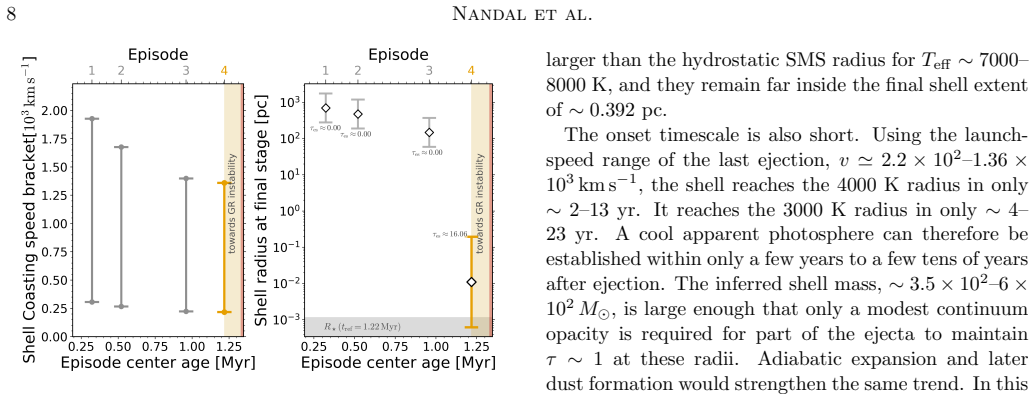
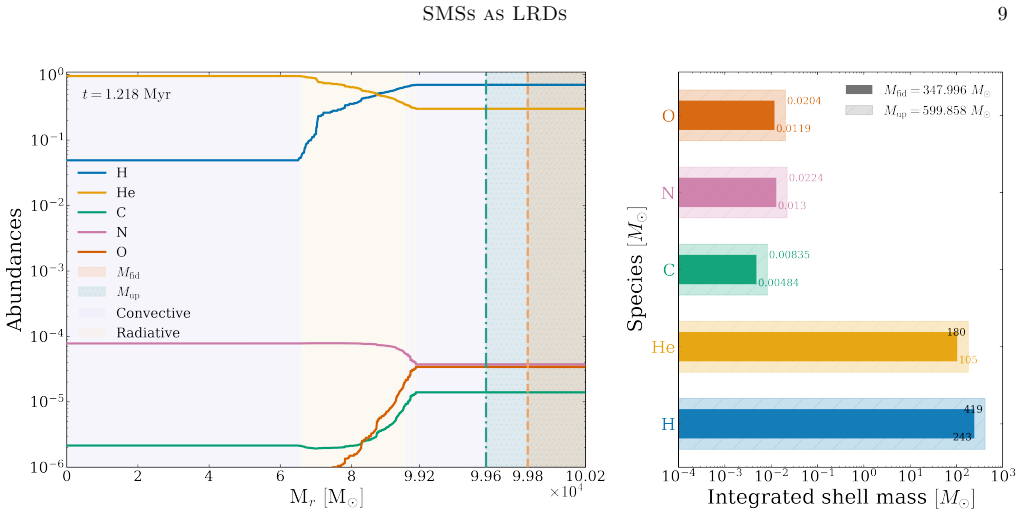
The central object is the final pre-collapse strange-mode ejection episode from a supermassive star. The paper shows that this single event, occurring just before the star collapses via general-relativistic instability, produces a shell that is simultaneously compact (≤0.4 pc), optically thick (τ_geo ≈ 8), massive (~348 solar masses in the fiducial case), and chemically distinctive (nitrogen-rich with log(N/O) ≈ 0.13). Earlier ejection episodes expand to tens or hundreds of parsecs and become optically irrelevant by the time of collapse. Only the last episode matters for the circumstellar environment at the observable LRD phase. The mechanism is strange-mode pulsation — an instability of the
What carries the argument
Strange-mode pulsations are envelope-confined radial oscillations that arise in stars with very high luminosity-to-mass ratio and short thermal timescales in their outer layers, where radiation pressure and rapid radiative diffusion alter the usual phase relation between pressure and density. In supermassive stars, these pulsations grow exponentially and can couple enough energy to the weakly bound outer envelope to eject material in discrete bursts rather than steady winds.
If this is right
- If the final shell is indeed the source of LRD continua, then LRDs should show nitrogen-enhanced abundance patterns (log(N/O) > 0) and blueshifted multi-component absorption lines from shell gas moving at 100–1000 km/s — both directly testable with JWST spectroscopy.
- The compact shell's fallback timescale (~13,000 years for marginally bound material) could feed the newly formed black hole, potentially linking the SMS-collapse LRD phase to a longer-lived accreting black hole phase embedded in dense gas.
- The prediction that the apparent continuum temperature (3000–4000 K) is set by shell reprocessing rather than the stellar photosphere implies that LRDs should lack strong TiO molecular bands that a true 3000–4000 K star would show — a discriminant against alternative cool-photosphere models.
- If pulsational shell ejection is generic across metallicity, then the fraction of SMS-collapse events observable as LRDs may depend on metallicity through its effect on shell compactness and chemistry rather than on whether shells form at all.
Where Pith is reading between the lines
- The non-monotonic metallicity dependence of ejecta mass and episode count suggests that the LRD population could have a redshift-dependent luminosity function shaped by the metallicity distribution of SMS-forming halos, not just by their abundance.
- If the final shell forms only years to decades before collapse, the observable LRD lifetime is set by the shell expansion and fallback timescale (~10^3–10^4 yr), which is short enough that the LRD population density constrains the SMS collapse rate directly.
- The distinction between earlier diffuse shells and the final compact shell implies that some SMS collapse sites could show nested circumstellar structures — an old extended relic plus a young compact shell — potentially detectable in deep imaging or in absorption-line systems along sightlines to the source.
- The coupling efficiency parameter that converts pulsation energy to ejected mass is the single largest source of uncertainty; if real nonlinear radiation hydrodynamics couples more efficiently than the quasi-nonadiabatic estimate, the shell could be more massive and longer-lived, strengthening the LRD interpretation, or if less efficiently, the channel could fail for some metallicities.
Load-bearing premise
The paper does not solve the full nonlinear radiation hydrodynamics of how pulsations actually unbind envelope material. Instead, it takes adiabatic pulsation eigenfunctions, evaluates approximate driving and damping on them, and then maps the resulting growth rate to a mass-loss rate through a coupling efficiency parameter with branch-dependent ceilings and a tunable efficiency factor. The authors explicitly state this mapping should be read as a structured estimate, not a唯一
What would settle it
If LRD spectra systematically show strong TiO molecular bands (expected from a true 3000–4000 K photosphere but not from a hot star seen through a dense shell), or if their circumstellar gas shows N/O ratios inconsistent with the predicted nitrogen-rich signature, the pulsational-shell origin would be disfavored.
Figures



read the original abstract
Little Red Dots (LRDs) have emerged as one of the central puzzles of the JWST era. Their spectra increasingly require dense gas close to the source, yet the physical origin of that cocoon-like structure remains unclear. We examine whether late pulsational mass loss from supermassive stars (SMS)leads to dense gas cocoons. We analyze five accreting GENEC models at different metallicities with characteristic masses of order $10^5\,M_\odot$, following them through post-accretion evolution with radial pulsation calculations and general relativistic (GR) stability diagnostics. Mass loss during the final stages of evolution occurs not as a steady wind, but through discrete strange-mode ejection episodes. In the $Z=10^{-2}\,Z_\odot$ model, which provides the clearest LRD analogue, four late episodes last $41$--$282$ yr and eject $10$--$348\,M_\odot$ each, for a total loss of $(4.8-10)\times10^2\,M_\odot$; the final episode alone contributes $\simeq 73\%$ of that budget. Since the last episode dominates the mass-loss, it is the only event sufficiently massive enough to leave behind a compact, optically thick shell extending out to 0.4 pc that reproduces the LRD dense gas cocoon. The final ejecta are H/He dominated but chemically distinctive, with a robust nitrogen-rich composition, $\log(\mathrm{N/O})\simeq0.13$ and $\log(\mathrm{C/O})\simeq-0.23$. The SMS reaches GR instability at an age of $\sim 1$ Myr and collapses in $\sim10^4$ s, retaining $\sim 99\%$ all of its mass. Across the full metallicity range from Pop III to $10^{-2}\,Z_\odot$, this shell-ejection channel persists. Pulsational mass-loss from SMSs therefore provides a physically motivated origin for the compact cocoon-like structure implied by LRDs, while remaining the natural progenitors of the massive black hole seeds invoked in direct collapse scenario.
Editorial analysis
A structured set of objections, weighed in public.
Referee Report
Summary. This Letter proposes that late strange-mode pulsations from supermassive stars (SMSs) produce discrete mass-loss episodes whose final pre-collapse event leaves a compact ($R_{out} leq 0.4$ pc), optically thick ($tau_{geo} simeq 8$), nitrogen-rich shell that reproduces the dense circumstellar gas environment implied by Little Red Dots (LRDs), while the SMS collapses via GR instability into a $sim 10^5 M_odot$ black hole seed. The analysis combines GENEC stellar evolution models at five metallicities, linear adiabatic radial pulsation calculations (Newtonian and GR), a quasi-nonadiabatic driving/damping evaluation, an energy-limited mass-loss prescription with branch-dependent parameters, ballistic shell propagation, and a 1D GR hydrodynamics collapse follow-up. The GR stability and collapse calculations are cross-checked against three independent criteria (Saio et al. 2024; Haemmerle 2021; Nagele et al. 2022).
Significance. The paper addresses a timely and important question: the physical origin of the compact dense gas cocoons inferred around Little Red Dots. The scenario is physically motivated and connects SMS evolution, strange-mode pulsations, and direct-collapse black hole seed formation in a single evolutionary pathway. The nitrogen-rich composition prediction ($log(N/O) simeq 0.13$, $log(C/O) simeq -0.23$) is a falsifiable diagnostic that can be confronted with LRD spectra. The cross-metallicity analysis (Table A2) demonstrating that the shell-ejection channel persists from Pop III to $10^{-2} Z_odot$ is a valuable contribution. The GR collapse calculations are standard and well-executed. The authors are commendably transparent about the approximations in the mass-loss mapping (Appendix A.6).
major comments (3)
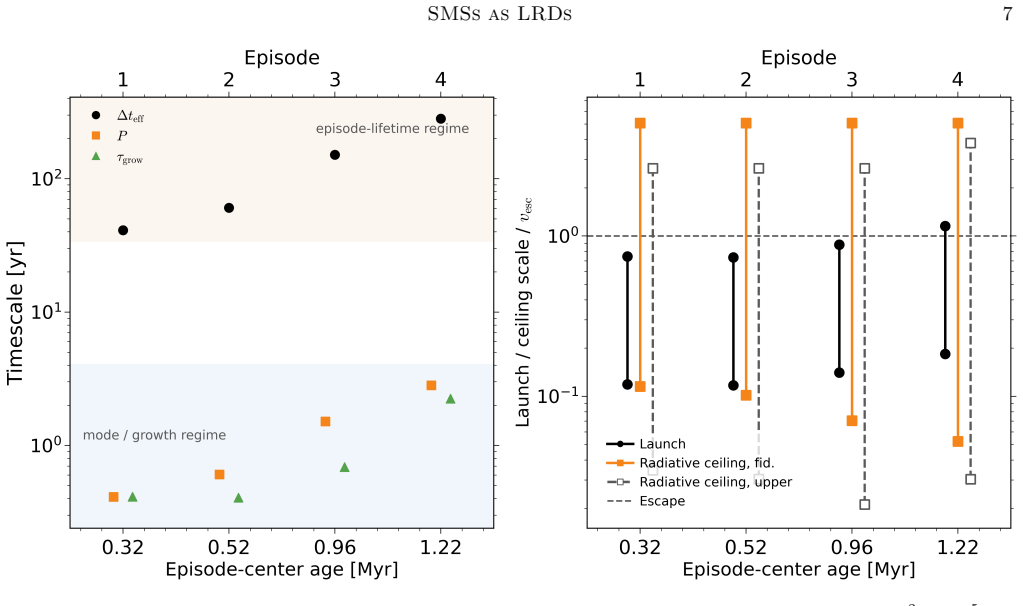
- Eq. (A40), Section A.7: The episode duration $Delta t_{eff} = max(N_{grow} tau_{grow}, N_P P)$ with $N_P approx 100$ is a constructed timescale, not a derived one. The final shell mass (348 $M_odot$ fiducial) scales linearly with $Delta t_{eff}$, and the shell outer radius (0.392 pc) scales as $v_{high} times Delta t_{eff}$. The text states that events last '$sim 100P$' but provides no physical justification for this choice. If the actual pulsation-driven ejection lasts $sim 10P$ or $sim 1000P$, both the shell mass and optical depth would change by an order of magnitude, directly affecting the central claim that the shell is compact and optically thick. The authors should either justify $N_P approx 100$ from the pulsation physics (e.g., nonlinear saturation arguments, growth-time estimates) or demonstrate sensitivity to this parameter.
- Section A.8 vs. Section 4.2: The optical depth estimate uses constant electron-scattering opacity $kappa = 0.34$ cm$^2$/g (Section A.8), but Section 4.2 argues the shell reprocesses radiation at 3000--4000 K, where dust and molecular opacity would dominate and could be orders of magnitude larger. This internal inconsistency affects the $tau_{geo} simeq 8$ estimate. If the shell is cool enough for dust to form, the relevant opacity is much higher and the shell is even more optically thick; if electron scattering is the only relevant opacity, the shell temperature argument needs revision. The authors should clarify which opacity regime applies and use a self-consistent estimate.
- Section A.3, Eqs. (A25)--(A31): Strange modes are inherently nonadiabatic phenomena whose character arises from the coupling between pulsation and radiative diffusion in the outer envelope. By evaluating driving and damping integrals on adiabatic eigenfunctions, the spatial structure of the mode may be misrepresented precisely in the envelope layers where driving occurs. This could systematically bias the growth proxy $gamma$ and, through Eq. (A39), the ejected mass. The authors acknowledge this in Appendix A.6, but the impact is not quantified. A comparison with a full linear nonadiabatic calculation for at least one snapshot would substantially strengthen the reliability of the growth rates and the resulting mass-loss estimates.
minor comments (8)
- Abstract: 'retaining $sim 99%$ all of its mass' should read 'retaining $sim 99%$ of all its mass' or similar.
- Abstract: 'SMSs therefore provides' should be 'SMSs therefore provide'.
- Section 1, paragraph 4: 'it's stability' should be 'its stability'.
- Table A2: The formatting is difficult to parse, particularly the $R_{sh}$ and $tau_{es}$ columns where values appear to run together (e.g., '1.5e-04 2.46e4' for the $Z=10^{-2}$ row). Clarifying the column alignment or adding separators would help.
- Figure 3, left panel caption: The symbol for $v_{L/c}$ appears garbled ('$v_{���}$').
- Section 3.3: The statement that $2pi R/P$ reaches 1.15 times $v_{esc}$ in the final episode is interesting but the implication that this implies unbound material should be qualified, since this is a linear pulsation speed scale, not an actual surface velocity.
- Section 4.2: The required photospheric radii for re-emission at 4000 K ($sim 590$ AU) and 3000 K ($sim 1050$ AU) are computed assuming the full SMS luminosity. If the shell does not cover all solid angles or if some radiation escapes through lower-column-density sightlines, these radii would change. A brief mention of covering factor assumptions would be useful.
- References: Several arXiv preprints from 2026 are cited (e.g., Matthee et al. 2026, Asada et al. 2026, Wang et al. 2026). The journal should verify these are properly formatted per its standards for preprints.
Simulated Author's Rebuttal
We thank the referee for a careful and constructive report. The comments identify legitimate weaknesses in our treatment of episode durations, opacity self-consistency, and the quasi-nonadiabatic approximation. We address each below and indicate where revisions will be made.
read point-by-point responses
-
Referee: Eq. (A40), Section A.7: The episode duration Δt_eff = max(N_grow τ_grow, N_P P) with N_P ≈ 100 is a constructed timescale, not a derived one. The final shell mass and outer radius scale with this choice. No physical justification is provided for N_P ≈ 100. The authors should either justify this from pulsation physics or demonstrate sensitivity.
Authors: The referee is correct that N_P ≈ 100 is not derived from first principles. We will revise the manuscript to address this in two ways. First, we will provide the physical reasoning behind the choice: the episode duration is set by the requirement that the mode has grown through many e-foldings into the nonlinear regime, where saturation and finite-envelope mass supply terminate the event. With growth times τ_grow ≈ 0.4–2.2 yr and periods P ≈ 0.4–2.8 yr, the condition max(N_grow τ_grow, N_P P) with N_grow ≈ 100 and N_P ≈ 100 yields durations of 40–280 yr, which are simultaneously (i) far longer than the linear growth time, (ii) far shorter than the evolutionary half-gap (~10^4–10^5 yr), and (iii) consistent with the mode having grown by e^100, deep into nonlinear saturation. The choice N_P ≈ 100 is therefore not arbitrary but reflects the physically motivated expectation that the event persists for many growth times until nonlinear processes (shock formation, mass unloading, envelope restructuring) quench the driving. Second, we will add a sensitivity analysis showing how the final shell mass and outer radius scale with N_P. For N_P = 10, the final shell mass drops to ~35 M☉ and R_out to ~0.04 pc, but τ_geo remains ≳ 1 because the shell is still compact. For N_P = 1000, the shell mass rises to ~3500 M☉ and R_out to ~4 pc, and the shell remains optically thick but less compact. The qualitative conclusion—that the final pre-collapse ejection produces a compact, optically thick shell—survives over a factor-of-10 variation in N_P, though the quantitative shell parameters do scale as the referee notes. We will state this explicitly in the revised text and include the sensitivity table in Appendix A.7. revision: partial
-
Referee: Section A.8 vs. Section 4.2: The optical depth estimate uses constant electron-scattering opacity κ = 0.34 cm²/g, but Section 4.2 argues the shell reprocesses radiation at 3000–4000 K where dust and molecular opacity would dominate. This internal inconsistency affects the τ_geo ≈ 8 estimate. The authors should clarify which opacity regime applies and use a self-consistent estimate.
Authors: The referee has identified a genuine inconsistency in our presentation. We will revise the manuscript to resolve it. The key point is that κ = 0.34 cm²/g is a conservative lower bound on the opacity, appropriate for the earliest phase of shell expansion when the gas is still hot and ionized. As the shell expands and cools below ~5000 K, dust condensation and molecular opacity sources (TiO, H₂O, CO) increase the total opacity by one to two orders of magnitude. This means our τ_geo ≈ 8 estimate is a lower limit: if dust forms, the shell is even more optically thick at the relevant reprocessing radii. We will revise Section A.8 to state explicitly that the electron-scattering value is used as a conservative floor for the order-of-magnitude diagnostic, and we will add a sentence in Section 4.2 noting that once the shell cools to 3000–4000 K, the effective opacity is substantially higher, reinforcing rather than undermining the conclusion that the shell can reprocess the SMS continuum. The two sections are therefore consistent once the time evolution of the shell opacity is made explicit: electron scattering dominates early, and dust/molecular opacity dominates later, with both regimes yielding an optically thick shell. revision: yes
-
Referee: Section A.3, Eqs. (A25)–(A31): Strange modes are inherently nonadiabatic. Evaluating driving and damping on adiabatic eigenfunctions may misrepresent the mode structure in the envelope where driving occurs, potentially biasing the growth proxy γ and the ejected mass. The authors acknowledge this in Appendix A.6 but do not quantify the impact. A comparison with a full linear nonadiabatic calculation for at least one snapshot would substantially strengthen the reliability of the growth rates and mass-loss estimates.
Authors: This is a valid and important concern. We acknowledge that the quasi-nonadiabatic approach—evaluating driving and damping integrals on adiabatic eigenfunctions—is an approximation whose systematic error we have not quantified. Strange modes derive their character from the strong coupling between pulsation and radiative diffusion in the outer envelope, and the adiabatic eigenfunctions may not capture the correct spatial structure of the displacement in precisely the layers where driving is concentrated. We cannot fully resolve this concern within the scope of the present Letter. A full linear nonadiabatic calculation for at least one snapshot is the right next step, and we commit to performing such a comparison in a follow-up paper. For the revised manuscript, we will (i) expand the discussion in Appendix A.6 to state more explicitly that the quasi-nonadiabatic treatment may systematically bias γ and therefore the mass-loss estimates, (ii) note that the direction of the bias is not obvious a priori—nonadiabatic eigenfunctions could either enhance or suppress the surface displacement relative to the adiabatic solution—and (iii) emphasize that our use of multiple branch parameters (low, fiducial, high, upper-limit) is partly designed to bracket this uncertainty, though it does not substitute for a proper nonadiabatic treatment. We agree with the referee that a direct nonadiabatic comparison would substantially strengthen the results and will prioritize this in follow-up work. revision: partial
- The quasi-nonadiabatic treatment (Comment 3) cannot be fully validated without a full linear nonadiabatic calculation, which is beyond the scope of this Letter. We acknowledge this limitation honestly and commit to addressing it in a follow-up, but we cannot quantify the systematic bias at present.
Circularity Check
No significant circularity; self-citations are methodological, not load-bearing for the central claim
full rationale
The paper's derivation chain proceeds from independently evolved GENEC stellar models through linear adiabatic pulsation calculations, a quasi-nonadiabatic driving analysis, a parametrized mass-loss mapping, and finally simple kinematic propagation of shell properties. No step reduces to its own inputs by construction. The mass-loss prescription (Eq. A36–A39) contains free parameters (f_coup,max, η branches in Table A1, N_P ≈ 100 in Eq. A40), but these are efficiency brackets chosen on physical grounds, not values fitted to LRD observables and then presented as predictions. The paper is explicit that the mapping is 'a structured estimate rather than as a unique prediction' (Appendix A.6). The composition ratios (N/O, C/O) come directly from the nuclear-burning abundance profiles of the GENEC models at the ejected mass depth, not from the mass-loss prescription. The GR collapse follow-up uses a separate 1D GR hydrodynamics code (Nagele et al. 2020, 2021) as a consistency check on the linear stability analysis. Several self-citations appear (Saio et al. 2024 for the GR pulsation framework, with Nandal as coauthor; Nandal et al. 2024a, 2025b for stellar models; Nagele et al. 2022 for GR stability, with Nagele as coauthor), but these cite methods and codes rather than results that would make the central claim circular. The GR stability criteria are cross-checked against the independent hydrodynamic collapse calculation. The score of 2 reflects these methodological self-citations, which are normal and do not undermine the independence of the central derivation.
Axiom & Free-Parameter Ledger
free parameters (6)
- f_coup,max (surface-leakage) =
0.05
- f_coup,max (opacity-dominated) =
0.02
- η (efficiency factor) =
0.03-1.00 (low to upper)
- f_bind,eff =
derived from local gas-pressure fraction
- κ (opacity for optical depth) =
0.34 cm²/g
- N_grow, N_P (episode duration) =
implicit in Eq. A40
axioms (5)
- domain assumption GENEC stellar evolution models accurately represent the structure and post-accretion evolution of supermassive stars at 10^5 M⊙ across metallicities from Pop III to 10^-2 Z⊙.
- domain assumption Quasi-nonadiabatic evaluation of driving/damping on adiabatic eigenfunctions provides a reliable growth proxy for strange-mode instability.
- ad hoc to paper The energy-limited mass-loss formula (Eq. 2/A39) with a coupling efficiency parameter adequately maps pulsation driving to ejecta mass.
- ad hoc to paper Ballistic propagation of ejecta with constant launch speeds is sufficient to estimate shell radii and optical depths at collapse.
- standard math The GR radial stability criteria of Saio et al. (2024), Haemmerlé (2021), and Nagele et al. (2022) correctly identify the onset of collapse.
Forward citations
Cited by 3 Pith papers
-
Little Red Dots as Intermediate Mass, Super-Eddington Engines: Insights from Type IIn Supernovae and The 1837-1856 Great Eruption of $\eta$ Carinae
LRDs are reinterpreted as intermediate-mass super-Eddington systems with wind-driven pseudo-photospheres that explain their spectra and imply engine masses below 10^5 solar masses rather than overmassive black holes.
-
Little Red Dots at z~2 in EIGER reveal a gentle decline with respect to their peak number density at z~5
Five LRDs at z≈2 yield number density ≈7×10^{-6} cMpc^{-3}, confirming a decline from the z≈5 peak but gentler than prior photometric estimates.
-
SEEDZ: Rapid Galaxy Assembly as a Pathway to Supermassive Stars, Dense Stellar Environments and Massive Black Hole Seeds
Rapid halo growth in SEEDZ simulations enables heavy black hole seed formation via supermassive stars at a comoving number density of 0.1 cMpc^{-3} by z=10, with most seeds in near-solar metallicity gas.
Reference graph
Works this paper leans on
-
[1]
, " * write output.state after.block = add.period write newline
ENTRY address archivePrefix author booktitle chapter doi edition editor eprint howpublished institution journal key month number organization pages publisher school series title misctitle type volume year version url label extra.label sort.label short.list INTEGERS output.state before.all mid.sentence after.sentence after.block FUNCTION init.state.consts ...
-
[2]
" write newline "" before.all 'output.state := FUNCTION format.url url empty "" new.block "" url * "" * if FUNCTION format.eprint eprint empty "" archivePrefix empty "" archivePrefix "arXiv" = new.block " " eprint * " " * new.block " " eprint * " " * if if if FUNCTION format.doi doi empty "" " " doi * " " * if FUNCTION format.pid doi empty eprint empty ur...
-
[3]
- [1] #1 = = ^ ^ ^ .\!\!^ d .\!\!^ h .\!\!^ m .\!\!^ s .\!\!^ @mss
thebibliography [1] 20pt to REFERENCES 6pt =0pt \@twocolumntrue 12pt -12pt 10pt plus 3pt =0pt =0pt =1pt plus 1pt =0pt =0pt -12pt =13pt plus 1pt =20pt =13pt plus 1pt \@M =10000 =-1.0em =0pt =0pt 0pt =0pt =1.0em @enumiv\@empty 10000 10000 `\.\@m \@noitemerr \@latex@warning Empty `thebibliography' environment \@ifnextchar \@reference \@latexerr Missing key o...
work page 2017
-
[4]
, " * write output.state after.block = add.period write newline
ENTRY address author booktitle chapter edition editor howpublished institution journal key month note number organization pages publisher school series title type volume year label extra.label sort.label short.list INTEGERS output.state before.all mid.sentence after.sentence after.block FUNCTION init.state.consts #0 'before.all := #1 'mid.sentence := #2 '...
-
[5]
" write newline "" before.all 'output.state := FUNCTION n.dashify 't := "" t empty not t #1 #1 substring "-" = t #1 #2 substring "--" = not "--" * t #2 global.max substring 't := t #1 #1 substring "-" = "-" * t #2 global.max substring 't := while if t #1 #1 substring * t #2 global.max substring 't := if while FUNCTION word.in bbl.in " " * FUNCTION format....
discussion (0)
Sign in with ORCID, Apple, or X to comment. Anyone can read and Pith papers without signing in.