Optimizing Explicit Unit-Distance Lower-Bound Certificates
Pith reviewed 2026-06-28 08:56 UTC · model grok-4.3
The pith
Optimizing the choice of primes and multiplicities in Sawin's construction improves the explicit lower bound on unit distances to more than n to the power 1.0152.
A machine-rendered reading of the paper's core claim, the machinery that carries it, and where it could break.
Core claim
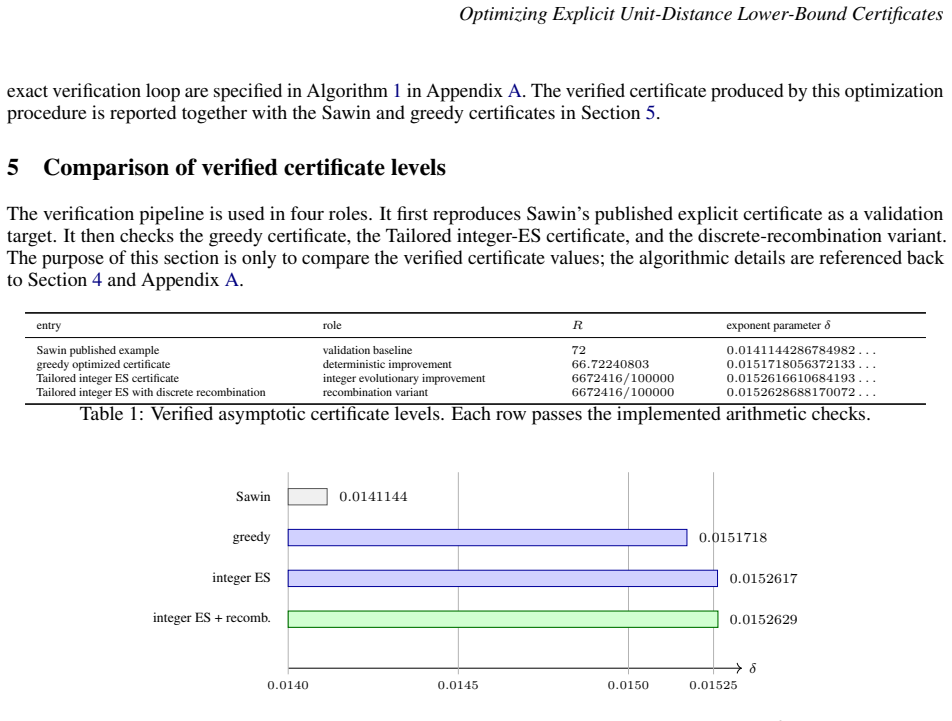
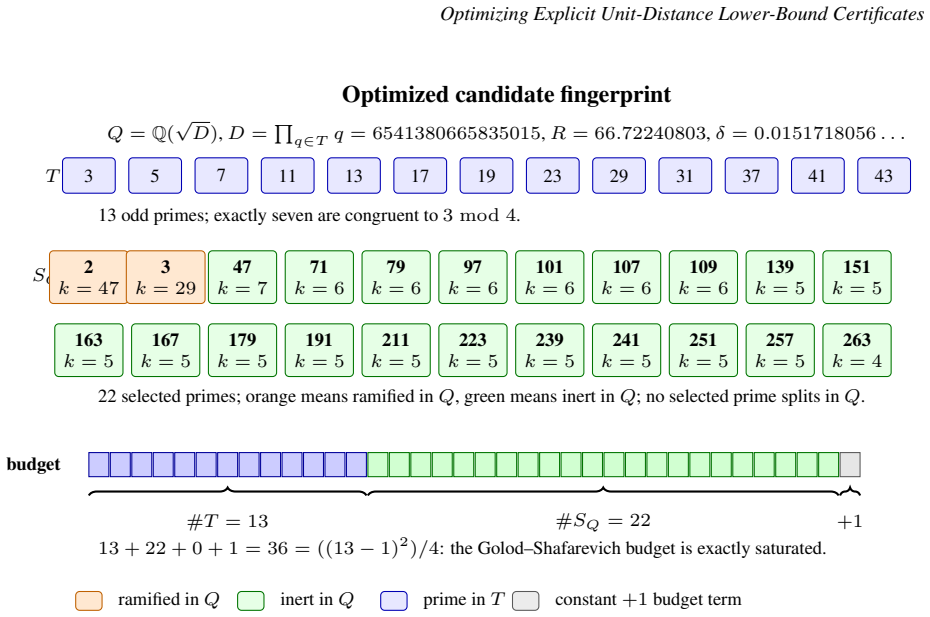
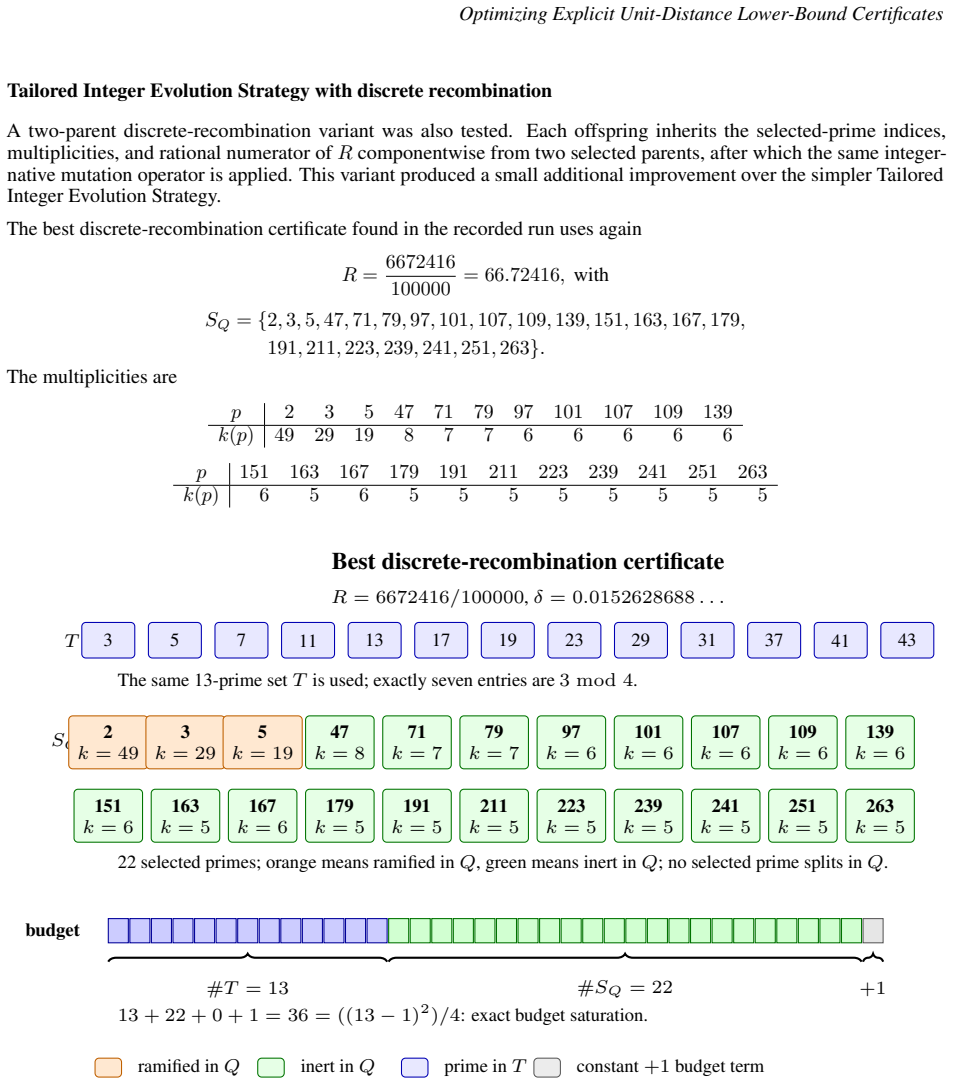
Treating Sawin's parameter selection as a nonlinear integer optimization problem and solving it with a tailored evolution strategy yields an explicit certificate with delta equal to 0.015263 that verifies u(n) greater than n to the power 1.0152 for arbitrarily large n, improving on the original 1.014; the same framework applied to a larger set of ramified primes produces a certificate supporting an exponent above 1.031.
What carries the argument
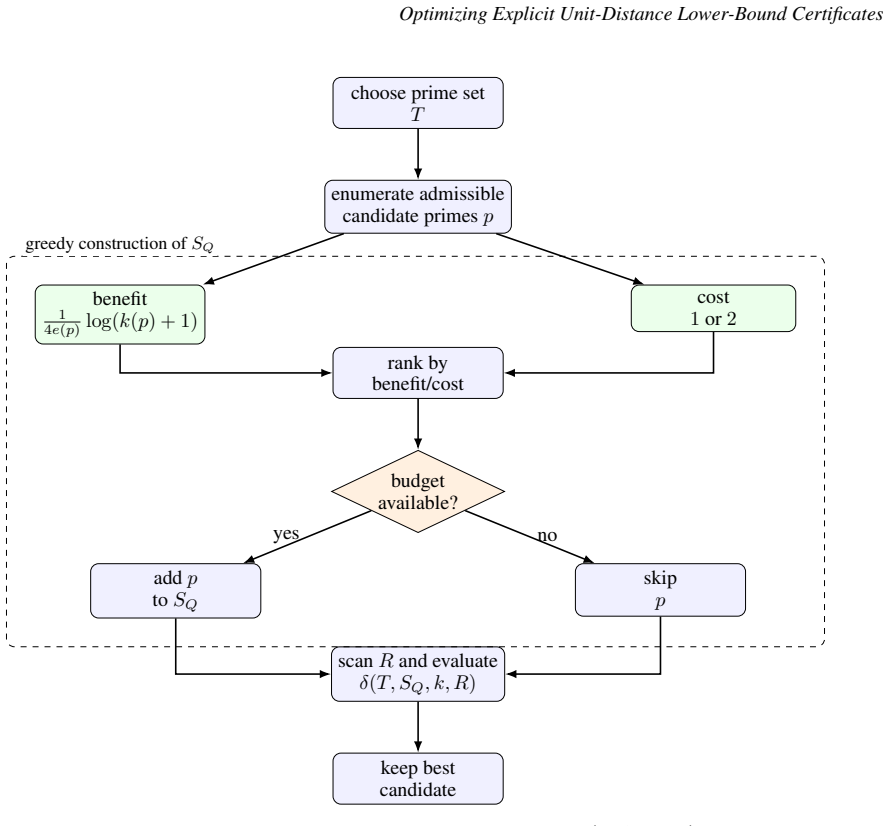
The nonlinear integer optimization pipeline that searches over prime sets T, multiplicities k(p), auxiliary primes S_Q and the rationally encoded real R to maximize delta subject to the algebraic and geometric conditions of Sawin's certificate construction.
If this is right
- Improved certificates with a fixed T are obtainable by systematic randomized search rather than manual parameter tuning.
- Enlarging the range of ramified primes T produces substantially stronger explicit exponents.
- The same verification pipeline can be reused to certify any candidate parameter vector found by the optimizer.
- Randomized heuristics can refine explicit combinatorial-geometry certificates beyond their initial manual construction.
Where Pith is reading between the lines
- The method could be applied to other explicit certificate problems in extremal graph theory where parameters must satisfy algebraic inequalities.
- Further gains are likely if the constraint system is extended beyond the exact formulation used by Sawin.
- The reported recent certificates with delta above 0.036 indicate that the optimization landscape contains higher values once the prime range and model degrees of freedom are both increased.
Load-bearing premise
The verification pipeline correctly confirms that the optimized integer parameters and real value R satisfy all the algebraic and geometric conditions required by Sawin's certificate construction for every sufficiently large n.
What would settle it
A direct algebraic check showing that one of the required inequalities on the products involving the primes in T and S_Q fails to hold for the reported parameter values, or a computational enumeration for some large n that finds fewer unit distances than the claimed lower bound.
Figures
read the original abstract
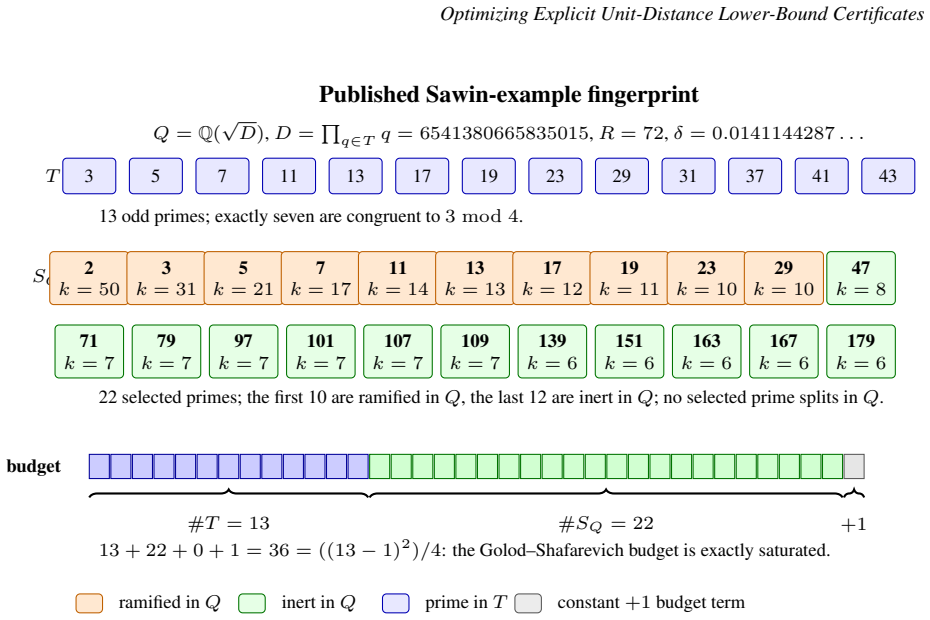
The 2026 disproof of Erd\H{o}s's unit-distance conjecture and Sawin's quantitative refinement show that the maximum number $u(n)$ of unit distances among $n$ planar points can exceed $n^{1+\varepsilon}$ for a fixed positive $\varepsilon$. Sawin's explicit bound gives more than $n^{1.014}$ unit distances for arbitrarily large $n$ and exposes integer parameters whose choice is not fully optimized. This report treats Sawin's parameter selection as a nonlinear integer optimization problem and develops an open-source Python optimization and verification pipeline for certificates involving prime sets $T$ and $S_Q$, integer multiplicities $k(p)$, and a rationally encoded real parameter $R$. After reproducing Sawin's certificate with $\delta=0.014114\ldots$, the pipeline yields improved certificates with the same $T$. We develop a tailored integer evolution strategy achieving a certificate with $\delta=0.015263\ldots$ and supporting the cautious statement $u(n)>n^{1.0152}$ for arbitrarily large $n$. For extended ramified prime ranges, the Emmerich--Cordella certificate obtained with the same framework reports $u(n)>n^{1.031}$ for $\#T=67$, illustrating the importance of enlarging $T$. Very recent MathOverflow discussions, brought to the author's attention as of version~4, report further improvements, including certificates above $\delta>0.035$ and beyond $\delta>0.036$. Some of these improvements may rely not only on larger prime ranges but also on modified constraint systems and additional degrees of freedom that deviate from Sawin's original formulation. Beyond this application, the work illustrates how randomized optimization heuristics can improve, verify, and refine explicit certificates for combinatorial geometry through nonlinear integer optimization.
Editorial analysis
A structured set of objections, weighed in public.
Referee Report
Summary. The manuscript frames parameter choice in Sawin's explicit unit-distance certificate as a nonlinear integer optimization problem. It supplies an open-source Python pipeline that reproduces Sawin's original certificate (δ0.014114) and, via a tailored integer evolution strategy, obtains an improved certificate (δ0.015263) supporting u(n)>n^{1.0152} for all large n; the same framework is applied to larger prime sets T to reach δ>0.031 for #T=67.
Significance. If the reported certificates are valid, the work supplies concrete, explicit improvements to the best-known lower bounds on u(n) and illustrates the use of randomized heuristics for refining combinatorial-geometry certificates. The open-source code, reproduction of the baseline Sawin certificate, and explicit demonstration that enlarging T yields further gains are concrete strengths.
major comments (2)
- [Verification pipeline] Verification pipeline: the central claim that the optimized multiplicities and rationally encoded R produce a valid certificate with δ=0.015263 (hence u(n)>n^{1.0152}) rests on the pipeline correctly enforcing every algebraic and geometric predicate of Sawin's construction for all sufficiently large n. The manuscript does not enumerate the exact predicates checked or the tolerance handling used for the real parameter R; a single omitted or mis-coded inequality would invalidate the reported δ while leaving the optimization heuristic unaffected.
- [Results for extended ramified prime ranges] Extended-T certificates: the claim that the Emmerich-Cordella certificate with #T=67 yields u(n)>n^{1.031} requires confirmation that the same verification pipeline was applied without additional ad-hoc adjustments to the constraint system when T is enlarged. The manuscript should state explicitly, in the section presenting these results, whether any predicates were relaxed or added for the larger prime range.
minor comments (1)
- [Abstract] The abstract is unusually long and contains forward-looking remarks on MathOverflow improvements; these would be better placed in the introduction or a dedicated discussion section.
Simulated Author's Rebuttal
We thank the referee for the positive evaluation of the work's significance and for the detailed comments on verification. We address both major comments below with clarifications and commit to revisions that improve the manuscript's documentation of the pipeline.
read point-by-point responses
-
Referee: Verification pipeline: the central claim that the optimized multiplicities and rationally encoded R produce a valid certificate with δ=0.015263 (hence u(n)>n^{1.0152}) rests on the pipeline correctly enforcing every algebraic and geometric predicate of Sawin's construction for all sufficiently large n. The manuscript does not enumerate the exact predicates checked or the tolerance handling used for the real parameter R; a single omitted or mis-coded inequality would invalidate the reported δ while leaving the optimization heuristic unaffected.
Authors: We agree that explicit enumeration of the predicates is necessary for full transparency. The open-source pipeline already implements all predicates from Sawin's construction (the four algebraic inequalities on the multiplicities k(p) and the geometric condition on R derived from the ramified primes), with R encoded as a rational to eliminate floating-point tolerance issues entirely. In the revised manuscript we will insert a new subsection under the verification pipeline that lists each predicate verbatim, states the exact rational encoding of R, and confirms that all checks are performed exactly (no numerical tolerances). This documentation change does not alter the reported δ values. revision: yes
-
Referee: Extended-T certificates: the claim that the Emmerich-Cordella certificate with #T=67 yields u(n)>n^{1.031} requires confirmation that the same verification pipeline was applied without additional ad-hoc adjustments to the constraint system when T is enlarged. The manuscript should state explicitly, in the section presenting these results, whether any predicates were relaxed or added for the larger prime range.
Authors: The identical verification pipeline, with the same set of predicates and no relaxations or additions, was used for all reported T, including the Emmerich-Cordella instance with #T=67. The only change is the input prime set T; the constraint system remains exactly Sawin's original formulation. In the revised manuscript we will add an explicit sentence in the extended-T results section stating that no predicates were relaxed or added and that the verification code path is unchanged from the baseline case. revision: yes
Circularity Check
No circularity: optimization searches parameters against external Sawin certificate predicates
full rationale
The derivation begins from Sawin's explicit certificate construction (external to the present paper) and treats its integer parameters k(p), prime sets T/S_Q, and rational R as decision variables in a nonlinear integer optimization problem whose objective is to maximize δ subject to the algebraic and geometric conditions stated by Sawin. The reported δ=0.015263… is the value attained by the evolution strategy on those constraints; it is not defined in terms of the target exponent, nor is any predicate obtained by fitting to the exponent itself. Reproduction of the original Sawin certificate serves as an external sanity check rather than a self-referential loop. No self-citation is load-bearing for the central claim, and the Emmerich–Cordella extension is presented as an application of the same framework rather than a premise required to justify it.
Axiom & Free-Parameter Ledger
free parameters (4)
- prime set T
- multiplicities k(p) for p in T
- real parameter R
- prime set S_Q
axioms (2)
- domain assumption Sawin's original certificate construction is valid for the chosen parameters when the algebraic conditions hold.
- standard math Standard properties of primes and rational numbers suffice to encode and verify the certificate.
Reference graph
Works this paper leans on
-
[1]
On sets of distances ofnpoints,
P. Erd ˝os, “On sets of distances ofnpoints,”American Mathematical Monthly, vol. 53, no. 5, pp. 248–250, 1946
1946
-
[2]
Extremal problems in discrete geometry,
E. Szemerédi and W. T. Trotter, “Extremal problems in discrete geometry,”Combinatorica, vol. 3, pp. 381–392, 1983
1983
-
[3]
Unit distances in the Euclidean plane,
J. Spencer, E. Szemerédi, and W. T. Trotter, “Unit distances in the Euclidean plane,” inGraph Theory and Combinatorics, Academic Press, 1984, pp. 294–304
1984
-
[4]
An OpenAI model has disproved a central conjecture in discrete geometry,
OpenAI, “An OpenAI model has disproved a central conjecture in discrete geometry,” May 20, 2026. Available at https://openai.com/index/model-disproves-discrete-geometry-conjecture/
2026
-
[5]
Remarks on the disproof of the unit distance conjecture,
N. Alon, T. F. Bloom, W. T. Gowers, D. Litt, W. Sawin, A. Shankar, J. Tsimerman, V . Wang, and M. Matchett Wood, “Remarks on the disproof of the unit distance conjecture,” arXiv:2605.20695, 2026. Available athttps: //arxiv.org/abs/2605.20695
Pith/arXiv arXiv 2026
-
[6]
An explicit lower bound for the unit distance problem,
W. Sawin, “An explicit lower bound for the unit distance problem,” arXiv:2605.20579, 2026. Available at https://arxiv.org/abs/2605.20579
Pith/arXiv arXiv 2026
-
[7]
What is the unit distance exponent?,
D. G. Mixon, “What is the unit distance exponent?,” MathOverflow question and discussion thread, asked May 21,
-
[8]
Available at MathOverflow, question 511514 (accessed June 8, 2026)
2026
-
[9]
What is the unit distance exponent?,
E. Naslund, answer to “What is the unit distance exponent?,” MathOverflow, answered May 23, 2026; edited May 26, 2026. Available at MathOverflow, question 511514 (accessed June 8, 2026)
2026
-
[10]
Unit-distance certificate package and verification pipeline,
P.-L. Tseng, “Unit-distance certificate package and verification pipeline,” Zenodo record 20357019, 2026. Avail- able athttps://zenodo.org/records/20357019(accessed June 9, 2026)
arXiv 2026
-
[11]
Optimized Certificate for the Unit Distance Problem with Extended Prime Number Range,
M. T. M. Emmerich and F. Cordella, “Optimized Certificate for the Unit Distance Problem with Extended Prime Number Range,” dataset, Zenodo, June 6, 2026. doi: 10.5281/zenodo.20551478
-
[12]
An evolutionary algorithm for integer programming,
G. Rudolph, “An evolutionary algorithm for integer programming,” in Y . Davidor, H.-P. Schwefel, and R. Männer, Eds.,Parallel Problem Solving from Nature – PPSN III, Lecture Notes in Computer Science, vol. 866, Berlin, Heidelberg: Springer, 1994, pp. 139–148. doi: 10.1007/3-540-58484-6_258
-
[13]
Ueber die dichteste Kugellagerung,
L. Fejes Tóth, “Ueber die dichteste Kugellagerung,”Mathematische Zeitschrift, vol. 48, pp. 676–684, 1942. doi: 10.1007/BF01180035. 20
discussion (0)
Sign in with ORCID, Apple, or X to comment. Anyone can read and Pith papers without signing in.