Evolving Dark Energy Is Vacuum Energy After All
Pith reviewed 2026-06-26 16:21 UTC · model grok-4.3
The pith
A model of dark energy arising from the QCD vacuum fits observations and matches DESI hints without new fields or instabilities
A machine-rendered reading of the paper's core claim, the machinery that carries it, and where it could break.
Core claim
The QCD-induced dark-energy model provides an excellent fit to the data and reproduces the late-time dark-energy evolution preferred by DESI observations while remaining free from theoretical instabilities.
What carries the argument
The global vacuum effect associated with the response of the non-perturbative topological structure of the QCD vacuum to an expanding spacetime, implemented via an activation mechanism.
Load-bearing premise
The QCD vacuum produces a specific time-dependent energy density in response to cosmic expansion through a chosen activation mechanism.
What would settle it
A future data set showing either no phantom-crossing behavior at intermediate redshifts or the emergence of theoretical instabilities in the effective equation of state would falsify the model.
Figures

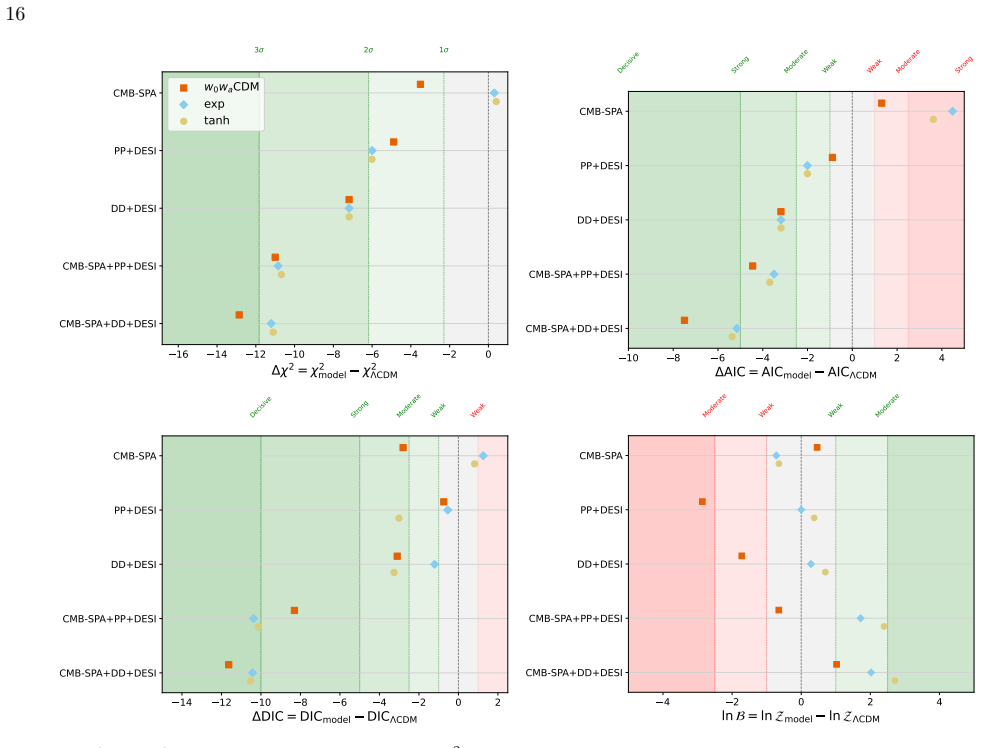
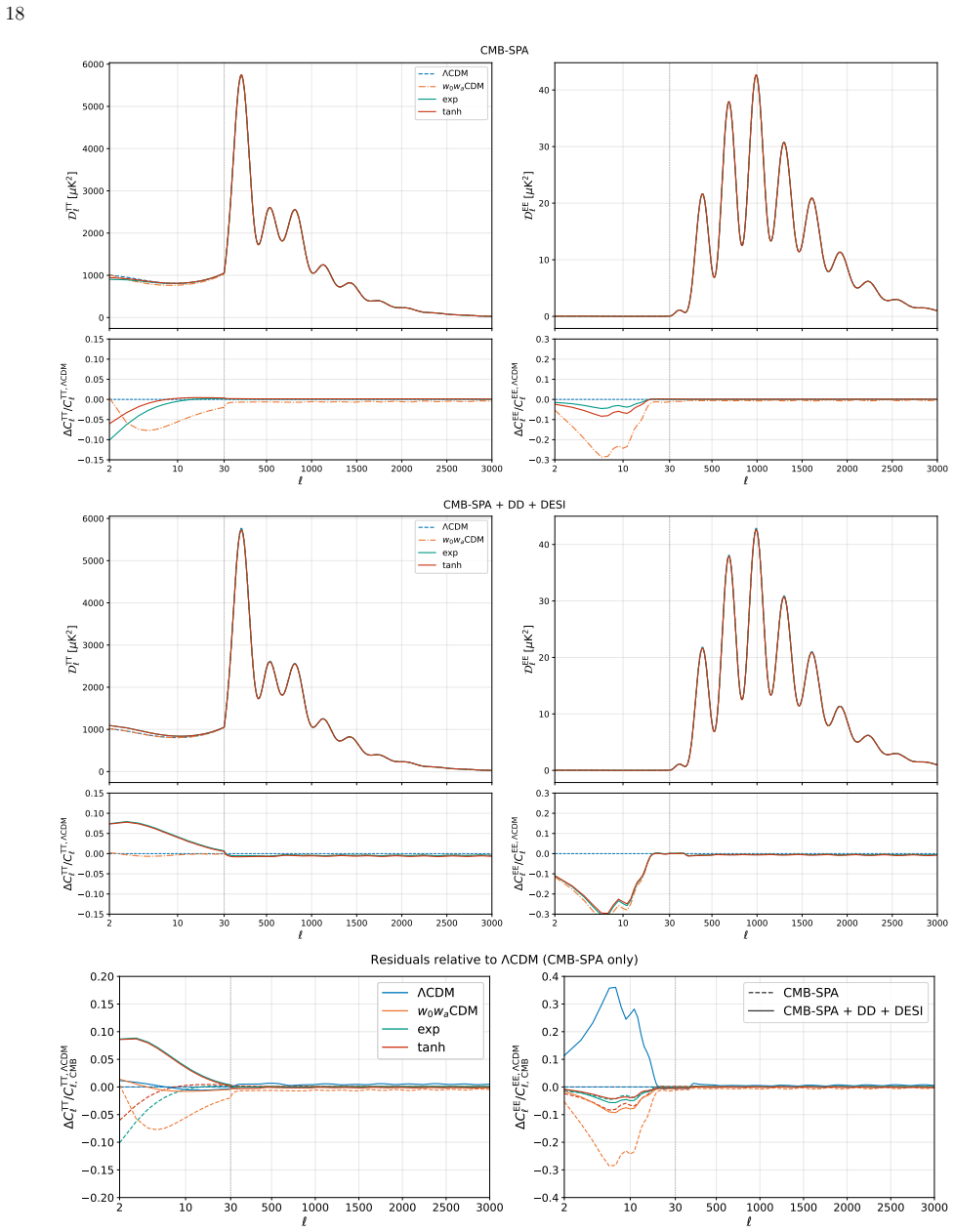

read the original abstract
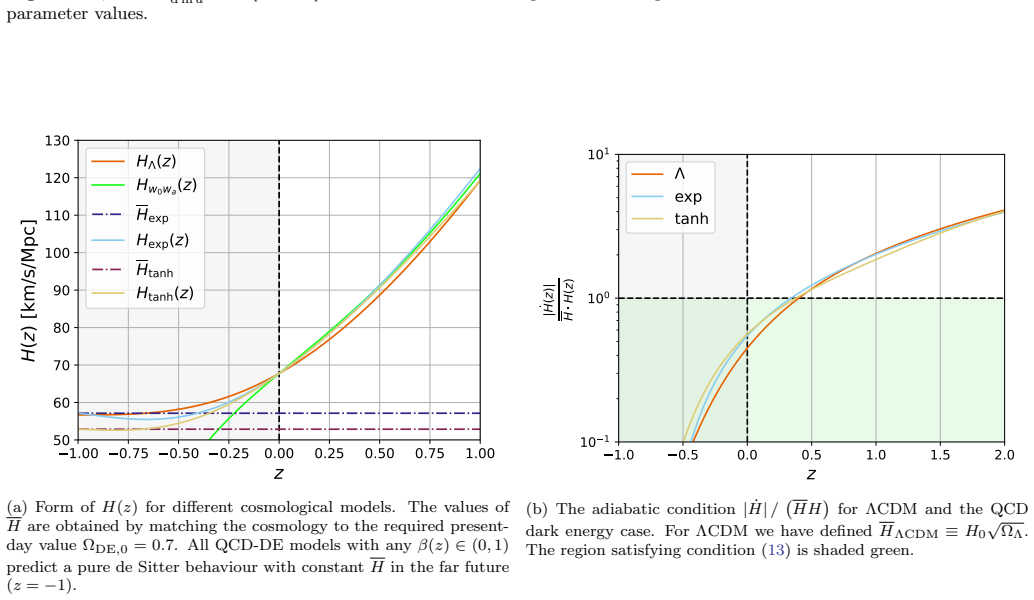
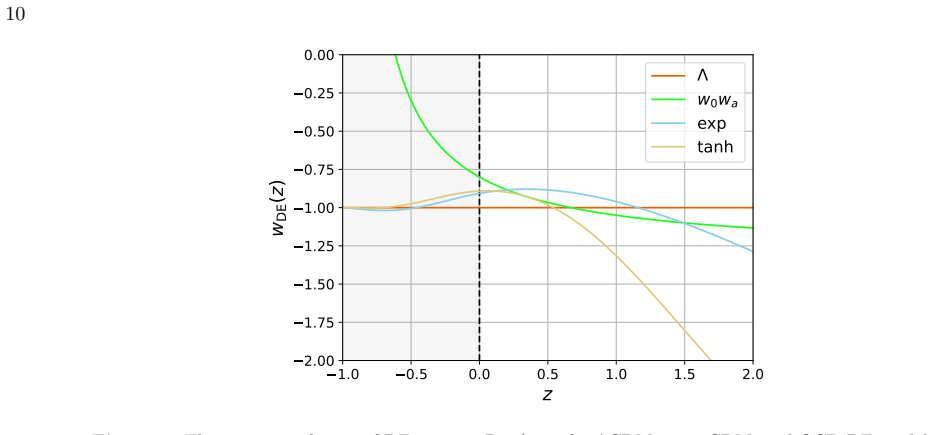
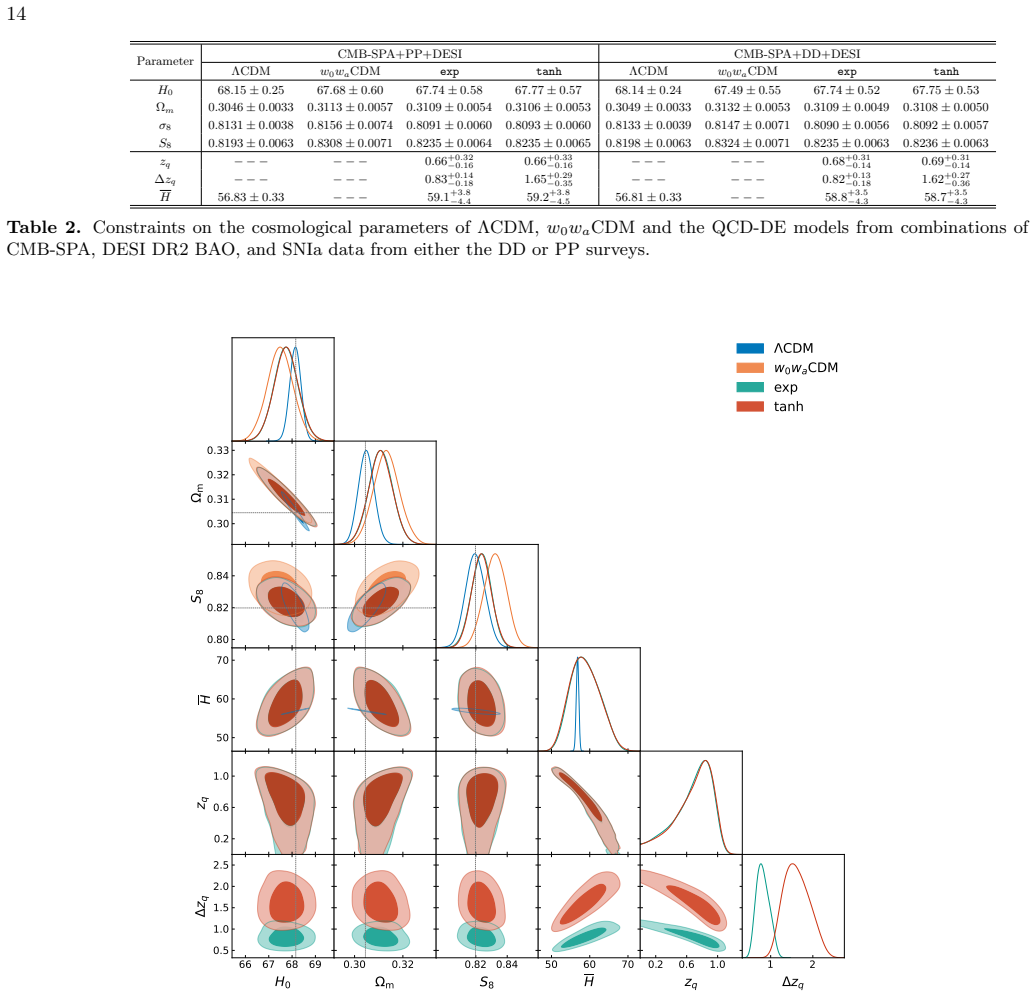
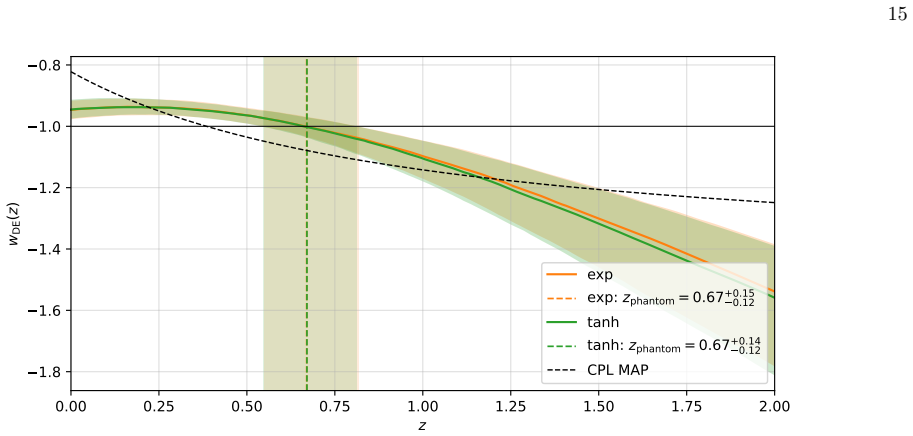
We investigate a physically motivated model of dynamical dark energy arising from the non-perturbative topological structure of the Quantum Chromodynamics (QCD) vacuum. Unlike conventional dark-energy scenarios, the model does not introduce any new fundamental field or propagating degree of freedom. Instead, the dark-energy density emerges as a global vacuum effect associated with the response of the QCD vacuum to an expanding spacetime, representing a possible paradigm shift in the interpretation of cosmic acceleration. We develop the first comprehensive cosmological implementation of this QCD-induced dark-energy scenario and confront it with current observations, including the latest combination of Planck, ACT and SPT-3G cosmic microwave background measurements, DESI DR2 baryon acoustic oscillation data, and Type Ia supernova samples from Pantheon+ and DES-Dovekie. We compare the model with both the standard $\Lambda$CDM cosmology and the widely used CPL ($w_0w_a$CDM) parametrization of evolving dark energy. We find that the model provides an excellent fit to the data and reproduces the late-time dark-energy evolution preferred by DESI observations. The inferred cosmological parameters are robust against different implementations of the dark-energy activation mechanism, indicating that the cosmological predictions are largely insensitive to the specific form of the transition. The model naturally predicts an effective phantom-crossing behaviour at intermediate redshifts while remaining free from the theoretical instabilities commonly associated with phantom scalar-field models. Using a combination of goodness-of-fit statistics and Bayesian model-selection techniques, including Akaike and Deviance Information Criteria and Bayesian evidence estimated from Markov Chain Monte Carlo chains, [abridged]
Editorial analysis
A structured set of objections, weighed in public.
Referee Report
Summary. The manuscript proposes a model in which dynamical dark energy arises as a global effect from the response of the QCD vacuum's non-perturbative topological structure to cosmic expansion, without introducing new fields or degrees of freedom. The authors implement this via a phenomenological activation mechanism whose functional form is varied, and show that the resulting cosmology provides an excellent fit to combined CMB (Planck+ACT+SPT-3G), BAO (DESI DR2), and SN (Pantheon+, DES-Dovekie) data, reproduces the DESI-preferred late-time evolution, predicts phantom-crossing without instabilities, and is robust to the activation choice. The model is compared to ΛCDM and CPL using AIC, DIC, and Bayesian evidence from MCMC.
Significance. If the central claim holds—that the dark-energy density emerges from QCD vacuum effects in response to expansion without new fields or ad-hoc tuning—this would constitute a significant advance by grounding evolving dark energy in established particle physics rather than new scalars or modified gravity. Strengths include the comprehensive dataset combination, explicit use of Bayesian evidence and information criteria for model comparison, and reported robustness of cosmological parameters to activation variations.
major comments (2)
- [implementation and activation mechanism section] The activation mechanism (varied across cases in the implementation section) is introduced and selected by hand to control the onset and time dependence of the vacuum response rather than obtained by solving the QCD vacuum (e.g., via instanton or gluon-condensate evolution) in a time-dependent FLRW metric. This makes the reproduction of the DESI-preferred w(z) evolution an input rather than an emergent, parameter-free prediction from QCD, directly affecting the central claim of a physically motivated, field-free model.
- [Abstract and results section] Abstract and results: no explicit posterior values, tension metrics (e.g., Δχ² or H0/S8 shifts relative to ΛCDM), or numerical Bayes factors are reported despite the use of MCMC chains and model-selection techniques; this weakens the quantitative support for the 'excellent fit' and 'robust' claims.
Simulated Author's Rebuttal
We thank the referee for their thorough review and valuable comments on our manuscript. We provide point-by-point responses to the major comments below.
read point-by-point responses
-
Referee: [implementation and activation mechanism section] The activation mechanism (varied across cases in the implementation section) is introduced and selected by hand to control the onset and time dependence of the vacuum response rather than obtained by solving the QCD vacuum (e.g., via instanton or gluon-condensate evolution) in a time-dependent FLRW metric. This makes the reproduction of the DESI-preferred w(z) evolution an input rather than an emergent, parameter-free prediction from QCD, directly affecting the central claim of a physically motivated, field-free model.
Authors: We agree that the activation mechanism is introduced phenomenologically rather than derived from a first-principles solution of the QCD vacuum in an expanding FLRW spacetime. A complete derivation from non-perturbative QCD would indeed be highly desirable but is currently beyond reach due to the complexity of solving the instanton or gluon condensate dynamics in a time-dependent metric. The present work focuses on implementing the global vacuum effect in cosmology and testing its viability against data. The fact that the results are robust across different activation forms suggests that the key features are not artifacts of the specific choice. We will revise the manuscript to more explicitly discuss this limitation and its implications for the physical motivation of the model. revision: partial
-
Referee: [Abstract and results section] Abstract and results: no explicit posterior values, tension metrics (e.g., Δχ² or H0/S8 shifts relative to ΛCDM), or numerical Bayes factors are reported despite the use of MCMC chains and model-selection techniques; this weakens the quantitative support for the 'excellent fit' and 'robust' claims.
Authors: The manuscript does report the use of AIC, DIC, and Bayesian evidence from MCMC, with detailed results in the main text and appendices. However, to enhance clarity and address this concern, we will add explicit numerical values for key quantities such as Δχ², parameter shifts, and Bayes factors to the abstract and include a summary table in the results section. revision: yes
- The derivation of the activation mechanism from first-principles QCD in curved spacetime cannot be provided in this work, as it requires solving non-perturbative QCD dynamics in an FLRW background, which is not currently feasible.
Circularity Check
No significant circularity detected in derivation chain
full rationale
The paper defines a QCD-vacuum-based dark-energy model, introduces an activation mechanism for its cosmological implementation, and reports that results are robust across different implementations of that mechanism while confronting the model with external datasets (Planck, DESI, supernovae). No quoted step shows a prediction or central result reducing by construction to a fitted input, self-citation, or ansatz whose functional form is the output itself. The derivation remains self-contained: the QCD motivation supplies the physical premise, the activation supplies a concrete implementation whose details do not dictate the reported data agreement, and model comparison is performed against independent observations and parametrizations.
Axiom & Free-Parameter Ledger
free parameters (1)
- activation transition parameters
axioms (2)
- domain assumption The QCD vacuum possesses a non-perturbative topological structure that can respond to spacetime expansion by generating a homogeneous energy density.
- standard math Standard FLRW cosmology and linear perturbation theory remain valid when this vacuum energy is added.
Reference graph
Works this paper leans on
-
[1]
Planck 2018 results. VI. Cosmological parameters
Aghanim, N. and others. Planck 2018 results. VI. Cosmological parameters. Astron. Astrophys. 2020. doi:10.1051/0004-6361/201833910. arXiv:1807.06209
work page internal anchor Pith review Pith/arXiv arXiv doi:10.1051/0004-6361/201833910 2018
-
[2]
The Atacama Cosmology Telescope: DR6 Power Spectra, Likelihoods and $\Lambda$CDM Parameters
Louis, Thibaut and others. The Atacama Cosmology Telescope: DR6 power spectra, likelihoods and CDM parameters. JCAP. 2025. doi:10.1088/1475-7516/2025/11/062. arXiv:2503.14452
work page internal anchor Pith review Pith/arXiv arXiv doi:10.1088/1475-7516/2025/11/062 2025
-
[3]
Camphuis, E. and others. SPT-3G D1: CMB temperature and polarization power spectra and cosmology from 2019 and 2020 observations of the SPT-3G main field. Phys. Rev. D. 2026. doi:10.1103/7wt3-9v2y. arXiv:2506.20707
work page internal anchor Pith review Pith/arXiv arXiv doi:10.1103/7wt3-9v2y 2019
-
[4]
KiDS-Legacy: Cosmological constraints from cosmic shear with the complete Kilo-Degree Survey
Wright, Angus H. and others. KiDS-Legacy: Cosmological constraints from cosmic shear with the complete Kilo-Degree Survey. Astron. Astrophys. 2025. doi:10.1051/0004-6361/202554908. arXiv:2503.19441
work page internal anchor Pith review Pith/arXiv arXiv doi:10.1051/0004-6361/202554908 2025
-
[5]
Abbott, T. M. C. and others. Dark Energy Survey Year 6 Results: Cosmological Constraints from Galaxy Clustering and Weak Lensing. 2026. arXiv:2601.14559
arXiv 2026
-
[6]
Alam, Shadab and others. Completed SDSS-IV extended Baryon Oscillation Spectroscopic Survey: Cosmological implications from two decades of spectroscopic surveys at the Apache Point Observatory. Phys. Rev. D. 2021. doi:10.1103/PhysRevD.103.083533. arXiv:2007.08991
work page internal anchor Pith review Pith/arXiv arXiv doi:10.1103/physrevd.103.083533 2021
-
[7]
DESI DR2 Results II: Measurements of Baryon Acoustic Oscillations and Cosmological Constraints
Abdul Karim, M. and others. DESI DR2 results. II. Measurements of baryon acoustic oscillations and cosmological constraints. Phys. Rev. D. 2025. doi:10.1103/tr6y-kpc6. arXiv:2503.14738
work page internal anchor Pith review Pith/arXiv arXiv doi:10.1103/tr6y-kpc6 2025
-
[8]
and Stern, Hal S
Gelman, Andrew and Carlin, John B. and Stern, Hal S. and Dunson, David B. and Vehtari, Aki and Rubin, Donald B. , year = 2013, month = nov, publisher =. Bayesian
2013
-
[9]
Observational Evidence from Supernovae for an Accelerating Universe and a Cosmological Constant
Riess, Adam G. and others. Observational evidence from supernovae for an accelerating universe and a cosmological constant. Astron. J. 1998. doi:10.1086/300499. arXiv:astro-ph/9805201
work page internal anchor Pith review Pith/arXiv arXiv doi:10.1086/300499 1998
-
[10]
Measurements of Omega and Lambda from 42 High-Redshift Supernovae
Perlmutter, S. and others. Measurements of and from 42 High Redshift Supernovae. Astrophys. J. 1999. doi:10.1086/307221. arXiv:astro-ph/9812133
work page internal anchor Pith review Pith/arXiv arXiv doi:10.1086/307221 1999
-
[11]
The Pantheon+ Analysis: Cosmological Constraints
Brout, Dillon and others. The Pantheon+ Analysis: Cosmological Constraints. Astrophys. J. 2022. doi:10.3847/1538-4357/ac8e04. arXiv:2202.04077
work page internal anchor Pith review Pith/arXiv arXiv doi:10.3847/1538-4357/ac8e04 2022
-
[12]
McEwen, Jason D. and Wallis, Christopher G. R. and Price, Matthew A. and Mancini, Alessio Spurio , year = 2023, month = nov, number =. Machine Learning Assisted. doi:10.48550/arXiv.2111.12720 , urldate =. arXiv , keywords =:2111.12720 , primaryclass =
-
[13]
Di Valentino, Eleonora and others. The CosmoVerse White Paper: Addressing observational tensions in cosmology with systematics and fundamental physics. Phys. Dark Univ. 2025. doi:10.1016/j.dark.2025.101965. arXiv:2504.01669
-
[14]
In the Realm of the Hubble tension $-$ a Review of Solutions
Di Valentino, Eleonora and Mena, Olga and Pan, Supriya and Visinelli, Luca and Yang, Weiqiang and Melchiorri, Alessandro and Mota, David F. and Riess, Adam G. and Silk, Joseph. In the realm of the Hubble tension a review of solutions. Class. Quant. Grav. 2021. doi:10.1088/1361-6382/ac086d. arXiv:2103.01183
work page internal anchor Pith review Pith/arXiv arXiv doi:10.1088/1361-6382/ac086d 2021
-
[15]
Casertano, Stefano and others. The Local Distance Network: A community consensus report on the measurement of the Hubble constant at 1 \. Astron. Astrophys. 2026. doi:10.1051/0004-6361/202557993. arXiv:2510.23823
work page internal anchor Pith review Pith/arXiv arXiv doi:10.1051/0004-6361/202557993 2026
-
[16]
and Rubin, David and Aldering, Greg and Perlmutter, Saul and Cuceu, Andrei and Gupta, Ravi
Hoyt, Taylor J. and Rubin, David and Aldering, Greg and Perlmutter, Saul and Cuceu, Andrei and Gupta, Ravi. Union3.1: Self-consistent Measurements of Host Galaxy Properties for 2000 Type Ia Supernovae. 2026. arXiv:2601.19424
arXiv 2000
-
[17]
Rubin, David and Hoyt, Taylor and Aldering, Greg and Perlmutter, Saul. Banana Split: Improved Cosmological Constraints with Two Light-Curve-Shape and Color Populations Using Union3.1+UNITY1.8. 2026. arXiv:2601.19854
arXiv 2026
-
[18]
Popovic, B. and others. A Reassessment of the Pantheon+ and DES 5YR Calibration Uncertainties: Dovekie. 2025. arXiv:2506.05471
arXiv 2025
-
[19]
Popovic, B. and others. The Dark Energy Survey Supernova Program: A Reanalysis Of Cosmology Results And Evidence For Evolving Dark Energy With An Updated Type Ia Supernova Calibration. Mon. Not. Roy. Astron. Soc. 2026. doi:10.1093/mnras/stag632. arXiv:2511.07517
work page internal anchor Pith review Pith/arXiv arXiv doi:10.1093/mnras/stag632 2026
-
[20]
Abbott, T. M. C. and others. Constraints on Dynamical Dark Energy from Multiple Probes in the Full Dark Energy Survey. 2026. arXiv:2605.27221
Pith/arXiv arXiv 2026
-
[21]
Dynamical dark energy confronted with multiple CMB missions
Najafi, Mahdi and Pan, Supriya and Di Valentino, Eleonora and Firouzjaee, Javad T. Dynamical dark energy confronted with multiple CMB missions. Phys. Dark Univ. 2024. doi:10.1016/j.dark.2024.101539. arXiv:2407.14939
-
[22]
Robust preference for Dynamical Dark Energy in DESI BAO and SN measurements
Giar \`e , William and Najafi, Mahdi and Pan, Supriya and Di Valentino, Eleonora and Firouzjaee, Javad T. Robust preference for Dynamical Dark Energy in DESI BAO and SN measurements. JCAP. 2024. doi:10.1088/1475-7516/2024/10/035. arXiv:2407.16689
-
[23]
Giar \`e , William. Dynamical dark energy beyond Planck? Constraints from multiple CMB probes, DESI BAO, and type-Ia supernovae. Phys. Rev. D. 2025. doi:10.1103/ss37-cxhn. arXiv:2409.17074
-
[24]
Jiang, Jun-Qian and Pedrotti, Davide and da Costa, Simony Santos and Vagnozzi, Sunny. Nonparametric late-time expansion history reconstruction and implications for the Hubble tension in light of recent DESI and type Ia supernovae data. Phys. Rev. D. 2024. doi:10.1103/PhysRevD.110.123519. arXiv:2408.02365
-
[25]
Roy Choudhury, Shouvik and Okumura, Teppei. Updated Cosmological Constraints in Extended Parameter Space with Planck PR4, DESI Baryon Acoustic Oscillations, and Supernovae: Dynamical Dark Energy, Neutrino Masses, Lensing Anomaly, and the Hubble Tension. Astrophys. J. Lett. 2024. doi:10.3847/2041-8213/ad8c26. arXiv:2409.13022
work page internal anchor Pith review Pith/arXiv arXiv doi:10.3847/2041-8213/ad8c26 2024
-
[26]
An overview of what current data can (and cannot yet) say about evolving dark energy
Giar \`e , William and Mahassen, Tariq and Di Valentino, Eleonora and Pan, Supriya. An overview of what current data can (and cannot yet) say about evolving dark energy. Phys. Dark Univ. 2025. doi:10.1016/j.dark.2025.101906. arXiv:2502.10264
-
[27]
Kessler, Daniel A. and Escamilla, Luis A. and Pan, Supriya and Di Valentino, Eleonora. One-parameter dynamical dark energy: Hints for oscillations. 2025. arXiv:2504.00776
arXiv 2025
-
[28]
Roy Choudhury, Shouvik. Cosmology in Extended Parameter Space with DESI Data Release 2 Baryon Acoustic Oscillations: A 2 + Detection of Nonzero Neutrino Masses with an Update on Dynamical Dark Energy and Lensing Anomaly. Astrophys. J. Lett. 2025. doi:10.3847/2041-8213/ade1cc. arXiv:2504.15340
-
[29]
Scherer, Mateus and Sabogal, Miguel A. and Nunes, Rafael C. and De Felice, Antonio. Challenging the CDM model: 5 evidence for a dynamical dark energy late-time transition. Phys. Rev. D. 2025. doi:10.1103/n86r-sjgm. arXiv:2504.20664
-
[30]
and Garc \' a-Garc \' a, Carlos and Ferreira, Pedro G
Wolf, William J. and Garc \' a-Garc \' a, Carlos and Ferreira, Pedro G. Robustness of dark energy phenomenology across different parameterizations. JCAP. 2025. doi:10.1088/1475-7516/2025/05/034. arXiv:2502.04929
-
[31]
Santos, Felipe Bruno Medeiros dos and Morais, Jonathan and Pan, Supriya and Yang, Weiqiang and Di Valentino, Eleonora. A New Window on Dynamical Dark Energy: Combining DESI-DR2 BAO with future Gravitational Wave Observations. 2025. arXiv:2504.04646
arXiv 2025
-
[32]
Updated Constraints on Omnipotent Dark Energy: A Comprehensive Analysis with CMB and BAO Data
Specogna, Enrico and Adil, Shahnawaz A. and Ozulker, Emre and Di Valentino, Eleonora and Nunes, Rafael C. and Akarsu, Ozgur and Sen, Anjan A. Updated constraints on omnipotent dark energy: A comprehensive analysis with CMB and BAO data. Phys. Rev. D. 2026. doi:10.1103/b7ht-lx26. arXiv:2504.17859
work page internal anchor Pith review Pith/arXiv arXiv doi:10.1103/b7ht-lx26 2026
-
[33]
Cheng, Hanyu and Di Valentino, Eleonora and Escamilla, Luis A. and Sen, Anjan A. and Visinelli, Luca. Pressure parametrization of dark energy: first and second-order constraints with latest cosmological data. JCAP. 2025. doi:10.1088/1475-7516/2025/09/031. arXiv:2505.02932
-
[34]
Cosmic strings as dynamical dark energy: Novel constraints
Cheng, Hanyu and Di Valentino, Eleonora and Visinelli, Luca. Cosmic strings as dynamical dark energy: Novel constraints. JHEAp. 2026. doi:10.1016/j.jheap.2026.100610. arXiv:2505.22066
-
[35]
Robust evidence for dynamical dark energy in light of DESI DR2 and joint ACT, SPT, and Planck data
Li, Tian-Nuo and Du, Guo-Hong and Zhou, Sheng-Han and Li, Yun-He and Zhang, Jing-Fei and Zhang, Xin. Robust evidence for dynamical dark energy in light of DESI DR2 and joint ACT, SPT, and Planck data. Phys. Dark Univ. 2026. doi:10.1016/j.dark.2026.102254. arXiv:2511.22512
-
[36]
Shape of dark energy: Constraining its evolution with a general parametrization
Lee, Dong Ha and Yang, Weiqiang and Di Valentino, Eleonora and Pan, Supriya and van de Bruck, Carsten. Shape of dark energy: Constraining its evolution with a general parametrization. Phys. Rev. D. 2026. doi:10.1103/z7y2-yvhg. arXiv:2507.11432
-
[37]
Cosmographic Footprints of Dynamical Dark Energy
Fazzari, Elisa and Giar \`e , William and Di Valentino, Eleonora. Cosmographic Footprints of Dynamical Dark Energy. Astrophys. J. Lett. 2026. doi:10.3847/2041-8213/ae2917. arXiv:2509.16196
-
[38]
Smith, Adam and. Dynamical Dark Energy Meets Varying Electron Mass: Implications for Phantom Crossing and the Hubble Constant. 2025. arXiv:2510.21931
arXiv 2025
-
[39]
Bayesian and frequentist perspectives agree on dynamical dark energy
Herold, Laura and Karwal, Tanvi. Bayesian and frequentist perspectives agree on dynamical dark energy. 2025. arXiv:2506.12004
arXiv 2025
-
[40]
Beyond Two Parameters: Revisiting Dark Energy with the Latest Cosmic Probes
Cheng, Hanyu and Pan, Supriya and Di Valentino, Eleonora. Beyond Two Parameters: Revisiting Dark Energy with the Latest Cosmic Probes. Astrophys. J. 2026. doi:10.3847/1538-4357/ae3a8f. arXiv:2512.09866
-
[41]
Revisiting CPL with sign-switching density: To cross or not to cross the NECB
G. Revisiting CPL with sign-switching density: To cross or not to cross the NECB. Phys. Dark Univ. 2026. doi:10.1016/j.dark.2026.102273. arXiv:2602.21169
-
[42]
Ishak, Mustapha and Medina-Varela, Leonel. Persistent and serious challenge to the Λ CDM throne: Evidence for dynamical dark energy rising from combinations of different types of datasets. 2025. arXiv:2507.22856
arXiv 2025
-
[43]
Najafi, Mahdi and Habibollahi, Mahdi and Reyhani, Masoume and Di Valentino, Eleonora and Pan, Supriya and Firouzjaee, Javad T. and Yang, Weiqiang. When Dark Energy Turns On: Constraints on a Critical Emergence Model. 2026. arXiv:2603.13137
arXiv 2026
-
[44]
and Zhang, Sibo and Pan, Supriya
Yang, Weiqiang and Di Valentino, Eleonora and Linder, Eric V. and Zhang, Sibo and Pan, Supriya. When One-Parameter Dark Energy Makes Neutrinos Physical Again. 2026. arXiv:2603.15422
arXiv 2026
-
[45]
Dark Energy Crosses the Line: Quantifying and Testing the Evidence for Phantom Crossing. 2025. arXiv:2506.19053
arXiv 2025
-
[46]
Ong, Dily Duan Yi and Yallup, David and Handley, Will. The Bayesian view of DESI DR2 with unimpeded: Evidence and tension in a combined analysis with CMB and supernovae across cosmological models. 2026. arXiv:2603.05472
Pith/arXiv arXiv 2026
-
[47]
Inflaton as an auxiliary topological field in a QCD-like system
Zhitnitsky, Ariel R. Inflaton as an auxiliary topological field in a QCD-like system. Phys. Rev. D. 2014. doi:10.1103/PhysRevD.89.063529. arXiv:1310.2258
work page internal anchor Pith review Pith/arXiv arXiv doi:10.1103/physrevd.89.063529 2014
-
[48]
Zhitnitsky, Ariel R. Dynamical de Sitter phase and nontrivial holonomy in strongly coupled gauge theories in an expanding universe. Phys. Rev. D. 2015. doi:10.1103/PhysRevD.92.043512. arXiv:1505.05151
work page internal anchor Pith review Pith/arXiv arXiv doi:10.1103/physrevd.92.043512 2015
-
[49]
Barvinsky, Andrey O. and Zhitnitsky, Ariel R. Inflation and gauge field holonomy. Phys. Rev. D. 2018. doi:10.1103/PhysRevD.98.045008. arXiv:1709.09671
work page internal anchor Pith review Pith/arXiv arXiv doi:10.1103/physrevd.98.045008 2018
-
[50]
Zeldovich, Y. B. Cosmological Constant and Elementary Particles. JETP Lett. 1967
1967
-
[51]
Casimir scaling in gauge theories with a gap. Deformed QCD as a toy model
Thomas, Evan and Zhitnitsky, Ariel R. Casimir scaling in gauge theories with a gap. Deformed QCD as a toy model. Phys. Rev. D. 2012. doi:10.1103/PhysRevD.86.065029. arXiv:1203.6073
work page internal anchor Pith review Pith/arXiv arXiv doi:10.1103/physrevd.86.065029 2012
-
[52]
Lattice QCD in curved spacetimes
Yamamoto, Arata. Lattice QCD in curved spacetimes. Phys. Rev. D. 2014. doi:10.1103/PhysRevD.90.054510. arXiv:1405.6665
work page internal anchor Pith review Pith/arXiv arXiv doi:10.1103/physrevd.90.054510 2014
-
[53]
Topological Casimir effect in Maxwell Electrodynamics on a Compact Manifold
Cao, ChunJun and van Caspel, Moos and Zhitnitsky, Ariel R. Topological Casimir effect in Maxwell Electrodynamics on a Compact Manifold. Phys. Rev. D. 2013. doi:10.1103/PhysRevD.87.105012. arXiv:1301.1706
work page internal anchor Pith review Pith/arXiv arXiv doi:10.1103/physrevd.87.105012 2013
-
[54]
Aharonov-Bohm phases in a quantum LC circuit
Cao, ChunJun and Yao, Yuan and Zhitnitsky, Ariel R. Aharonov-Bohm phases in a quantum LC circuit. Phys. Rev. D. 2016. doi:10.1103/PhysRevD.93.065049. arXiv:1512.00470
work page internal anchor Pith review Pith/arXiv arXiv doi:10.1103/physrevd.93.065049 2016
-
[55]
Topological Casimir effect in a quantum LC circuit: real-time dynamics
Yao, Yuan and Zhitnitsky, Ariel R. Topological Casimir effect in a quantum LC circuit: real-time dynamics. Phys. Rev. D. 2017. doi:10.1103/PhysRevD.95.065018. arXiv:1605.01411
work page internal anchor Pith review Pith/arXiv arXiv doi:10.1103/physrevd.95.065018 2017
-
[56]
Quintom Cosmology: Theoretical implications and observations
Cai, Yi-Fu and Saridakis, Emmanuel N. and Setare, Mohammad R. and Xia, Jun-Qing. Quintom Cosmology: Theoretical implications and observations. Phys. Rept. 2010. doi:10.1016/j.physrep.2010.04.001. arXiv:0909.2776
work page internal anchor Pith review Pith/arXiv arXiv doi:10.1016/j.physrep.2010.04.001 2010
-
[57]
Accelerating Universes with Scaling Dark Matter
Chevallier, Michel and Polarski, David. Accelerating universes with scaling dark matter. Int. J. Mod. Phys. D. 2001. doi:10.1142/S0218271801000822. arXiv:gr-qc/0009008
work page internal anchor Pith review Pith/arXiv arXiv doi:10.1142/s0218271801000822 2001
-
[58]
Exploring the Expansion History of the Universe
Linder, Eric V. Exploring the expansion history of the universe. Phys. Rev. Lett. 2003. doi:10.1103/PhysRevLett.90.091301. arXiv:astro-ph/0208512
work page internal anchor Pith review Pith/arXiv arXiv doi:10.1103/physrevlett.90.091301 2003
-
[59]
The Cosmic Linear Anisotropy Solving System (CLASS) II: Approximation schemes
Blas, Diego and Lesgourgues, Julien and Tram, Thomas. The Cosmic Linear Anisotropy Solving System (CLASS) II: Approximation schemes. JCAP. 2011. doi:10.1088/1475-7516/2011/07/034. arXiv:1104.2933
work page internal anchor Pith review Pith/arXiv arXiv doi:10.1088/1475-7516/2011/07/034 2011
-
[60]
Planck 2018 results. V. CMB power spectra and likelihoods
Aghanim, N. and others. Planck 2018 results. V. CMB power spectra and likelihoods. Astron. Astrophys. 2020. doi:10.1051/0004-6361/201936386. arXiv:1907.12875
work page internal anchor Pith review Pith/arXiv arXiv doi:10.1051/0004-6361/201936386 2018
-
[61]
Caldwell, R. R. and Dave, Rahul and Steinhardt, Paul J. Cosmological imprint of an energy component with general equation of state. Phys. Rev. Lett. 1998. doi:10.1103/PhysRevLett.80.1582. arXiv:astro-ph/9708069
work page internal anchor Pith review Pith/arXiv arXiv doi:10.1103/physrevlett.80.1582 1998
-
[62]
Cosmology and the Fate of Dilatation Symmetry
Wetterich, C. Cosmology and the Fate of Dilatation Symmetry. Nucl. Phys. B. 1988. doi:10.1016/0550-3213(88)90193-9. arXiv:1711.03844
work page internal anchor Pith review Pith/arXiv arXiv doi:10.1016/0550-3213(88)90193-9 1988
-
[63]
Quintessence arising from exponential potentials
Barreiro, T. and Copeland, Edmund J. and Nunes, N. J. Quintessence arising from exponential potentials. Phys. Rev. D. 2000. doi:10.1103/PhysRevD.61.127301. arXiv:astro-ph/9910214
work page internal anchor Pith review Pith/arXiv arXiv doi:10.1103/physrevd.61.127301 2000
-
[64]
The Cosmon model for an asymptotically vanishing time dependent cosmological 'constant'
Wetterich, Christof. The Cosmon model for an asymptotically vanishing time dependent cosmological 'constant'. Astron. Astrophys. 1995. arXiv:hep-th/9408025
Pith/arXiv arXiv 1995
-
[65]
Caldwell, R. R. A Phantom menace?. Phys. Lett. B. 2002. doi:10.1016/S0370-2693(02)02589-3. arXiv:astro-ph/9908168
work page internal anchor Pith review Pith/arXiv arXiv doi:10.1016/s0370-2693(02)02589-3 2002
-
[66]
Cosmological Dynamics of Phantom Field
Singh, Parampreet and Sami, M. and Dadhich, Naresh. Cosmological dynamics of phantom field. Phys. Rev. D. 2003. doi:10.1103/PhysRevD.68.023522. arXiv:hep-th/0305110
work page internal anchor Pith review Pith/arXiv arXiv doi:10.1103/physrevd.68.023522 2003
-
[67]
Dabrowski, Mariusz P. and Stachowiak, Tomasz and Szydlowski, Marek. Phantom cosmologies. Phys. Rev. D. 2003. doi:10.1103/PhysRevD.68.103519. arXiv:hep-th/0307128
work page internal anchor Pith review Pith/arXiv arXiv doi:10.1103/physrevd.68.103519 2003
-
[68]
Armendariz-Picon, C. and Mukhanov, Viatcheslav F. and Steinhardt, Paul J. Essentials of k essence. Phys. Rev. D. 2001. doi:10.1103/PhysRevD.63.103510. arXiv:astro-ph/0006373
work page internal anchor Pith review Pith/arXiv arXiv doi:10.1103/physrevd.63.103510 2001
-
[69]
K-essence and the coincidence problem
Malquarti, Michael and Copeland, Edmund J. and Liddle, Andrew R. K-essence and the coincidence problem. Phys. Rev. D. 2003. doi:10.1103/PhysRevD.68.023512. arXiv:astro-ph/0304277
work page internal anchor Pith review Pith/arXiv arXiv doi:10.1103/physrevd.68.023512 2003
-
[70]
Early dark energy, the Hubble-parameter tension, and the string axiverse
Karwal, Tanvi and Kamionkowski, Marc. Dark energy at early times, the Hubble parameter, and the string axiverse. Phys. Rev. D. 2016. doi:10.1103/PhysRevD.94.103523. arXiv:1608.01309
work page internal anchor Pith review Pith/arXiv arXiv doi:10.1103/physrevd.94.103523 2016
-
[71]
Early Dark Energy Can Resolve The Hubble Tension
Poulin, Vivian and Smith, Tristan L. and Karwal, Tanvi and Kamionkowski, Marc. Early Dark Energy Can Resolve The Hubble Tension. Phys. Rev. Lett. 2019. doi:10.1103/PhysRevLett.122.221301. arXiv:1811.04083
work page internal anchor Pith review Pith/arXiv arXiv doi:10.1103/physrevlett.122.221301 2019
-
[72]
1/R gravity and Scalar-Tensor Gravity
Chiba, Takeshi. 1/R gravity and scalar - tensor gravity. Phys. Lett. B. 2003. doi:10.1016/j.physletb.2003.09.033. arXiv:astro-ph/0307338
work page internal anchor Pith review Pith/arXiv arXiv doi:10.1016/j.physletb.2003.09.033 2003
-
[73]
Is Cosmic Speed-Up Due to New Gravitational Physics?
Carroll, Sean M. and Duvvuri, Vikram and Trodden, Mark and Turner, Michael S. Is Cosmic Speed-Up Due to New Gravitational Physics?. Phys. Rev. D. 2004. doi:10.1103/PhysRevD.70.043528. arXiv:astro-ph/0306438
work page internal anchor Pith review Pith/arXiv arXiv doi:10.1103/physrevd.70.043528 2004
-
[74]
Flanagan, Eanna E. Palatini form of 1/R gravity. Phys. Rev. Lett. 2004. doi:10.1103/PhysRevLett.92.071101. arXiv:astro-ph/0308111
work page internal anchor Pith review Pith/arXiv arXiv doi:10.1103/physrevlett.92.071101 2004
-
[75]
Viability of f(R) Theories with Additional Powers of Curvature
Brookfield, Anthony W. and van de Bruck, Carsten and Hall, Lisa M. H. Viability of f(R) Theories with Additional Powers of Curvature. Phys. Rev. D. 2006. doi:10.1103/PhysRevD.74.064028. arXiv:hep-th/0608015
work page internal anchor Pith review Pith/arXiv arXiv doi:10.1103/physrevd.74.064028 2006
-
[76]
First evidence of running cosmic vacuum: challenging the concordance model
Sol \`a , Joan and G \'o mez-Valent, Adria and de Cruz P \'e rez, Javier. First evidence of running cosmic vacuum: challenging the concordance model. Astrophys. J. 2017. doi:10.3847/1538-4357/836/1/43. arXiv:1602.02103
work page internal anchor Pith review Pith/arXiv arXiv doi:10.3847/1538-4357/836/1/43 2017
-
[77]
Unified Dark Energy and Dark Matter from Dynamical Space Time
Benisty, David and Guendelman, Eduardo I. Unified dark energy and dark matter from dynamical spacetime. Phys. Rev. D. 2018. doi:10.1103/PhysRevD.98.023506. arXiv:1802.07981
work page internal anchor Pith review Pith/arXiv arXiv doi:10.1103/physrevd.98.023506 2018
-
[78]
Banerjee, S. and Benisty, D. and Guendelman, E. I. Running Dark Energy and Dark Matter from Dynamical Spacetime. Bulg. J. Phys. 2021. arXiv:1910.03933
arXiv 2021
-
[79]
The Hubble Tension and Early Dark Energy
Kamionkowski, Marc and Riess, Adam G. The Hubble Tension and Early Dark Energy. Ann. Rev. Nucl. Part. Sci. 2023. doi:10.1146/annurev-nucl-111422-024107. arXiv:2211.04492
work page internal anchor Pith review Pith/arXiv arXiv doi:10.1146/annurev-nucl-111422-024107 2023
-
[80]
Balkenhol, L. and Trendafilova, C. and Benabed, K. and Galli, S. candl: cosmic microwave background analysis with a differentiable likelihood. Astron. Astrophys. 2024. doi:10.1051/0004-6361/202449432. arXiv:2401.13433
discussion (0)
Sign in with ORCID, Apple, or X to comment. Anyone can read and Pith papers without signing in.