Game Changers: Designing and Measuring Dynamic Feedback To Help Users Self-Regulate in a VR Pointing Game
Pith reviewed 2026-06-26 02:56 UTC · model grok-4.3
The pith
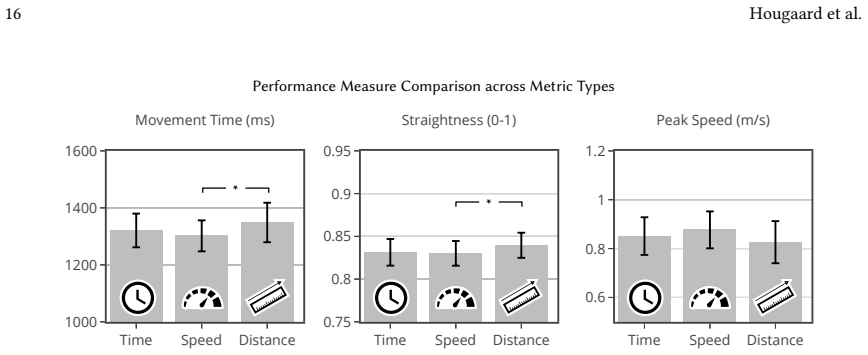
Dynamic feedback driven by performance metrics in a VR pointing task leads to straighter and faster pointing on average, though effects vary by individual.
A machine-rendered reading of the paper's core claim, the machinery that carries it, and where it could break.
Core claim
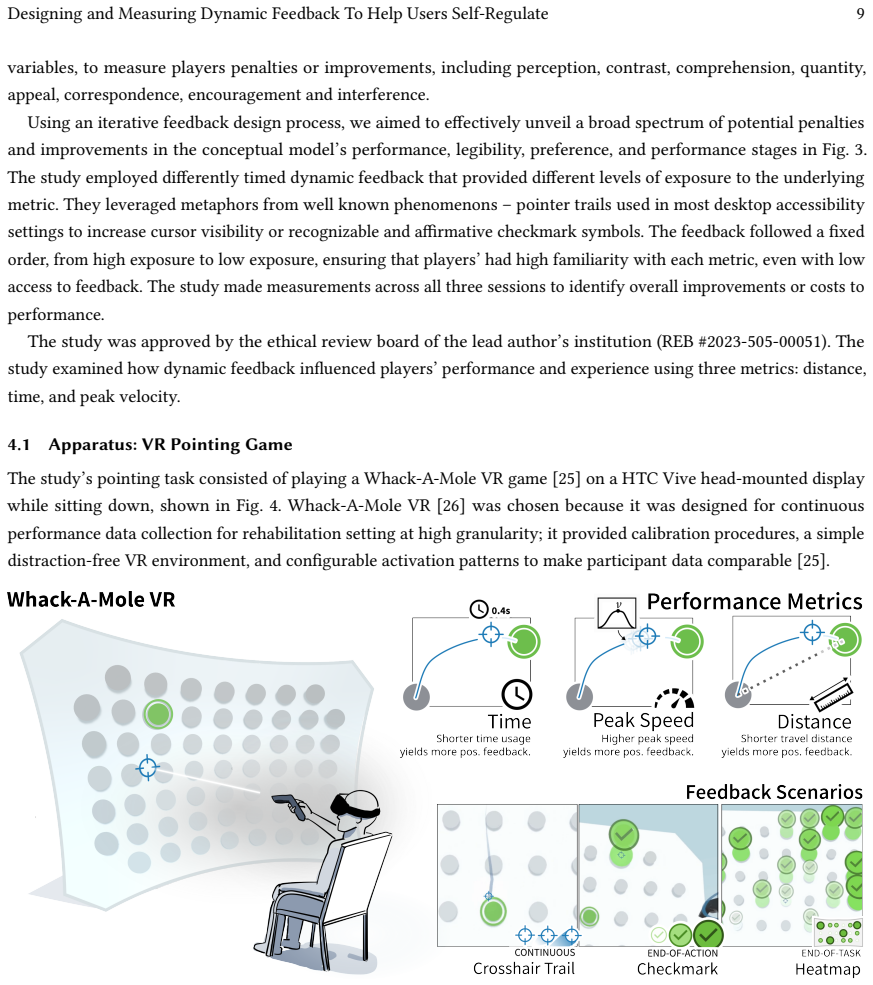
By comparing dynamic feedback schemes in a VR pointing task where the feedback is driven by metrics for short completion times, straight movements, or high peak speed, and presented continuously, at end-of-action, or end-of-task, the study shows that on average the feedback leads to straighter and faster pointing, though individual responses vary.
What carries the argument
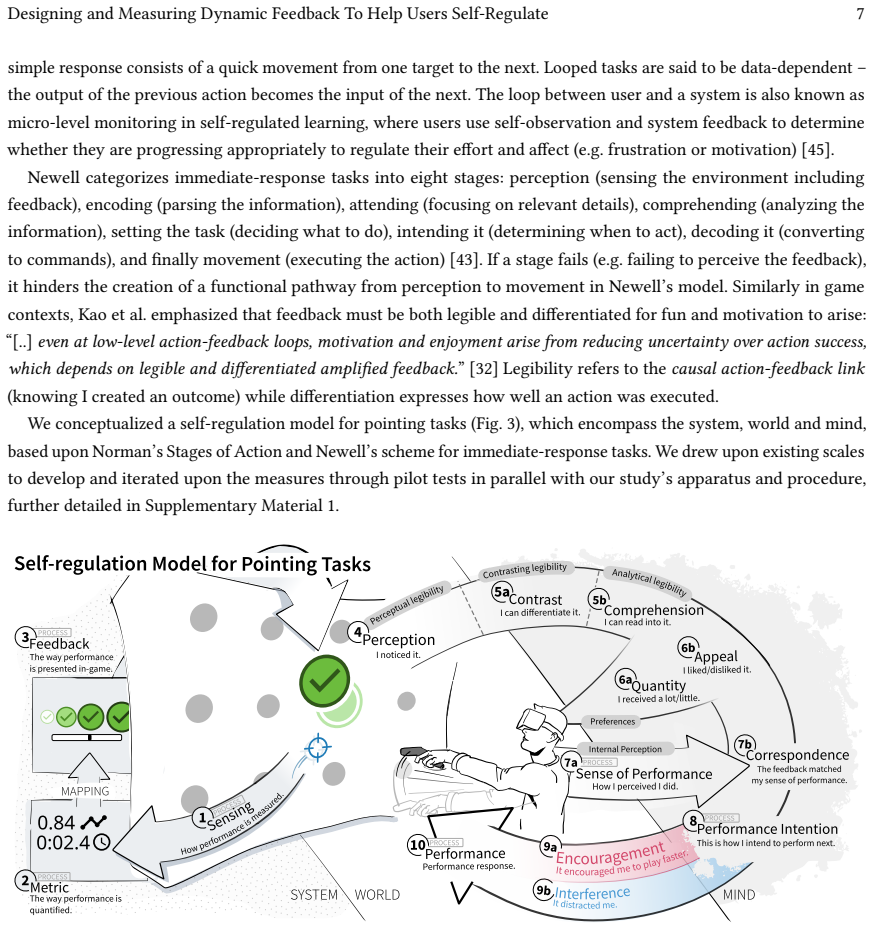
Performance-metric-driven dynamic feedback, where the chosen metric (completion time, straightness, or peak speed) shapes the form of the feedback delivered at one of three timings to encourage self-regulation.
If this is right
- Aligning feedback with a straightness metric promotes straighter movements on average in pointing tasks.
- Feedback based on peak speed can increase movement speed on average.
- Feedback schemes should be selected to match the specific performance objectives of the game.
- Individual differences in response require designers to account for users who may not benefit or may be hindered.
Where Pith is reading between the lines
- Personalized selection of which metric drives the feedback could reduce the cases of small or negative effects.
- The same metric-driven approach might transfer to other motor control tasks such as steering or object manipulation in VR.
- Testing the feedback inside complete games rather than isolated pointing trials could show whether the average gains persist during play.
Load-bearing premise
The three chosen performance metrics and three timing conditions are sufficient to represent the space of dynamic feedback relevant to self-regulation in pointing tasks.
What would settle it
A replication of the VR pointing experiment that finds no average improvement in straightness or speed across the dynamic feedback conditions compared to a baseline.
Figures





read the original abstract
The way games dynamically convey information through feedback is critical to players' ability to perform, learn, and improve. However, it is poorly understood how performance metrics impact player performance and perception in core game tasks like pointing or steering. With a virtual reality pointing task we systematically explored how three performance metrics driving the feedback affected players when rewarding short completion times, straight movements, or high peak speed. across different points in time - continuously, at end-of-action, or at end-of-task. On average the dynamic feedback helped people point more straight and faster, while for others it had small or opposite effect. The study quantitatively compared dynamic feedback across three forms with the metrics driving the form as the intended locus of quantitative comparison. Our work improves game designers basis for crafting dynamic feedback by helping them know when to employ feedback schemes that align with desirable game performance objectives.
Editorial analysis
A structured set of objections, weighed in public.
Referee Report
Summary. The paper describes a VR user study on dynamic feedback in a pointing task. It explores three performance metrics (short completion times, straight movements, high peak speed) and three timing conditions (continuous, end-of-action, end-of-task) for feedback. The main finding is that on average, dynamic feedback helped users point more straight and faster, with some individual variation in effects. The goal is to provide guidance for game designers on using feedback aligned with performance objectives.
Significance. If supported by appropriate statistical analysis, this study offers empirical insights into how different feedback designs affect self-regulation in VR pointing tasks, which could inform the design of more effective game feedback mechanisms.
major comments (1)
- [Abstract] Abstract: The central claim that 'On average the dynamic feedback helped people point more straight and faster' is presented without any mention of sample size, statistical tests, error bars, p-values, or exclusion criteria. This omission makes it difficult to assess the strength and reliability of the reported average improvement.
minor comments (2)
- [Abstract] Abstract: The sentence 'across different points in time - continuously, at end-of-action, or at end-of-task.' appears to be missing a verb or connector after 'time'.
- [Abstract] Abstract: The phrasing 'The study quantitatively compared dynamic feedback across three forms with the metrics driving the form as the intended locus of quantitative comparison.' is somewhat unclear and could be rephrased for better readability.
Simulated Author's Rebuttal
We thank the referee for their review and the opportunity to clarify the presentation of our results. We address the concern regarding the abstract below.
read point-by-point responses
-
Referee: [Abstract] Abstract: The central claim that 'On average the dynamic feedback helped people point more straight and faster' is presented without any mention of sample size, statistical tests, error bars, p-values, or exclusion criteria. This omission makes it difficult to assess the strength and reliability of the reported average improvement.
Authors: We agree that the abstract would benefit from additional statistical context to support the central claim. In the revised version we will add a concise clause noting the sample size, the use of appropriate statistical tests (with key p-values), and that the reported average effects are accompanied by individual variation. Due to typical abstract length limits we will keep the addition brief while ensuring the claim is better grounded. revision: yes
Circularity Check
Empirical user study; no derivations or self-citations reduce claims
full rationale
The paper reports results from a factorial VR pointing-task experiment comparing three performance metrics and three feedback timings. No equations, fitted parameters presented as predictions, or load-bearing self-citations appear in the abstract or described structure. Central claims rest on direct statistical comparison of collected participant data and are therefore self-contained against external benchmarks.
Axiom & Free-Parameter Ledger
Reference graph
Works this paper leans on
-
[1]
Amina Adadi and Mohammed Berrada. 2018. Peeking Inside the Black-Box: A Survey on Explainable Artificial Intelligence (XAI). IEEE Access 6 (2018), 52138–52160. doi:10.1109/ACCESS.2018.2870052
-
[2]
Scott Mackenzie, and Thierry Hasbrouq
Motoyuki Akamatsu, I. Scott Mackenzie, and Thierry Hasbrouq. 1995. A comparison of tactile, auditory, and visual feedback in a pointing task using a mouse-type device. Ergonomics 38, 4 (April 1995), 816–827. doi:10.1080/00140139508925152
-
[3]
Anil Ufuk Batmaz, Kangyou Yu, Hai-Ning Liang, and Wolfgang Stuerzlinger. 2022. Improving Effective Throughput Performance using Auditory Feedback in Virtual Reality. InProceedings of the 2022 ACM Symposium on Spatial User Interaction (SUI ’22). Association for Computing Machinery, New York, NY, USA, 1–11. doi:10.1145/3565970.3567702
-
[4]
Doug Bowman, Chadwick Wingrave, Joshua Campbell, and Vinh Ly. 2001. Using Pinch Gloves(TM) for both Natural and Abstract Interaction Techniques in Virtual Environments. Technical Report TR-01-23, Computer Science, Virginia Tech
2001
-
[5]
Louise Brennan, Enrique Dorronzoro Zubiete, and Brian Caulfield. 2020. Feedback Design in Targeted Exercise Digital Biofeedback Systems for Home Rehabilitation: A Scoping Review. Sensors 20, 1 (Jan. 2020), 181. doi:10.3390/s20010181
-
[6]
Deborah L. Butler and Philip H. Winne. 1995. Feedback and Self-Regulated Learning: A Theoretical Synthesis. Review of Educational Research 65, 3 (Sept. 1995), 245–281. doi:10.3102/00346543065003245
-
[7]
Arthur Theil Cabreira and Faustina Hwang. 2018. Evaluating the Effects of Feedback Type on Older Adults’ Performance in Mid-Air Pointing and Target Selection. In Proceedings of the 2018 ACM Symposium on Spatial User Interaction (Berlin, Germany) (SUI ’18). Association for Computing Machinery, New York, NY, USA, 111–119. doi:10.1145/3267782.3267933
-
[8]
Loïc Caroux and Katherine Isbister. 2016. Influence of head-up displays’ characteristics on user experience in video games. International Journal of Human-Computer Studies 87 (March 2016), 65–79. doi:10.1016/j.ijhcs.2015.11.001
-
[9]
Julian Felipe Villada Castillo, Maria Fernanda Montoya Vega, John Edison Muñoz Cardona, David Lopez, Leonardo Quiñones, Oscar Alberto Henao Gallo, and Jose Fernando Lopez. 2024. Design of Virtual Reality Exergames for Upper Limb Stroke Rehabilitation Following Iterative Design Methods: Usability Study. JMIR Serious Games 12, 1 (Jan. 2024), e48900. doi:10....
-
[10]
Jean Côté. 2006. The Development of Coaching Knowledge. International Journal of Sports Science & Coaching 1, 3 (Sept. 2006), 217–222. doi:10.1260/174795406778604609
-
[11]
Sebastian Deterding. 2015. The Lens of Intrinsic Skill Atoms: A Method for Gameful Design. Human–Computer Interaction 30, 3–4 (May 2015), 294–335. doi:10.1080/07370024.2014.993471
-
[12]
Dillman, Terrance Tin Hoi Mok, Anthony Tang, Lora Oehlberg, and Alex Mitchell
Kody R. Dillman, Terrance Tin Hoi Mok, Anthony Tang, Lora Oehlberg, and Alex Mitchell. 2018. A Visual Interaction Cue Framework from Video Game Environments for Augmented Reality. In Proceedings of the 2018 CHI Conference on Human Factors in Computing Systems (CHI ’18). Association for Computing Machinery, New York, NY, USA, 1–12. doi:10.1145/3173574.3173714
-
[13]
Marie Harkin, and Sebastian Pannasch
Annika Dix, Clarissa Sabrina Arlinghaus, A. Marie Harkin, and Sebastian Pannasch. 2023. The Role of Audiovisual Feedback Delays and Bimodal Congruency for Visuomotor Performance in Human-Machine Interaction. In Proceedings of the 25th International Conference on Multimodal Interaction (ICMI ’23). Association for Computing Machinery, New York, NY, USA, 555...
-
[14]
Paul M Fitts and James R Peterson. 1964. Information capacity of discrete motor responses. Journal of Experimental Psychology: General 67, 2 (1964), 103–112
1964
-
[15]
Beat Games. 2019. Beat Saber. Game [Windows, Playstation 4, Playstation 5, Meta Quest]. Designing and Measuring Dynamic Feedback To Help Users Self-Regulate 23
2019
-
[16]
Andrea Gauthier, Laura Benton, Leona Bunting, Elisabeth Herbert, Emma Sumner, Manolis Mavrikis, Andrea Revesz, and Asimina Vasalou. 2022. I Don’t Usually Listen, I Read: How Different Learner Groups Process Game Feedback. InProceedings of the 2022 CHI Conference on Human Factors in Computing Systems (CHI ’22). Association for Computing Machinery, New York...
-
[17]
Halfbrick. 2010. Fruit Ninja. Game [iOS, Android, PlayStation 4, PlayStation Vita, Web Browser, Xbox One]
2010
-
[18]
Rex Hartson. 2003. Cognitive, physical, sensory, and functional affordances in interaction design. Behaviour & Information Technology 22, 5 (Sept. 2003), 315–338. doi:10.1080/01449290310001592587
-
[19]
Dean Herbert. 2007. Osu! https://osu.ppy.sh. Game [macOS, Windows, Linux, Android, iOS]
2007
-
[20]
Kieran Hicks, Patrick Dickinson, Jussi Holopainen, and Kathrin Gerling. 2018. Good Game Feel: An Empirically Grounded Framework for Juicy Design. In Proceedings of DiGRA 2018 Conference: The Game is the Message. Digital Games Research Association, Finland, 1–17
2018
-
[21]
Kieran Hicks, Kathrin Gerling, Patrick Dickinson, and Vero Vanden Abeele. 2019. Juicy Game Design: Understanding the Impact of Visual Embellishments on Player Experience. In Proceedings of the Annual Symposium on Computer-Human Interaction in Play (CHI PLAY ’19). Association for Computing Machinery, New York, NY, USA, 185–197
2019
-
[22]
Bas Van Hooren, Jos Goudsmit, Juan Restrepo, and Steven Vos. 2020. Real-time feedback by wearables in running: Current approaches, challenges and suggestions for improvements. Journal of Sports Sciences 38, 2 (jan 2020), 14–230. https://www .tandfonline.com/doi/abs/10.1080/ 02640414.2019.1690960
arXiv 2020
-
[23]
Britton Horn, Seth Cooper, and Sebastian Deterding. 2017. Adapting Cognitive Task Analysis to Elicit the Skill Chain of a Game. In Proceedings of the Annual Symposium on Computer-Human Interaction in Play (CHI PLAY ’17). Association for Computing Machinery, New York, NY, USA, 277–289. doi:10.1145/3116595.3116640
-
[24]
Bastian Ilsø Hougaard and Hendrik Knoche. 2024. Aiming, Pointing, Steering: A Core Task Analysis Framework for Gameplay. Proceedings of ACM Human-Computer Interaction 8 (Oct. 2024), 49. doi:10.1145/3677057 In Press
-
[25]
Bastian Ilsø Hougaard, Hendrik Knoche, Iris Charlotte Brunner, and Lars Evald. 2022. Whack-A-Mole VR: Demonstration of Accessible Virtual Reality Game Design for Stroke Rehabilitation. In Adjunct Proceedings of the 2022 Nordic Human-Computer Interaction Conference (Aarhus, Denmark) (NordiCHI ’22). Association for Computing Machinery, New York, NY, USA, Ar...
-
[26]
Hougaard, Hendrik Knoche, Lars Evald, and Iris Brunner
Bastian I. Hougaard, Hendrik Knoche, Lars Evald, and Iris Brunner. 2019. Whack-A-Mole VR. https://github.com/med-material/Whack_A_Mole_VR. Game [Windows, macOS, Linux]
2019
-
[27]
Bastian Ilsø Hougaard, Milo Marsfeldt Skovfoged, Lars Evald, Iris Brunner, and Hendrik Knoche. 2022. Virtual Motor Spaces: Exploring how to amplify movements in VR stroke rehabilitation to aid patients with upper limb hemiparesis. In Proceedings of the podium and poster presentations at the International Conference for Virtual Reality 2022. ICVR 2022, Rot...
-
[28]
Christos Ioannou, Patrick Archard, Eamonn O’Neill, and Christof Lutteroth. 2019. Virtual Performance Augmentation in an Immersive Jump & Run Exergame. In Proceedings of the 2019 CHI Conference on Human Factors in Computing Systems. ACM, New York, NY, USA, 1–15
2019
-
[29]
Susan A. Jackson and Herbert W. Marsh. 1996. Development and Validation of a Scale to Measure Optimal Experience: The Flow State Scale.Journal of Sport and Exercise Psychology 18, 1 (March 1996), 17–35. doi:10.1123/jsep.18.1.17
-
[30]
Cheryl I. Johnson, Shannon K. T. Bailey, and Wendi L. Van Buskirk. 2017.Designing Effective Feedback Messages in Serious Games and Simulations: A Research Review. Springer International Publishing, Cham, 119–140. doi:10.1007/978-3-319-39298-1_7
-
[31]
Jesper Juul and Jason Scott Begy. 2016. Good Feedback for bad Players? A preliminary Study of ‘juicy’Interface feedback. InProceedings of first joint FDG/DiGRA Conference, Dundee. Digital Games Research Association, Finland, 1
2016
-
[32]
Dominic Kao, Nick Ballou, Kathrin Gerling, Heiko Breitsohl, and Sebastian Deterding. 2024. How does Juicy Game Feedback Motivate? Testing Curiosity, Competence, and Effectance. InProceedings of the 2024 CHI Conference on Human Factors in Computing Systems (CHI ’24). Association for Computing Machinery, New York, NY, USA, 1–16. doi:10.1145/3613904.3642656
-
[33]
Sukran Karaosmanoglu, Moritz Wegner, Sebastian Cmentowski, and Frank Steinicke. 2024. Move, React, Repeat! The Role of Continuous Cues in Immersive Exergames. Proc. ACM Hum.-Comput. Interact. 8, CHI PLAY (Oct. 2024), 326:1–326:23. doi:10.1145/3677091
-
[34]
Robyn S. Kim, Aaron R. Seitz, and Ladan Shams. 2008. Benefits of Stimulus Congruency for Multisensory Facilitation of Visual Learning. PLOS ONE 3, 1 (Jan. 2008), e1532. doi:10.1371/journal.pone.0001532
-
[35]
Christoph Klimmt, Tilo Hartmann, and Andreas Frey. 2007. Effectance and Control as Determinants of Video Game Enjoyment. CyberPsychology & Behavior 10, 6 (Dec. 2007), 845–848. doi:10.1089/cpb.2007.9942
-
[36]
Michael Lankes and Argenis Ramirez Gomez. 2022. GazeCues: Exploring the Effects of Gaze-based Visual Cues in Virtual Reality Exploration Games. Proc. ACM Hum.-Comput. Interact. 6, CHI PLAY (Oct. 2022), 237:1–237:25. doi:10.1145/3549500
-
[37]
Regan L. Mandryk and Calvin Lough. 2011. The effects of intended use on target acquisition. In Proceedings of the SIGCHI Conference on Human Factors in Computing Systems (CHI ’11). Association for Computing Machinery, New York, NY, USA, 1649–1652. doi:10.1145/1978942.1979182
-
[38]
Jana Maresch and Opher Donchin. 2022. Prolonged Feedback Duration Does Not Affect Implicit Recalibration in a Visuomotor Rotation Task. eNeuro 9, 2 (March 2022). doi:10.1523/ENEURO.0447-21.2022
-
[39]
Mitchell McEwan, Alethea Blackler, Peta Wyeth, and Daniel Johnson. 2020. Intuitive Interaction with Motion Controls in a Tennis Video Game. In Proceedings of the Annual Symposium on Computer-Human Interaction in Play (CHI PLAY ’20). Association for Computing Machinery, New York, NY, USA, 321–333. doi:10.1145/3410404.3414242
-
[40]
Meyer, J
David E. Meyer, J. E. Keith Smith, Sylvan Kornblum, Richard A. Abrams, and Charles E. Wright. 1990. Speed—Accuracy Tradeoffs in Aimed Movements: Toward a Theory of Rapid Voluntary Action. In Attention and Performance Xiii. Psychology Press, Sussex, UK. 24 Hougaard et al
1990
-
[41]
Vera and Xiao, Ziang , title =
Josh Aaron Miller, Kutub Gandhi, Matthew Alexander Whitby, Mehmet Kosa, Seth Cooper, Elisa D. Mekler, and Ioanna Iacovides. 2024. A Design Framework for Reflective Play. In Proceedings of the 2024 CHI Conference on Human Factors in Computing Systems (CHI ’24). Association for Computing Machinery, New York, NY, USA, 1–21. doi:10.1145/3613904.3642455
-
[42]
Lennart Erik Nacke, Michael Kalyn, Calvin Lough, and Regan Lee Mandryk. 2011. Biofeedback game design: using direct and indirect physiological control to enhance game interaction. In Proceedings of the SIGCHI Conference on Human Factors in Computing Systems (CHI ’11). Association for Computing Machinery, New York, NY, USA, 103–112. doi:10.1145/1978942.1978958
-
[43]
Allen Newell. 1994. Unified Theories of Cognition. Harvard University Press
1994
-
[44]
Donald A. Norman. 1988. The psychology of everyday things. Basic Books, New York, NY, US. xi, 257 pages
1988
-
[45]
Ernesto Panadero. 2017. A Review of Self-regulated Learning: Six Models and Four Directions for Research. Frontiers in Psychology 8 (April 2017). doi:10.3389/fpsyg.2017.00422
-
[46]
Elissa Phillips, Damian Farrow, Kevin Ball, and Richard Helmer. 2013. Harnessing and Understanding Feedback Technology in Applied Settings. Sports Medicine 43, 10 (Oct. 2013), 919–925. doi:10.1007/s40279-013-0072-7
-
[47]
Scott Rigby and Richard M. Ryan. 2011. Glued to Games: How Video Games Draw Us In and Hold Us Spellbound. Bloomsbury Publishing USA
2011
-
[48]
Jesse Schell. 2019. The Art of Game Design: A Book of Lenses, Third Edition. CRC Press, Boca Raton, Florida
2019
-
[49]
Schmidt, Timothy D
Richard A. Schmidt, Timothy D. Lee, Carolee Winstein, Gabriele Wulf, and Howard N. Zelaznik. 2018. Motor Control and Learning: A Behavioral Emphasis. Human Kinetics, Champaign, IL
2018
-
[50]
Bianca G. S. Schor, Chris Norval, Ellen Charlesworth, and Jatinder Singh. 2024. Mind The Gap: Designers and Standards on Algorithmic System Transparency for Users. In Proceedings of the 2024 CHI Conference on Human Factors in Computing Systems (CHI ’24). Association for Computing Machinery, New York, NY, USA, 1–16. doi:10.1145/3613904.3642531
-
[51]
Ben Shneiderman. 2020. Bridging the Gap Between Ethics and Practice: Guidelines for Reliable, Safe, and Trustworthy Human-centered AI Systems. ACM Trans. Interact. Intell. Syst. 10, 4 (Oct. 2020), 26:1–26:31. doi:10.1145/3419764
-
[52]
Valerie J. Shute. 2008. Focus on Formative Feedback. Review of Educational Research 78, 1 (March 2008), 153–189. doi:10 .3102/0034654307313795
2008
-
[53]
Roland Sigrist, Georg Rauter, Robert Riener, and Peter Wolf. 2013. Augmented visual, auditory, haptic, and multimodal feedback in motor learning: A review. Psychonomic Bulletin & Review 20, 1 (Feb. 2013), 21–53. doi:10.3758/s13423-012-0333-8
-
[54]
Paul Skalski, Ron Tamborini, Ashleigh Shelton, Michael Buncher, and Pete Lindmark. 2011. Mapping the road to fun: Natural video game controllers, presence, and game enjoyment. New Media & Society 13, 2 (March 2011), 224–242. doi:10.1177/1461444810370949
-
[55]
R. William Soukoreff and I. Scott MacKenzie. 2004. Towards a standard for pointing device evaluation, perspectives on 27 years of Fitts’ law research in HCI. International Journal of Human-Computer Studies 61, 6 (Dec. 2004), 751–789. doi:10.1016/j.ijhcs.2004.09.001
-
[56]
Steve Swink. 2014. Game Feel: A Game Designer’sGuide to Virtual Sensation. CRC Press, Boca Raton. doi:10.1201/9781482267334
-
[57]
Taylor, Robert Bogdan, and Marjorie DeVault
Steven J. Taylor, Robert Bogdan, and Marjorie DeVault. 2015.Introduction to Qualitative Research Methods: A Guidebook and Resource (4th edition ed.). Wiley, Hoboken, New Jersey
2015
-
[58]
Michael G. Trotter, Emmanuel A. C. Obine, and Benjamin T. Sharpe. 2023. Self-regulation, stress appraisal, and esport action performance.Frontiers in Psychology 14 (Oct. 2023). doi:10.3389/fpsyg.2023.1265778
-
[59]
S. A. G. Wensveen, J. P. Djajadiningrat, and C. J. Overbeeke. 2004. Interaction frogger: a design framework to couple action and function through feedback and feedforward. In Proceedings of the 5th conference on Designing interactive systems: processes, practices, methods, and techniques (DIS ’04). Association for Computing Machinery, New York, NY, USA, 1...
discussion (0)
Sign in with ORCID, Apple, or X to comment. Anyone can read and Pith papers without signing in.