TNG SAM: Bridging Hydrodynamical Complexity and Semi-Analytic Efficiency to Model Galaxy Formation
Pith reviewed 2026-06-26 23:38 UTC · model grok-4.3
The pith
A calibrated semi-analytic model reproduces hydrodynamical galaxy and halo properties within 30 percent accuracy out to redshift 6.
A machine-rendered reading of the paper's core claim, the machinery that carries it, and where it could break.
Core claim
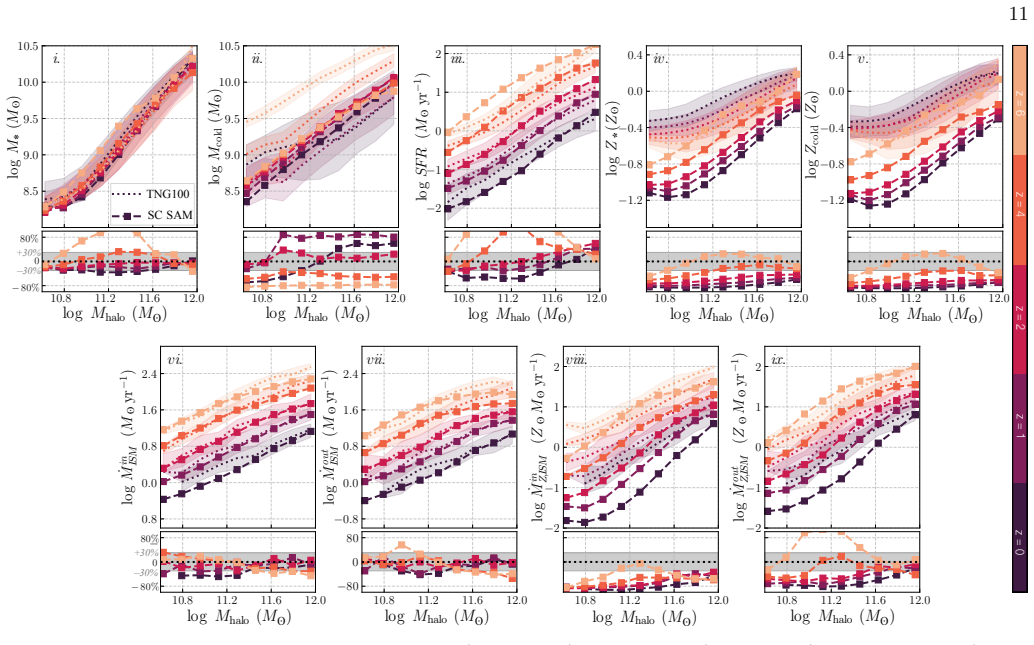
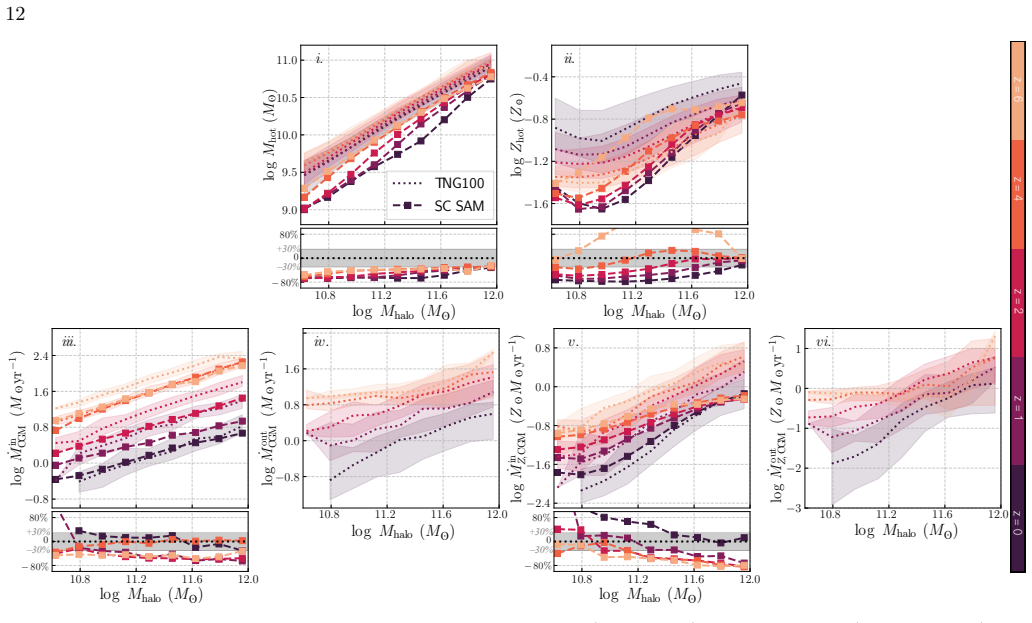
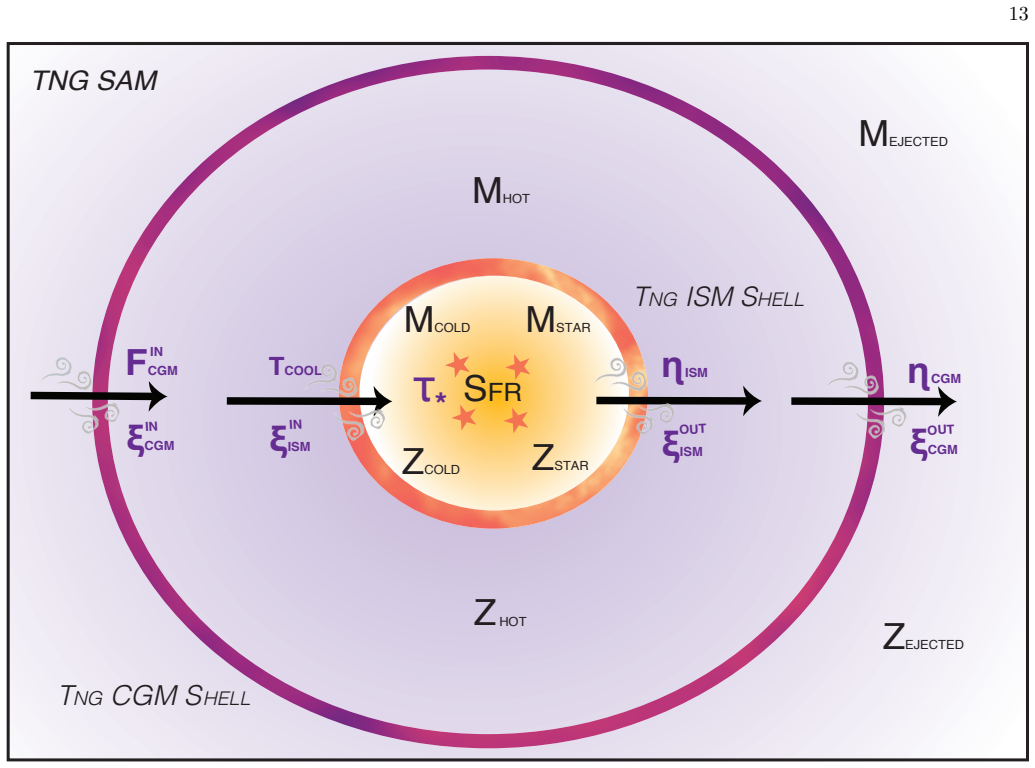
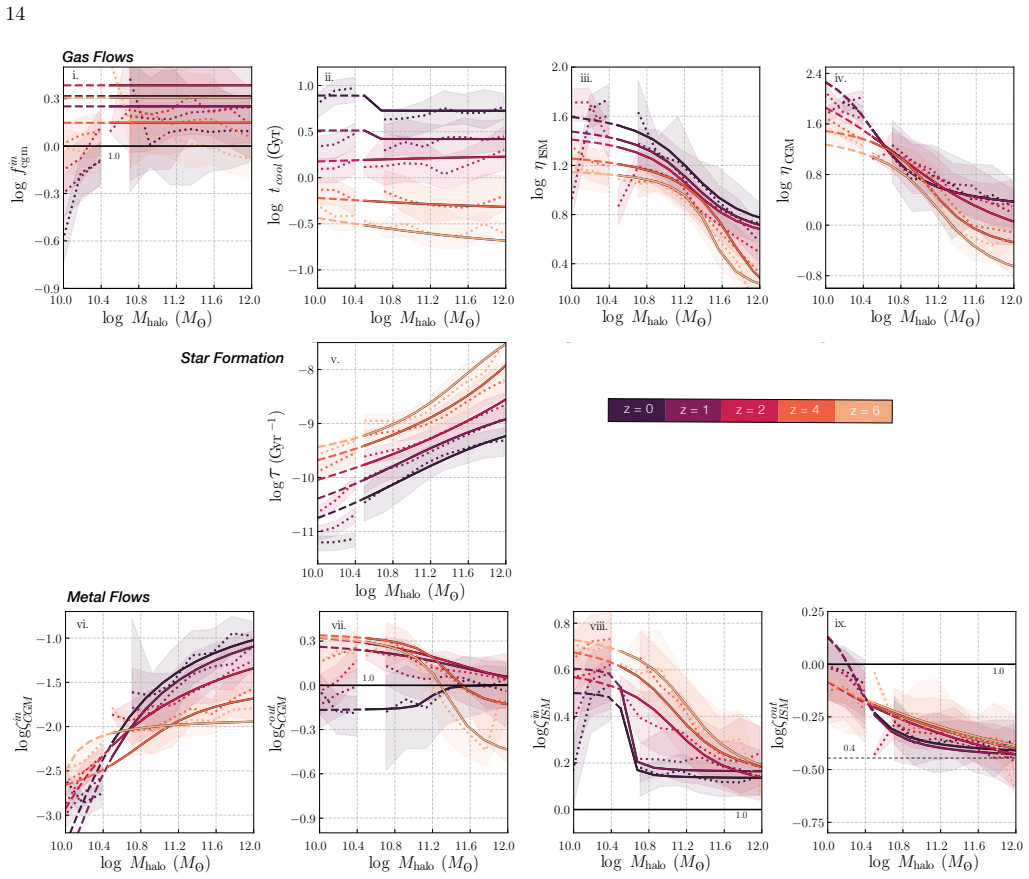
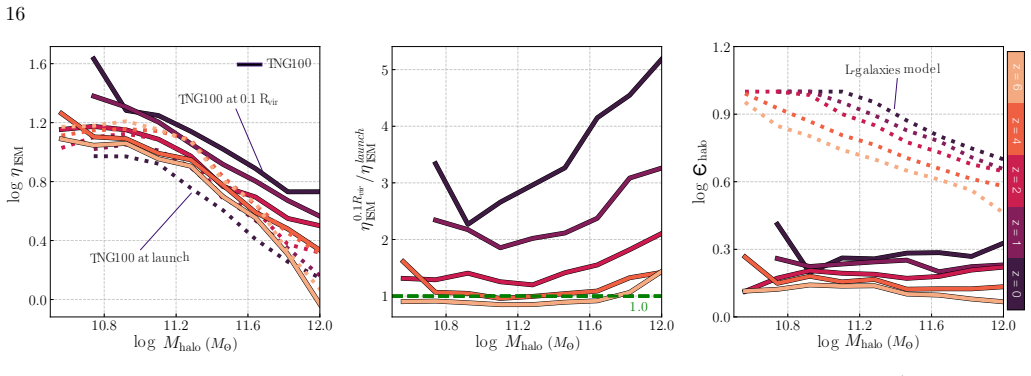
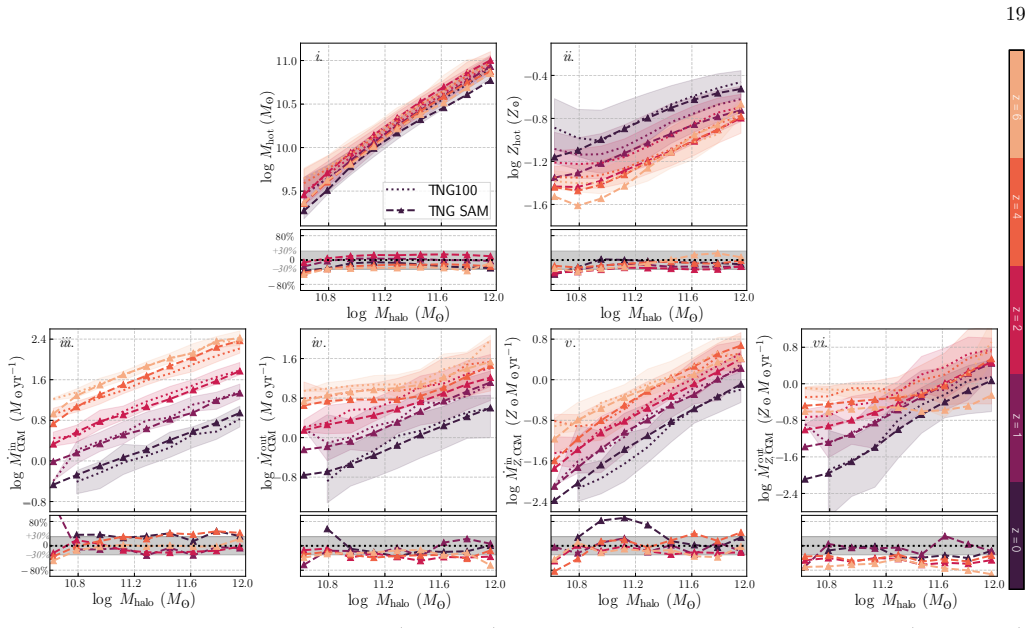
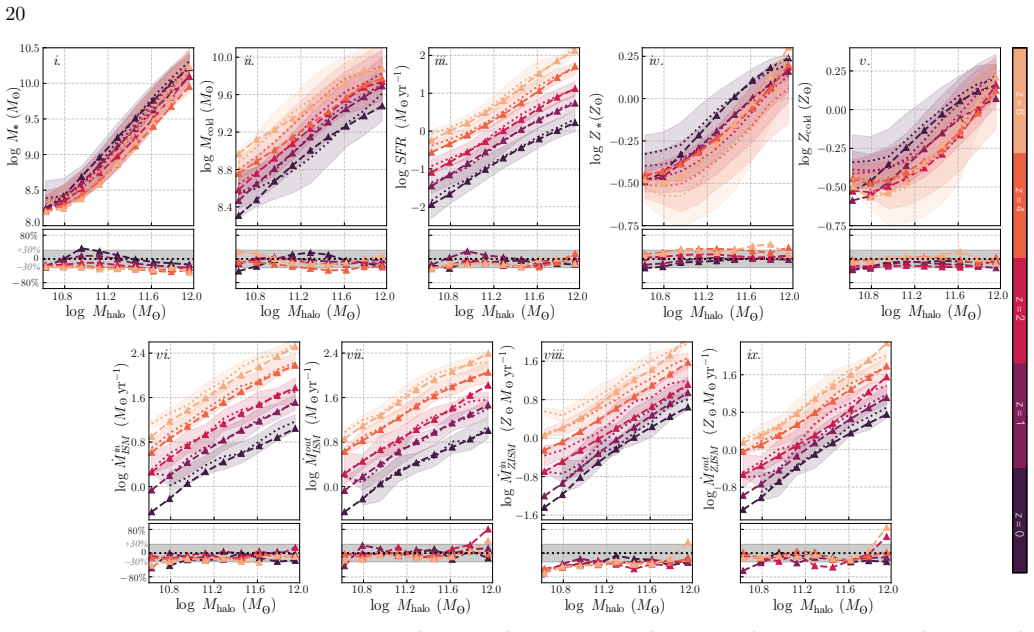
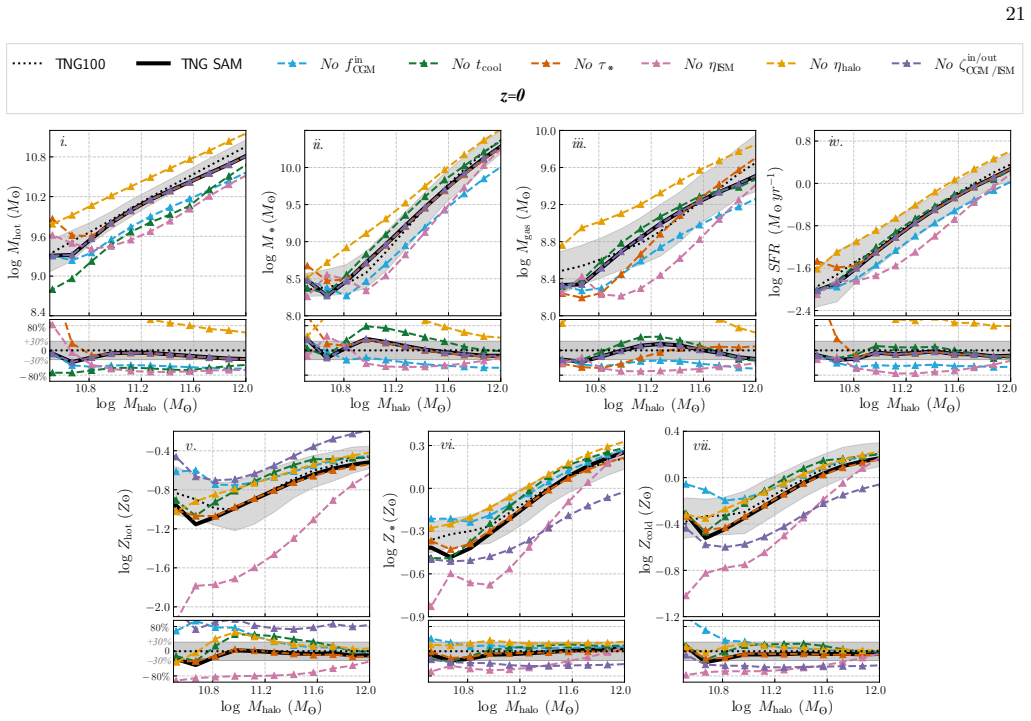
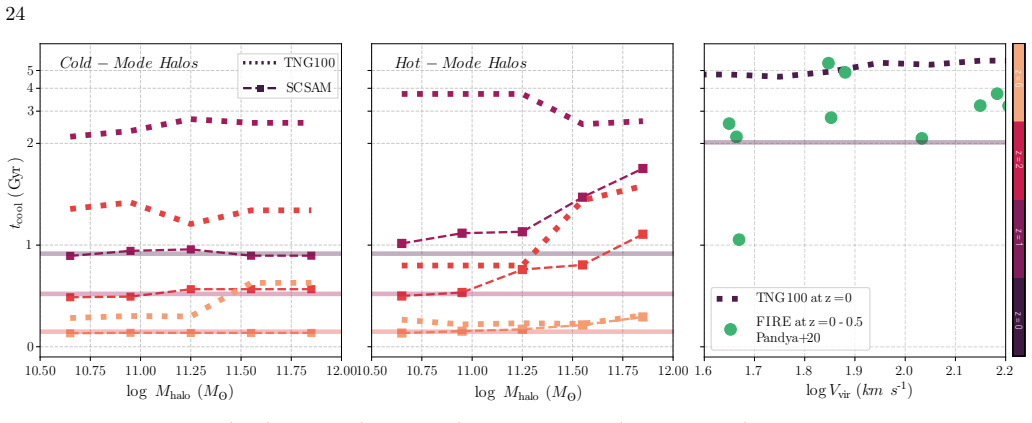
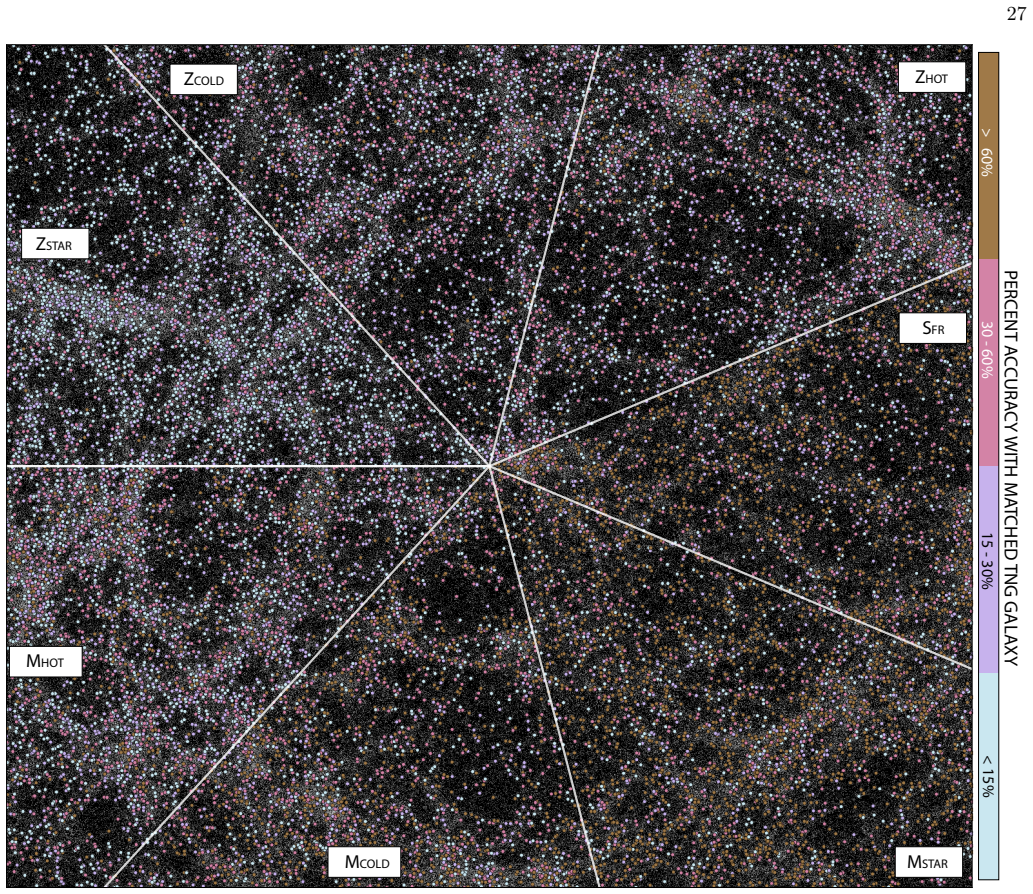
With updates to halo gas re-accretion efficiency, a cooling model that goes beyond the traditional cold or hot mode split, explicit galactic and halo outflows, star formation efficiency, and metal circulation between galaxies and surroundings, the model reproduces the gas and metal flows from galaxy to halo scales as well as global properties within 30 percent accuracy out to redshift 6 after calibration on stellar feedback dominated galaxies.
What carries the argument
The updated semi-analytic model that incorporates targeted changes to gas cycling and feedback processes to align with hydrodynamical simulation results.
If this is right
- Such a model enables study of galaxy evolution across large cosmological volumes needed for future observational surveys.
- The complex physics of gas and metal flows in galaxy formation can be captured in an efficient analytic framework.
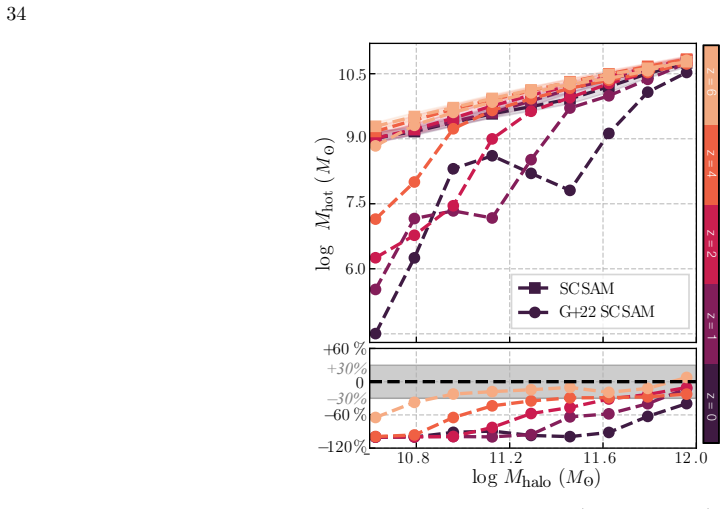
- Global properties of galaxies and halos are matched to within 30 percent accuracy across a range of redshifts.
- The approach bridges the detail of hydrodynamical simulations with the speed of semi-analytic methods.
Where Pith is reading between the lines
- Rapid parameter variation studies become possible that would be too costly in full hydrodynamical simulations.
- Calibration to a broader range of halo masses could extend the model's reach to different galaxy populations.
- Direct comparisons with wide-field survey data could become more feasible with this efficient modeling tool.
Load-bearing premise
The calibration performed only on stellar feedback-dominated galaxies in halos from about 10 billion to 1 trillion solar masses captures the key baryon cycling physics needed for accuracy at all redshifts and for all galaxy properties.
What would settle it
A comparison where the model's predicted stellar masses or hot halo gas masses deviate by more than 30 percent from those in the hydrodynamical simulation at redshifts or masses outside the calibration sample would disprove the central claim.
Figures





read the original abstract
All cosmological models of galaxy formation must navigate the trade-off between physical accuracy and computational efficiency. Hydrodynamical simulations provide spatially resolved predictions for the co-evolution of dark matter, gas, stars, and black holes, but rely on phenomenological subgrid models for small-scale processes (e.g., star formation). Semi-analytic models (SAMs), by contrast, gain efficiency through simplified, analytic treatments of the same processes, at the cost of reduced predictive scope. In this work, we leverage the strengths of the Santa Cruz SAM and the IllustrisTNG hydrodynamical simulation to develop the TNG SAM. Calibrated to reproduce baryon cycling in stellar feedback-dominated TNG galaxies ($\sim 10^{10}M_\odot < M_{200} < 10^{12}M_\odot$), the TNG SAM introduces several key updates to the Santa Cruz framework regarding: 1) halo gas (re-)accretion efficiency, 2) a cooling model that moves beyond the traditional cold/hot mode dichotomy, 3) explicit treatment of both galactic- and halo-scale outflows, 4) star formation efficiency, and 5) the circulation of metals between galaxies and their surroundings. These changes enable the TNG SAM to reproduce TNG's flow of gas and metals from the scale of the galaxy to the halo, as well as global galaxy (e.g., stellar mass) and halo (e.g. hot halo gas mass) properties within $\lesssim 30\%$ accuracy out to $z=6$. This work demonstrates that, with appropriate calibration, SAMs can capture the complex physics of galaxy formation modeled in hydrodynamical simulations while providing a flexible framework for studying galaxy evolution across the large cosmological volumes targeted by future observational surveys.
Editorial analysis
A structured set of objections, weighed in public.
Referee Report
Summary. The manuscript introduces the TNG SAM, an updated version of the Santa Cruz semi-analytic model incorporating five changes (halo gas re-accretion efficiency, a cooling model beyond the cold/hot dichotomy, explicit galactic- and halo-scale outflows, star formation efficiency, and metal circulation parameters) that are calibrated to reproduce baryon cycling and global properties (stellar mass, hot halo gas, metals) from the IllustrisTNG hydrodynamical simulation for stellar-feedback-dominated galaxies in the halo mass range ~10^10 < M_200 < 10^12 M_⊙, achieving agreement within ≲30% out to z=6.
Significance. If the calibrated parameters capture essential baryon cycling physics rather than fitting the narrow calibration domain, the result would be significant for enabling efficient modeling of galaxy evolution over the large cosmological volumes needed for future surveys while retaining key aspects of hydrodynamical complexity; however, the presented evidence consists solely of post-calibration agreement without independent validation.
major comments (2)
- [Abstract] Abstract: the reproduction of TNG gas flows, metal circulation, stellar mass, and hot halo gas mass to ≲30% is achieved by explicit calibration of the five model updates to TNG data in the stated mass range; the manuscript provides no independent validation tests outside ~10^10–10^12 M_⊙ or in AGN-feedback regimes, which is load-bearing for the claim that the updates enable accuracy across redshifts and properties.
- [Abstract] Abstract: no details are supplied on the procedure used to choose or constrain the five free parameters (halo gas re-accretion efficiency, cooling model parameters, outflow parameters, star formation efficiency, metal circulation parameters), making it impossible to determine whether the reported match reflects captured physics or is by construction within the fitted parameter space.
Simulated Author's Rebuttal
We thank the referee for their constructive report and for highlighting the need for greater clarity in the abstract regarding the calibration domain and parameter selection. We agree that revisions are warranted to avoid any implication of independent validation or unspecified fitting procedures. We respond to each major comment below and will update the abstract and, where appropriate, the methods section in the revised manuscript.
read point-by-point responses
-
Referee: [Abstract] Abstract: the reproduction of TNG gas flows, metal circulation, stellar mass, and hot halo gas mass to ≲30% is achieved by explicit calibration of the five model updates to TNG data in the stated mass range; the manuscript provides no independent validation tests outside ~10^10–10^12 M_⊙ or in AGN-feedback regimes, which is load-bearing for the claim that the updates enable accuracy across redshifts and properties.
Authors: We agree that the reported agreement is the direct result of calibration to TNG within 10^10 < M_200 < 10^12 M_⊙ for stellar-feedback-dominated galaxies and that no independent validation outside this range or in AGN-feedback regimes is presented. The abstract already qualifies the results as calibrated, but we will revise it to state explicitly that the ≲30% accuracy holds within the calibrated domain and redshift range, without claiming broader applicability. This addresses the concern that the claim is load-bearing; the revised wording will limit the scope to the stellar-feedback regime where the updates were tuned. revision: yes
-
Referee: [Abstract] Abstract: no details are supplied on the procedure used to choose or constrain the five free parameters (halo gas re-accretion efficiency, cooling model parameters, outflow parameters, star formation efficiency, metal circulation parameters), making it impossible to determine whether the reported match reflects captured physics or is by construction within the fitted parameter space.
Authors: The full manuscript includes a methods section that describes the iterative calibration process used to constrain the five parameters against TNG baryon-cycle diagnostics. To ensure the abstract is self-contained, we will add a brief clause summarizing that the parameters were adjusted via targeted matching to TNG gas and metal flow rates, star-formation efficiencies, and outflow loadings within the stated mass range. This will clarify that the procedure is not arbitrary but is documented in the paper, while still acknowledging that the match is by design within the calibration space. revision: yes
Circularity Check
TNG SAM reproduction of TNG properties achieved by explicit calibration to TNG data
specific steps
-
fitted input called prediction
[Abstract]
"Calibrated to reproduce baryon cycling in stellar feedback-dominated TNG galaxies (∼10^{10}M_⊙<M_{200}<10^{12}M_⊙), the TNG SAM introduces several key updates to the Santa Cruz framework regarding: 1) halo gas (re-)accretion efficiency, 2) a cooling model that moves beyond the traditional cold/hot mode dichotomy, 3) explicit treatment of both galactic- and halo-scale outflows, 4) star formation efficiency, and 5) the circulation of metals between galaxies and their surroundings. These changes enable the TNG SAM to reproduce TNG's flow of gas and metals ... within ≲30% accuracy out to z=6."
The five updates are introduced and then stated to enable reproduction of the same TNG quantities to which the model was calibrated. The reported agreement is therefore enforced by the calibration step rather than emerging as a separate result.
full rationale
The paper's core claim is that the updated Santa Cruz SAM reproduces TNG baryon cycling, gas/metal flows, stellar masses, and halo gas masses to ≲30% out to z=6. This match is obtained after the model is calibrated to TNG galaxies in the stellar-feedback-dominated window 10^10 < M_200 < 10^12 M_⊙. The reproduction therefore reduces directly to the fitting procedure within the calibrated domain rather than constituting an independent derivation or prediction.
Axiom & Free-Parameter Ledger
free parameters (5)
- halo gas re-accretion efficiency
- cooling model parameters
- galactic- and halo-scale outflow parameters
- star formation efficiency
- metal circulation parameters
axioms (2)
- standard math Hierarchical merging and structure formation in ΛCDM cosmology
- domain assumption Baryon cycling can be captured by analytic prescriptions with five targeted updates
Reference graph
Works this paper leans on
-
[1]
A semi-analytic model for the co-evolution of galaxies, black holes and active galactic nuclei , volume =. MNRAS , author =. 2008 , keywords =. doi:10.1111/j.1365-2966.2008.13805.x , abstract =
-
[2]
2018, MNRAS, 475, 676, doi: 10.1093/mnras/stx3304
First results from the. MNRAS , author =. 2018 , pages =. doi:10.1093/mnras/stx3304 , abstract =
-
[3]
E pur si muove:. MNRAS , author =. 2010 , pages =. doi:10.1111/j.1365-2966.2009.15715.x , abstract =
-
[4]
Bigiel, F. and Leroy, A. and Walter, F. and Brinks, E. and de Blok, W. J. G. and Madore, B. and Thornley, M. D. , month =. The. 2008 , comment =. doi:10.1088/0004-6256/136/6/2846 , journal=
-
[5]
Benson, A. J. and Bower, R. G. and Frenk, C. S. and Lacey, C. G. and Baugh, C. M. and Cole, S. , month =. What. 2003 , comment =. doi:10.1086/379160 , journal=
-
[6]
Kennicutt, Jr., R. C. , month =. The. 1998 , comment =. doi:10.1086/305588 , journal=
work page internal anchor Pith review doi:10.1086/305588 1998
-
[7]
Sutherland, R. S. and Dopita, M. A. , month =. Cooling functions for low-density astrophysical plasmas , volume =. 1993 , keywords =. doi:10.1086/191823 , journal=
-
[8]
Bower, R. G. and Benson, A. J. and Malbon, R. and Helly, J. C. and Frenk, C. S. and Baugh, C. M. and Cole, S. and Lacey, C. G. , month =. Breaking the hierarchy of galaxy formation , volume =. 2006 , comment =. doi:10.1111/j.1365-2966.2006.10519.x , journal=
-
[9]
Croton, D. J. and Springel, V. and White, S. D. M. and De Lucia, G. and Frenk, C. S. and Gao, L. and Jenkins, A. and Kauffmann, G. and Navarro, J. F. and Yoshida, N. , month =. The many lives of active galactic nuclei: cooling flows, black holes and the luminosities and colours of galaxies , volume =. 2006 , comment =. doi:10.1111/j.1365-2966.2005.09675.x...
-
[10]
Characterizing mass, momentum, energy, and metal outflow rates of multiphase galactic winds in the. MNRAS , author =. 2021 , keywords =. doi:10.1093/mnras/stab2714 , abstract =
-
[11]
and Angles-Alcazar, Daniel and Hayward, Christopher C
Pandya, Viraj and Somerville, Rachel S. and Angles-Alcazar, Daniel and Hayward, Christopher C. and Bryan, Greg L. and Fielding, Drummond B. and Forbes, John C. and Burkhart, Blakesley and Genel, Shy and Hernquist, Lars and Kim, Chang-Goo and Tonnesen, Stephanie and Starkenburg, Tjitske , month =. First. ApJ , publisher =. 2020 , keywords =. doi:10.3847/15...
-
[12]
The evolution of the mass-metallicity relation and its scatter in. MNRAS , author =. 2019 , file =. doi:10.1093/mnras/stz243 , abstract =
-
[13]
Atomic and molecular gas in. MNRAS , author =. 2019 , comment =. doi:10.1093/mnras/stz1323 , abstract =
-
[14]
2018a, MNRAS, 473, 4077, doi: 10.1093/mnras/stx2656
Simulating. MNRAS , author =. 2018 , comment =. doi:10.1093/mnras/stx2656 , abstract =
work page internal anchor Pith review doi:10.1093/mnras/stx2656 2018
-
[15]
Physical. ARA&A , author =. 2015 , comment =. doi:10.1146/annurev-astro-082812-140951 , abstract =
work page internal anchor Pith review doi:10.1146/annurev-astro-082812-140951 2015
-
[16]
Constraining the galaxy-halo connection over the last 13.3. MNRAS , author =. 2017 , comment =. doi:10.1093/mnras/stx1172 , abstract =
-
[17]
Robitaille, Thomas P. and Tollerud, Erik J. and Greenfield, Perry and Droettboom, Michael and Bray, Erik and Aldcroft, Tom and Davis, Matt and Ginsburg, Adam and Price-Whelan, Adrian M. and Kerzendorf, Wolfgang E. and Conley, Alexander and Crighton, Neil and Barbary, Kyle and Muna, Demitri and Ferguson, Henry and Grollier, Frederic and Parikh, Madhura M. ...
-
[18]
Galactic outflow rates in the. MNRAS , author =. 2020 , pages =. doi:10.1093/mnras/staa938 , abstract =
-
[19]
The impact of stellar and. MNRAS , author =. 2020 , pages =. doi:10.1093/mnras/staa2359 , abstract =
-
[20]
Matching the observed evolution of star formation rates, colours and stellar masses
Galaxy formation in the. MNRAS , author =. 2015 , pages =. doi:10.1093/mnras/stv705 , abstract =
-
[21]
Virtanen, Pauli and Gommers, Ralf and Oliphant, Travis E. and Haberland, Matt and Reddy, Tyler and Cournapeau, David and Burovski, Evgeni and Peterson, Pearu and Weckesser, Warren and Bright, Jonathan and van der Walt, Stefan J. and Brett, Matthew and Wilson, Joshua and Millman, K. Jarrod and Mayorov, Nikolay and Nelson, Andrew R. J. and Jones, Eric and K...
-
[22]
The. Computing in Science & Engineering , author =. 2011 , comment =. doi:10.1109/MCSE.2011.37 , abstract =
-
[23]
Caswell, Thomas A. and Lee, Antony and Droettboom, Michael and Andrade, Elliott Sales de and Hoffmann, Tim and Klymak, Jody and Hunter, John and Firing, Eric and Stansby, David and Varoquaux, Nelle and Nielsen, Jens Hedegaard and Root, Benjamin and May, Ryan and Elson, Phil and Seppanen, Jouni K. and Dale, Darren and Lee, Jae-Joon and McDougall, Damon and...
-
[24]
Perez, Fernando and Granger, Brian E. , month =. Computing in Science & Engineering , publisher =. 2007 , pages =. doi:10.1109/MCSE.2007.53 , abstract =
-
[25]
2017, MNRAS, 465, 3291, doi: 10.1093/mnras/stw2944
Simulating galaxy formation with black hole driven thermal and kinetic feedback , volume =. MNRAS , author =. 2017 , pages =. doi:10.1093/mnras/stw2944 , abstract =
work page internal anchor Pith review doi:10.1093/mnras/stw2944 2017
-
[26]
2018b, MNRAS, 475, 648, doi: 10.1093/mnras/stx3112 Planck Collaboration, Ade, P
First results from the. MNRAS , author =. 2018 , pages =. doi:10.1093/mnras/stx3112 , abstract =
work page internal anchor Pith review doi:10.1093/mnras/stx3112 2018
-
[27]
First results from the. MNRAS , author =. 2019 , pages =. doi:10.1093/mnras/stz2338 , abstract =
-
[28]
A&A , author =. 2016 , pages =. doi:10.1051/0004-6361/201525830 , language =
-
[29]
2018, MNRAS, 475, 624, doi: 10.1093/mnras/stx3040
First results from the. MNRAS , author =. 2018 , pages =. doi:10.1093/mnras/stx3040 , abstract =
work page internal anchor Pith review doi:10.1093/mnras/stx3040 2018
-
[30]
2019, MNRAS, 490, 3234, doi: 10.1093/mnras/stz2306
First results from the. MNRAS , author =. 2019 , pages =. doi:10.1093/mnras/stz2306 , abstract =
work page internal anchor Pith review doi:10.1093/mnras/stz2306 2019
-
[31]
Anderson, L. D. and Bania, T. M. and Balser, Dana S. and Cunningham, V. and Wenger, T. V. and Johnstone, B. M. and Armentrout, W. P. , month =. ApJS , publisher =. 2014 , pages =. doi:10.1088/0067-0049/212/1/1 , abstract =
-
[32]
1999, MNRAS, 307, 857, doi: 10.1046/j.1365-8711.1999.02699.x
Semi-analytic modelling of galaxy formation: the local. MNRAS , author =. 1999 , pages =. doi:10.1046/j.1365-8711.1999.03032.x , abstract =
-
[33]
Sanchez, S. F. and Kennicutt, R. C. and Paz, A. Gil de and Ven, G. van de and Vilchez, J. M. and Wisotzki, L. and Walcher, C. J. and Mast, D. and Aguerri, J. a. L. and Albiol-Perez, S. and Alonso-Herrero, A. and Alves, J. and Bakos, J. and Bartakova, T. and Bland-Hawthorn, J. and Boselli, A. and Bomans, D. J. and Castillo-Morales, A. and Cortijo-Ferrero, ...
-
[34]
Galaxy formation in the. MNRAS , author =. 2022 , pages =. doi:10.1093/mnras/stac2297 , abstract =
-
[35]
The relationship between black hole mass and galaxy properties: examining the black hole feedback model in. MNRAS , author =. 2020 , pages =. doi:10.1093/mnras/staa374 , abstract =
-
[36]
Star formation in semi-analytic galaxy formation models with multiphase gas , volume =. MNRAS , author =. 2015 , pages =. doi:10.1093/mnras/stv1877 , abstract =
-
[37]
A comparison of semi-analytic and smoothed particle hydrodynamics galaxy formation , volume =. MNRAS , author =. 2001 , pages =. doi:10.1046/j.1365-8711.2001.03966.x , abstract =
-
[38]
A comparison of gas dynamics in smooth particle hydrodynamics and semi-analytic models of galaxy formation , volume =. MNRAS , author =. 2003 , pages =. doi:10.1046/j.1365-8711.2003.06152.x , abstract =
-
[39]
Analytic and numerical realizations of a disc galaxy , volume =. MNRAS , author =. 2010 , pages =. doi:10.1111/j.1365-2966.2010.16944.x , abstract =
-
[40]
Galaxy formation in semi-analytic models and cosmological hydrodynamic zoom simulations , volume =. MNRAS , author =. 2012 , pages =. doi:10.1111/j.1365-2966.2011.19961.x , abstract =
-
[41]
Galaxies in the. MNRAS , author =. 2016 , pages =. doi:10.1093/mnras/stw1525 , abstract =
-
[42]
2013, MNRAS, 436, 3031, doi: 10.1093/mnras/stt1789
A model for cosmological simulations of galaxy formation physics , volume =. MNRAS , author =. 2013 , pages =. doi:10.1093/mnras/stt1789 , abstract =
work page internal anchor Pith review doi:10.1093/mnras/stt1789 2013
-
[43]
Gas cooling in simulations of the formation of the galaxy population , volume =. MNRAS , author =. 2002 , pages =. doi:10.1046/j.1365-8711.2002.05661.x , abstract =
-
[44]
Magnetohydrodynamics on an unstructured moving grid , volume =. MNRAS , author =. 2011 , pages =. doi:10.1111/j.1365-2966.2011.19591.x , abstract =
-
[45]
Simulations of magnetic fields in isolated disc galaxies , volume =. MNRAS , author =. 2013 , pages =. doi:10.1093/mnras/stt428 , abstract =
-
[46]
FIRE-2 Simulations: Physics versus Numerics in Galaxy Formation
MNRAS , author =. 2018 , pages =. doi:10.1093/mnras/sty1690 , abstract =
work page internal anchor Pith review doi:10.1093/mnras/sty1690 2018
-
[47]
2014, MNRAS, 438, 1985, doi: 10.1093/mnras/stt2295
A model for cosmological simulations of galaxy formation physics: multi-epoch validation , volume =. MNRAS , author =. 2014 , pages =. doi:10.1093/mnras/stt2295 , abstract =
-
[48]
Galaxy properties from the ultraviolet to the far-infrared: L cold dark matter models confront observations , volume =. MNRAS , author =. 2012 , pages =. doi:10.1111/j.1365-2966.2012.20490.x , abstract =
-
[49]
Understanding the structural scaling relations of early-type galaxies , volume =. MNRAS , author =. 2014 , pages =. doi:10.1093/mnras/stu1434 , abstract =
-
[50]
Semi-analytic forecasts for. MNRAS , author =. 2023 , pages =. doi:10.1093/mnras/stac3595 , abstract =
-
[51]
Evolution of the atomic and molecular gas content of galaxies , volume =. MNRAS , author =. 2014 , pages =. doi:10.1093/mnras/stu991 , abstract =
-
[52]
Collaboration, The Astropy and Price-Whelan, A. M. and Sipocz, B. M. and Gunther, H. M. and Lim, P. L. and Crawford, S. M. and Conseil, S. and Shupe, D. L. and Craig, M. W. and Dencheva, N. and Ginsburg, A. and VanderPlas, J. T. and Bradley, L. D. and Perez-Suarez, D. and Val-Borro, M. de and Contributors), (Primary Paper and Aldcroft, T. L. and Cruz, K. ...
-
[53]
Collaboration, The Astropy and Price-Whelan, Adrian M. and Lim, Pey Lian and Earl, Nicholas and Starkman, Nathaniel and Bradley, Larry and Shupe, David L. and Patil, Aarya A. and Corrales, Lia and Brasseur, C. E. and Nothe, Maximilian and Donath, Axel and Tollerud, Erik and Morris, Brett M. and Ginsburg, Adam and Vaher, Eero and Weaver, Benjamin A. and To...
work page internal anchor Pith review doi:10.3847/1538-4357/ac7c74 2022
-
[54]
The Rockstar Phase-Space Temporal Halo Finder and the Velocity Offsets of Cluster Cores
Behroozi, Peter S. and Wechsler, Risa H. and Wu, Hao-Yi , month =. ApJ , publisher =. 2012 , pages =. doi:10.1088/0004-637X/762/2/109 , abstract =
work page internal anchor Pith review doi:10.1088/0004-637x/762/2/109 2012
-
[55]
The evolution of large-scale structure in a universe dominated by cold dark matter , volume =. ApJ , author =. 1985 , pages =. doi:10.1086/163168 , abstract =
-
[56]
Mass loss of galaxies due to an ultraviolet background , volume =. MNRAS , author =. 2008 , pages =. doi:10.1111/j.1365-2966.2008.13830.x , abstract =
-
[57]
and Barden, Marco and Rix, Hans-Walter and Bell, Eric F
Somerville, Rachel S. and Barden, Marco and Rix, Hans-Walter and Bell, Eric F. and Beckwith, Steven V. W. and Borch, Andrea and Caldwell, John A. R. and Haussler, Boris and Heymans, Catherine and Jahnke, Knud and Jogee, Shardha and McIntosh, Daniel H. and Meisenheimer, Klaus and Peng, Chien Y. and Sanchez, Sebastian F. and Wisotzki, Lutz and Wolf, Christi...
-
[58]
A general model for the. MNRAS , author =. 2012 , pages =. doi:10.1111/j.1365-2966.2012.20536.x , abstract =
-
[59]
Gnedin, Nickolay Y. and Kravtsov, Andrey V. , month =. ApJ , publisher =. 2011 , pages =. doi:10.1088/0004-637X/728/2/88 , abstract =
-
[60]
Galaxy formation through hierarchical clustering , volume =. ApJ , author =. 1991 , pages =. doi:10.1086/170483 , abstract =
-
[61]
The. ApJ , author =. 1996 , comment =. doi:10.1086/177173 , abstract =
-
[62]
Pandya, Viraj and Fielding, Drummond B. and Bryan, Greg L. and Carr, Christopher and Somerville, Rachel S. and Stern, Jonathan and Faucher-Giguere, Claude-Andre and Hafen, Zachary and Angles-Alcazar, Daniel and Forbes, John C. , month =. A. ApJ , publisher =. 2023 , pages =. doi:10.3847/1538-4357/acf3ea , language =
-
[63]
Comparing galaxy formation in semi-analytic models and hydrodynamical simulations , volume =. MNRAS , author =. 2018 , pages =. doi:10.1093/mnras/stx2770 , abstract =
-
[64]
Cosmological smoothed particle hydrodynamics simulations: a hybrid multiphase model for star formation , volume =. MNRAS , author =. 2003 , pages =. doi:10.1046/j.1365-8711.2003.06206.x , abstract =
-
[65]
2019, MNRAS, 485, 4817, doi: 10.1093/mnras/stz712
The star formation activity of. MNRAS , author =. 2019 , pages =. doi:10.1093/mnras/stz712 , abstract =
-
[66]
Cote, Benoit and Silvia, Devin W. and O'Shea, Brian W. and Smith, Britton and Wise, John H. , month =. Validating. ApJ , publisher =. 2018 , pages =. doi:10.3847/1538-4357/aabe8f , abstract =
-
[67]
Hydrodynamical simulations and semi-analytic models of galaxy formation: two sides of the same coin , volume =. MNRAS , author =. 2012 , pages =. doi:10.1111/j.1365-2966.2012.20584.x , abstract =
-
[68]
Gas cooling in semi-analytic models and smoothed particle hydrodynamics simulations: are results consistent? , volume =. MNRAS , author =. 2010 , pages =. doi:10.1111/j.1365-2966.2010.16737.x , abstract =
-
[69]
A semi-analytic model comparison: testing cooling models against hydrodynamical simulations , volume =. MNRAS , author =. 2014 , pages =. doi:10.1093/mnras/stu655 , abstract =
-
[70]
Wise, John H. and Turk, Matthew J. and Norman, Michael L. and Abel, Tom , month =. ApJ , publisher =. 2011 , pages =. doi:10.1088/0004-637X/745/1/50 , abstract =
-
[71]
Monthly Notices of the Royal Astronomical Society , volume =
The size evolution of star-forming and quenched galaxies in the. MNRAS , author =. 2018 , pages =. doi:10.1093/mnras/stx3078 , abstract =
-
[72]
Pandya, Viraj , year =. Semi-
-
[73]
From dwarf spheroidals to. MNRAS , author =. 2011 , pages =. doi:10.1111/j.1365-2966.2010.18114.x , abstract =
-
[74]
Constraints on star formation driven galaxy winds from the mass-metallicity relation at z= 0 , volume =. MNRAS , author =. 2011 , pages =. doi:10.1111/j.1365-2966.2011.19456.x , abstract =
-
[75]
Diemer, Benedikt and Stevens, Adam R. H. and Forbes, John C. and Marinacci, Federico and Hernquist, Lars and Lagos, Claudia del P. and Sternberg, Amiel and Pillepich, Annalisa and Nelson, Dylan and Popping, Gergo and Villaescusa-Navarro, Francisco and Torrey, Paul and Vogelsberger, Mark , month =. Modeling the. ApJS , publisher =. 2018 , pages =. doi:10.3...
-
[76]
Carr, Christopher and Bryan, Greg L. and Fielding, Drummond B. and Pandya, Viraj and Somerville, Rachel S. , month =. Regulation of. ApJ , publisher =. 2023 , pages =. doi:10.3847/1538-4357/acc4c7 , abstract =
-
[77]
How gas flows shape the stellar-halo mass relation in the eagle simulation , volume =. MNRAS , author =. 2022 , pages =. doi:10.1093/mnras/stab3339 , abstract =
-
[78]
The degeneracy of galaxy formation models , volume =. MNRAS , author =. 2010 , pages =. doi:10.1111/j.1365-2966.2010.16656.x , abstract =
-
[79]
2018, MNRAS, 480, 5113, doi: 10.1093/mnras/sty2206
First results from the. MNRAS , author =. 2018 , pages =. doi:10.1093/mnras/sty2206 , abstract =
work page internal anchor Pith review doi:10.1093/mnras/sty2206 2018
-
[80]
The massive end of the luminosity and stellar mass functions: dependence on the fit to the light profile , volume =. MNRAS , author =. 2013 , pages =. doi:10.1093/mnras/stt1607 , abstract =
work page internal anchor Pith review doi:10.1093/mnras/stt1607 2013
discussion (0)
Sign in with ORCID, Apple, or X to comment. Anyone can read and Pith papers without signing in.