Realtime Wind Estimation using Low Cost Quadrotor Uncrewed Aerial Vehicles
Pith reviewed 2026-06-30 05:00 UTC · model grok-4.3
The pith
Unscented Kalman Filter outperforms Extended Kalman Filter for wind velocity estimation on maneuvering quadrotors.
A machine-rendered reading of the paper's core claim, the machinery that carries it, and where it could break.
Core claim
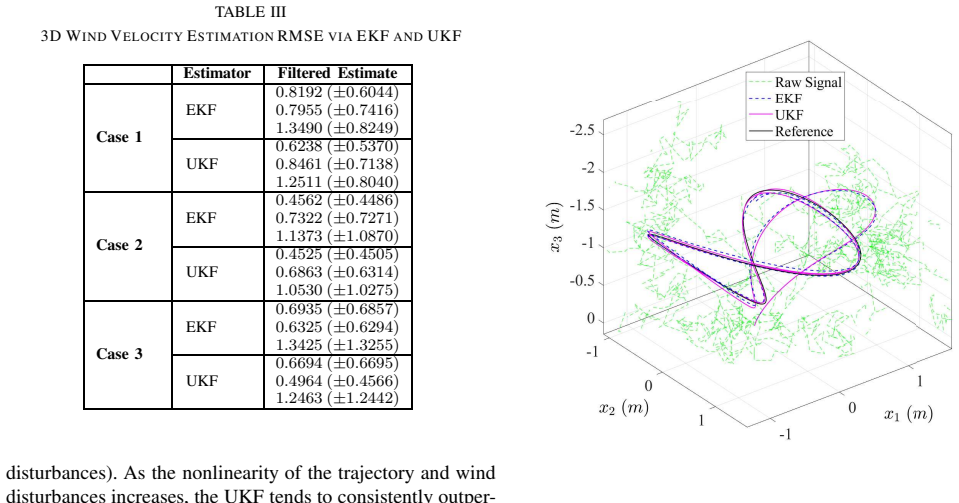
The paper claims that the Unscented Kalman Filter, applied to a quadrotor modeled on the Special Euclidean group SE(3), outperforms the Extended Kalman Filter in estimating wind velocity during flight. Using numerical simulations with a geometric controller to maintain paths, the results show that as the nonlinearity of the simulation increases, the UKF consistently provides accurate wind velocity estimations while keeping the trajectory deviation minimal. This establishes the UKF as a reliable estimator for highly nonlinear scenarios in quadrotor-based wind measurement.
What carries the argument
Unscented Kalman Filter applied to quadrotor dynamics on the SE(3) manifold, with a geometric controller maintaining flight paths.
If this is right
- UKF supports wind estimation during maneuvering flight instead of only hovering.
- UKF performance advantage over EKF grows with increasing wind-induced nonlinearity.
- Accurate wind estimates enable the quadrotor to follow desired trajectories with minimal deviation.
- The method applies to real-time wind data needs in environmental monitoring and emergency response.
Where Pith is reading between the lines
- Hardware experiments on low-cost quadrotors would test whether simulation gains appear in real wind.
- The UKF approach could extend to wind estimation on other small UAV platforms.
- Sensor fusion with additional measurements might reduce estimation error further in gusty conditions.
Load-bearing premise
The SE(3) model and geometric controller accurately capture quadrotor behavior and path maintenance under wind disturbances in simulations.
What would settle it
Physical flight tests on a real quadrotor in varying wind where the EKF achieves equal or better trajectory tracking and wind estimation accuracy than the UKF.
Figures
read the original abstract
In environmental monitoring as well as emergency response applications such as wildfires, wind velocity measurement is essential. Quadrotor UAVs have become popular platforms for wind velocity estimation due to their maneuverability, compact size, and cost-effectiveness. Numerous studies use the Extended Kalman Filter (EKF) to estimate the wind velocity based on the quadrotor dynamic model. However, most of them use hovering quadrotors only for wind estimation, others use a near-linear trajectory to estimate near-constant velocities. Furthermore, EKF performance is constrained by its reliance on linearized approximations of the nonlinear quadrotor dynamics around current states, limiting accuracy in highly nonlinear scenarios, including windy conditions. This study proposes the use of an Unscented Kalman Filter (UKF), a nonlinear estimator to provide accurate wind estimations while maintaining the trajectory of the quadrotor UAV. The quadrotor is modeled on the Special Euclidean group SE(3) and the approach is evaluated through numerical simulations using a geometric controller to maintain quadrotor flight paths. The results indicate that as the nonlinearity of the simulation increases, the UKF consistently outperforms the EKF. This demonstrates the potential of the UKF as a reliable estimator for highly nonlinear scenarios, capable of maintaining the trajectory with minimal deviation while providing accurate wind velocity estimations.
Editorial analysis
A structured set of objections, weighed in public.
Referee Report
Summary. The manuscript proposes replacing the Extended Kalman Filter (EKF) with an Unscented Kalman Filter (UKF) for real-time wind-velocity estimation on low-cost quadrotor UAVs. The vehicle is modeled as a rigid body on SE(3); a geometric controller is used to maintain prescribed trajectories while wind acts as an external disturbance. Numerical simulations are reported to show that UKF estimation error and trajectory deviation remain smaller than those of the EKF once the simulated wind field renders the closed-loop dynamics sufficiently nonlinear.
Significance. If the reported performance gap survives more rigorous validation, the work would supply a concrete, implementable nonlinear estimator for a practically relevant sensing task. The SE(3) formulation and geometric controller are standard in the literature, so the incremental contribution would lie in the side-by-side UKF/EKF comparison under increasing nonlinearity rather than in any new modeling axiom.
major comments (2)
- [Abstract / Numerical Simulations] Abstract and evaluation description: the central claim that 'as the nonlinearity of the simulation increases, the UKF consistently outperforms the EKF' is presented without any quantitative error metrics (RMSE, bias, covariance trace), without tabulated simulation parameters (wind-field spectra, initial conditions, process/measurement noise intensities), and without any statement of how many Monte-Carlo runs were performed. These omissions make the performance comparison impossible to assess or reproduce.
- [Quadrotor Model on SE(3) / Geometric Controller] Modeling and controller assumptions: the quadrotor is stated to evolve on SE(3) under a geometric controller whose ability to reject wind disturbances is taken as given. No analysis or even a reference is supplied showing that the closed-loop trajectory remains close to the commanded path once wind velocity reaches the magnitudes used in the 'highly nonlinear' regime; any systematic deviation would couple estimator performance to controller behavior rather than isolating the filter comparison.
minor comments (1)
- [Abstract] The abstract states that 'most studies use hovering quadrotors' but supplies no citations; a short literature table or two-sentence summary of representative EKF hovering papers would clarify the claimed novelty.
Simulated Author's Rebuttal
We thank the referee for the constructive comments on our manuscript. We address each major point below and will revise the manuscript to improve clarity, reproducibility, and rigor where the concerns are valid.
read point-by-point responses
-
Referee: [Abstract / Numerical Simulations] Abstract and evaluation description: the central claim that 'as the nonlinearity of the simulation increases, the UKF consistently outperforms the EKF' is presented without any quantitative error metrics (RMSE, bias, covariance trace), without tabulated simulation parameters (wind-field spectra, initial conditions, process/measurement noise intensities), and without any statement of how many Monte-Carlo runs were performed. These omissions make the performance comparison impossible to assess or reproduce.
Authors: We agree that the absence of quantitative metrics and tabulated parameters limits reproducibility. In the revised manuscript we will augment the abstract and the numerical simulations section with explicit RMSE, bias, and covariance-trace values for wind-velocity estimates under each regime, a table listing all simulation parameters (wind-field spectra, initial conditions, process/measurement noise intensities), and the number of Monte-Carlo runs performed. These additions will allow direct assessment of the reported performance gap. revision: yes
-
Referee: [Quadrotor Model on SE(3) / Geometric Controller] Modeling and controller assumptions: the quadrotor is stated to evolve on SE(3) under a geometric controller whose ability to reject wind disturbances is taken as given. No analysis or even a reference is supplied showing that the closed-loop trajectory remains close to the commanded path once wind velocity reaches the magnitudes used in the 'highly nonlinear' regime; any systematic deviation would couple estimator performance to controller behavior rather than isolating the filter comparison.
Authors: The geometric controller on SE(3) is a standard, well-referenced method whose disturbance-rejection properties have been established in the literature. Our simulations already indicate that trajectory deviation remains small; however, to isolate the estimator comparison we will add (i) a brief reference to the geometric-control literature and (ii) quantitative plots or tables of position and attitude tracking errors across the wind-velocity range used in the highly nonlinear regime. This will confirm that controller behavior does not confound the UKF/EKF comparison. revision: yes
Circularity Check
No circularity; standard UKF/EKF applied to external SE(3) model
full rationale
The paper applies the standard UKF and EKF formulations to a quadrotor dynamic model on SE(3) with a geometric controller, evaluated only via numerical simulations. No parameters are fitted to data and then renamed as predictions, no self-definitional loops appear in the estimator equations, and no load-bearing claims reduce to self-citations. The performance comparison (UKF outperforming EKF with increasing nonlinearity) is generated from the external model and controller, which are independent of the estimators themselves. This matches the default expectation of a non-circular paper.
Axiom & Free-Parameter Ledger
axioms (1)
- domain assumption Quadrotor dynamics can be accurately modeled on the Special Euclidean group SE(3)
Reference graph
Works this paper leans on
-
[1]
Real-time wind estimat ion on a micro unmanned aerial vehicle using its inertial measureme nt unit,
P . P . Neumann and M. Bartholmai, “Real-time wind estimat ion on a micro unmanned aerial vehicle using its inertial measureme nt unit,” Sensors and Actuators, A: Physical, vol. 235, pp. 300–310, 11 2015
2015
-
[2]
Wind field estimation through autonomous quadcopter avion ics,
X. Xiang, Z. Wang, Z. Mo, G. Chen, K. Pham, and E. Blasch, “Wind field estimation through autonomous quadcopter avion ics,” AIAA/IEEE Digital Avionics Systems Conference - Proceedings , vol. 2016-Decem, pp. 1–6, 2016
2016
-
[3]
Model-based wind profiling in the lower atmosphere with mul tirotor uas,
J. Gonz´ alez-Rocha, C. A. Woolsey, C. Sultan, and S. F. D. Wekker, “Model-based wind profiling in the lower atmosphere with mul tirotor uas,” in AIAA Scitech 2019 Forum. American Institute of Aeronautics and Astronautics Inc, AIAA, 1 2019
2019
-
[4]
Iros 2016 : 2016 ieee/rsj international conference on intelligent robots a nd systems : October 9-14, 2016, daejeon convention center, daejeon, ko rea,
L. Sikkel, G. de Croon, C. D. Wagter, and Q. Chu, “Iros 2016 : 2016 ieee/rsj international conference on intelligent robots a nd systems : October 9-14, 2016, daejeon convention center, daejeon, ko rea,” in 2016 IEEE/RSJ International Conference on Intelligent Robots and Systems. IEEE, 10 2016, pp. 2141–2146
2016
-
[5]
Shear wind estimation with q uadro- tor uavs using kalman filtering regressing method,
Z. Xing, Y . Qu, and Y . Zhang, “Shear wind estimation with q uadro- tor uavs using kalman filtering regressing method,” International Conference on Advanced Mechatronic Systems, ICAMechS , vol. 2017-Decem, pp. 196–201, 2017
2017
-
[6]
Invariant-ekf design f or quadcopter wind estimation,
H. Chen, H. Bai, and C. N. Taylor, “Invariant-ekf design f or quadcopter wind estimation,” Proceedings of the American Control Conference , vol. 2022-June, pp. 1236–1241, 2022
2022
-
[7]
Experimental wind field estimation and aircraft identifica tion,
J.-P . Condomines, M. Bronz, G. Hattenberger, and J.-F. E rdelyi, “Experimental wind field estimation and aircraft identifica tion,” in IMA V2015: International Micro Air V ehiclesConference and Flight Competition. HAL open science, 9 2015. [Online]. Available : http://www.researchgate.net/publication/282003424
-
[8]
Onboard wind velocity estimation comparison for unmanned aircraft syst ems,
M. B. Rhudy, Y . Gu, J. N. Gross, and H. Chao, “Onboard wind velocity estimation comparison for unmanned aircraft syst ems,” IEEE Transactions on Aerospace and Electronic Systems, vol. 53, pp. 55–66, 2 2017
2017
-
[9]
Uav state and parameter estim ation in wind using calibration trajectories optimized for observa bility,
A. Shastry and D. A. Paley, “Uav state and parameter estim ation in wind using calibration trajectories optimized for observa bility,” IEEE Control Systems Letters, vol. 5, pp. 1801–1806, 11 2021
2021
-
[10]
System identification for high- performance uav control in wind,
A. K. Shastry and D. A. Paley, “System identification for high- performance uav control in wind,” International Journal of Robust and Nonlinear Control, vol. 33, pp. 10 451–10 467, 11 2023
2023
-
[11]
Real-time kinema tics gps based telemetry system for airborne measurements of ship ai r wake,
K. Gamagedara, T. Lee, and M. Snyder, “Real-time kinema tics gps based telemetry system for airborne measurements of ship ai r wake,” in AIAA Scitech 2019 Forum. American Institute of Aeronautics and Astronautics Inc, AIAA, 2019
2019
-
[12]
Wind field velocity and ac celera- tion estimation using a small uav,
M. B. Rhudy, Y . Gu, and H. Chao, “Wind field velocity and ac celera- tion estimation using a small uav,” in AIAA Modeling and Simulation Technologies Conference. American Institute of Aeronautics and Astronautics (AIAA), 6 2014, pp. 1–9
2014
-
[13]
Sensing wind from quadrotor motion,
J. Gonz´ alez-Rocha, C. A. Woolsey, C. Sultan, and S. F. D e Wekker, “Sensing wind from quadrotor motion,” Journal of Guidance, Control, and Dynamics, vol. 42, no. 4, pp. 836–852, 2019
2019
-
[14]
Global formulation of an exte nded kalman filter on se(3) for geometric control of a quadrotor uav,
F. A. Goodarzi and T. Lee, “Global formulation of an exte nded kalman filter on se(3) for geometric control of a quadrotor uav,” Journal of Intelligent and Robotic Systems: Theory and Applications , vol. 88, pp. 395–413, 12 2017
2017
-
[15]
Stochastic wind modeling and estimation for unmanned aircraft systems,
M. Rhudy, J. Gross, and Y . Gu, “Stochastic wind modeling and estimation for unmanned aircraft systems,” in AIAA Aviation 2019 Forum. American Institute of Aeronautics and Astronautics Inc, AIAA, 2019, pp. 1–9
2019
-
[16]
J. L. Crassidis and J. L. Junkins, Optimal Estimation of Dynamics Systems, 2nd ed. Chapman & Hall CRCy, 2004
2004
-
[17]
S. S. Haykin, Kalman Filtering and Neural Networks. John Wiley & Sons, 2001
2001
-
[18]
ICM-45686,
TDK InvenSense, “ICM-45686,” https://invensense.td k.com, 2025, ac- cessed: 2025-06-25
2025
-
[19]
M10 GPS,
Holybro Store, “M10 GPS,” https://holybro.com, 2025, accessed: 2025-06-25
2025
discussion (0)
Sign in with ORCID, Apple, or X to comment. Anyone can read and Pith papers without signing in.