A Bounded-Confidence Model of Opinion Dynamics with Adaptive Interaction Probabilities
Pith reviewed 2026-05-21 06:45 UTC · model grok-4.3
The pith
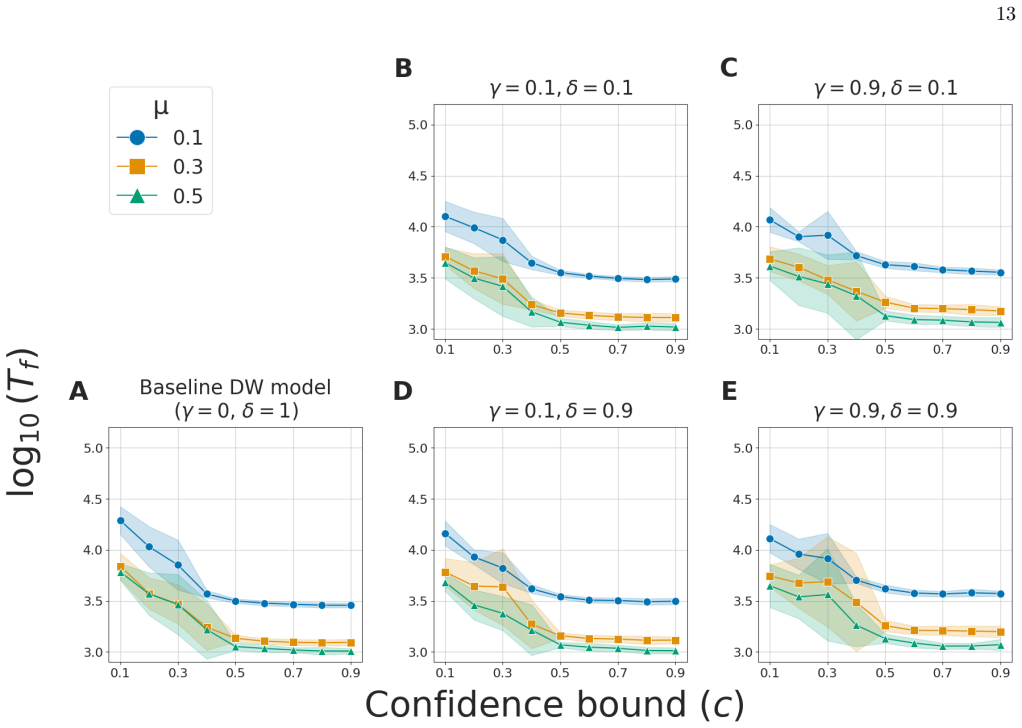
Adaptive edge weights in a bounded-confidence model decrease convergence time for dense networks but increase it for sparse networks when confidence bounds are small.
A machine-rendered reading of the paper's core claim, the machinery that carries it, and where it could break.
Core claim
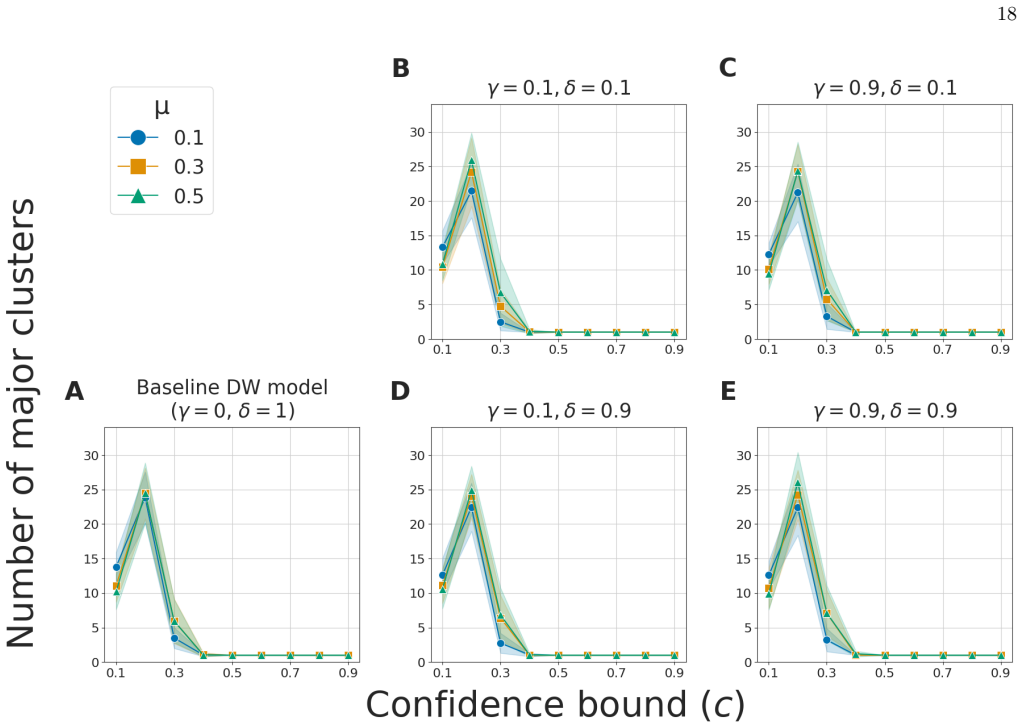
By making edge weights adaptive in the Deffuant-Weisbuch bounded-confidence model, the opinions of agents converge to clusters, the edge weights evolve to reflect the history of compromises, and the effective graph updates to show current receptive interactions. For small confidence bounds, adding this adaptivity reduces the number of steps needed to reach consensus on dense networks while increasing that number on sparse networks.
What carries the argument
Adaptive edge weights that modify interaction probabilities based on whether prior interactions resulted in compromise.
If this is right
- The adaptive model still converges to opinion clusters for any initial conditions.
- Edge weights reach a steady state determined by the frequency of compromising interactions.
- The effective graph is the time-varying subgraph consisting of pairs with sufficiently close opinions.
- For small confidence bounds, convergence time decreases with adaptivity on dense networks and increases on sparse networks.
Where Pith is reading between the lines
- Social networks with high connectivity may form opinion consensus more rapidly if positive interactions increase future contact rates.
- Testing the weight update rule against data from social media platforms could validate or refine how reinforcement affects interaction probabilities.
- Similar adaptive mechanisms might be added to other opinion dynamics models to study their effects on cluster formation.
Load-bearing premise
The specific rule for increasing or decreasing edge weights after each interaction based on whether agents compromised accurately reflects real social reinforcement.
What would settle it
Running simulations of the adaptive model versus the non-adaptive model on a complete graph and on a cycle graph, then checking if convergence time decreases on the complete graph and increases on the cycle graph for a small fixed confidence bound.
Figures





read the original abstract
Models of opinion dynamics aim to capture how individuals' opinions change when they interact with each other. One well-known model of opinion dynamics is the Deffuant--Weisbuch (DW) model, which is a type of bounded-confidence model (BCM). In the DW model, agents have pairwise interactions, and they are receptive to other agents' opinions when their opinions are sufficiently close to each other. In this paper, we extend the DW model by studying it on networks with heterogeneous and adaptive edge weights between pairs of agents. These edge weights govern the interaction probabilities between the agents and thereby encode the idea that people are more likely to communicate with individuals with whom they have previously compromised or had other positive interactions. We prove theoretical guarantees of our adaptive edge-weighted DW model's convergence properties, the long-time dynamics of its edge weights, and the model's associated ``effective graph", which is a time-dependent subgraph that includes edges only between agents that are receptive to each other's opinions. We support our theoretical results with numerical simulations of our adaptive edge-weighted DW model on a variety of networks and find that including adaptive edge weights yields different qualitative dynamics for different types of networks. In particular, for small confidence bounds, we observe that incorporating adaptive edge weights decreases the convergence time for dense networks but increases the convergence time for sparse networks.
Editorial analysis
A structured set of objections, weighed in public.
Referee Report
Summary. The manuscript extends the Deffuant-Weisbuch bounded-confidence model to networks with heterogeneous adaptive edge weights, where weights increase after a compromise and decrease otherwise. It establishes theoretical guarantees for opinion convergence, the long-time behavior of the edge weights, and the associated time-dependent effective graph (the subgraph of currently receptive pairs). Simulations on multiple network topologies then show that, for small confidence bounds, the adaptive rule shortens convergence time on dense networks while lengthening it on sparse networks.
Significance. The combination of an adaptive-interaction rule with rigorous convergence and effective-graph analysis is a useful addition to the bounded-confidence literature. The reported topology-dependent effect on convergence time, if robust, supplies a concrete, falsifiable prediction about how social reinforcement modulates consensus formation in different social structures. The proofs and effective-graph construction are the primary strengths; the simulations serve mainly to illustrate the qualitative distinction between dense and sparse regimes.
major comments (2)
- [§3] §3 (Convergence and effective-graph analysis): the proof that the effective graph eventually becomes static appears to rely on the edge weights converging to a limit; however, the argument does not explicitly rule out persistent oscillations between two or more effective graphs when the adaptation rate is comparable to the opinion-update rate. A short additional lemma or remark addressing this case would strengthen the claim that the long-time dynamics are fully characterized.
- [§4.3] §4.3 (Sparse-network simulations): the reported increase in convergence time for sparse networks is load-bearing for the central qualitative claim, yet the manuscript presents only mean convergence times without reporting the number of independent runs or standard deviations. Adding these statistics (or a table of raw values) is necessary to confirm that the observed lengthening is not an artifact of a single atypical realization.
minor comments (3)
- [§2] The definition of the adaptation rule (increase after compromise, decrease otherwise) is stated clearly, but the precise functional form (linear, multiplicative, etc.) and the normalization that keeps weights in [0,1] should be written as an explicit equation in §2 for reproducibility.
- [Figure 3] Figure 3 (or whichever panel shows the dense vs. sparse comparison) would benefit from a legend that explicitly labels the adaptive and non-adaptive curves; the current caption is slightly ambiguous about which line corresponds to which variant.
- [Introduction] A brief remark on the relation to existing adaptive-interaction models (e.g., those that adapt based on opinion similarity rather than compromise outcome) would help readers situate the contribution.
Simulated Author's Rebuttal
We thank the referee for the positive evaluation and the specific suggestions that help strengthen the presentation. We respond to each major comment below and have revised the manuscript to incorporate the requested clarifications and statistical details.
read point-by-point responses
-
Referee: [§3] §3 (Convergence and effective-graph analysis): the proof that the effective graph eventually becomes static appears to rely on the edge weights converging to a limit; however, the argument does not explicitly rule out persistent oscillations between two or more effective graphs when the adaptation rate is comparable to the opinion-update rate. A short additional lemma or remark addressing this case would strengthen the claim that the long-time dynamics are fully characterized.
Authors: We agree that an explicit treatment of comparable timescales strengthens the result. Our existing proof already shows that opinions converge to a finite number of clusters and that each edge weight is updated by a rule that is monotonic in the long run (increasing only upon successful compromise and otherwise decreasing toward a lower bound). Because there are only finitely many possible effective graphs on a finite vertex set, and the weight dynamics cannot sustain indefinite cycling once opinions have clustered, the effective graph must stabilize. We have added a short remark in §3 making this argument explicit and confirming that the long-time characterization holds independently of the relative rates. revision: yes
-
Referee: [§4.3] §4.3 (Sparse-network simulations): the reported increase in convergence time for sparse networks is load-bearing for the central qualitative claim, yet the manuscript presents only mean convergence times without reporting the number of independent runs or standard deviations. Adding these statistics (or a table of raw values) is necessary to confirm that the observed lengthening is not an artifact of a single atypical realization.
Authors: We concur that statistical reporting is required for the simulation claims. In the revised §4.3 we now state that every mean convergence time is computed from 100 independent realizations with distinct random initial opinions and seeds. Standard deviations are reported alongside the means (both in the text and via error bars in the figures) for the sparse-network cases, confirming that the lengthening effect is statistically consistent and not driven by outliers. revision: yes
Circularity Check
No significant circularity
full rationale
The paper defines an explicit update rule for adaptive edge weights based on whether agents compromise during interactions, proves convergence properties and long-time edge-weight behavior directly from the model equations, constructs an effective graph as a time-dependent subgraph of receptive pairs, and reports qualitative simulation results on convergence times for dense versus sparse networks under small confidence bounds. These elements are internally consistent and do not reduce by construction to fitted parameters, self-referential definitions, or load-bearing self-citations; the central claim is a direct numerical observation from the independently specified dynamics.
Axiom & Free-Parameter Ledger
free parameters (2)
- confidence bound
- adaptation rate or update strength for edge weights
axioms (2)
- domain assumption Agents only interact when their opinions differ by less than the confidence bound.
- ad hoc to paper Edge weights increase after compromise and decrease otherwise, encoding positive reinforcement.
discussion (0)
Sign in with ORCID, Apple, or X to comment. Anyone can read and Pith papers without signing in.