Recognition: 2 theorem links
· Lean TheoremThe 2025 AI Agent Index: Documenting Technical and Safety Features of Deployed Agentic AI Systems
Pith reviewed 2026-05-15 20:39 UTC · model grok-4.3
The pith
The 2025 AI Agent Index catalogs origins, capabilities, and safety details for 30 leading AI agents while showing uneven developer transparency.
A machine-rendered reading of the paper's core claim, the machinery that carries it, and where it could break.
Core claim
The 2025 AI Agent Index compiles information on the origins, design, capabilities, ecosystem, and safety features of 30 state-of-the-art AI agents from publicly available information and email correspondence with developers. It reveals different transparency levels among agent developers and finds that most share little information about safety, evaluations, and societal impacts.
What carries the argument
The AI Agent Index, a structured documentation compiled from public data and voluntary developer responses that tracks technical features and safety posture across agents.
If this is right
- Transparency on safety and evaluations varies widely among the 30 agents.
- Most developers release minimal details about societal impacts and risk assessments.
- The index provides a baseline reference for observing trends in agent capabilities and developer practices.
- Policymakers gain a consolidated view of the current agent ecosystem from public sources.
Where Pith is reading between the lines
- The index could serve as a starting point for standardized disclosure requirements in future AI governance.
- Developers may face pressure to increase transparency if the index becomes a widely used reference.
- Gaps in the public record suggest value in supplementary verification methods beyond voluntary responses.
Load-bearing premise
Publicly available information together with voluntary developer responses gives an accurate and representative picture of each agent's actual capabilities and safety posture without major undisclosed details.
What would settle it
An independent audit or technical inspection of any one indexed agent that reveals substantial undisclosed safety vulnerabilities or capabilities would show the index's documentation to be incomplete.
Figures








read the original abstract
Agentic AI systems are increasingly capable of performing professional and personal tasks with limited human involvement. However, tracking these developments is difficult because the AI agent ecosystem is complex, rapidly evolving, and inconsistently documented, posing obstacles to both researchers and policymakers. To address these challenges, this paper presents the 2025 AI Agent Index. The Index documents information regarding the origins, design, capabilities, ecosystem, and safety features of 30 state-of-the-art AI agents based on publicly available information and email correspondence with developers. In addition to documenting information about individual agents, the Index illuminates broader trends in the development of agents, their capabilities, and the level of transparency of developers. Notably, we find different transparency levels among agent developers and observe that most developers share little information about safety, evaluations, and societal impacts. The 2025 AI Agent Index is available online at https://aiagentindex.mit.edu
Editorial analysis
A structured set of objections, weighed in public.
Referee Report
Summary. The paper presents the 2025 AI Agent Index, which documents the origins, design, capabilities, ecosystem, and safety features of 30 state-of-the-art AI agents using publicly available information supplemented by email correspondence with developers. It additionally reports broader trends, including varying transparency levels across developers and limited disclosure on safety evaluations and societal impacts, with the full Index hosted online at https://aiagentindex.mit.edu.
Significance. If the collected data accurately reflect available public and volunteered information, the Index supplies a timely baseline resource for researchers and policymakers tracking the AI agent ecosystem. The public online release and the descriptive observations on transparency gaps constitute concrete contributions that can inform future work on documentation standards and evaluation practices.
major comments (1)
- [Data Collection] Data Collection section: the manuscript provides insufficient detail on the number of developers contacted, response rates to correspondence, verification procedures for public claims, and the handling of incomplete or unverified entries. These omissions directly affect the reliability of the central observational claims about transparency levels and safety-feature coverage.
minor comments (2)
- [Abstract] Abstract: a single sentence summarizing the data-gathering approach (public sources plus voluntary correspondence) would better frame the reported transparency findings for readers.
- [Online Index] Index presentation: the online resource should explicitly tag each data field with its source type (public document vs. developer reply) to allow users to assess completeness independently.
Simulated Author's Rebuttal
We thank the referee for their positive evaluation of the 2025 AI Agent Index as a timely baseline resource and for the recommendation of minor revision. We address the single major comment below and will incorporate the requested details to strengthen the manuscript.
read point-by-point responses
-
Referee: Data Collection section: the manuscript provides insufficient detail on the number of developers contacted, response rates to correspondence, verification procedures for public claims, and the handling of incomplete or unverified entries. These omissions directly affect the reliability of the central observational claims about transparency levels and safety-feature coverage.
Authors: We agree that the current description of data collection is insufficient for readers to fully assess the reliability of our transparency and safety-feature observations. In the revised manuscript we will expand the Data Collection section (or add a dedicated subsection) to report: the total number of developers contacted (both for the 30 indexed agents and any additional outreach), the response rate to email correspondence, the verification procedures applied to public claims (cross-referencing official documentation, multiple independent sources, and release notes), and the explicit protocol for incomplete or unverified entries (marking fields as “not publicly disclosed” and excluding them from aggregate statistics only when appropriate). These additions will be presented without changing the underlying data or conclusions. revision: yes
Circularity Check
No significant circularity identified
full rationale
The paper is a purely observational documentation project that compiles publicly available information and voluntary developer correspondence into an index of 30 AI agents. It contains no equations, derivations, fitted parameters, predictions, or mathematical claims of any kind. All content consists of descriptive summaries of external data sources, with no load-bearing steps that reduce to self-definition, self-citation chains, or renaming of results. The central observations about transparency levels are direct reports from the collected sources and do not rely on any internal circular logic.
Axiom & Free-Parameter Ledger
Lean theorems connected to this paper
-
IndisputableMonolith/Foundation/RealityFromDistinction.leanreality_from_one_distinction unclear?
unclearRelation between the paper passage and the cited Recognition theorem.
The Index documents information regarding the origins, design, capabilities, ecosystem, and safety features of 30 state-of-the-art AI agents based on publicly available information and email correspondence with developers.
-
IndisputableMonolith/Foundation/AbsoluteFloorClosure.leanabsolute_floor_iff_bare_distinguishability unclear?
unclearRelation between the paper passage and the cited Recognition theorem.
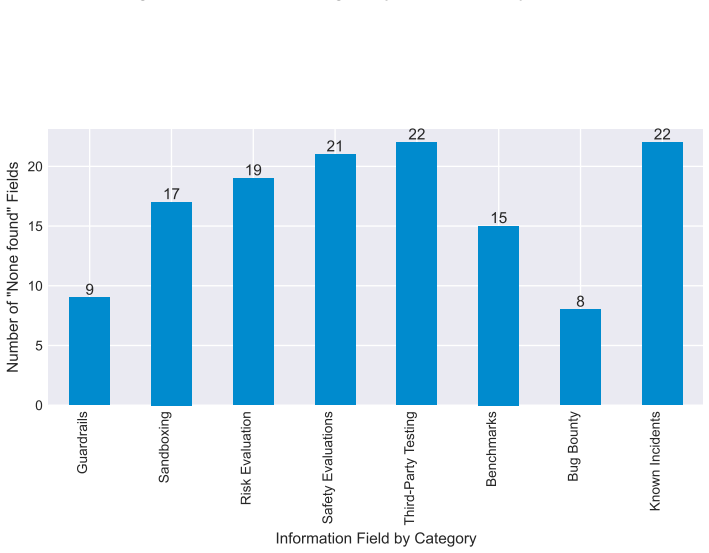
most safety-related fields (135/240) have no public information available
What do these tags mean?
- matches
- The paper's claim is directly supported by a theorem in the formal canon.
- supports
- The theorem supports part of the paper's argument, but the paper may add assumptions or extra steps.
- extends
- The paper goes beyond the formal theorem; the theorem is a base layer rather than the whole result.
- uses
- The paper appears to rely on the theorem as machinery.
- contradicts
- The paper's claim conflicts with a theorem or certificate in the canon.
- unclear
- Pith found a possible connection, but the passage is too broad, indirect, or ambiguous to say the theorem truly supports the claim.
Forward citations
Cited by 10 Pith papers
-
The Moltbook Observatory Archive: an incremental dataset of agent-only social network activity
The Moltbook Observatory Archive is the first large-scale dataset from a social network populated exclusively by autonomous AI agents, covering 78 days with 2.6 million posts and 1.2 million comments.
-
Anumati: Proof of Adherence as a Formal Consent Model for Autonomous Agent Protocols
Anumati defines proof of adherence via versioned PolicyDocument, ConsentRecord, and AdherenceEvent primitives as a non-breaking extension to A2A and MCP protocols.
-
AI Agents Under EU Law
AI agent providers face an exhaustive inventory requirement for actions and data flows, as high-risk systems with untraceable behavioral drift cannot meet the AI Act's essential requirements.
-
HDP: A Lightweight Cryptographic Protocol for Human Delegation Provenance in Agentic AI Systems
HDP is a lightweight protocol that binds human authorization to sessions via signed append-only token chains, enabling offline verification of delegation provenance using only an Ed25519 public key and session identifier.
-
Security Considerations for Multi-agent Systems
No existing AI security framework covers a majority of the 193 identified multi-agent system threats in any category, with OWASP Agentic Security Initiative achieving the highest overall coverage at 65.3%.
-
Nautilus: From One Prompt to Plug-and-Play Robot Learning
NAUTILUS is a prompt-driven harness that automates plug-and-play adapters, typed contracts, and validation for policies, benchmarks, and robots in learning research.
-
Agentic AI in the Software Development Lifecycle: Architecture, Empirical Evidence, and the Reshaping of Software Engineering
Agentic AI systems are shifting software engineering from line-level code generation to delegated repository-scale execution under supervision, with SWE-bench performance rising from 1.96% to 78.4% and productivity ga...
-
Sovereign Agentic Loops: Decoupling AI Reasoning from Execution in Real-World Systems
Sovereign Agentic Loops decouple LLM reasoning from execution by emitting validated intents through a control plane with obfuscation and evidence chains, blocking 93% of unsafe actions in a cloud prototype while addin...
-
Dive into Claude Code: The Design Space of Today's and Future AI Agent Systems
Claude Code centers on a model-tool while-loop surrounded by permission systems, context compaction, extensibility hooks, subagent delegation, and session storage; the same design questions yield different answers in ...
-
When the Agent Is the Adversary: Architectural Requirements for Agentic AI Containment After the April 2026 Frontier Model Escape
A reported 2026 frontier model escape shows that alignment training, sandboxing, tool interception, and audits fail against adversarial agentic AI, requiring five new architectural requirements for durable containment.
Reference graph
Works this paper leans on
-
[1]
Coalition for Content Provenance and Authenticity
2025. Coalition for Content Provenance and Authenticity
work page 2025
-
[2]
Frontier AI Safety Commitments, AI Seoul Summit 2024
2025. Frontier AI Safety Commitments, AI Seoul Summit 2024. https://www.gov.uk/government/publications/frontier-ai-safety- commitments-ai-seoul-summit-2024/frontier-ai-safety-commitments-ai-seoul-summit-2024
work page 2025
-
[3]
From Clawdbot to Moltbot to OpenClaw: Meet the AI agent generating buzz and fear globally.CNBC(2 Feb
2026. From Clawdbot to Moltbot to OpenClaw: Meet the AI agent generating buzz and fear globally.CNBC(2 Feb. 2026). https: //www.cnbc.com/2026/02/02/openclaw-open-source-ai-agent-rise-controversy-clawdbot-moltbot-moltbook.html
work page 2026
-
[4]
AIAgentsList.com. 2025. AI Agents Directory 2025: 600+ AI Tools & Autonomous Agents. https://aiagentslist.com/
work page 2025
-
[5]
Amazon.com Services LLC. 2025. Amazon.com Services LLC v. Perplexity AI, Inc. Complaint filed in the U.S. District Court for the Western District of Washington. Case No. 3:25-cv-09514
work page 2025
-
[6]
Maksym Andriushchenko, Alexandra Souly, Mateusz Dziemian, Derek Duenas, Maxwell Lin, Justin Wang, Dan Hendrycks, Andy Zou, Zico Kolter, Matt Fredrikson, Eric Winsor, Jerome Wynne, Yarin Gal, and Xander Davies. 2025. AgentHarm: A Benchmark for Measuring Harmfulness of LLM Agents. InInternational Conference on Learning Representations
work page 2025
-
[7]
Samar Ansari. 2025. AI Slop and Data Pollution in the Age of Generative AI: Strategic Risks, Economic Consequences, and Governance Pathways for Business, Management, and the Creative Industries.Economic Consequences, and Governance Pathways for Business, Management, and the Creative Industries (October 23, 2025)(2025)
work page 2025
-
[8]
2025.Responsible Scaling Policy
Anthropic. 2025.Responsible Scaling Policy. Technical Report
work page 2025
-
[9]
Matthew Arnold, Rachel KE Bellamy, Michael Hind, Stephanie Houde, Sameep Mehta, Aleksandra Mojsilović, Ravi Nair, K Natesan Ramamurthy, Alexandra Olteanu, David Piorkowski, et al . 2019. FactSheets: Increasing Trust in AI Services Through Supplier’s Declarations of Conformity.IBM Journal of Research and Development63, 4/5 (2019), 6–1
work page 2019
-
[10]
W. Ross Ashby. 1956.An Introduction to Cybernetics. Chapman & Hall, London
work page 1956
-
[11]
Nicholas Barrow. 2024. Anthropomorphism and AI Hype.AI and Ethics4, 3 (Aug. 2024), 707–711. doi:10.1007/s43681-024-00454-1
-
[12]
Matthias Bastian. 2026. Malicious skills turn AI agent OpenClaw into a malware delivery system.The Decoder(8 Feb. 2026). https://the-decoder.com/malicious-skills-turn-ai-agent-openclaw-into-a-malware-delivery-system/
work page 2026
- [13]
-
[14]
Ivan Belcic and Cole Stryker. 2025. AI Agents in 2025: Expectations vs. Reality. IBM Think. https://www.ibm.com/think/insights/ai- agents-2025-expectations-vs-reality
work page 2025
-
[15]
Yoshua Bengio. 2023. AI and Catastrophic Risk.Journal of Democracy34, 4 (2023), 111–121
work page 2023
-
[16]
Yoshua Bengio, Sören Mindermann, Daniel Privitera, Tamay Besiroglu, Rishi Bommasani, Stephen Casper, Yejin Choi, Philip Fox, Ben Garfinkel, Danielle Goldfarb, Hoda Heidari, Anson Ho, Sayash Kapoor, Leila Khalatbari, Shayne Longpre, Sam Manning, Vasilios Mavroudis, Mantas Mazeika, Julian Michael, Jessica Newman, Kwan Yee Ng, Chinasa T. Okolo, Deborah Raji,...
-
[17]
Martin Beraja and Noam Yuchtman. 2025. Generalized Disruption: Society, Work, and Property Rights in the Age of AI. InNBER Chapters. National Bureau of Economic Research, Inc
work page 2025
-
[18]
Elettra Bietti. 2020. From Ethics Washing to Ethics Bashing: A View on Tech Ethics from Within Moral Philosophy. InProceedings of the 2020 Conference on Fairness, Accountability, and Transparency (FAT* ’20). Association for Computing Machinery, New York, NY, USA, 210–219. doi:10.1145/3351095.3372860
- [19]
- [20]
-
[21]
Rishi Bommasani, Dilara Soylu, Thomas I Liao, Kathleen A Creel, and Percy Liang. 2024. Ecosystem Graphs: The Social Footprint of Foundation Models. InProceedings of the Seventh AAAI/ACM Conference on AI, Ethics, and Society
work page 2024
- [22]
-
[23]
Artem Chaikin and Shivan Kaul Sahib. 2025. Agentic Browser Security: Indirect Prompt Injection in Perplexity Comet. https: //brave.com/blog/comet-prompt-injection/
work page 2025
-
[24]
Alan Chan, Carson Ezell, Max Kaufmann, Kevin Wei, Lewis Hammond, Herbie Bradley, Emma Bluemke, Nitarshan Rajkumar, David Krueger, Noam Kolt, et al. 2024. Visibility into AI Agents. InThe 2024 ACM Conference on Fairness, Accountability, and Transparency. 958–973
work page 2024
- [25]
-
[26]
Alan Chan, Rebecca Salganik, Alva Markelius, Chris Pang, Nitarshan Rajkumar, Dmitrii Krasheninnikov, Lauro Langosco, Zhonghao He, Yawen Duan, Micah Carroll, et al. 2023. Harms from Increasingly Agentic Algorithmic Systems. InProceedings of the 2023 ACM Conference on Fairness, Accountability, and Transparency. ACM, Chicago, IL, USA, 651–666. doi:10.1145/35...
-
[27]
Alan Chan, Kevin Wei, Sihao Huang, Nitarshan Rajkumar, Elija Perrier, Seth Lazar, Gillian K Hadfield, and Markus Anderljung. 2025. Infrastructure for AI Agents.Transactions on Machine Learning Research(2025). https://openreview.net/forum?id=Ckh17xN2R2
work page 2025
-
[28]
Artificial Intelligence Safety Commitments
China Academy of Information and Communications Technology. 2024. First 17 Companies Sign Landmark “Artificial Intelligence Safety Commitments” Setting a New Standard for Industry Self-Regulation. https://mp.weixin.qq.com/s/s-XFKQCWhu0uye4opgb3Ng
work page 2024
- [29]
-
[30]
Michael K Cohen, Noam Kolt, Yoshua Bengio, Gillian K Hadfield, and Stuart Russell. 2024. Regulating Advanced Artificial Agents. Science384, 6691 (2024), 36–38
work page 2024
-
[31]
Cesareo Contreras. 2026. Why the OpenClaw AI agent is a ‘privacy nightmare’.Northeastern Global News(10 Feb. 2026). https: //news.northeastern.edu/2026/02/10/open-claw-ai-assistant/
work page 2026
-
[33]
A. Feder Cooper, Emanuel Moss, Benjamin Laufer, and Helen Nissenbaum. 2022. Accountability in an Algorithmic Society: Relationality, Responsibility, and Robustness in Machine Learning. InProceedings of the 2022 ACM Conference on Fairness, Accountability, and Transparency (FAccT ’22). Association for Computing Machinery, New York, NY, USA, 864–876. doi:10....
-
[34]
Gabriel Corral, Vaibhav Singhal, Brian Mitchell, and Reid Tatoris. 2025. Perplexity Is Using Stealth, Undeclared Crawlers to Evade Website No-Crawl Directives. https://blog.cloudflare.com/perplexity-is-using-stealth-undeclared-crawlers-to-evade-website-no- crawl-directives/
work page 2025
-
[35]
Sumanth Dathathri, Abigail See, Sumedh Ghaisas, Po-Sen Huang, Rob McAdam, Johannes Welbl, Vandana Bachani, Alex Kaskasoli, Robert Stanforth, Tatiana Matejovicova, Jamie Hayes, Nidhi Vyas, Majd Al Merey, Jonah Brown-Cohen, Rudy Bunel, Borja Balle, Taylan Cemgil, Zahra Ahmed, Kitty Stacpoole, Ilia Shumailov, Ciprian Baetu, Sven Gowal, Demis Hassabis, and Pu...
-
[36]
2025.Technological Disruption in the Labor Market
David J Deming, Christopher Ong, and Lawrence H Summers. 2025.Technological Disruption in the Labor Market. Technical Report. National Bureau of Economic Research. The 2025 AI Agent Index FAccT ’26, June 25–28, 2026, Montreal, QC, Canada
work page 2025
- [37]
- [38]
-
[39]
Dow Jones & Co., Inc. and NYP Holdings, Inc. 2024. Dow Jones & Co., Inc. v. Perplexity AI, Inc. Complaint filed in the U.S. District Court for the Southern District of New York. Case No. 1:24-cv-07984
work page 2024
-
[40]
Leonard Dung. 2024. Understanding Artificial Agency.The Philosophical Quarterly(2024), pqae010
work page 2024
- [41]
-
[42]
K. J. Kevin Feng, David W. McDonald, and Amy X. Zhang. 2025. Levels of Autonomy for AI Agents. doi:10.48550/arXiv.2506.12469
-
[43]
Luciano Floridi. 2019. Translating Principles into Practices of Digital Ethics: Five Risks of Being Unethical.Philosophy & Technology32, 2 (June 2019), 185–193. doi:10.1007/s13347-019-00354-x
-
[44]
Stan Franklin and Art Graesser. 1996. Is It an Agent, or Just a Program?: A Taxonomy for Autonomous Agents. InInternational Workshop on Agent Theories, Architectures, and Languages. Springer, 21–35
work page 1996
-
[45]
Frontier Model Forum. [n. d.]. Membership. https://www.frontiermodelforum.org/membership/
-
[46]
2025.AI Safety Index: Summer 2025
Future of Life Institute. 2025.AI Safety Index: Summer 2025. Technical Report. Future of Life Institute. https://futureoflife.org/wp- content/uploads/2025/07/FLI-AI-Safety-Index-Report-Summer-2025.pdf
work page 2025
- [47]
-
[48]
Salvatore Gariuolo, Vincenzo Ciancaglini, and Fernando Tucci. 2026. Viral AI, Invisible Risks: What OpenClaw Reveals About Agentic Assistants.Trend Micro Research(6 Feb. 2026). https://www.trendmicro.com/en_us/research/26/b/what-openclaw-reveals-about- agentic-assistants.html
work page 2026
-
[49]
Timnit Gebru, Jamie Morgenstern, Briana Vecchione, Jennifer Wortman Vaughan, Hanna Wallach, Hal Daumé III, and Kate Crawford
-
[50]
InProceedings of the 5th Workshop on Fairness, Accountability, and Transparency in Machine Learning
Datasheets for Datasets. InProceedings of the 5th Workshop on Fairness, Accountability, and Transparency in Machine Learning
-
[51]
Elizabeth Gibney. 2025. AI Bots Wrote and Reviewed All Papers at This Conference.Nature646, 8086 (2025), 786–786
work page 2025
-
[52]
Elizabeth Gibney. 2025. How AI Agents Will Change Research: A Scientist’s Guide.Nature(3 Oct. 2025). doi:10.1038/d41586-025-03246-7
-
[53]
Thomas Krendl Gilbert, Nathan Lambert, Sarah Dean, Tom Zick, and Aaron Snoswell. 2023. Reward Reports for Reinforcement Learning. InProceedings of the 2023 AAAI/ACM Conference on AI, Ethics, and Society
work page 2023
-
[54]
Aviad Gispan. 2025. CometJacking: How One Click Can Turn Perplexity’s Comet AI Browser Against You. https://layerxsecurity.com/ blog/cometjacking-how-one-click-can-turn-perplexitys-comet-ai-browser-against-you/
work page 2025
-
[55]
Google Cloud. 2025. What Are AI Agents? Definition, Examples, and Types. https://cloud.google.com/discover/what-are-ai-agents
work page 2025
-
[56]
Juraj Gottweis, Wei-Hung Weng, Alexander Daryin, Tao Tu, Anil Palepu, Petar Sirkovic, Artiom Myaskovsky, Felix Weissenberger, Keran Rong, Ryutaro Tanno, et al. 2025. Towards an AI Co-Scientist.arXiv preprint arXiv:2502.18864(2025)
work page internal anchor Pith review Pith/arXiv arXiv 2025
- [57]
- [58]
-
[59]
Gillian K Hadfield and Andrew Koh. 2025. An Economy of AI Agents. InThe Economics of Transformative AI. National Bureau of Economic Research. https://www.nber.org/system/files/chapters/c15305/c15305.pdf
work page 2025
-
[60]
Teresa Hammerschmidt, Katharina Stolz, and Oliver Posegga. 2025. Bridging the Gap: Inequalities That Divide Those Who Can and Cannot Create Sustainable Outcomes with AI.Behaviour & Information Technology(2025), 1–30
work page 2025
- [61]
-
[62]
Johannes Himmelreich. 2019. Responsibility for Killer Robots.Ethical Theory and Moral Practice22, 3 (2019), 731–747
work page 2019
-
[63]
Nanna Inie, Stefania Druga, Peter Zukerman, and Emily M. Bender. 2024. From “AI” to Probabilistic Automation: How Does Anthropomorphization of Technical Systems Descriptions Influence Trust?. InProceedings of the 2024 ACM Conference on Fairness, Accountability, and Transparency (FAccT ’24). Association for Computing Machinery, New York, NY, USA, 2322–2347...
-
[64]
Aaron Jaech, Adam Kalai, Adam Lerer, Adam Richardson, Ahmed El-Kishky, Aiden Low, Alec Helyar, Aleksander Madry, Alex Beutel, Alex Carney, et al. 2024. OpenAI o1 System Card.arXiv preprint arXiv:2412.16720(2024)
work page internal anchor Pith review Pith/arXiv arXiv 2024
-
[65]
Nicholas R Jennings. 2000. On Agent-Based Software Engineering.Artificial Intelligence117, 2 (2000), 277–296
work page 2000
-
[66]
Sayash Kapoor, Noam Kolt, and Seth Lazar. 2025. Position: Build Agent Advocates, Not Platform Agents. https://openreview.net/ forum?id=jd1N60VNFE
work page 2025
-
[67]
Sayash Kapoor, Benedikt Stroebl, Peter Kirgis, Nitya Nadgir, Zachary S Siegel, Boyi Wei, Tianci Xue, Ziru Chen, Felix Chen, Saiteja Utpala, et al. 2025. Holistic Agent Leaderboard: The Missing Infrastructure for AI Agent Evaluation.arXiv preprint arXiv:2510.11977 FAccT ’26, June 25–28, 2026, Montreal, QC, Canada Staufer et al. (2025)
-
[68]
Atoosa Kasirzadeh and Iason Gabriel. 2025. Characterizing AI Agents for Alignment and Governance.arXiv preprint arXiv:2504.21848 (April 2025). doi:10.48550/arXiv.2504.21848
- [69]
-
[70]
Zachary Kenton, Ramana Kumar, Sebastian Farquhar, Jonathan Richens, Matt MacDermott, and Tom Everitt. 2023. Discovering Agents. Artificial Intelligence322 (2023), 103963
work page 2023
-
[71]
Noam Kolt. 2025. Governing AI Agents.Notre Dame Law Review(2025)
work page 2025
- [72]
- [73]
-
[74]
Dan M Kotliar. 2025. Can’t Stop the Hype: Scrutinizing AI’s Realities.Information, Communication & Society(2025), 1–22
work page 2025
-
[75]
Michael Kouremetis, Marissa Dotter, Alex Byrne, Dan Martin, Ethan Michalak, Gianpaolo Russo, Michael Threet, and Guido Zarrella
- [76]
- [77]
-
[78]
Weixin Liang, Nazneen Rajani, Xinyu Yang, Ezinwanne Ozoani, Eric Wu, Yiqun Chen, Daniel Scott Smith, and James Zou. 2024. Systematic Analysis of 32,111 AI Model Cards Characterizes Documentation Practice in AI.Nature Machine Intelligence6, 7 (July 2024), 744–753. doi:10.1038/s42256-024-00857-z
-
[80]
Shayne Longpre, Robert Mahari, Anthony Chen, Naana Obeng-Marnu, Damien Sileo, William Brannon, Niklas Muennighoff, Nathan Khazam, Jad Kabbara, Kartik Perisetla, Xinyi (Alexis) Wu, Enrico Shippole, Kurt Bollacker, Tongshuang Wu, Luis Villa, Sandy Pentland, and Sara Hooker. 2024. A Large-Scale Audit of Dataset Licensing and Attribution in AI.Nature Machine ...
-
[81]
1990.Designing Autonomous Agents: Theory and Practice from Biology to Engineering and Back
Pattie Maes. 1990.Designing Autonomous Agents: Theory and Practice from Biology to Engineering and Back. MIT Press
work page 1990
-
[82]
Pattie Maes. 1993. Modeling Adaptive Autonomous Agents.Artificial Life1, 1_2 (1993), 135–162
work page 1993
discussion (0)
Sign in with ORCID, Apple, or X to comment. Anyone can read and Pith papers without signing in.