Optuna: A Next-generation Hyperparameter Optimization Framework
Pith reviewed 2026-05-24 16:19 UTC · model grok-4.3
The pith
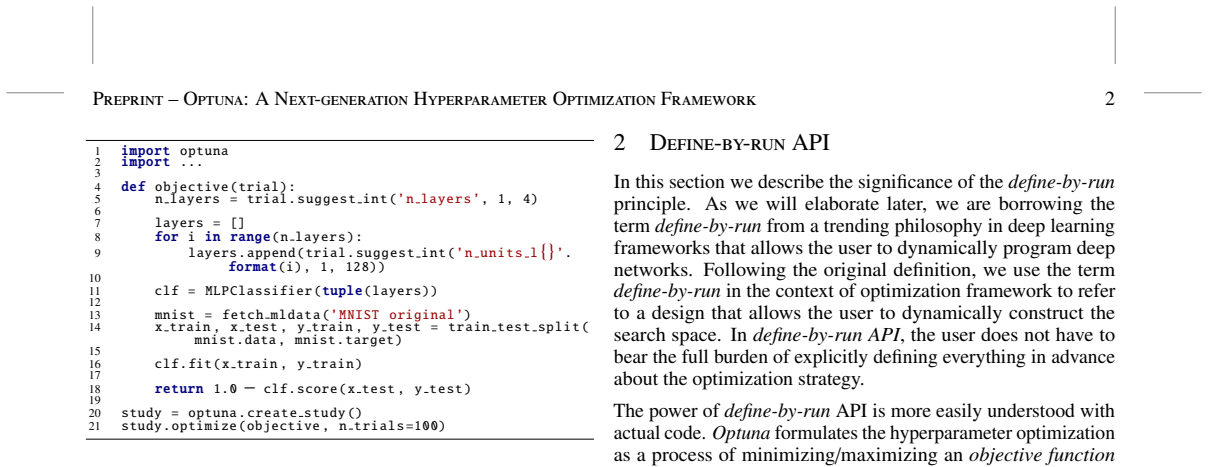
Optuna is the first hyperparameter optimization software designed with a define-by-run principle.
A machine-rendered reading of the paper's core claim, the machinery that carries it, and where it could break.
Core claim
Optuna implements a define-by-run API that allows users to construct the parameter search space dynamically during the optimization process, paired with efficient implementations of searching and pruning strategies and an easy-to-setup architecture that supports scalable distributed computing as well as lightweight interactive experiments. The paper presents this as the first optimization software designed around the define-by-run principle and shows its effectiveness through experimental results and real-world applications.
What carries the argument
The define-by-run API, which permits dynamic construction of the parameter search space as optimization proceeds rather than requiring it to be fixed in advance.
If this is right
- Users can define conditional hyperparameters whose availability depends on values chosen earlier in a trial.
- Pruning strategies can be applied efficiently because the framework knows the full trial structure at runtime.
- The same codebase can run unchanged from a single interactive session to a multi-node distributed setup.
- Real-world applications become feasible without rewriting the search logic for each deployment scale.
Where Pith is reading between the lines
- The dynamic space construction could reduce manual engineering effort when tuning models whose architecture choices affect later hyperparameters.
- Similar define-by-run patterns might transfer to automated machine learning pipelines beyond hyperparameter search.
- Integration with dynamic-graph frameworks would become more natural because both sides evaluate structure at runtime.
Load-bearing premise
That the three proposed design criteria are the appropriate and sufficient requirements for next-generation hyperparameter optimization software.
What would settle it
A head-to-head comparison in which a conventional fixed-space optimizer matches or exceeds Optuna on both final performance and total compute time when the task requires conditional or outcome-dependent hyperparameters.
Figures


read the original abstract
The purpose of this study is to introduce new design-criteria for next-generation hyperparameter optimization software. The criteria we propose include (1) define-by-run API that allows users to construct the parameter search space dynamically, (2) efficient implementation of both searching and pruning strategies, and (3) easy-to-setup, versatile architecture that can be deployed for various purposes, ranging from scalable distributed computing to light-weight experiment conducted via interactive interface. In order to prove our point, we will introduce Optuna, an optimization software which is a culmination of our effort in the development of a next generation optimization software. As an optimization software designed with define-by-run principle, Optuna is particularly the first of its kind. We will present the design-techniques that became necessary in the development of the software that meets the above criteria, and demonstrate the power of our new design through experimental results and real world applications. Our software is available under the MIT license (https://github.com/pfnet/optuna/).
Editorial analysis
A structured set of objections, weighed in public.
Referee Report
Summary. The paper proposes three design criteria for next-generation hyperparameter optimization software: (1) a define-by-run API enabling dynamic construction of the parameter search space, (2) efficient implementations of searching and pruning strategies, and (3) a versatile, easy-to-deploy architecture supporting distributed and interactive use cases. It introduces Optuna as an open-source (MIT) implementation of these criteria, asserts that it is the first HPO framework designed around the define-by-run principle, and illustrates its utility via experimental results and real-world applications.
Significance. If the design criteria and their implementation in Optuna hold, the work could meaningfully advance practical HPO by supporting more flexible search spaces than static APIs allow. The public GitHub release under an open license is a concrete strength that aids reproducibility and community adoption.
major comments (2)
- [Abstract] Abstract: the claim that Optuna is 'particularly the first of its kind' as a define-by-run HPO framework is presented without any comparison to prior systems that already support conditional or dynamic parameter spaces at runtime (e.g., Hyperopt's conditional parameters). Because this novelty assertion is used to position the entire contribution, the absence of such a comparison is load-bearing for the central claim.
- [Experimental results (referenced in abstract)] The manuscript does not indicate whether the experimental results include head-to-head comparisons against existing HPO libraries on standard benchmarks with reported metrics (wall-clock time, final objective value, number of trials). Without such baselines the demonstration that the three proposed criteria yield measurable gains remains unverified.
Simulated Author's Rebuttal
We thank the referee for the constructive feedback. We address each major comment below and indicate the revisions we will make to the manuscript.
read point-by-point responses
-
Referee: [Abstract] Abstract: the claim that Optuna is 'particularly the first of its kind' as a define-by-run HPO framework is presented without any comparison to prior systems that already support conditional or dynamic parameter spaces at runtime (e.g., Hyperopt's conditional parameters). Because this novelty assertion is used to position the entire contribution, the absence of such a comparison is load-bearing for the central claim.
Authors: We agree that the abstract's claim would be strengthened by explicit comparison to prior systems supporting conditional parameters. The define-by-run API in Optuna permits fully dynamic search-space construction at runtime via arbitrary Python control flow inside the objective function, which is distinct from the conditional mechanisms in frameworks such as Hyperopt that still require an upfront static specification. To address the concern, we will revise the abstract to qualify or remove the 'first of its kind' phrasing and add a concise comparison to related work in the manuscript body. revision: yes
-
Referee: [Experimental results (referenced in abstract)] The manuscript does not indicate whether the experimental results include head-to-head comparisons against existing HPO libraries on standard benchmarks with reported metrics (wall-clock time, final objective value, number of trials). Without such baselines the demonstration that the three proposed criteria yield measurable gains remains unverified.
Authors: The experiments in the manuscript illustrate the three design criteria through real-world applications and selected benchmarks. We acknowledge that the current presentation does not explicitly report head-to-head comparisons with quantitative metrics against other libraries. We will revise the experimental section to include such comparisons on standard benchmarks, reporting wall-clock time, final objective values, and number of trials. revision: yes
Circularity Check
No circularity: software introduction paper with no derivation chain
full rationale
The paper proposes three design criteria for HPO software and presents Optuna as an implementation meeting them, explicitly stating it is the first with define-by-run API. No equations, fitted parameters, predictions, or mathematical derivations exist that could reduce to inputs by construction. The novelty assertion is a direct claim without load-bearing self-citations or self-definitional loops. This matches the expected non-finding for a framework introduction paper that is self-contained against external benchmarks.
Axiom & Free-Parameter Ledger
axioms (1)
- domain assumption The three proposed design criteria are the key requirements for next-generation hyperparameter optimization software.
Forward citations
Cited by 22 Pith papers
-
Searches for $B^0\to K^+\pi^-\tau^+\tau^-$ and $B_s^0\to K^+K^-\tau^+\tau^-$ decays
LHCb reports the first upper limits on B0 → K+π−τ+τ− and Bs0 → K+K−τ+τ− branching fractions, with recast limits of 2.8×10⁻⁴ on B0 → K*(892)0 τ+τ− at 95% CL that improve prior bounds by an order of magnitude.
-
Learning Dynamic Stability Landscapes in Synchronization Networks
Introduces graph-to-image prediction of per-node dynamic stability landscapes in oscillator networks from topology, releases two 10k-graph datasets, and shows GNN-CNN models achieve good accuracy with cross-size gener...
-
Multivariate quantum reservoir computing with discrete and continuous variable systems
Quantum reservoirs handle multivariate time series best with task-specific encodings that leverage non-classical effects.
-
Polarized Target Nuclear Magnetic Resonance Measurements with Deep Neural Networks
Deep neural networks reduce fitting uncertainties in CW-NMR polarization measurements for dynamically polarized targets.
-
optimize_anything: A Universal API for Optimizing any Text Parameter
A universal LLM optimizer for text artifacts achieves SOTA results on six tasks including tripling ARC-AGI accuracy and cutting cloud costs by 40% via cross-task transfer and side information.
-
PEML: Parameter-efficient Multi-Task Learning with Optimized Continuous Prompts
PEML co-optimizes continuous prompts and low-rank adaptations to deliver up to 6.67% average accuracy gains over existing multi-task PEFT methods on GLUE, SuperGLUE, and other benchmarks.
-
Self-Supervised Laplace Approximation for Bayesian Uncertainty Quantification
SSLA approximates the posterior predictive distribution by refitting Bayesian models on self-predicted data, providing a sampling-free method that improves predictive calibration over classical Laplace approximations ...
-
On Privacy Leakage in Tabular Diffusion Models: Influential Factors, Attacker Knowledge, and Metrics
Tabular diffusion models leak membership information via attacks even with partial attacker knowledge, and common heuristic privacy metrics like distance-to-closest-record are unreliable.
-
Euclid preparation. CosmoPostProcess: A simulation calibrated framework for weak lensing selection bias in richness-selected galaxy clusters
CosmoPostProcess delivers simulation-calibrated radial corrections for projection-induced selection bias (20-40% amplitude near 1 h^{-1} Mpc) and baryonic effects in Euclid richness-selected cluster weak lensing profiles.
-
Efficiently emulating distribution functions in gigaparsec volumes for varying cosmological parameters
A new overdensity-conditioned emulator trained on small subvolumes from Quijote recovers the global halo mass function via integration over the overdensity distribution at 0.026% of the simulation cost.
-
Natural Language Embeddings of Synthesis and Testing conditions Enhance Glass Dissolution Prediction
Natural language embeddings of synthesis and testing conditions improve ML predictions of glass dissolution rates and enable generalization to out-of-distribution compositions with new elements.
-
Search for the lepton-flavour violating decays $B^+ \to \pi^+ \mu^\pm e^\mp$
No signal observed for B+ → π+ μ± e∓; branching fraction upper limit set at 1.8 × 10^{-9} at 90% CL.
-
Efficient Brain Extraction of MRI Scans with Mild to Moderate Neuropathology
A U-net with signed-distance transform loss achieves mean Dice scores of 0.96 on held-out and external MRI data for robust skull stripping in neuropathological cases.
-
TreeCoder: Systematic Exploration and Optimisation of Decoding and Constraints for LLM Code Generation
TreeCoder improves LLM code generation accuracy by representing decoding as an optimizable tree search over programs with first-class constraints for syntax, style, and execution, outperforming baselines on MBPP and S...
-
Search for the lepton-flavor-violating $\tau^{-} \rightarrow e^{\mp} \ell^{\pm} \ell^{\mp}$ decays at Belle II
Belle II sets upper limits between 1.3 and 2.5 times 10 to the minus 8 on branching fractions for four tau to e l l decay modes at 90 percent confidence level, the most stringent to date for four modes.
-
A Leaf-Level Dataset for Soybean-Cotton Detection and Segmentation
A new leaf-instance dataset for soybean-cotton detection and segmentation collected across growth stages and conditions from commercial farms is presented and validated with YOLOv11.
-
Inferring identified hadron production in $pp$ collisions with physics-informed machine learning at the LHC
A physics-informed neural network infers pT spectra of pi, K, p, Lambda, and Ks in unmeasured rapidity regions from PYTHIA8 pp collisions at 13.6 TeV, achieving 1.5-5.83% yield uncertainties while reproducing yield ra...
-
Combating the Memory Walls: Optimization Pathways for Long-Context Agentic LLM Inference
PLENA introduces a co-designed system with three optimization pathways for long-context agentic LLM inference, claiming up to 2.23x throughput over A100 and 4.04x energy efficiency.
-
Improved Chase-Pyndiah Decoding for Product Codes with Scaled Messages
Scaling extrinsic messages by decoder confidence in Chase-Pyndiah decoding for product codes delivers a 0.1 dB gain over the baseline decoder.
-
VIGILant: an automatic classification pipeline for glitches in the Virgo detector
VIGILant applies tree-based models and a ResNet CNN to classify Virgo O3b glitches with 98% accuracy and has been deployed for daily use with an interactive dashboard.
-
PR3DICTR: A modular AI framework for medical 3D image-based detection and outcome prediction
PR3DICTR is a new open-access modular framework for 3D medical image classification and outcome prediction that works with as little as two lines of code.
-
An Automatic Ground Collision Avoidance System with Reinforcement Learning
The paper designs a reinforcement learning-based automatic ground collision avoidance system for jet trainers that uses limited observations and line-of-sight terrain queries to prevent collisions.
Reference graph
Works this paper leans on
-
[1]
Hyperopt: a Python library for model selection and hyperparameter optimization
James Bergstra, Brent Komer, Chris Eliasmith, Dan Yamins, and David D Cox. Hyperopt: a Python library for model selection and hyperparameter optimization. Compu- tational Science & Discovery, 8(1):14008, 2015
work page 2015
-
[2]
Prac- tical bayesian optimization of machine learning algorithms
Jasper Snoek, Hugo Larochelle, and Ryan P Adams. Prac- tical bayesian optimization of machine learning algorithms. In NIPS, pages 2951–2959, 2012
work page 2012
-
[3]
Frank Hutter, Holger H. Hoos, and Kevin Leyton-Brown. Sequential model-based optimization for general algorithm 8 Blender Foundation — www.blender.org Preprint – Optuna: A Next-generation Hyperparameter Optimization Framework 9 configuration. In LION, pages 507–523, 2011. ISBN 978- 3-642-25565-6
work page 2011
-
[4]
Autotune: A derivative- free optimization framework for hyperparameter tuning
Patrick Koch, Oleg Golovidov, Steven Gardner, Brett Wu- jek, Joshua Griffin, and Yan Xu. Autotune: A derivative- free optimization framework for hyperparameter tuning. In KDD, pages 443–452, 2018. ISBN 978-1-4503-5552-0
work page 2018
-
[5]
Google Vizier: A service for black-box optimization
Daniel Golovin, Benjamin Solnik, Subhodeep Moitra, Greg Kochanski, John Karro, and D Sculley. Google Vizier: A service for black-box optimization. In KDD, pages 1487–1495, 2017. ISBN 978-1-4503-4887-4
work page 2017
-
[6]
Algorithms for hyper-parameter optimization
James Bergstra, R ´emi Bardenet, Yoshua Bengio, and Bal´azs K´egl. Algorithms for hyper-parameter optimization. In NIPS, pages 2546–2554, 2011
work page 2011
-
[7]
Richard Liaw, Eric Liang, Robert Nishihara, Philipp Moritz, Joseph E. Gonzalez, and Ion Stoica. Tune: A research platform for distributed model selection and train- ing. In ICML Workshop on AutoML, 2018
work page 2018
-
[8]
Tobias Domhan, Jost Tobias Springenberg, and Frank Hut- ter. Speeding up automatic hyperparameter optimization of deep neural networks by extrapolation of learning curves. In IJCAI, pages 3460–3468, 2015
work page 2015
-
[9]
Learning curve prediction with Bayesian neural networks
Aaron Klein, Stefan Falkner, Jost Tobias Springenberg, and Frank Hutter. Learning curve prediction with Bayesian neural networks. In ICLR, 2017
work page 2017
-
[10]
Hyperband: A novel bandit-based approach to hyperparameter optimization
Lisha Li, Kevin Jamieson, Giulia DeSalvo, Afshin Ros- tamizadeh, and Ameet Talwalkar. Hyperband: A novel bandit-based approach to hyperparameter optimization. Journal of Machine Learning Research , 18(185):1–52, 2018
work page 2018
-
[11]
Ray: A Distributed Framework for Emerging AI Applications
Philipp Moritz, Robert Nishihara, Stephanie Wang, Alexey Tumanov, Richard Liaw, Eric Liang, William Paul, Michael I. Jordan, and Ion Stoica. Ray: A dis- tributed framework for emerging AI applications. CoRR, abs/1712.05889, 2017. URL http://arxiv.org/abs/ 1712.05889
work page internal anchor Pith review Pith/arXiv arXiv 2017
-
[12]
Automatic Machine Learning: Methods, Sys- tems, Challenges
Frank Hutter, Lars Kottho ff, and Joaquin Vanschoren, editors. Automatic Machine Learning: Methods, Sys- tems, Challenges . Springer, 2018. In press, available at http://automl.org/book
work page 2018
-
[13]
Chainer: a next-generation open source framework for deep learning
Seiya Tokui, Kenta Oono, Shohei Hido, and Justin Clayton. Chainer: a next-generation open source framework for deep learning. In NIPS Workshop on Machine Learning Systems, 2015
work page 2015
-
[14]
DyNet: The Dynamic Neural Network Toolkit
Graham Neubig, Chris Dyer, Yoav Goldberg, Austin Matthews, Waleed Ammar, Antonios Anastasopoulos, Miguel Ballesteros, David Chiang, Daniel Clothiaux, Trevor Cohn, Kevin Duh, Manaal Faruqui, Cynthia Gan, Dan Garrette, Yangfeng Ji, Lingpeng Kong, Adhiguna Kun- coro, Gaurav Kumar, Chaitanya Malaviya, Paul Michel, Yusuke Oda, Matthew Richardson, Naomi Saphra,...
work page internal anchor Pith review Pith/arXiv arXiv 2017
-
[15]
Automatic differentiation in PyTorch
Adam Paszke, Sam Gross, Soumith Chintala, Gregory Chanan, Edward Yang, Zachary DeVito, Zeming Lin, Al- ban Desmaison, Luca Antiga, and Adam Lerer. Automatic differentiation in PyTorch. In NIPS Autodiff Workshop, 2017
work page 2017
-
[16]
Mart´ın Abadi, Paul Barham, Jianmin Chen, Zhifeng Chen, Andy Davis, Jeffrey Dean, Matthieu Devin, Sanjay Ghe- mawat, Geoffrey Irving, Michael Isard, Manjunath Kudlur, Josh Levenberg, Rajat Monga, Sherry Moore, Derek G. Murray, Benoit Steiner, Paul Tucker, Vijay Vasudevan, Pete Warden, Martin Wicke, Yuan Yu, and Xiaoqiang Zheng. TensorFlow: A system for larg...
work page 2016
-
[17]
Completely derandomized self-adaptation in evolution strategies
Nikolaus Hansen and Andreas Ostermeier. Completely derandomized self-adaptation in evolution strategies. Evo- lutionary Computation, 9(2):159–195, 2001
work page 2001
-
[18]
Taking the human out of the loop: A review of bayesian optimization
Bobak Shahriari, Kevin Swersky, Ziyu Wang, Ryan P Adams, and Nando De Freitas. Taking the human out of the loop: A review of bayesian optimization. Proceedings of the IEEE, 104(1):148–175, 2016
work page 2016
-
[19]
Massively parallel hyperparameter tuning
Liam Li, Kevin Jamieson, Afshin Rostamizadeh, Ekate- rina Gonina, Moritz Hardt, Benjamin Recht, and Ameet Talwalkar. Massively parallel hyperparameter tuning. In NeurIPS Workshop on Machine Learning Systems, 2018
work page 2018
-
[20]
Non-stochastic best arm identification and hyperparameter optimization
Kevin Jamieson and Ameet Talwalkar. Non-stochastic best arm identification and hyperparameter optimization. In Artificial Intelligence and Statistics, pages 240–248, 2016
work page 2016
-
[21]
Pandas: a foundational python library for data analysis and statistics
Wes McKinney. Pandas: a foundational python library for data analysis and statistics. In SC Workshop on Python for High Performance and Scientific Computing, 2011
work page 2011
-
[22]
Jupyter notebooks – a publishing format for re- producible computational workflows
Thomas Kluyver, Benjamin Ragan-Kelley, Fernando P´erez, Brian Granger, Matthias Bussonnier, Jonathan Frederic, Kyle Kelley, Jessica Hamrick, Jason Grout, Sylvain Cor- lay, Paul Ivanov, Dami´an Avila, Safia Abdalla, and Carol Willing. Jupyter notebooks – a publishing format for re- producible computational workflows. In F. Loizides and B. Schmidt, editors, P...
work page 2016
-
[23]
Benchmark suite of test functions suitable for evaluating black-box optimization strategies
Michael McCourt. Benchmark suite of test functions suitable for evaluating black-box optimization strategies. https://github.com/sigopt/evalset, 2016
work page 2016
-
[24]
A strategy for ranking optimization methods using multiple criteria
Ian Dewancker, Michael McCourt, Scott Clark, Patrick Hayes, Alexandra Johnson, and George Ke. A strategy for ranking optimization methods using multiple criteria. In ICML Workshop on AutoML, pages 11–20, 2016
work page 2016
-
[25]
ImageNet classification with deep convolutional neural networks
Alex Krizhevsky, Ilya Sutskever, and Geoffrey E Hinton. ImageNet classification with deep convolutional neural networks. In NIPS, pages 1097–1105, 2012
work page 2012
-
[26]
Reading digits in nat- ural images with unsupervised feature learning
Yuval Netzer, Tao Wang, Adam Coates, Alessandro Bis- sacco, Bo Wu, and Andrew Y Ng. Reading digits in nat- ural images with unsupervised feature learning. In NIPS Workshop on Deep Learning and Unsupervised Feature Learning, 2011
work page 2011
-
[27]
Alina Kuznetsova, Hassan Rom, Neil Alldrin, Jasper R. R. Uijlings, Ivan Krasin, Jordi Pont-Tuset, Shahab Kamali, Stefan Popov, Matteo Malloci, Tom Duerig, and Vittorio Ferrari. The open images dataset V4: unified image classi- fication, object detection, and visual relationship detection at scale. CoRR, abs/1811.00982, 2018
-
[28]
Takuya Akiba, Tommi Kerola, Yusuke Niitani, Toru Ogawa, Shotaro Sano, and Shuji Suzuki. PFDet: 2nd Preprint – Optuna: A Next-generation Hyperparameter Optimization Framework 10 place solution to open images challenge 2018 object detec- tion track. In ECCV Workshop on Open Images Challenge, 2018
work page 2018
-
[29]
Optimizing space amplification in rocksdb
Siying Dong, Mark Callaghan, Leonidas Galanis, Dhruba Borthakur, Tony Savor, and Michael Strum. Optimizing space amplification in rocksdb. InCIDR, 2017
work page 2017
discussion (0)
Sign in with ORCID, Apple, or X to comment. Anyone can read and Pith papers without signing in.