The evolution of the galaxy stellar mass function and star formation rates in the COLIBRE simulations from redshift 17 to 0
Pith reviewed 2026-05-18 17:37 UTC · model grok-4.3
The pith
COLIBRE simulations match observed galaxy stellar mass functions and star formation rates from redshift 0 to 12 using feedback calibrated only at z=0
A machine-rendered reading of the paper's core claim, the machinery that carries it, and where it could break.
Core claim
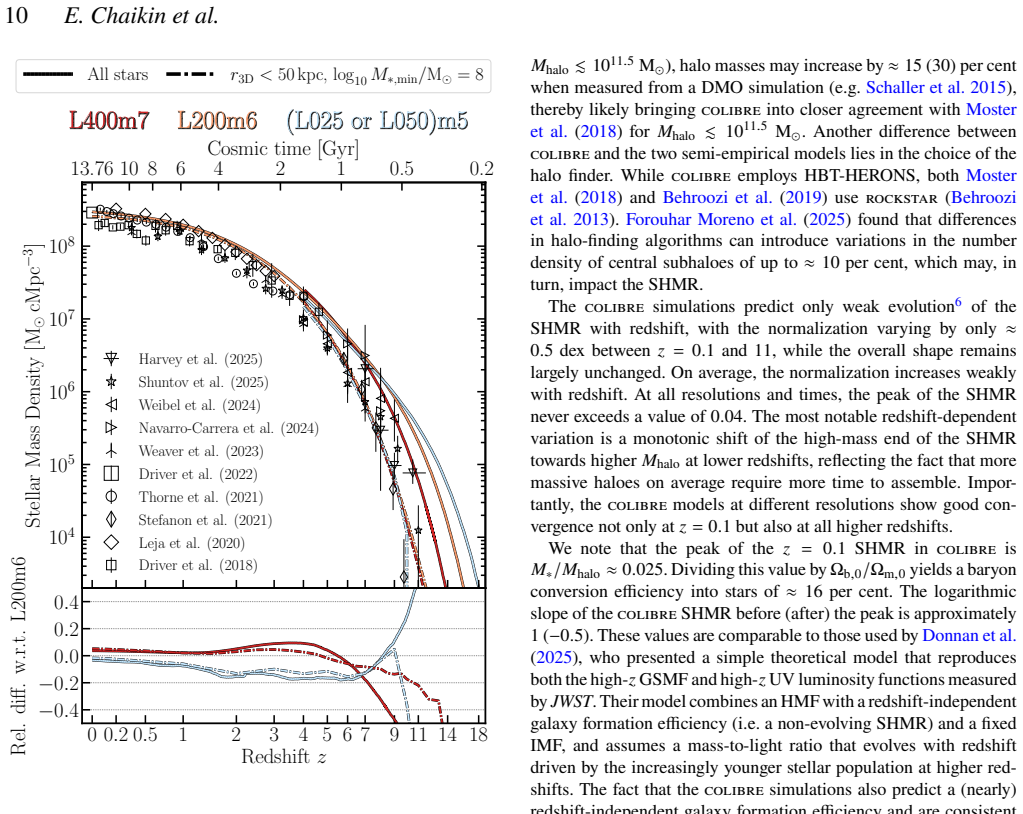
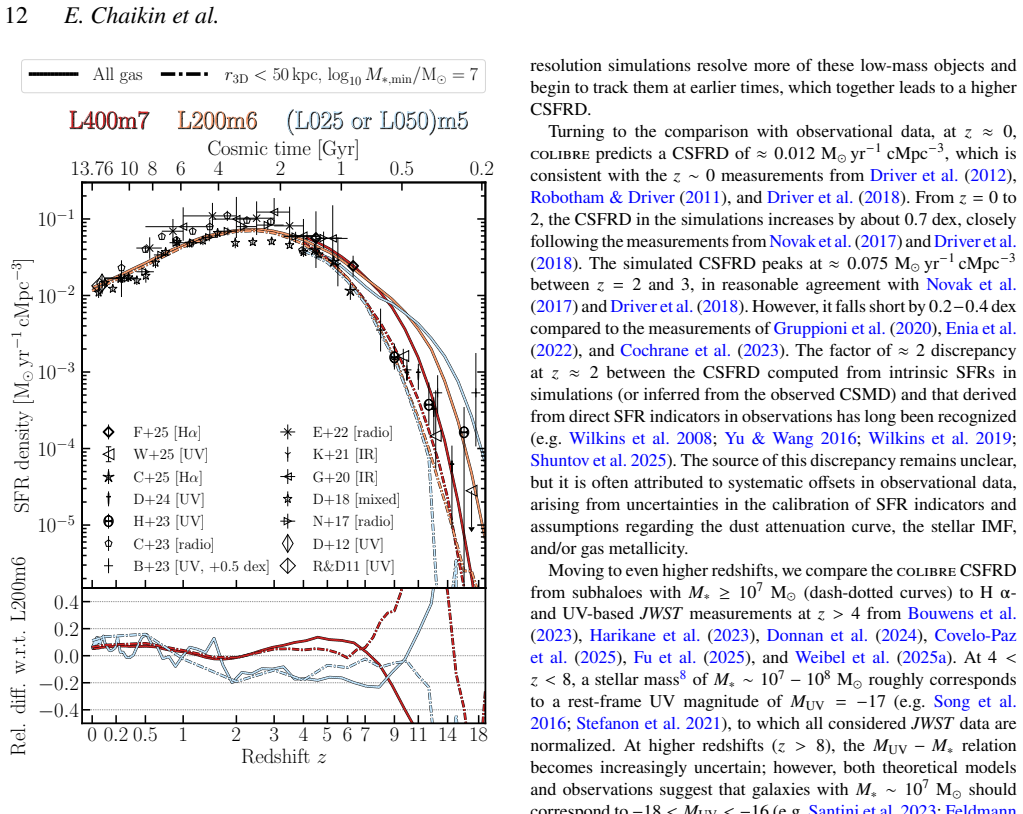
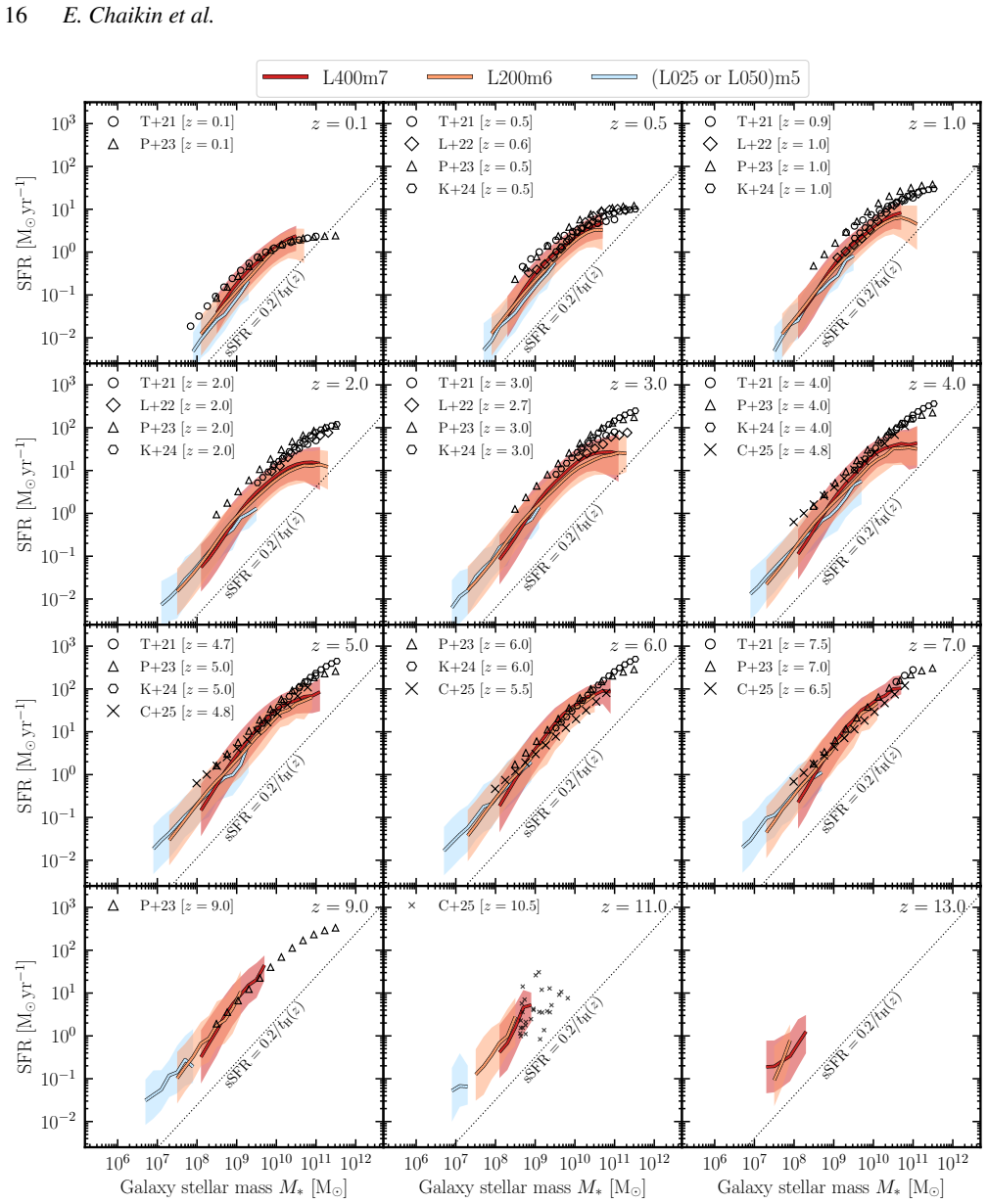
COLIBRE simulations reproduce the galaxy stellar mass function from z=0 to z=12 with systematic deviations reaching at most 0.3 dex at 2<z<4. They also match the evolution of the star-forming main sequence, cosmic SFR density, stellar mass density, and the number density of massive quiescent galaxies at high redshifts as seen by JWST. The stellar-to-halo mass relation evolves little with redshift. The authors conclude that neither a redshift-dependent star formation efficiency, nor a variable stellar initial mass function, nor a deviation from Lambda CDM is necessary to reproduce the high-redshift JWST stellar masses and SFRs.
What carries the argument
The COLIBRE galaxy formation model with multiphase ISM, dust-coupled radiative cooling, and stellar/AGN feedback (thermal or hybrid jet) calibrated to the z=0 GSMF and stellar mass-size relation.
If this is right
- The number density of massive quiescent galaxies at high redshifts matches JWST reports.
- The stellar-to-halo mass relation evolves little with redshift.
- The model produces good agreement with the star-forming main sequence and cosmic SFR density across cosmic time.
- Both the fiducial thermal AGN feedback and the hybrid jet variant yield consistent high-redshift results.
Where Pith is reading between the lines
- If the calibration at z=0 continues to hold, deeper surveys should find the same level of agreement at z>12.
- The weak redshift evolution of the stellar-to-halo mass relation implies that quenching efficiency changes mainly through halo growth rather than new baryonic processes.
- The framework can be used to predict metallicity and dust content evolution for comparison with upcoming ALMA or JWST data.
Load-bearing premise
The stellar and AGN feedback prescriptions calibrated exclusively at z=0 remain physically accurate when applied at high redshifts.
What would settle it
Future observations showing a galaxy stellar mass function at z>12 that lies more than 0.5 dex above or below the COLIBRE predictions at fixed halo mass.
Figures





read the original abstract
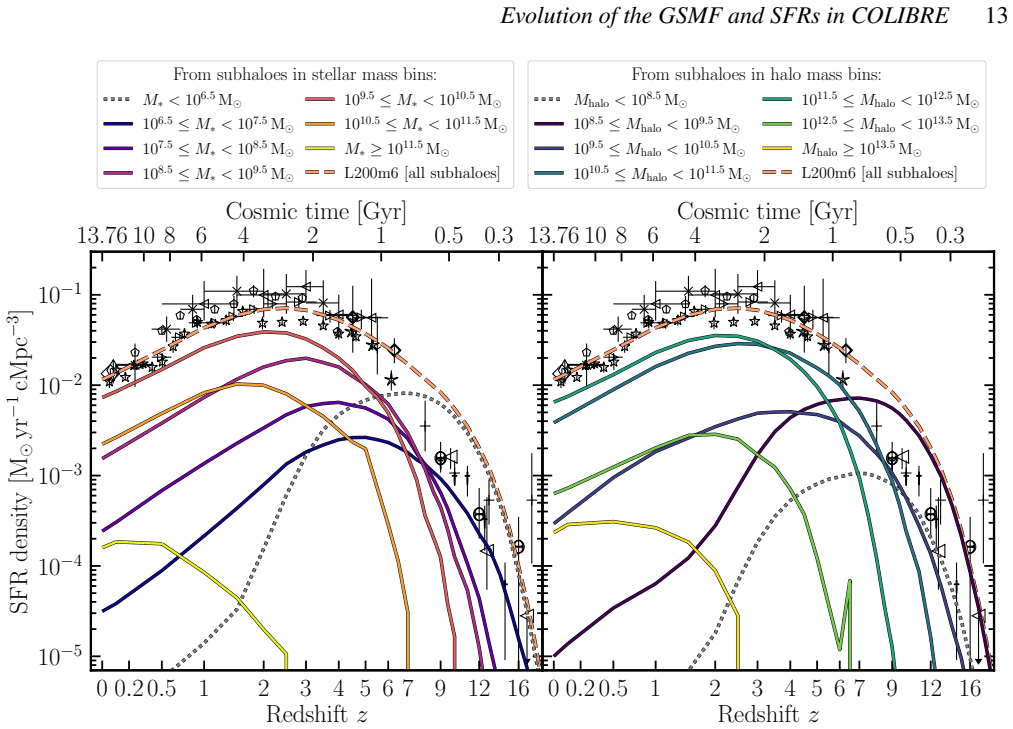
We investigate the evolution of the galaxy stellar mass function (GSMF) and star formation rates (SFRs) across cosmic time in the COLIBRE simulations of galaxy formation. COLIBRE includes a multiphase interstellar medium, radiative cooling rates coupled to a model for the evolution of dust grains, and employs prescriptions for stellar and AGN feedback calibrated to reproduce the $z=0$ observed GSMF and stellar mass - size relation. We present the evolution of the GSMF from simulations at three resolutions: $m_{\rm gas}\approx m_{\rm dm}\sim 10^7$, $10^6$, and $10^5~\mathrm{M_\odot}$, in cosmological volumes of up to $400^3$, $200^3$, and $100^3$ cMpc$^3$, respectively. We demonstrate that COLIBRE is consistent with the observed GSMF over the full redshift range for which there are observations to compare with ($0<z<12$), with maximum systematic deviations of $\approx 0.3$ dex reached at $2<z<4$. We also examine the evolution of the star-forming main sequence, cosmic SFR density, stellar mass density, and galaxy quenched fraction, making predictions for both the fiducial COLIBRE model with thermally-driven AGN feedback and its variant with hybrid (thermal + kinetic jet) AGN feedback, and finding good agreement with observations. Notably, we show that COLIBRE matches the number density of massive quiescent galaxies at high redshifts reported by JWST, while predicting a stellar-to-halo mass relation that evolves little with redshift. We conclude that neither a redshift-dependent star formation efficiency, nor a variable stellar initial mass function, nor a deviation from $\Lambda\mathrm{CDM}$ is necessary to reproduce the high-redshift JWST stellar masses and SFRs.
Editorial analysis
A structured set of objections, weighed in public.
Referee Report
Summary. The paper presents results from the COLIBRE cosmological hydrodynamical simulations, which incorporate a multiphase ISM, dust grain evolution, and stellar plus AGN feedback prescriptions calibrated exclusively to reproduce the z=0 observed GSMF and stellar mass-size relation. Using three resolutions (m_gas ≈ m_dm ∼ 10^7, 10^6, and 10^5 M_⊙) in volumes up to 400^3 cMpc^3, the authors show that the simulated GSMF remains consistent with observations over 0 < z < 12, with maximum systematic deviations of ≈0.3 dex at 2 < z < 4. They further report good agreement for the star-forming main sequence, cosmic SFR density, stellar mass density, and quenched fractions, including the number density of massive quiescent galaxies at high redshift as reported by JWST. Two AGN feedback variants (purely thermal and hybrid thermal+kinetic jet) are compared. The central conclusion is that neither a redshift-dependent star formation efficiency, a variable stellar IMF, nor a departure from ΛCDM is required to match the high-redshift JWST stellar masses and SFRs.
Significance. If the results hold, the work is significant because it demonstrates that a z=0-calibrated galaxy formation model can extrapolate successfully to z≈12 and reproduce key JWST observables without additional redshift-dependent adjustments. The multi-resolution and multi-volume consistency, together with the comparison of two distinct AGN feedback implementations, provides a robust test that the agreement is not resolution-dependent or tied to one specific feedback choice. This supplies a concrete counterexample to interpretations that invoke new physics (redshift-dependent SFE, variable IMF, or modified cosmology) at early times and yields falsifiable predictions for the redshift evolution of the stellar-to-halo mass relation.
major comments (2)
- [Abstract] Abstract and concluding section: The claim that 'neither a redshift-dependent star formation efficiency, nor a variable stellar initial mass function, nor a deviation from ΛCDM is necessary' is the central interpretive statement. Because the stellar and AGN feedback parameters are fitted to z=0 GSMF and size data, the high-z agreement constitutes a test of extrapolation rather than a parameter-free prediction; this distinction is noted but should be stated more explicitly when framing the conclusion so that readers do not misinterpret the result as fully independent of modeling choices.
- [Results section on GSMF] Results on GSMF evolution (around the discussion of 2<z<4): The maximum systematic offset of ≈0.3 dex is reported, yet the text does not quantify whether this offset lies inside the combined observational and simulation uncertainties or whether it could be removed by modest redshift evolution in feedback efficiency. A direct comparison of the offset to the observational error budget at those redshifts would make the 'consistency' statement more precise and would clarify how much room remains for mild additional physics.
minor comments (3)
- [Figures] The figures showing GSMF at multiple redshifts would be clearer if observational data points (with error bars) were over-plotted on the same panels rather than referenced only in the text.
- [Methods] The description of the hybrid AGN feedback implementation would benefit from a short additional paragraph or table listing the key parameter values that differ from the thermal-only run, aiding reproducibility.
- [References] A few recent JWST papers arguing for variable IMF or modified cosmology at high z are cited, but the reference list could be expanded by one or two more to give balanced context for the counter-claim.
Simulated Author's Rebuttal
We thank the referee for their constructive review and recommendation for minor revision. We address each major comment below and have incorporated clarifications to improve the precision and framing of our results.
read point-by-point responses
-
Referee: [Abstract] Abstract and concluding section: The claim that 'neither a redshift-dependent star formation efficiency, nor a variable stellar initial mass function, nor a deviation from ΛCDM is necessary' is the central interpretive statement. Because the stellar and AGN feedback parameters are fitted to z=0 GSMF and size data, the high-z agreement constitutes a test of extrapolation rather than a parameter-free prediction; this distinction is noted but should be stated more explicitly when framing the conclusion so that readers do not misinterpret the result as fully independent of modeling choices.
Authors: We agree that the distinction between extrapolation from z=0 calibration and a fully parameter-free prediction merits clearer emphasis to prevent misinterpretation. In the revised manuscript we have updated both the abstract and the concluding section to explicitly note that stellar and AGN feedback parameters were calibrated exclusively to z=0 data, and that the high-redshift agreement therefore tests the model's ability to extrapolate successfully without additional redshift-dependent adjustments. revision: yes
-
Referee: [Results section on GSMF] Results on GSMF evolution (around the discussion of 2<z<4): The maximum systematic offset of ≈0.3 dex is reported, yet the text does not quantify whether this offset lies inside the combined observational and simulation uncertainties or whether it could be removed by modest redshift evolution in feedback efficiency. A direct comparison of the offset to the observational error budget at those redshifts would make the 'consistency' statement more precise and would clarify how much room remains for mild additional physics.
Authors: We accept that a quantitative comparison to observational uncertainties would make the consistency statement more precise. In the revised results section we now compare the reported 0.3 dex offset at 2<z<4 directly to the typical observational error budget (0.2–0.4 dex across the relevant surveys), showing that the offset remains within the combined uncertainties. We have also added a brief remark that modest redshift evolution in feedback efficiency could in principle reduce the offset further, although our current z=0-calibrated model already reproduces the data within errors without such evolution. revision: yes
Circularity Check
No significant circularity; z=0 calibration tested on external high-z benchmarks
full rationale
The paper calibrates stellar and AGN feedback prescriptions exclusively to z=0 GSMF and mass-size relation, then evolves the model forward in a standard ΛCDM cosmology and compares the resulting GSMF, SFRs, and quiescent fractions to independent observational datasets at 0<z<12, including JWST. This constitutes a test of extrapolation against external benchmarks rather than any self-definitional loop, fitted-input-as-prediction, or load-bearing self-citation. No equations or steps reduce the high-z agreement to the z=0 inputs by construction; the cosmological evolution supplies the separation. The central claim (no need for redshift-dependent SFE, variable IMF, or non-ΛCDM) follows directly from the mismatch between the calibrated model and the necessity arguments in the literature, without circular reduction.
Axiom & Free-Parameter Ledger
free parameters (1)
- Stellar and AGN feedback parameters
axioms (2)
- standard math Lambda CDM cosmology governs large-scale structure and initial conditions
- domain assumption Sub-grid multiphase ISM, dust-coupled cooling, and feedback prescriptions capture unresolved physics
Lean theorems connected to this paper
-
IndisputableMonolith/Cost/FunctionalEquation.leanwashburn_uniqueness_aczel unclear?
unclearRelation between the paper passage and the cited Recognition theorem.
prescriptions for stellar and AGN feedback calibrated to reproduce the z=0 observed GSMF and stellar mass-size relation
-
IndisputableMonolith/Foundation/RealityFromDistinction.leanreality_from_one_distinction unclear?
unclearRelation between the paper passage and the cited Recognition theorem.
We conclude that neither a redshift-dependent star formation efficiency, nor a variable stellar initial mass function, nor a deviation from ΛCDM is necessary
What do these tags mean?
- matches
- The paper's claim is directly supported by a theorem in the formal canon.
- supports
- The theorem supports part of the paper's argument, but the paper may add assumptions or extra steps.
- extends
- The paper goes beyond the formal theorem; the theorem is a base layer rather than the whole result.
- uses
- The paper appears to rely on the theorem as machinery.
- contradicts
- The paper's claim conflicts with a theorem or certificate in the canon.
- unclear
- Pith found a possible connection, but the passage is too broad, indirect, or ambiguous to say the theorem truly supports the claim.
Forward citations
Cited by 4 Pith papers
-
Winding Back the Clock: Recent Star Formation Histories of Massive Quiescent Galaxies Are Consistent With Their Rapid Number Density Evolution Since $\mathbf{z\sim7}$
Star formation histories inferred for z=2-5 massive quiescent galaxies imply past number densities that align with observed rapid evolution since z~7.
-
The morphologies of present-day galaxies in the COLIBRE simulations
COLIBRE simulations find kinematic galaxy morphology peaks in rotational support at stellar masses of 1-2 x 10^10 solar masses and correlates more with internal properties like gas richness than with host halo properties.
-
Kinematic scaling relations of disc galaxies from ionised gas at $z\sim1$ and their connection with dark matter haloes
At z=0.9, disk galaxies show a TFR slope of 3.82 and FR slope of 0.44 with moderate TFR and strong FR evolution from z=0, implying higher and less mass-dependent stellar-to-halo mass fractions f_M while f_j remains near 0.8.
-
Forged by Feedback: Stellar Properties of Brightest Group Galaxies in Cosmological Simulations
The OBSIDIAN simulation with its three-regime AGN feedback best reproduces the observed stellar masses, star formation rates, and ages of brightest group galaxies, unlike the other simulations which show mismatches in...
Reference graph
Works this paper leans on
-
[1]
Abbott T. M. C., et al., 2022, @doi [ ] 10.1103/PhysRevD.105.023520 , https://ui.adsabs.harvard.edu/abs/2022PhRvD.105b3520A 105, 023520
-
[2]
Arnouts S., Ilbert O., 2011, LePHARE: Photometric Analysis for Redshift Estimate , Astrophysics Source Code Library, record ascl:1108.009
work page 2011
-
[3]
Asplund M., Grevesse N., Sauval A. J., Scott P., 2009, @doi [Annual Review of Astronomy and Astrophysics] 10.1146/annurev.astro.46.060407.145222 , 47, 481
-
[4]
Bah \'e Y. M., et al., 2022, @doi [ ] 10.1093/mnras/stac1339 , https://ui.adsabs.harvard.edu/abs/2022MNRAS.516..167B 516, 167
-
[5]
Baker W. M., et al., 2025a, @doi [arXiv e-prints] 10.48550/arXiv.2506.04119 , https://ui.adsabs.harvard.edu/abs/2025arXiv250604119B p. arXiv:2506.04119
-
[6]
Baker W. M., et al., 2025b, @doi [ ] 10.1093/mnras/staf475 , https://ui.adsabs.harvard.edu/abs/2025MNRAS.539..557B 539, 557
-
[7]
Baldry I. K., et al., 2012, @doi [ ] 10.1111/j.1365-2966.2012.20340.x , https://ui.adsabs.harvard.edu/abs/2012MNRAS.421..621B 421, 621
-
[8]
Bauer A. E., et al., 2013, @doi [ ] 10.1093/mnras/stt1011 , https://ui.adsabs.harvard.edu/abs/2013MNRAS.434..209B 434, 209
-
[9]
Behroozi P. S., Conroy C., Wechsler R. H., 2010, @doi [ ] 10.1088/0004-637X/717/1/379 , https://ui.adsabs.harvard.edu/abs/2010ApJ...717..379B 717, 379
-
[10]
doi.org/10.1088/0004-637X/762/2/109
Behroozi P. S., Wechsler R. H., Wu H.-Y., 2013, @doi [ ] 10.1088/0004-637X/762/2/109 , https://ui.adsabs.harvard.edu/abs/2013ApJ...762..109B 762, 109
work page internal anchor Pith review doi:10.1088/0004-637x/762/2/109 2013
-
[11]
Behroozi P., Wechsler R. H., Hearin A. P., Conroy C., 2019, @doi [ ] 10.1093/mnras/stz1182 , https://ui.adsabs.harvard.edu/abs/2019MNRAS.488.3143B 488, 3143
-
[12]
Bellstedt S., Robotham A. S. G., 2025, @doi [ ] 10.1093/mnras/staf889 , https://ui.adsabs.harvard.edu/abs/2025MNRAS.540.2703B 540, 2703
-
[13]
Bellstedt S., et al., 2020, @doi [ ] 10.1093/mnras/staa2620 , https://ui.adsabs.harvard.edu/abs/2020MNRAS.498.5581B 498, 5581
-
[14]
Benson A. J., Bower R. G., Frenk C. S., Lacey C. G., Baugh C. M., Cole S., 2003, @doi [ ] 10.1086/379160 , https://ui.adsabs.harvard.edu/abs/2003ApJ...599...38B 599, 38
-
[15]
Bocquet S., Saro A., Dolag K., Mohr J. J., 2016, @doi [ ] 10.1093/mnras/stv2657 , https://ui.adsabs.harvard.edu/abs/2016MNRAS.456.2361B 456, 2361
-
[16]
Booth C. M., Schaye J., 2009, @doi [ ] 10.1111/j.1365-2966.2009.15043.x , https://ui.adsabs.harvard.edu/abs/2009MNRAS.398...53B 398, 53
-
[17]
Borrow J., Borrisov A., 2020, @doi [Journal of Open Source Software] 10.21105/joss.02430 , p. 2430
-
[18]
J., 2021, arXiv e-prints, https://ui.adsabs.harvard.edu/abs/2021arXiv210605281B p
Borrow J., Kelly A. J., 2021, arXiv e-prints, https://ui.adsabs.harvard.edu/abs/2021arXiv210605281B p. arXiv:2106.05281
-
[19]
Borrow J., Schaller M., Bower R. G., Schaye J., 2022, @doi [ ] 10.1093/mnras/stab3166 , https://ui.adsabs.harvard.edu/abs/2022MNRAS.511.2367B 511, 2367
-
[20]
Bouwens R., Illingworth G., Oesch P., Stefanon M., Naidu R., van Leeuwen I., Magee D., 2023, @doi [ ] 10.1093/mnras/stad1014 , https://ui.adsabs.harvard.edu/abs/2023MNRAS.523.1009B 523, 1009
-
[21]
Bower R. G., Benson A. J., Malbon R., Helly J. C., Frenk C. S., Baugh C. M., Cole S., Lacey C. G., 2006, @doi [ ] 10.1111/j.1365-2966.2006.10519.x , https://ui.adsabs.harvard.edu/abs/2006MNRAS.370..645B 370, 645
-
[22]
Brammer G. B., van Dokkum P. G., Coppi P., 2008, @doi [ ] 10.1086/591786 , https://ui.adsabs.harvard.edu/abs/2008ApJ...686.1503B 686, 1503
work page internal anchor Pith review doi:10.1086/591786 2008
-
[23]
Brinchmann J., Charlot S., White S. D. M., Tremonti C., Kauffmann G., Heckman T., Brinkmann J., 2004, @doi [ ] 10.1111/j.1365-2966.2004.07881.x , https://ui.adsabs.harvard.edu/abs/2004MNRAS.351.1151B 351, 1151
-
[24]
Bruzual G., Charlot S., 2003, @doi [ ] 10.1046/j.1365-8711.2003.06897.x , https://ui.adsabs.harvard.edu/abs/2003MNRAS.344.1000B 344, 1000
-
[25]
Statistical Properties of X-ray Clusters: Analytic and Numerical Comparisons
Bryan G. L., Norman M. L., 1998, @doi [ ] 10.1086/305262 , https://ui.adsabs.harvard.edu/abs/1998ApJ...495...80B 495, 80
work page internal anchor Pith review doi:10.1086/305262 1998
-
[26]
Bunker A. J., et al., 2023, @doi [ ] 10.1051/0004-6361/202346159 , https://ui.adsabs.harvard.edu/abs/2023A&A...677A..88B 677, A88
-
[27]
Carnall A. C., McLure R. J., Dunlop J. S., Dav \'e R., 2018, @doi [ ] 10.1093/mnras/sty2169 , https://ui.adsabs.harvard.edu/abs/2018MNRAS.480.4379C 480, 4379
work page internal anchor Pith review doi:10.1093/mnras/sty2169 2018
-
[28]
Carnall A. C., et al., 2024, @doi [ ] 10.1093/mnras/stae2092 , https://ui.adsabs.harvard.edu/abs/2024MNRAS.534..325C 534, 325
-
[29]
Casey C. M., et al., 2023, @doi [ ] 10.3847/1538-4357/acc2bc , https://ui.adsabs.harvard.edu/abs/2023ApJ...954...31C 954, 31
-
[30]
Casey C. M., et al., 2024, @doi [ ] 10.3847/1538-4357/ad2075 , https://ui.adsabs.harvard.edu/abs/2024ApJ...965...98C 965, 98
-
[31]
Chabrier G., 2003, @doi [ ] 10.1086/376392 , https://ui.adsabs.harvard.edu/abs/2003PASP..115..763C 115, 763
work page internal anchor Pith review doi:10.1086/376392 2003
-
[32]
Chaikin E., Schaye J., Schaller M., Ben \' tez-Llambay A., Nobels F. S. J., Ploeckinger S., 2023, @doi [ ] 10.1093/mnras/stad1626 , https://ui.adsabs.harvard.edu/abs/2023MNRAS.523.3709C 523, 3709
-
[33]
COLIBRE: calibrating subgrid feedback in cosmological simulations that include a cold gas phase
Chaikin E., et al., 2025, @doi [arXiv e-prints] 10.48550/arXiv.2509.04067 , https://ui.adsabs.harvard.edu/abs/2025arXiv250904067C p. arXiv:2509.04067
work page internal anchor Pith review Pith/arXiv arXiv doi:10.48550/arxiv.2509.04067 2025
-
[34]
Cochrane R. K., et al., 2023, @doi [ ] 10.1093/mnras/stad1602 , https://ui.adsabs.harvard.edu/abs/2023MNRAS.523.6082C 523, 6082
-
[35]
Cochrane R. K., Katz H., Begley R., Hayward C. C., Best P. N., 2025, @doi [ ] 10.3847/2041-8213/ad9a4d , https://ui.adsabs.harvard.edu/abs/2025ApJ...978L..42C 978, L42
-
[36]
Cole S., et al., 2001, @doi [ ] 10.1046/j.1365-8711.2001.04591.x , https://ui.adsabs.harvard.edu/abs/2001MNRAS.326..255C 326, 255
-
[37]
Cole J. W., et al., 2025, @doi [ ] 10.3847/1538-4357/ad9a6a , https://ui.adsabs.harvard.edu/abs/2025ApJ...979..193C 979, 193
-
[38]
Conroy C., Wechsler R. H., 2009, @doi [ ] 10.1088/0004-637X/696/1/620 , https://ui.adsabs.harvard.edu/abs/2009ApJ...696..620C 696, 620
-
[39]
Conroy C., Gunn J. E., White M., 2009, @doi [ ] 10.1088/0004-637X/699/1/486 , https://ui.adsabs.harvard.edu/abs/2009ApJ...699..486C 699, 486
work page internal anchor Pith review doi:10.1088/0004-637x/699/1/486 2009
-
[40]
Covelo-Paz A., et al., 2025, @doi [ ] 10.1051/0004-6361/202452363 , https://ui.adsabs.harvard.edu/abs/2025A&A...694A.178C 694, A178
-
[41]
Crain R. A., et al., 2015, @doi [ ] 10.1093/mnras/stv725 , https://ui.adsabs.harvard.edu/abs/2015MNRAS.450.1937C 450, 1937
-
[42]
The DESI Experiment Part I: Science,Targeting, and Survey Design
DESI Collaboration et al., 2016, @doi [arXiv e-prints] 10.48550/arXiv.1611.00036 , https://ui.adsabs.harvard.edu/abs/2016arXiv161100036D p. arXiv:1611.00036
work page internal anchor Pith review Pith/arXiv arXiv doi:10.48550/arxiv.1611.00036 2016
-
[43]
Simba: Cosmological Simulations with Black Hole Growth and Feedback
Dav \'e R., Angl \'e s-Alc \'a zar D., Narayanan D., Li Q., Rafieferantsoa M. H., Appleby S., 2019, @doi [ ] 10.1093/mnras/stz937 , https://ui.adsabs.harvard.edu/abs/2019MNRAS.486.2827D 486, 2827
work page internal anchor Pith review doi:10.1093/mnras/stz937 2019
-
[44]
Davidzon I., et al., 2017, @doi [ ] 10.1051/0004-6361/201730419 , https://ui.adsabs.harvard.edu/abs/2017A&A...605A..70D 605, A70
-
[45]
Davies L. J. M., et al., 2018, @doi [ ] 10.1093/mnras/sty1553 , https://ui.adsabs.harvard.edu/abs/2018MNRAS.480..768D 480, 768
-
[46]
De Lucia G., Fontanot F., Xie L., Hirschmann M., 2024, @doi [ ] 10.1051/0004-6361/202349045 , https://ui.adsabs.harvard.edu/abs/2024A&A...687A..68D 687, A68
-
[47]
Donnan C. T., et al., 2024, @doi [ ] 10.1093/mnras/stae2037 , https://ui.adsabs.harvard.edu/abs/2024MNRAS.533.3222D 533, 3222
-
[48]
Donnan C. T., Dunlop J. S., McLure R. J., McLeod D. J., Cullen F., 2025, @doi [ ] 10.1093/mnras/staf641 , https://ui.adsabs.harvard.edu/abs/2025MNRAS.539.2409D 539, 2409
-
[49]
Donnari M., et al., 2019, @doi [ ] 10.1093/mnras/stz712 , https://ui.adsabs.harvard.edu/abs/2019MNRAS.485.4817D 485, 4817
-
[50]
Driver S. P., et al., 2011, @doi [Monthly Notices of the Royal Astronomical Society] 10.1111/j.1365-2966.2010.18188.x , 413, 971
-
[51]
Driver S. P., et al., 2012, @doi [ ] 10.1111/j.1365-2966.2012.22036.x , https://ui.adsabs.harvard.edu/abs/2012MNRAS.427.3244D 427, 3244
-
[52]
Driver S. P., et al., 2018, @doi [ ] 10.1093/mnras/stx2728 , https://ui.adsabs.harvard.edu/abs/2018MNRAS.475.2891D 475, 2891
-
[53]
Driver S. P., et al., 2022, @doi [ ] 10.1093/mnras/stac472 , https://ui.adsabs.harvard.edu/abs/2022MNRAS.513..439D 513, 439
-
[54]
Duncan K., et al., 2014, @doi [ ] 10.1093/mnras/stu1622 , https://ui.adsabs.harvard.edu/abs/2014MNRAS.444.2960D 444, 2960
-
[55]
Eddington A. S., 1913, @doi [ ] 10.1093/mnras/73.5.359 , https://ui.adsabs.harvard.edu/abs/1913MNRAS..73..359E 73, 359
-
[56]
Eke V. R., Cole S., Frenk C. S., 1996, @doi [ ] 10.1093/mnras/282.1.263 , https://ui.adsabs.harvard.edu/abs/1996MNRAS.282..263E 282, 263
-
[57]
Eke V. R., et al., 2004, @doi [ ] 10.1111/j.1365-2966.2004.08354.x , https://ui.adsabs.harvard.edu/abs/2004MNRAS.355..769E 355, 769
-
[58]
Enia A., et al., 2022, @doi [ ] 10.3847/1538-4357/ac51ca , https://ui.adsabs.harvard.edu/abs/2022ApJ...927..204E 927, 204
-
[59]
Euclid Collaboration et al., 2025, @doi [arXiv e-prints] 10.48550/arXiv.2503.15314 , https://ui.adsabs.harvard.edu/abs/2025arXiv250315314E p. arXiv:2503.15314
-
[60]
Feldmann R., et al., 2025, @doi [ ] 10.1093/mnras/stae2633 , https://ui.adsabs.harvard.edu/abs/2025MNRAS.536..988F 536, 988
-
[61]
Forouhar Moreno V. J., Helly J., McGibbon R., Schaye J., Schaller M., Han J., Kugel R., 2025, @doi [arXiv e-prints] 10.48550/arXiv.2502.06932 , https://ui.adsabs.harvard.edu/abs/2025arXiv250206932F p. arXiv:2502.06932
-
[62]
Franx M., van Dokkum P. G., F \"o rster Schreiber N. M., Wuyts S., Labb \'e I., Toft S., 2008, @doi [ ] 10.1086/592431 , https://ui.adsabs.harvard.edu/abs/2008ApJ...688..770F 688, 770
-
[63]
Fu S., et al., 2025,
work page 2025
-
[64]
Furlong M., et al., 2015, @doi [ ] 10.1093/mnras/stv852 , https://ui.adsabs.harvard.edu/abs/2015MNRAS.450.4486F 450, 4486
-
[65]
Gallazzi A., Bell E. F., 2009, @doi [ ] 10.1088/0067-0049/185/2/253 , https://ui.adsabs.harvard.edu/abs/2009ApJS..185..253G 185, 253
-
[66]
F., Zibetti S., Brinchmann J., Kelson D
Gallazzi A., Bell E. F., Zibetti S., Brinchmann J., Kelson D. D., 2014, @doi [ ] 10.1088/0004-637X/788/1/72 , https://ui.adsabs.harvard.edu/abs/2014ApJ...788...72G 788, 72
-
[67]
Graaff de Graaff de Graaff A., Trayford J., Franx M., Schaller M., Schaye J., van der Wel A., 2022, @doi [ ] 10.1093/mnras/stab3510 , https://ui.adsabs.harvard.edu/abs/2022MNRAS.511.2544D 511, 2544
-
[68]
Graaff de Graaff de Graaff A., et al., 2025, @doi [Nature Astronomy] 10.1038/s41550-024-02424-3 , https://ui.adsabs.harvard.edu/abs/2025NatAs...9..280D 9, 280
-
[69]
Gruppioni C., et al., 2020, @doi [ ] 10.1051/0004-6361/202038487 , https://ui.adsabs.harvard.edu/abs/2020A&A...643A...8G 643, A8
-
[70]
Guo Q., et al., 2011, @doi [ ] 10.1111/j.1365-2966.2010.18114.x , https://ui.adsabs.harvard.edu/abs/2011MNRAS.413..101G 413, 101
-
[71]
Hahn O., Michaux M., Rampf C., Uhlemann C., Angulo R. E., 2020, MUSIC2-monofonIC: 3LPT initial condition generator , Astrophysics Source Code Library, record ascl:2008.024 ( @eprint ascl 2008.024 )
work page 2020
-
[72]
Han J., Cole S., Frenk C. S., Benitez-Llambay A., Helly J., 2018, @doi [ ] 10.1093/mnras/stx2792 , https://ui.adsabs.harvard.edu/abs/2018MNRAS.474..604H 474, 604
-
[73]
A., Cortese L., Obreschkow D., Catinella B., Cook R
Hardwick J. A., Cortese L., Obreschkow D., Catinella B., Cook R. H. W., 2022, @doi [ ] 10.1093/mnras/stab3261 , https://ui.adsabs.harvard.edu/abs/2022MNRAS.509.3751H 509, 3751
-
[74]
Harikane Y., et al., 2023, @doi [ ] 10.3847/1538-4365/acaaa9 , https://ui.adsabs.harvard.edu/abs/2023ApJS..265....5H 265, 5
-
[75]
Harvey T., et al., 2025, @doi [ ] 10.3847/1538-4357/ad8c29 , https://ui.adsabs.harvard.edu/abs/2025ApJ...978...89H 978, 89
-
[76]
Henriques B. M. B., White S. D. M., Thomas P. A., Angulo R., Guo Q., Lemson G., Springel V., Overzier R., 2015, @doi [ ] 10.1093/mnras/stv705 , https://ui.adsabs.harvard.edu/abs/2015MNRAS.451.2663H 451, 2663
-
[77]
Hu s ko F., et al., 2025a, arXiv e-prints, https://ui.adsabs.harvard.edu/abs/2025arXiv250905179H p. arXiv:2509.05179
-
[78]
Hu s ko F., Lacey C. G., Roper W. J., Schaye J., Briggs J. M., Schaller M., 2025b, @doi [ ] 10.1093/mnras/staf146 , https://ui.adsabs.harvard.edu/abs/2025MNRAS.537.2559H 537, 2559
-
[79]
Jenkins A., Frenk C. S., White S. D. M., Colberg J. M., Cole S., Evrard A. E., Couchman H. M. P., Yoshida N., 2001, @doi [ ] 10.1046/j.1365-8711.2001.04029.x , https://ui.adsabs.harvard.edu/abs/2001MNRAS.321..372J 321, 372
-
[80]
Jones G. T., Stanway E. R., Carnall A. C., 2022, @doi [Monthly Notices of the Royal Astronomical Society] 10.1093/mnras/stac1667 , 514, 5706
discussion (0)
Sign in with ORCID, Apple, or X to comment. Anyone can read and Pith papers without signing in.