Fast neural network surrogate for multimodal effective-one-body gravitational waveforms from generically precessing compact binaries
Pith reviewed 2026-05-10 12:32 UTC · model grok-4.3
The pith
A neural network surrogate reproduces accurate waveforms from precessing black hole binaries up to mass ratios of 1:10 while running far faster than the base model.
A machine-rendered reading of the paper's core claim, the machinery that carries it, and where it could break.
Core claim
The central claim is that SEOBNRv5PHM_NNSur7dq10, a reduced-order neural network surrogate of the SEOBNRv5PHM waveform model, accurately represents the multimodal gravitational waveforms from generically precessing quasicircular binary black hole systems with mass ratios up to 1:10 and arbitrary spin magnitudes and orientations. The surrogate has been validated for faithfulness against the base model and has been applied to Bayesian parameter inference on both real and injected gravitational wave data, delivering speedups of roughly five times on CPUs for single evaluations and nearly 1000 times per waveform when amortized over large GPU batches.
What carries the argument
The reduced-order neural network surrogate, which learns to map binary parameters directly to the full multimodal waveform output of the effective-one-body model.
If this is right
- Single waveforms can be generated approximately five times faster on CPUs than with the base SEOBNRv5PHM model.
- When evaluating large batches on GPUs the per-waveform cost drops by nearly 1000 times.
- The surrogate supports full Bayesian parameter estimation on real and injected gravitational wave data without detectable bias.
- The same reduced-order neural network approach can be applied to extend coverage of other precessing waveform models.
Where Pith is reading between the lines
- The speed gains could enable real-time or near-real-time analysis of gravitational wave alerts from future detectors.
- The same training strategy might be adapted to waveform models that include eccentricity or higher-order modes.
- Population studies that require thousands of waveform evaluations become feasible with this level of acceleration.
- Similar neural surrogates could reduce computational barriers in related areas such as neutron-star merger modeling.
Load-bearing premise
The neural network trained on SEOBNRv5PHM outputs can faithfully reproduce the multimodal structure of generically precessing waveforms across the full parameter space without introducing systematic biases that affect downstream parameter estimation.
What would settle it
A direct comparison of posterior distributions recovered from the same set of injected signals using both the surrogate and the original SEOBNRv5PHM model that shows statistically significant differences in recovered masses, spins, or distances would demonstrate that the surrogate introduces unacceptable errors.
Figures






read the original abstract
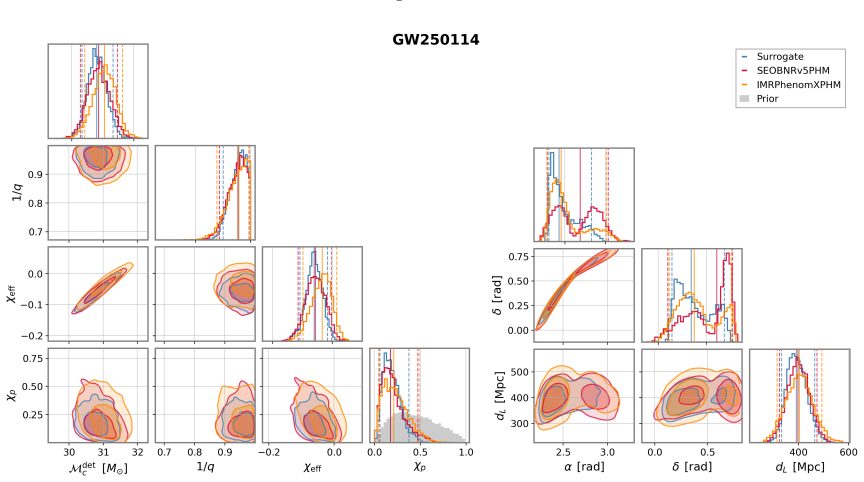
Gravitational waveform templates are a key ingredient for the detection and characterization of gravitational waves emitted by compact binary mergers in the universe. These templates must be physically accurate and extensive, but also highly computationally efficient, two requirements that are often in tension. One solution to this problem is the development of surrogate models, which are fast, data-driven models trained to predict the output of a slower, physically realistic waveform model. In this article we build on existing work to incorporate machine learning techniques into the conventional reduced order surrogate framework, with a focus on extending coverage to waveform models that describe generically precessing quasicircular binaries. In particular, we present SEOBNRv5PHM_NNSur7dq10, a reduced order neural network surrogate of the SEOBNRv5PHM waveform model, valid up to mass ratios 1:10 for precessing quasicircular binary black hole systems with arbitrary spin magnitudes and orientations. The faithfulness of the surrogate to SEOBNRv5PHM is validated, and the surrogate is successfully applied to Bayesian parameter inference using both real and injected gravitational wave data. The surrogate is approximately 5 times faster than SEOBNRv5PHM when evaluating a single waveform on a CPU, and nearly 1000 times faster per-waveform when amortizing the cost over large waveform batches on a GPU.
Editorial analysis
A structured set of objections, weighed in public.
Referee Report
Summary. The manuscript presents SEOBNRv5PHM_NNSur7dq10, a reduced-order neural-network surrogate trained on the SEOBNRv5PHM effective-one-body waveform model. The surrogate targets generically precessing quasicircular binary black hole systems with mass ratios up to 1:10 and arbitrary spin magnitudes and orientations. It claims to faithfully reproduce the multimodal structure of the parent model, reports validation of this faithfulness, and demonstrates successful application to Bayesian parameter estimation on both real and injected gravitational-wave data. Computational speedups of approximately 5x on CPU for single waveforms and nearly 1000x on GPU for batched evaluations are stated.
Significance. If the faithfulness validation and absence of systematic biases hold across the claimed domain, the work supplies a practical, high-speed waveform model that relaxes the computational cost of detailed EOB templates for precessing systems. This is directly relevant to large-scale parameter estimation campaigns and could support broader exploration of precession effects in current and future detectors. The combination of reduced-order modeling with neural networks, together with explicit demonstration on real and injected data, constitutes a concrete advance; credit is given for grounding the surrogate in an independent physical model rather than self-referential training.
major comments (1)
- The central claim of sufficient faithfulness for downstream inference rests on the validation results. The manuscript should report quantitative mismatch statistics (mean, median, and worst-case values) as functions of mass ratio, spin magnitude, and precession angle, with explicit separation of higher-mode contributions, to allow readers to judge whether residual errors remain below the threshold that would bias parameter recovery at the level of current detector sensitivities.
minor comments (2)
- Abstract: the reported GPU speedup is given without specifying batch size or hardware; adding these details would make the performance claim reproducible.
- The surrogate name SEOBNRv5PHM_NNSur7dq10 is introduced without an explicit statement of the training-set boundaries (e.g., exact spin and inclination ranges) in the abstract; a one-sentence clarification would improve immediate readability.
Simulated Author's Rebuttal
We thank the referee for their positive assessment of the manuscript and for the recommendation of minor revision. We address the single major comment below and agree to strengthen the validation presentation accordingly.
read point-by-point responses
-
Referee: The central claim of sufficient faithfulness for downstream inference rests on the validation results. The manuscript should report quantitative mismatch statistics (mean, median, and worst-case values) as functions of mass ratio, spin magnitude, and precession angle, with explicit separation of higher-mode contributions, to allow readers to judge whether residual errors remain below the threshold that would bias parameter recovery at the level of current detector sensitivities.
Authors: We agree that a more granular presentation of the mismatch statistics would improve transparency and help readers evaluate performance across the full domain. The current manuscript already reports overall faithfulness metrics, confirms that the surrogate reproduces the multimodal structure of SEOBNRv5PHM, and demonstrates unbiased parameter recovery on both injected and real data. To address the referee's request, we will revise the validation section to include tables (or supplementary figures) that tabulate mean, median, and worst-case mismatches as functions of mass ratio, spin magnitude, and precession angle. We will also provide separate statistics isolating the (2,2) mode from higher-mode contributions. These additions will make explicit that residual errors lie below thresholds relevant for current detector sensitivities and will not introduce systematic biases in inference. revision: yes
Circularity Check
No significant circularity; surrogate trained on independent external model
full rationale
The paper constructs SEOBNRv5PHM_NNSur7dq10 as a neural-network reduced-order surrogate trained directly on outputs from the independent SEOBNRv5PHM effective-one-body waveform model. The central claims of faithfulness and applicability to Bayesian inference rest on explicit validation by direct comparison to that external model plus application to real/injected data, with no derivation step that reduces by construction to a self-defined quantity, a fitted parameter renamed as prediction, or a load-bearing self-citation chain. Prior surrogate literature is cited for methodology but does not supply the new results on precessing multimodal coverage up to q=10.
Axiom & Free-Parameter Ledger
free parameters (1)
- Neural network weights and biases
axioms (1)
- domain assumption SEOBNRv5PHM provides an accurate representation of the gravitational waveforms from precessing binaries.
Reference graph
Works this paper leans on
-
[1]
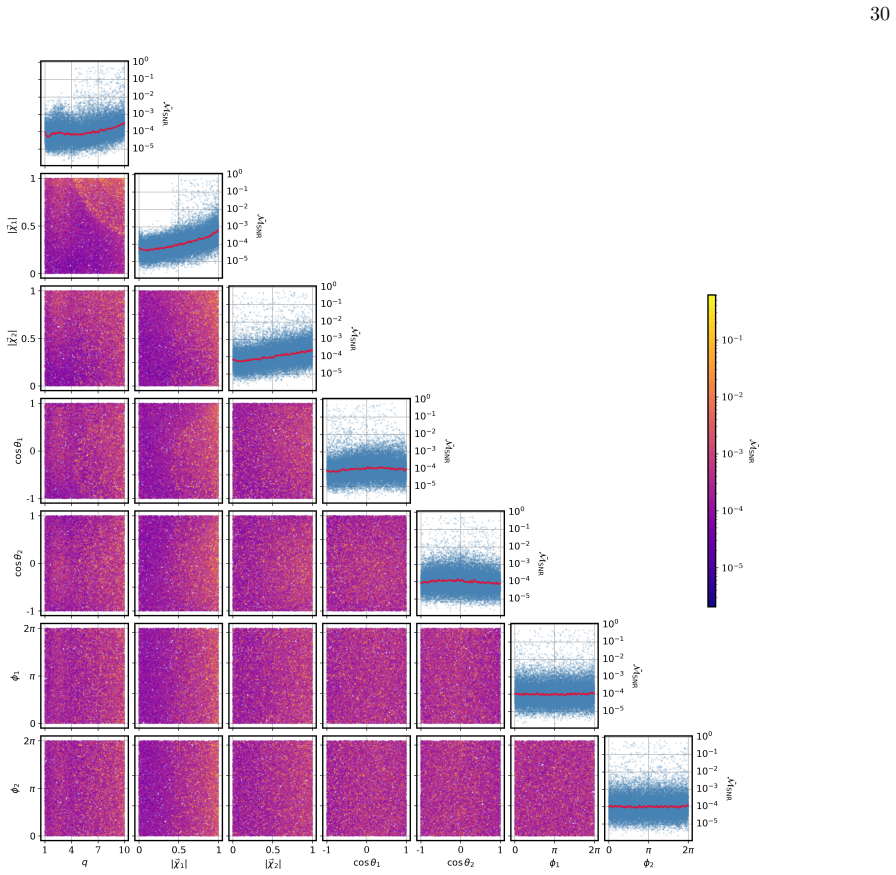
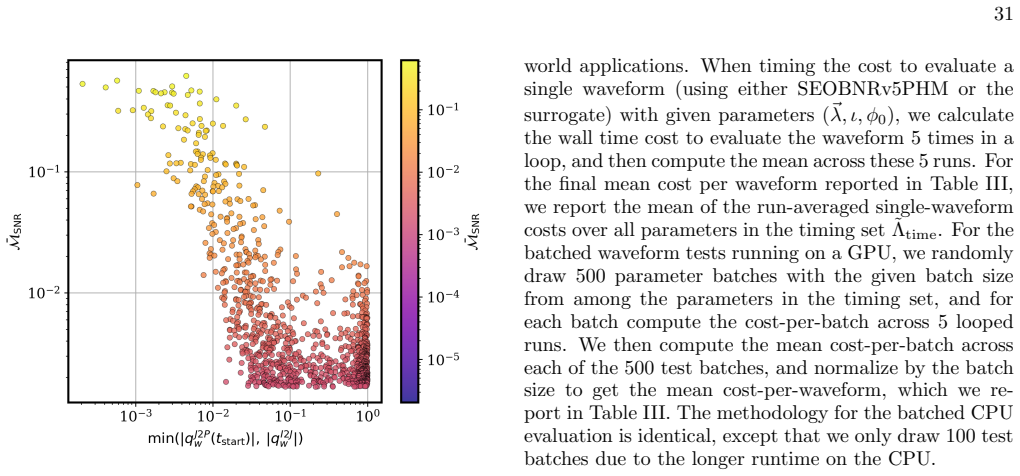
Dependence on intrinsic parameters In this section we explore how the mismatch be- tween our surrogate and SEOBNRv5PHM depends on the intrinsic parameters ⃗λ= (q,|⃗ χ1|, θ1, ϕ1,|⃗ χ2|, θ2, ϕ2), considering as a particular example the SNR-weighted, (ι, ϕ0, ψ)-averaged mismatches using the aLIGO PSD il- lustrated in Fig. 7. Figure 18 displays the same mis- ...
-
[2]
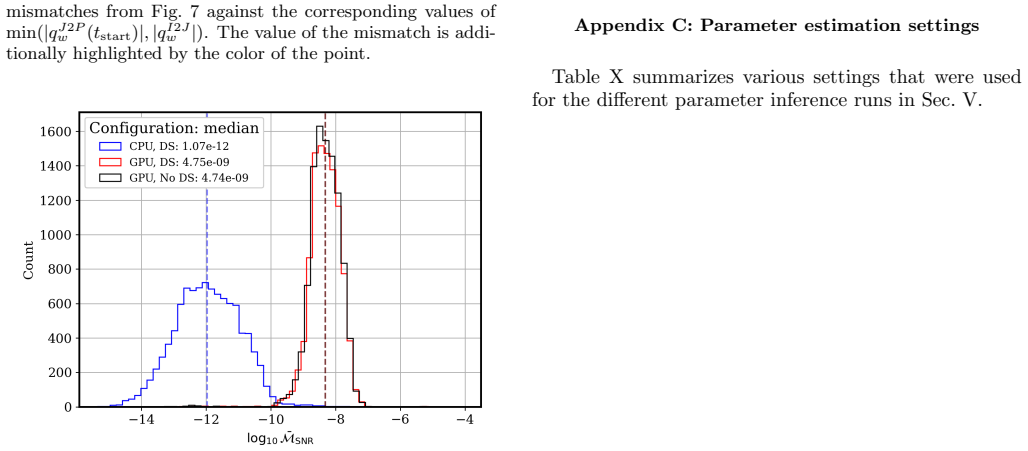
Equivalence of different model configurations In Sec. IV B we evaluated the faithfulness of our sur- rogate model to SEOBNRv5PHM, using the CPU ver- sion of our model without quaternion downsampling as the reference configuration. In this appendix, we confirm that different configurations of our surrogate model pro- duce consistent results with one anothe...
work page 2000
-
[3]
B. P. Abbottet al.(LIGO Scientific, Virgo), Obser- vation of Gravitational Waves from a Binary Black Hole Merger, Phys. Rev. Lett.116, 061102 (2016), arXiv:1602.03837 [gr-qc]
work page internal anchor Pith review arXiv 2016
-
[4]
A. G. Abacet al.(LIGO Scientific, VIRGO, KA- GRA), GWTC-4.0: Updating the Gravitational-Wave Transient Catalog with Observations from the First Part of the Fourth LIGO-Virgo-KAGRA Observing Run (2025), arXiv:2508.18082 [gr-qc]
work page internal anchor Pith review arXiv 2025
-
[5]
org/plan/(2026), last updated 13 February 2026
LIGO Scientific Collaboration, Virgo Collaboration, and KAGRA Collaboration, LIGO, Virgo and KAGRA Observing Run Plans,https://observing.docs.ligo. org/plan/(2026), last updated 13 February 2026
work page 2026
-
[6]
Punturoet al., The Einstein Telescope: A third-generation gravitational wave observatory, Class
M. Punturoet al., The Einstein Telescope: A third-generation gravitational wave observatory, Class. Quant. Grav.27, 194002 (2010)
work page 2010
-
[7]
Science with the Einstein Telescope: a comparison of different designs
M. Branchesiet al., Science with the Einstein Tele- scope: a comparison of different designs, JCAP07, 068, arXiv:2303.15923 [gr-qc]
work page internal anchor Pith review arXiv
-
[8]
The Science of the Einstein Telescope
A. Abacet al.(ET), The Science of the Einstein Tele- scope (2025), arXiv:2503.12263 [gr-qc]
work page internal anchor Pith review Pith/arXiv arXiv 2025
-
[9]
Cosmic Explorer: The U.S. Contribution to Gravitational-Wave Astronomy beyond LIGO
D. Reitzeet al., Cosmic Explorer: The U.S. Contribu- tion to Gravitational-Wave Astronomy beyond LIGO, Bull. Am. Astron. Soc.51, 035 (2019), arXiv:1907.04833 [astro-ph.IM]
work page internal anchor Pith review arXiv 2019
-
[10]
Evanset al., arXiv e-prints (2023), arXiv:2306.13745 [astro-ph.IM]
M. Evanset al., Cosmic Explorer: A Submission to the NSF MPSAC ngGW Subcommittee (2023), arXiv:2306.13745 [astro-ph.IM]
-
[11]
M. Colpiet al.(LISA), LISA Definition Study Report (2024), arXiv:2402.07571 [astro-ph.CO]
work page internal anchor Pith review arXiv 2024
-
[12]
T. A. Apostolatos, C. Cutler, G. J. Sussman, and K. S. Thorne, Spin induced orbital precession and its mod- ulation of the gravitational wave forms from merging binaries, Phys. Rev. D49, 6274 (1994)
work page 1994
-
[13]
Vecchio, LISA observations of rapidly spinning mas- sive black hole binary systems, Phys
A. Vecchio, LISA observations of rapidly spinning mas- sive black hole binary systems, Phys. Rev. D70, 042001 (2004), arXiv:astro-ph/0304051
-
[14]
Spin-Precession: Breaking the Black Hole--Neutron Star Degeneracy
K. Chatziioannou, N. Cornish, A. Klein, and N. Yunes, Spin-Precession: Breaking the Black Hole–Neutron Star Degeneracy, Astrophys. J. Lett.798, L17 (2015), arXiv:1402.3581 [gr-qc]
work page Pith review arXiv 2015
-
[15]
G. Pratten, P. Schmidt, R. Buscicchio, and L. M. Thomas, Measuring precession in asymmetric com- pact binaries, Phys. Rev. Res.2, 043096 (2020), arXiv:2006.16153 [gr-qc]
-
[16]
G. Prattenet al., Computationally efficient models for the dominant and subdominant harmonic modes of pre- cessing binary black holes, Phys. Rev. D103, 104056 (2021), arXiv:2004.06503 [gr-qc]
work page internal anchor Pith review arXiv 2021
- [17]
-
[18]
E. Hamiltonet al., PhenomXPNR: An improved gravitational wave model linking precessing in- spirals and NR-calibrated merger-ringdown (2025), arXiv:2507.02604 [gr-qc]
- [19]
-
[20]
S. E. Field, C. R. Galley, J. S. Hesthaven, J. Kaye, and M. Tiglio, Fast prediction and evaluation of gravi- tational waveforms using surrogate models, Phys. Rev. X4, 031006 (2014), arXiv:1308.3565 [gr-qc]
work page Pith review arXiv 2014
-
[21]
Frequency domain reduced order models for gravitational waves from aligned-spin compact binaries
M. P¨ urrer, Frequency domain reduced order models for gravitational waves from aligned-spin compact binaries, Class. Quant. Grav.31, 195010 (2014), arXiv:1402.4146 [gr-qc]
work page Pith review arXiv 2014
-
[22]
J. Blackman, S. E. Field, C. R. Galley, B. Szil´ agyi, M. A. Scheel, M. Tiglio, and D. A. Hemberger, Fast and Accurate Prediction of Numerical Relativity Wave- forms from Binary Black Hole Coalescences Using Sur- rogate Models, Phys. Rev. Lett.115, 121102 (2015), arXiv:1502.07758 [gr-qc]
work page Pith review arXiv 2015
-
[23]
J. Blackman, S. E. Field, M. A. Scheel, C. R. Gal- ley, D. A. Hemberger, P. Schmidt, and R. Smith, A Surrogate Model of Gravitational Waveforms from Numerical Relativity Simulations of Precessing Binary Black Hole Mergers, Phys. Rev. D95, 104023 (2017), arXiv:1701.00550 [gr-qc]
work page Pith review arXiv 2017
- [24]
-
[25]
Surrogate models for precessing binary black hole simulations with unequal masses
V. Varma, S. E. Field, M. A. Scheel, J. Blackman, D. Gerosa, L. C. Stein, L. E. Kidder, and H. P. Pfeiffer, Surrogate models for precessing binary black hole sim- ulations with unequal masses, Phys. Rev. Research.1, 033015 (2019), arXiv:1905.09300 [gr-qc]
work page internal anchor Pith review arXiv 2019
-
[26]
N. J. Cornish, Fast Fisher Matrices and Lazy Likeli- hoods (2010), arXiv:1007.4820 [gr-qc]
work page Pith review arXiv 2010
-
[27]
Relative Binning and Fast Likelihood Evaluation for Gravitational Wave Parameter Estimation
B. Zackay, L. Dai, and T. Venumadhav, Relative Bin- ning and Fast Likelihood Evaluation for Gravitational Wave Parameter Estimation (2018), arXiv:1806.08792 [astro-ph.IM]
work page Pith review arXiv 2018
- [28]
-
[29]
Accelerating gravitational wave parameter estimation with multi-band template interpolation
S. Vinciguerra, J. Veitch, and I. Mandel, Accelerat- ing gravitational wave parameter estimation with multi- band template interpolation, Class. Quant. Grav.34, 115006 (2017), arXiv:1703.02062 [gr-qc]
work page Pith review arXiv 2017
-
[30]
S. Morisaki, Accelerating parameter estimation of grav- itational waves from compact binary coalescence us- ing adaptive frequency resolutions, Phys. Rev. D104, 044062 (2021), arXiv:2104.07813 [gr-qc]
-
[31]
Gravitational wave parameter estimation with compressed likelihood evaluations
P. Canizares, S. E. Field, J. R. Gair, and M. Tiglio, Gravitational wave parameter estimation with com- pressed likelihood evaluations, Phys. Rev. D87, 124005 (2013), arXiv:1304.0462 [gr-qc]
work page Pith review arXiv 2013
-
[32]
Accelerated gravitational-wave parameter estimation with reduced order modeling
P. Canizares, S. E. Field, J. Gair, V. Raymond, R. Smith, and M. Tiglio, Accelerated gravitational-wave parameter estimation with reduced order modeling, Phys. Rev. Lett.114, 071104 (2015), arXiv:1404.6284 [gr-qc]
work page Pith review arXiv 2015
-
[33]
Fast and Accurate Inference on Gravitational Waves from Precessing Compact Binaries
R. Smith, S. E. Field, K. Blackburn, C.-J. Haster, M. P¨ urrer, V. Raymond, and P. Schmidt, Fast and ac- curate inference on gravitational waves from precess- 34 ing compact binaries, Phys. Rev. D94, 044031 (2016), arXiv:1604.08253 [gr-qc]
work page Pith review arXiv 2016
-
[34]
J. Tissino, G. Carullo, M. Breschi, R. Gamba, S. Schmidt, and S. Bernuzzi, Combining effective-one- body accuracy and reduced-order-quadrature speed for binary neutron star merger parameter estimation with machine learning, Phys. Rev. D107, 084037 (2023), arXiv:2210.15684 [gr-qc]
- [35]
- [36]
- [37]
- [38]
-
[39]
Hu, (2025), arXiv:2507.05209 [gr-qc]
Q. Hu, Hierarchical Subtraction with Neural Density Estimators as a General Solution to Overlapping Grav- itational Wave Signals (2025), arXiv:2507.05209 [gr-qc]
-
[40]
A. Ramos-Buades, A. Buonanno, H. Estell´ es, M. Khalil, D. P. Mihaylov, S. Ossokine, L. Pompili, and M. Shiferaw, Next generation of accurate and ef- ficient multipolar precessing-spin effective-one-body waveforms for binary black holes, Phys. Rev. D108, 124037 (2023), arXiv:2303.18046 [gr-qc]
-
[41]
M. Barrault, Y. Maday, N. C. Nguyen, and A. T. Pa- tera, An ‘empirical interpolation’ method: application to efficient reduced-basis discretization of partial differ- ential equations, Comptes Rendus Mathematique339, 667 (2004)
work page 2004
- [42]
-
[43]
A. J. K. Chua, C. R. Galley, and M. Vallisneri, Reduced- order modeling with artificial neurons for gravitational- wave inference, Phys. Rev. Lett.122, 211101 (2019), arXiv:1811.05491 [astro-ph.IM]
work page Pith review arXiv 2019
-
[44]
S. Khan and R. Green, Gravitational-wave surrogate models powered by artificial neural networks, Phys. Rev. D103, 064015 (2021), arXiv:2008.12932 [gr-qc]
- [45]
-
[46]
S.-C. Fragkouli, P. Nousi, N. Passalis, P. Iosif, N. Ster- gioulas, and A. Tefas, Deep residual error and bag- of-tricks learning for gravitational wave surrogate modeling, Appl. Soft Comput.147, 110746 (2023), arXiv:2203.08434 [astro-ph.IM]
-
[47]
O. Gramaxo Freitas, A. Theodoropoulos, N. Villanueva, T. Fernandes, S. Nunes, J. A. Font, A. Onofre, A. Torres-Forn´ e, and J. D. Martin-Guerrero, Deep learning powered numerical relativity surrogate for bi- nary black hole waveforms, Phys. Rev. D112, 043026 (2025), arXiv:2412.06946 [gr-qc]
-
[48]
L. E. Kidder, Coalescing binary systems of compact ob- jects to postNewtonian 5/2 order. 5. Spin effects, Phys. Rev. D52, 821 (1995), arXiv:gr-qc/9506022
work page Pith review arXiv 1995
-
[49]
Numerical Relativity Injection Infrastructure
P. Schmidt, I. W. Harry, and H. P. Pfeiffer, Nu- merical Relativity Injection Infrastructure (2017), arXiv:1703.01076 [gr-qc]
work page Pith review arXiv 2017
-
[50]
Tracking the precession of compact binaries from their gravitational-wave signal
P. Schmidt, M. Hannam, S. Husa, and P. Ajith, Tracking the precession of compact binaries from their gravitational-wave signal, Phys. Rev. D84, 024046 (2011), arXiv:1012.2879 [gr-qc]
work page Pith review arXiv 2011
-
[51]
P. Schmidt, M. Hannam, and S. Husa, Towards mod- els of gravitational waveforms from generic binaries: A simple approximate mapping between precessing and non-precessing inspiral signals, Phys. Rev. D86, 104063 (2012), arXiv:1207.3088 [gr-qc]
work page Pith review arXiv 2012
-
[52]
A geometric approach to the precession of compact binaries
M. Boyle, R. Owen, and H. P. Pfeiffer, A geometric approach to the precession of compact binaries, Phys. Rev. D84, 124011 (2011), arXiv:1110.2965 [gr-qc]
work page Pith review arXiv 2011
- [53]
-
[54]
Gravitational-wave modes from precessing black-hole binaries
M. Boyle, L. E. Kidder, S. Ossokine, and H. P. Pfeif- fer, Gravitational-wave modes from precessing black- hole binaries, arXiv:1409.4431 [gr-qc]
-
[55]
A. Ramos-Buades, P. Schmidt, G. Pratten, and S. Husa, Validity of common modeling approximations for pre- cessing binary black holes with higher-order modes, Phys. Rev. D101, 103014 (2020), arXiv:2001.10936 [gr- qc]
-
[56]
H. Estell´ es, A. Buonanno, R. Enficiaud, C. Foo, and L. Pompili, Adding equatorial-asymmetric effects for spin-precessing binaries into the SEOBNRv5PHM waveform model (2025), arXiv:2506.19911 [gr-qc]
-
[57]
K. S. Thorne, Multipole Expansions of Gravitational Radiation, Rev. Mod. Phys.52, 299 (1980)
work page 1980
-
[58]
Efficient asymptotic frame selection for binary black hole spacetimes using asymptotic radiation
R. O’Shaughnessy, B. Vaishnav, J. Healy, Z. Meeks, and D. Shoemaker, Efficient asymptotic frame selection for binary black hole spacetimes using asymptotic radia- tion, Phys. Rev. D84, 124002 (2011), arXiv:1109.5224 [gr-qc]
work page Pith review arXiv 2011
-
[59]
Angular velocity of gravitational radiation from precessing binaries and the corotating frame
M. Boyle, Angular velocity of gravitational radiation from precessing binaries and the corotating frame, Phys. Rev. D87, 104006 (2013), arXiv:1302.2919 [gr-qc]
work page Pith review arXiv 2013
-
[60]
L. N. Trefethen and I. Bau, David,Numerical Linear Algebra, illustrated ed., Other Titles in Applied Math- ematics, Vol. 50 (SIAM, 1997) p. 373
work page 1997
- [61]
-
[62]
High-accuracy mass, spin, and recoil predictions of generic black-hole merger remnants
V. Varma, D. Gerosa, L. C. Stein, F. H´ ebert, and H. Zhang, High-accuracy mass, spin, and recoil predic- tions of generic black-hole merger remnants, Phys. Rev. Lett.122, 011101 (2019), arXiv:1809.09125 [gr-qc]
work page Pith review arXiv 2019
-
[63]
D. Williams, I. S. Heng, J. Gair, J. A. Clark, and B. Khamesra, Precessing numerical relativity waveform surrogate model for binary black holes: A Gaussian process regression approach, Phys. Rev. D101, 063011 (2020), arXiv:1903.09204 [gr-qc]. 35
-
[64]
T. Islam, V. Varma, J. Lodman, S. E. Field, G. Khanna, M. A. Scheel, H. P. Pfeiffer, D. Gerosa, and L. E. Kid- der, Eccentric binary black hole surrogate models for the gravitational waveform and remnant properties: compa- rable mass, nonspinning case, Phys. Rev. D103, 064022 (2021), arXiv:2101.11798 [gr-qc]
- [65]
-
[66]
J. Bergstra, R. Bardenet, Y. Bengio, and B. K´ egl, Algo- rithms for hyper-parameter optimization, inAdvances in Neural Information Processing Systems, Vol. 24, edited by J. Shawe-Taylor, R. Zemel, P. Bartlett, F. Pereira, and K. Weinberger (Curran Associates, Inc., 2011)
work page 2011
-
[67]
J. Bergstra, D. Yamins, and D. Cox, Making a science of model search: Hyperparameter optimization in hun- dreds of dimensions for vision architectures, inProceed- ings of the 30th International Conference on Machine Learning, Proceedings of Machine Learning Research, Vol. 28 (PMLR, 2013) pp. 115–123
work page 2013
-
[68]
LIGO Scientific Collaboration, Virgo Collaboration, and KAGRA Collaboration, LVK Algorithm Library - LALSuite, Free software (GPL) (2018)
work page 2018
-
[69]
B. P. Abbottet al.(KAGRA, LIGO Scientific, Virgo), Prospects for observing and localizing gravitational- wave transients with Advanced LIGO, Advanced Virgo and KAGRA, Living Rev. Rel.19, 1 (2016), arXiv:1304.0670 [gr-qc]
work page internal anchor Pith review arXiv 2016
-
[70]
B. P. Abbottet al.(LIGO Scientific), Exploring the Sensitivity of Next Generation Gravitational Wave Detectors, Class. Quant. Grav.34, 044001 (2017), arXiv:1607.08697 [astro-ph.IM]
work page Pith review arXiv 2017
-
[71]
B. J. Owen and B. S. Sathyaprakash, Matched filter- ing of gravitational waves from inspiraling compact bi- naries: Computational cost and template placement, Phys. Rev. D60, 022002 (1999), arXiv:gr-qc/9808076
work page Pith review arXiv 1999
-
[72]
A. Nitz, I. Harry, D. Brown, C. M. Biwer, J. Willis, T. D. Canton, C. Capano, T. Dent, L. Pekowsky, G. S. C. Davies, S. De, M. Cabero, S. Wu, A. R. Williamson, B. Machenschalk, D. Macleod, F. Pan- narale, P. Kumar, S. Reyes, dfinstad, S. Kumar, M. T´ apai, L. Singer, P. Kumar, veronica villa, max- trevor, B. U. V. Gadre, S. Khan, S. Fairhurst, and A. Toll...
work page 2024
-
[73]
P. Virtanen, R. Gommers, T. E. Oliphant, M. Haber- land, T. Reddy, D. Cournapeau, E. Burovski, P. Pe- terson, W. Weckesser, J. Bright, S. J. van der Walt, M. Brett, J. Wilson, K. J. Millman, N. Mayorov, A. R. J. Nelson, E. Jones, R. Kern, E. Larson, C. J. Carey, ˙I. Polat, Y. Feng, E. W. Moore, J. VanderPlas, D. Laxalde, J. Perktold, R. Cimrman, I. Henrik...
work page 2020
-
[74]
Searching for Gravitational Waves from Compact Binaries with Precessing Spins
I. Harry, S. Privitera, A. Boh´ e, and A. Buonanno, Searching for Gravitational Waves from Compact Bi- naries with Precessing Spins, Phys. Rev. D94, 024012 (2016), arXiv:1603.02444 [gr-qc]
work page Pith review arXiv 2016
-
[75]
Model Waveform Accuracy Standards for Gravitational Wave Data Analysis
L. Lindblom, B. J. Owen, and D. A. Brown, Model Waveform Accuracy Standards for Gravitational Wave Data Analysis, Phys. Rev. D78, 124020 (2008), arXiv:0809.3844 [gr-qc]
work page Pith review arXiv 2008
-
[76]
S. T. McWilliams, B. J. Kelly, and J. G. Baker, Observ- ing mergers of non-spinning black-hole binaries, Phys. Rev. D82, 024014 (2010), arXiv:1004.0961 [gr-qc]
work page Pith review arXiv 2010
- [77]
-
[78]
Degeneracy between mass and spin in black-hole-binary waveforms
E. Baird, S. Fairhurst, M. Hannam, and P. Mur- phy, Degeneracy between mass and spin in black-hole- binary waveforms, Phys. Rev. D87, 024035 (2013), arXiv:1211.0546 [gr-qc]
work page Pith review arXiv 2013
-
[79]
Constructing Gravitational Waves from Generic Spin-Precessing Compact Binary Inspirals
K. Chatziioannou, A. Klein, N. Yunes, and N. Cornish, Constructing Gravitational Waves from Generic Spin- Precessing Compact Binary Inspirals, Phys. Rev. D95, 104004 (2017), arXiv:1703.03967 [gr-qc]
work page Pith review arXiv 2017
-
[80]
A. Toubiana and J. R. Gair, Indistinguishability cri- terion and estimating the presence of biases (2024), arXiv:2401.06845 [gr-qc]
discussion (0)
Sign in with ORCID, Apple, or X to comment. Anyone can read and Pith papers without signing in.