SimWorld Studio: Automatic Environment Generation with Evolving Coding Agent for Embodied Agent Learning
Reviewed by Pith T0 review T1 audit T2 compute T3 formal T4 kernel 2026-05-14 21:26 UTCgrok-4.3open to challenge →
The pith
SimWorld Studio uses a self-evolving coding agent to generate adaptive 3D environments that raise embodied navigation success rates by 18 points over fixed training.
A machine-rendered reading of the paper's core claim, the machinery that carries it, and where it could break.
Core claim
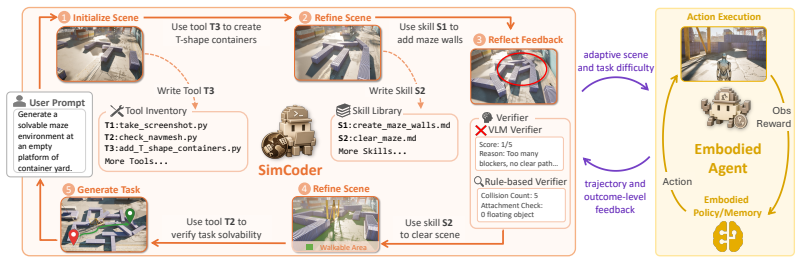
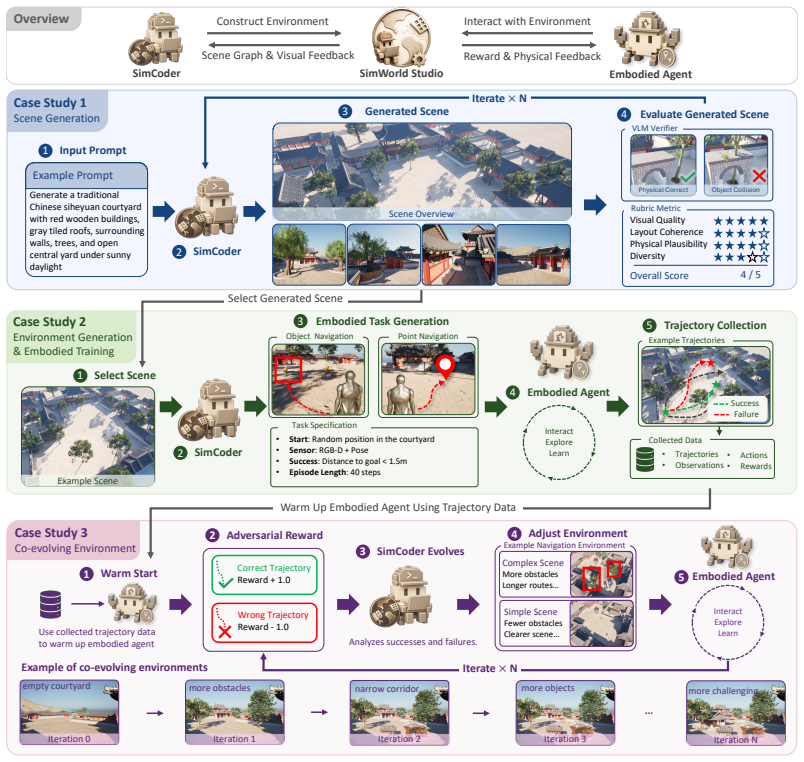
SimWorld Studio is an open-source platform on Unreal Engine 5 in which SimCoder, a tool-augmented coding agent, constructs physically grounded 3D environments from language or image instructions and exports them as Gym-style interfaces. SimCoder self-evolves by incorporating verifier feedback to fix errors and accumulate reusable tools and skills. The platform further enables co-evolution by feeding embodied-agent performance back to SimCoder so that it generates adaptive curricula at the learner's capability frontier.
What carries the argument
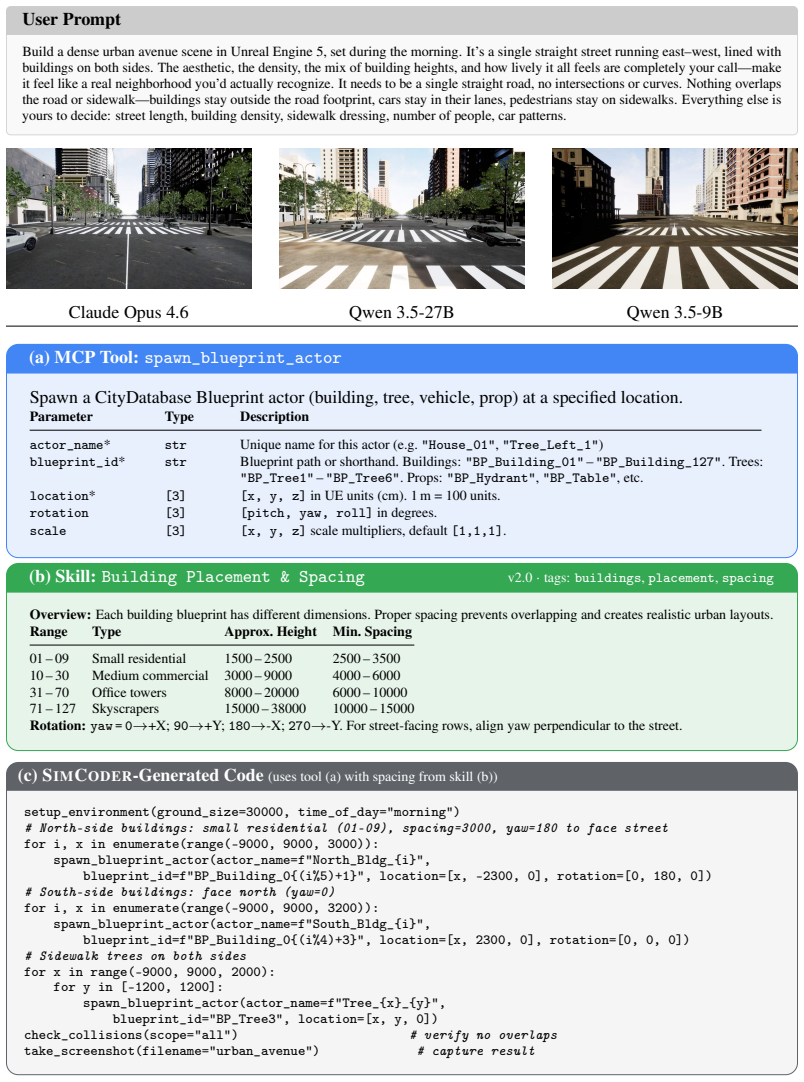
SimCoder, a tool- and skill-augmented coding agent that writes Unreal Engine 5 code and self-evolves by revising environments according to verifier feedback from compilation errors, physics checks, and VLM critiques.
If this is right
- Self-evolution via verifier feedback measurably increases the reliability of generated 3D environments.
- Environments produced by SimWorld Studio improve embodied-agent success rates on navigation tasks.
- Performance gains from the generated environments transfer to unseen benchmarks.
- Co-evolution between environment generation and agent learning produces an 18-point success-rate gain over fixed-environment training.
- The same co-evolution process yields a 40-point success-rate gain relative to an untrained agent.
Where Pith is reading between the lines
- The same verifier-driven loop could be ported to other game engines to expand the range of automatically generated training worlds.
- Adaptive curricula near the agent's frontier may reduce the sample complexity of embodied learning compared with static datasets.
- If the method scales, it offers a route to training regimes that require far less manual scene design than current embodied simulators.
Load-bearing premise
Feedback from compilation errors, physics checks, and visual-language critiques is sufficient to drive reliable self-evolution of complex, task-verifiable 3D environments without frequent human intervention.
What would settle it
A controlled run in which SimCoder receives repeated verifier feedback yet still produces non-functional or non-generalizing environments for a standard navigation benchmark, or in which co-evolution yields no measurable success-rate difference from fixed-environment training.
Figures












read the original abstract
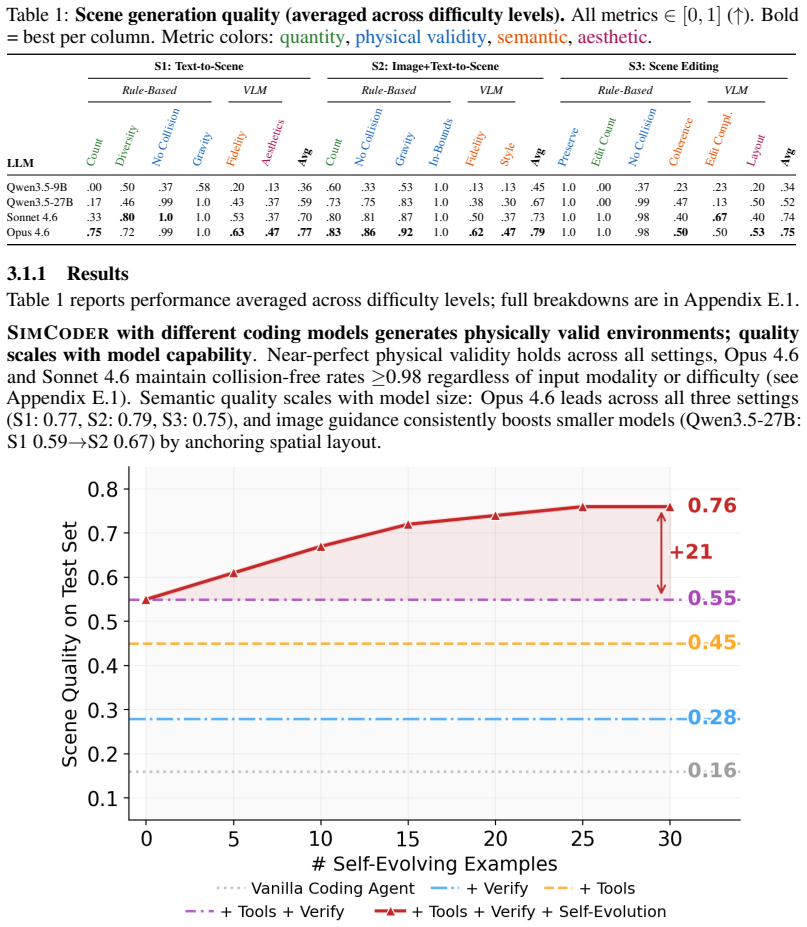
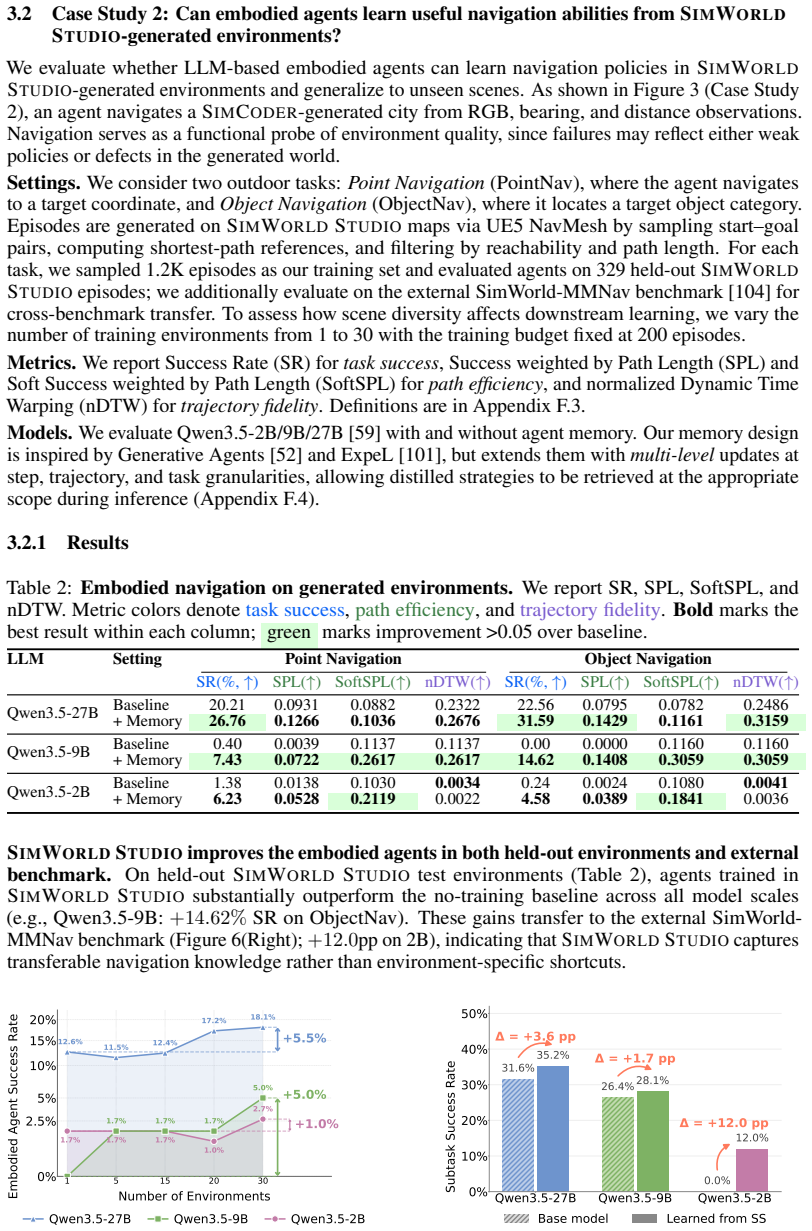
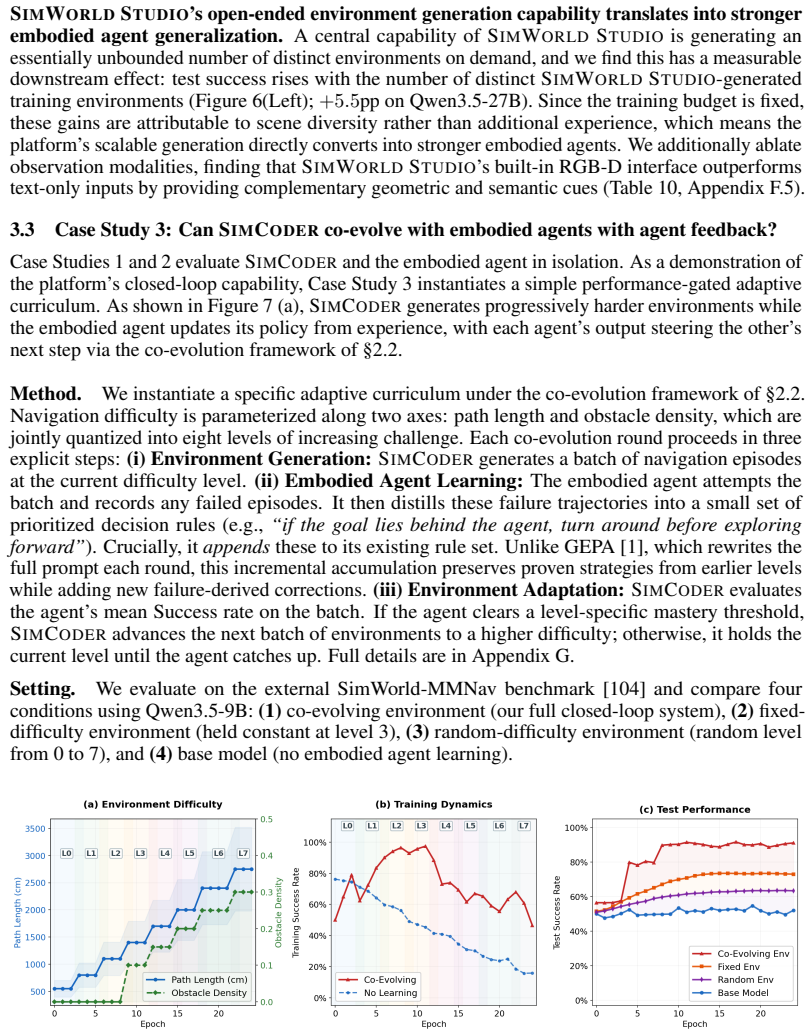
LLM/VLM-based digital agents have advanced rapidly thanks to scalable sandboxes for coding, web navigation, and computer use, which provide rich interactive training grounds. In contrast, embodied agents still lack abundant, diverse, and automatically generated 3D environments for interactive learning. Existing embodied simulators rely on manually crafted scenes or procedural templates, while recent LLM-based 3D generation systems mainly produce static scenes rather than deployable environments with verifiable tasks and standard learning interfaces. We introduce SimWorld Studio, an open-source platform built on Unreal Engine 5 for generating evolving embodied learning environments. At its core is SimCoder, a tool/skill-augmented coding agent that writes and executes engine-level code to construct physically grounded 3D worlds from language/image instructions. SimCoder self-evolves by using verifier feedback (e.g., compilation errors, physics checks, VLM critiques) to revise environments and autonomously add reusable tools and skills to its library. Generated worlds are exported as Gym-style environments for embodied agent learning. SimWorld Studio further enables co-evolution between environment generation and embodied learning: agent performance feedback guides SimCoder to generate adaptive curricula near the learner's capability frontier, so that environments become increasingly challenging as the embodied agent improves. Three case studies on embodied navigation show that self-evolution improves generation reliability, generated environments substantially improve embodied agent performance that generalizes to unseen benchmarks, and co-evolution yields an 18-point success-rate gain over fixed-environment learning and a 40-point gain over an untrained agent.
Editorial analysis
A structured set of objections, weighed in public.
Referee Report
Summary. The manuscript introduces SimWorld Studio, an open-source platform on Unreal Engine 5 that employs a tool-augmented coding agent (SimCoder) to generate physically grounded 3D environments from language or image instructions. SimCoder self-evolves by incorporating verifier feedback such as compilation errors, physics checks, and VLM critiques, while also adding reusable tools to its library. Generated environments are exported as Gym-style interfaces. The platform further supports co-evolution, in which embodied agent performance feedback guides SimCoder to produce adaptive curricula near the learner's capability frontier. Three case studies on embodied navigation tasks report that self-evolution improves generation reliability, that the generated environments yield substantial performance gains with generalization to unseen benchmarks, and that co-evolution produces an 18-point success-rate improvement over fixed-environment learning and a 40-point improvement over an untrained agent.
Significance. If the reported gains hold, the work provides a concrete step toward scalable, automatically generated training environments for embodied agents, reducing dependence on manually crafted scenes. The open-source release, the use of standard Gym interfaces, and the demonstration of generalization to external benchmarks are positive features that could support reproducibility and follow-on research. The co-evolution loop offers a plausible mechanism for creating capability-matched curricula.
major comments (2)
- [Abstract and Case Studies] Abstract and Case Studies: The reported 18-point and 40-point success-rate gains are presented without accompanying information on the number of experimental runs, standard deviations or error bars, exact baseline implementations, or the precise protocol used to enforce task verifiability. These details are required to assess whether the generalization claims to unseen benchmarks are statistically robust.
- [Case Studies] Case Studies: No quantitative metrics are supplied on the autonomous evolution success rate, the number of self-revision iterations, or the frequency of human interventions needed to correct verifier failures. Because the central claim depends on verifier feedback (compilation errors, physics checks, VLM critiques) reliably producing task-verifiable environments with minimal manual correction, the absence of these statistics leaves the reliability of the self-evolution loop unsubstantiated.
minor comments (1)
- [Abstract] Abstract: On first use, the terms 'SimCoder' and 'SimWorld Studio' would benefit from a short parenthetical gloss to aid readers who encounter the abstract in isolation.
Simulated Author's Rebuttal
We thank the referee for the constructive feedback and positive overall assessment. We address each major comment below and have revised the manuscript to incorporate the requested details on experimental statistics and evolution metrics.
read point-by-point responses
-
Referee: [Abstract and Case Studies] Abstract and Case Studies: The reported 18-point and 40-point success-rate gains are presented without accompanying information on the number of experimental runs, standard deviations or error bars, exact baseline implementations, or the precise protocol used to enforce task verifiability. These details are required to assess whether the generalization claims to unseen benchmarks are statistically robust.
Authors: We agree that these statistical details are necessary to evaluate robustness. The revised manuscript expands the Case Studies section with the number of experimental runs, standard deviations and error bars, exact baseline implementations, and the full task verifiability protocol (combining compilation checks, physics validation, VLM critiques, and targeted human review). These additions confirm the statistical significance of the reported gains and support the generalization claims. revision: yes
-
Referee: [Case Studies] Case Studies: No quantitative metrics are supplied on the autonomous evolution success rate, the number of self-revision iterations, or the frequency of human interventions needed to correct verifier failures. Because the central claim depends on verifier feedback (compilation errors, physics checks, VLM critiques) reliably producing task-verifiable environments with minimal manual correction, the absence of these statistics leaves the reliability of the self-evolution loop unsubstantiated.
Authors: We acknowledge the importance of these metrics for substantiating the self-evolution claims. The revised manuscript adds a dedicated paragraph in the Case Studies section reporting quantitative metrics on the autonomous evolution success rate, average number of self-revision iterations, and frequency of human interventions. These statistics demonstrate that the verifier feedback loop produces reliable environments with limited manual correction. revision: yes
Circularity Check
No circularity: empirical gains measured on external benchmarks and controls
full rationale
The paper describes an empirical system (SimCoder + Gym export + co-evolution loop) whose central claims are performance deltas on embodied navigation case studies. These deltas are reported against fixed-environment baselines, untrained agents, and unseen benchmarks; no equations, fitted parameters, or self-referential quantities are defined. No load-bearing self-citation, uniqueness theorem, or ansatz is invoked to derive the reported 18-point or 40-point gains. The derivation chain is therefore self-contained and externally falsifiable.
Axiom & Free-Parameter Ledger
axioms (1)
- domain assumption Unreal Engine 5 can be programmatically scripted to produce physically grounded, interactive 3D scenes with verifiable tasks
invented entities (2)
-
SimCoder
no independent evidence
-
SimWorld Studio
no independent evidence
Lean theorems connected to this paper
-
IndisputableMonolith/Cost/FunctionalEquation.leanwashburn_uniqueness_aczel unclear?
unclearRelation between the paper passage and the cited Recognition theorem.
SIMCODER self-evolves by using verifier feedback (e.g., compilation errors, physics checks, VLM critiques) to revise environments and autonomously add reusable tools and skills to its library.
-
IndisputableMonolith/Foundation/RealityFromDistinction.leanreality_from_one_distinction unclear?
unclearRelation between the paper passage and the cited Recognition theorem.
co-evolution yields an 18-point success-rate gain over fixed-environment learning
What do these tags mean?
- matches
- The paper's claim is directly supported by a theorem in the formal canon.
- supports
- The theorem supports part of the paper's argument, but the paper may add assumptions or extra steps.
- extends
- The paper goes beyond the formal theorem; the theorem is a base layer rather than the whole result.
- uses
- The paper appears to rely on the theorem as machinery.
- contradicts
- The paper's claim conflicts with a theorem or certificate in the canon.
- unclear
- Pith found a possible connection, but the passage is too broad, indirect, or ambiguous to say the theorem truly supports the claim.
Reference graph
Works this paper leans on
-
[1]
GEPA: Reflective Prompt Evolution Can Outperform Reinforcement Learning
Lakshya A Agrawal, Shangyin Tan, Dilara Soylu, Noah Ziems, Rishi Khare, Krista Opsahl- Ong, Arnav Singhvi, Herumb Shandilya, Michael J Ryan, Meng Jiang, Christopher Potts, 12 Koushik Sen, Alexandros G. Dimakis, Ion Stoica, Dan Klein, Matei Zaharia, and Omar Khattab. Gepa: Reflective prompt evolution can outperform reinforcement learning, 2026. URLhttps://...
work page internal anchor Pith review Pith/arXiv arXiv 2026
-
[2]
Peter Anderson, Angel Chang, Devendra Singh Chaplot, Alexey Dosovitskiy, Saurabh Gupta, Vladlen Koltun, Jana Kosecka, Jitendra Malik, Roozbeh Mottaghi, Manolis Savva, and Amir R. Zamir. On evaluation of embodied navigation agents, 2018. URL https://arxiv.org/ abs/1807.06757
work page internal anchor Pith review Pith/arXiv arXiv 2018
-
[3]
Introducing the model context protocol.https://www.anthropic.com/news/ model-context-protocol, 2024
Anthropic. Introducing the model context protocol.https://www.anthropic.com/news/ model-context-protocol, 2024. Published November 25, 2024. Accessed: 2026-05-03
work page 2024
-
[4]
Anthropic. Claude code by anthropic. https://www.anthropic.com/product/ claude-code, 2026. Accessed: 2026-05-07
work page 2026
-
[5]
Anthropic. Introducing claude opus 4.6. https://www.anthropic.com/news/ claude-opus-4-6, February 2026. Accessed: 2026-05-07
work page 2026
-
[6]
Anthropic. Claude sonnet 4.6. https://www.anthropic.com/claude/sonnet, February
-
[7]
Accessed: 2026-05-07
work page 2026
-
[8]
Program Synthesis with Large Language Models
Jacob Austin, Augustus Odena, Maxwell Nye, Maarten Bosma, Henryk Michalewski, David Dohan, Ellen Jiang, Carrie Cai, Michael Terry, Quoc Le, et al. Program synthesis with large language models.arXiv preprint arXiv:2108.07732, 2021. URL https://arxiv.org/abs/ 2108.07732
work page internal anchor Pith review Pith/arXiv arXiv 2021
-
[9]
Objectnav revisited: On evaluation of embodied agents navigating to objects
Dhruv Batra, Aaron Gokaslan, Aniruddha Kembhavi, Oleksandr Maksymets, Roozbeh Mot- taghi, Manolis Savva, Alexander Toshev, and Erik Wijmans. Objectnav revisited: On evaluation of embodied agents navigating to objects.CoRR, abs/2006.13171, 2020. URL https://arxiv.org/abs/2006.13171
-
[10]
Scenefactor: Factored latent 3d diffusion for controllable 3d scene generation
Aleksey Bokhovkin, Quan Meng, Shubham Tulsiani, and Angela Dai. Scenefactor: Factored latent 3d diffusion for controllable 3d scene generation. InProceedings of the Computer Vision and Pattern Recognition Conference, pages 628–639, 2025
work page 2025
-
[11]
Genie: Generative interactive environments
Jake Bruce, Michael D Dennis, Ashley Edwards, Jack Parker-Holder, Yuge Shi, Edward Hughes, Matthew Lai, Aditi Mavalankar, Richie Steigerwald, Chris Apps, et al. Genie: Generative interactive environments. InForty-first International Conference on Machine Learning, 2024
work page 2024
-
[12]
Large language models as tool makers, 2024
Tianle Cai, Xuezhi Wang, Tengyu Ma, Xinyun Chen, and Denny Zhou. Large language models as tool makers, 2024
work page 2024
-
[13]
Evaluating Large Language Models Trained on Code
Mark Chen, Jerry Tworek, Heewoo Jun, Qiming Yuan, Henrique Ponde De Oliveira Pinto, Jared Kaplan, Harri Edwards, Yuri Burda, Nicholas Joseph, Greg Brockman, et al. Evaluating large language models trained on code.arXiv preprint arXiv:2107.03374, 2021. URL https://arxiv.org/abs/2107.03374
work page internal anchor Pith review Pith/arXiv arXiv 2021
-
[14]
Qian Cheng, Xin Cong, Zhong Zhang, Yesai Wu, Yankai Lin, Xie Zhiyuan, Liu Zhiyuan, and Sun Maosong. Creator: Tool creation for disentangling abstract and concrete reasoning of large language models, 2023
work page 2023
-
[15]
LEGENT: open platform for embodied agents,
Zhili Cheng, Zhitong Wang, Jinyi Hu, Shengding Hu, An Liu, Yuge Tu, Pengkai Li, Lei Shi, Zhiyuan Liu, and Maosong Sun. LEGENT: Open platform for embodied agents. In Yixin Cao, Yang Feng, and Deyi Xiong, editors,Proceedings of the 62nd Annual Meeting of the Association for Computational Linguistics (Volume 3: System Demonstrations), pages 335–345, Bangkok,...
-
[16]
arXiv preprint arXiv:2311.13384 , year=
Jaeyoung Chung, Suyoung Lee, Hyeongjin Nam, Jaerin Lee, and Kyoung Mu Lee. Lu- ciddreamer: Domain-free generation of 3d gaussian splatting scenes, 2023. URL https: //arxiv.org/abs/2311.13384. 13
-
[17]
Procthor: Large-scale embodied ai using procedural generation.arXiv preprint arXiv:2206.06994, 2022
Matt Deitke, Eli VanderBilt, Alvaro Herrasti, Luca Weihs, Jordi Salvador, Kiana Ehsani, Winson Han, Eric Kolve, Ali Farhadi, Aniruddha Kembhavi, and Roozbeh Mottaghi. Procthor: Large-scale embodied ai using procedural generation, 2022. URL https://arxiv.org/ abs/2206.06994
-
[18]
Michael Dennis, Natasha Jaques, Eugene Vinitsky, Alexandre Bayen, Stuart Russell, Andrew Critch, and Sergey Levine. Emergent complexity and zero-shot transfer via unsupervised environment design.Advances in neural information processing systems, 33:13049–13061, 2020
work page 2020
-
[19]
Agent-World: Scaling Real-World Environment Synthesis for Evolving General Agent Intelligence
Guanting Dong, Junting Lu, Junjie Huang, Wanjun Zhong, Longxiang Liu, Shijue Huang, Zhenyu Li, Yang Zhao, Xiaoshuai Song, Xiaoxi Li, Jiajie Jin, Yutao Zhu, Hanbin Wang, Fangyu Lei, Qinyu Luo, Mingyang Chen, Zehui Chen, Jiazhan Feng, Ji-Rong Wen, and Zhicheng Dou. Agent-world: Scaling real-world environment synthesis for evolving general agent intelligence...
work page internal anchor Pith review Pith/arXiv arXiv 2026
-
[20]
CARLA: An Open Urban Driving Simulator
Alexey Dosovitskiy, German Ros, Felipe Codevilla, Antonio Lopez, and Vladlen Koltun. Carla: An open urban driving simulator, 2017. URLhttps://arxiv.org/abs/1711.03938
work page internal anchor Pith review Pith/arXiv arXiv 2017
-
[21]
Danny Driess, Fei Xia, Mehdi S. M. Sajjadi, Corey Lynch, Aakanksha Chowdhery, Brian Ichter, Ayzaan Wahid, Jonathan Tompson, Quan Vuong, Tianhe Yu, Wenlong Huang, Yevgen Chebotar, Pierre Sermanet, Daniel Duckworth, Sergey Levine, Vincent Vanhoucke, Karol Hausman, Marc Toussaint, Klaus Greff, Andy Zeng, Igor Mordatch, and Pete Florence. Palm-e: An embodied ...
work page 2023
-
[22]
Maxence Faldor, Jenny Zhang, Antoine Cully, and Jeff Clune. Omni-epic: Open-endedness via models of human notions of interestingness with environments programmed in code.arXiv preprint arXiv:2405.15568, 2024. URLhttps://arxiv.org/abs/2405.15568
-
[23]
Linxi Fan, Guanzhi Wang, Yunfan Jiang, Ajay Mandlekar, Yuncong Yang, Haoyi Zhu, Andrew Tang, De-An Huang, Yuke Zhu, and Anima Anandkumar. Minedojo: Building open-ended embodied agents with internet-scale knowledge, 2022. URL https://arxiv.org/abs/ 2206.08853
-
[24]
Jinyuan Fang, Yanwen Peng, Xi Zhang, Yingxu Wang, Xinhao Yi, Guibin Zhang, Yi Xu, Bin Wu, Siwei Liu, Zihao Li, et al. A comprehensive survey of self-evolving ai agents: A new paradigm bridging foundation models and lifelong agentic systems.arXiv preprint arXiv:2508.07407, 2025. URLhttps://arxiv.org/abs/2508.07407
work page internal anchor Pith review arXiv 2025
-
[25]
Webevolver: Enhancing web agent self-improvement with co-evolving world model
Tianqing Fang, Hongming Zhang, Zhisong Zhang, Kaixin Ma, Wenhao Yu, Haitao Mi, and Dong Yu. Webevolver: Enhancing web agent self-improvement with co-evolving world model. InProceedings of the 2025 Conference on Empirical Methods in Natural Language Processing, pages 8970–8986, 2025
work page 2025
-
[26]
ThreeDWorld: A Platform for Interactive Multi-Modal Physical Simulation
Chuang Gan, Jeremy Schwartz, Seth Alter, Damian Mrowca, Martin Schrimpf, James Traer, Julian De Freitas, Jonas Kubilius, Abhishek Bhandwaldar, Nick Haber, Megumi Sano, Kuno Kim, Elias Wang, Michael Lingelbach, Aidan Curtis, Kevin Feigelis, Daniel M. Bear, Dan Gutfreund, David Cox, Antonio Torralba, James J. DiCarlo, Joshua B. Tenenbaum, Josh H. McDermott,...
work page Pith review arXiv 2021
-
[27]
Chen Gao, Baining Zhao, Weichen Zhang, Jun Zhang, Jinzhu Mao, Zhiheng Zheng, Fanhang Man, Jianjie Fang, Zile Zhou, Jinqiang Cui, Xinlei Chen, and Yong Li. Embodiedcity: A benchmark platform for embodied agent in real-world city environment.arXiv preprint, 2024
work page 2024
-
[28]
Huan-ang Gao, Jiayi Geng, Wenyue Hua, Mengkang Hu, Xinzhe Juan, Hongzhang Liu, Shilong Liu, Jiahao Qiu, Xuan Qi, Yiran Wu, et al. A survey of self-evolving agents: What, when, how, and where to evolve on the path to artificial super intelligence.arXiv preprint arXiv:2507.21046, 2025. URLhttps://arxiv.org/abs/2507.21046. 14
work page internal anchor Pith review arXiv 2025
-
[29]
Jiacheng Guo, Ling Yang, Peter Chen, Qixin Xiao, Yinjie Wang, Xinzhe Juan, Jiahao Qiu, Ke Shen, and Mengdi Wang. Genenv: Difficulty-aligned co-evolution between llm agents and environment simulators.arXiv preprint arXiv:2512.19682, 2025. URL https://arxiv. org/abs/2512.19682
-
[30]
Yanjiang Guo, Tony Lee, Lucy Xiaoyang Shi, Jianyu Chen, Percy Liang, and Chelsea Finn. Vlaw: Iterative co-improvement of vision-language-action policy and world model.arXiv preprint arXiv:2602.12063, 2026. URLhttps://arxiv.org/abs/2602.12063
-
[31]
Hongliang He, Wenlin Yao, Kaixin Ma, Wenhao Yu, Hongming Zhang, Tianqing Fang, Zhenzhong Lan, and Dong Yu. Openwebvoyager: Building multimodal web agents via iterative real-world exploration, feedback and optimization. InProceedings of the 63rd Annual Meeting of the Association for Computational Linguistics (Volume 1: Long Papers), pages 27545–27564, 2025
work page 2025
-
[32]
Text2room: Extracting textured 3d meshes from 2d text-to-image models
Lukas Höllein, Ang Cao, Andrew Owens, Justin Johnson, and Matthias Nießner. Text2room: Extracting textured 3d meshes from 2d text-to-image models. InProceedings of the IEEE/CVF International Conference on Computer Vision, pages 7909–7920, 2023
work page 2023
-
[33]
Metagpt: Meta programming for a multi-agent collaborative framework
Sirui Hong, Mingchen Zhuge, Jonathan Chen, Xiawu Zheng, Yuheng Cheng, Jinlin Wang, Ceyao Zhang, Zili Wang, Steven Ka Shing Yau, Zijuan Lin, et al. Metagpt: Meta programming for a multi-agent collaborative framework. InThe twelfth international conference on learning representations, 2023
work page 2023
-
[34]
Relic: Interactive video world model with long-horizon memory.arXiv preprint arXiv:2512.04040, 2025
Yicong Hong, Yiqun Mei, Chongjian Ge, Yiran Xu, Yang Zhou, Sai Bi, Yannick Hold- Geoffroy, Mike Roberts, Matthew Fisher, Eli Shechtman, et al. Relic: Interactive video world model with long-horizon memory.arXiv preprint arXiv:2512.04040, 2025. URL https://arxiv.org/abs/2512.04040
-
[35]
Automated Design of Agentic Systems
Shengran Hu, Cong Lu, and Jeff Clune. Automated design of agentic systems.arXiv preprint arXiv:2408.08435, 2024. URLhttps://arxiv.org/abs/2408.08435
work page internal anchor Pith review arXiv 2024
-
[36]
Ross, Cordelia Schmid, and Alireza Fathi
Ziniu Hu, Ahmet Iscen, Aashi Jain, Thomas Kipf, Yisong Yue, David A. Ross, Cordelia Schmid, and Alireza Fathi. Scenecraft: An llm agent for synthesizing 3d scene as blender code, 2024. URLhttps://arxiv.org/abs/2403.01248
-
[37]
R-zero: Self-evolving reasoning llm from zero data
Chengsong Huang, Wenhao Yu, Xiaoyang Wang, Hongming Zhang, Zongxia Li, Ruosen Li, Jiaxin Huang, Haitao Mi, and Dong Yu. R-zero: Self-evolving reasoning llm from zero data
-
[38]
URLhttps://arxiv.org/abs/2508.05004
work page internal anchor Pith review Pith/arXiv arXiv
-
[39]
Prioritized Level Replay, 2020
Minqi Jiang, Edward Grefenstette, and Tim Rocktäschel. Prioritized Level Replay, 2020
work page 2020
-
[40]
WoVR: World Models as Reliable Simulators for Post-Training VLA Policies with RL
Zhennan Jiang, Shangqing Zhou, Yutong Jiang, Zefang Huang, Mingjie Wei, Yuhui Chen, Tianxing Zhou, Zhen Guo, Hao Lin, Quanlu Zhang, Yu Wang, Haoran Li, Chao Yu, and Dongbin Zhao. Wovr: World models as reliable simulators for post-training vla policies with rl.arXiv preprint arXiv:2602.13977, 2026. URLhttps://arxiv.org/abs/2602.13977
work page internal anchor Pith review arXiv 2026
-
[41]
SWE-bench: Can Language Models Resolve Real-World GitHub Issues?
Carlos E Jimenez, John Yang, Alexander Wettig, Shunyu Yao, Kexin Pei, Ofir Press, and Karthik Narasimhan. Swe-bench: Can language models resolve real-world github issues? arXiv preprint arXiv:2310.06770, 2023. URLhttps://arxiv.org/abs/2310.06770
work page internal anchor Pith review Pith/arXiv arXiv 2023
-
[42]
AI2-THOR: An Interactive 3D Environment for Visual AI
Eric Kolve, Roozbeh Mottaghi, Winson Han, Eli VanderBilt, Luca Weihs, Alvaro Herrasti, Matt Deitke, Kiana Ehsani, Daniel Gordon, Yuke Zhu, Aniruddha Kembhavi, Abhinav Gupta, and Ali Farhadi. Ai2-thor: An interactive 3d environment for visual ai, 2022. URL https: //arxiv.org/abs/1712.05474
work page internal anchor Pith review Pith/arXiv arXiv 2022
-
[43]
Vulcan: Tool-augmented multi agents for iterative 3d object arrangement, 2026
Zhengfei Kuang, Rui Lin, Long Zhao, Gordon Wetzstein, Saining Xie, and Sanghyun Woo. Vulcan: Tool-augmented multi agents for iterative 3d object arrangement, 2026. URL https: //arxiv.org/abs/2512.22351
- [45]
-
[46]
Chengshu Li, Ruohan Zhang, Josiah Wong, Cem Gokmen, Sanjana Srivastava, Roberto Martín- Martín, Chen Wang, Gabrael Levine, Wensi Ai, Benjamin Martinez, Hang Yin, Michael Lingelbach, Minjune Hwang, Ayano Hiranaka, Sujay Garlanka, Arman Aydin, Sharon Lee, Jiankai Sun, Mona Anvari, Manasi Sharma, Dhruva Bansal, Samuel Hunter, Kyu-Young Kim, Alan Lou, Caleb R...
work page internal anchor Pith review arXiv 2024
-
[47]
Eurekaverse: Environment Curriculum Generation via Large Language Models , journal =
William Liang, Sam Wang, Hung-Ju Wang, Osbert Bastani, Dinesh Jayaraman, and Yecheng Ja- son Ma. Eurekaverse: Environment curriculum generation via large language models.arXiv preprint arXiv:2411.01775, 2024. URLhttps://arxiv.org/abs/2411.01775
-
[48]
AgentBench: Evaluating LLMs as Agents
Xiao Liu, Hao Yu, Hanchen Zhang, Yifan Xu, Xuanyu Lei, Hanyu Lai, Yu Gu, Hangliang Ding, Kaiwen Men, Kejuan Yang, et al. Agentbench: Evaluating llms as agents.arXiv preprint arXiv:2308.03688, 2023. URLhttps://arxiv.org/abs/2308.03688
work page internal anchor Pith review Pith/arXiv arXiv 2023
-
[50]
URLhttps://arxiv.org/abs/2602.06508
work page internal anchor Pith review arXiv
-
[51]
Imagine a city: Citygenagent for procedural 3d city generation,
Zishan Liu, Zecong Tang, RuoCheng Wu, Xinzhe Zheng, Jingyu Hu, Ka-Hei Hui, Haoran Xie, Bo Dai, and Zhengzhe Liu. Imagine a city: Citygenagent for procedural 3d city generation,
- [52]
-
[53]
Self-adapting improvement loops for robotic learning.arXiv preprint arXiv:2506.06658, 2025
Calvin Luo, Zilai Zeng, Mingxi Jia, Yilun Du, and Chen Sun. Self-adapting improvement loops for robotic learning.arXiv preprint arXiv:2506.06658, 2025. URL https://arxiv. org/abs/2506.06658
-
[54]
Eureka: Human-Level Reward Design via Coding Large Language Models
Yecheng Jason Ma, William Liang, Guanzhi Wang, De-An Huang, Osbert Bastani, Dinesh Jayaraman, Yuke Zhu, Linxi Fan, and Anima Anandkumar. Eureka: Human-level reward design via coding large language models.arXiv preprint arXiv:2310.12931, 2023. URL https://arxiv.org/abs/2310.12931
work page internal anchor Pith review Pith/arXiv arXiv 2023
-
[55]
Aman Madaan, Niket Tandon, Prakhar Gupta, Skyler Hallinan, Luyu Gao, Sarah Wiegreffe, Uri Alon, Nouha Dziri, Shrimai Prabhumoye, Yiming Yang, et al. Self-refine: Iterative refinement with self-feedback.Advances in neural information processing systems, 36:46534–46594, 2023
work page 2023
-
[56]
Cosmos World Foundation Model Platform for Physical AI
NVIDIA et al. Cosmos world foundation model platform for physical ai.arXiv preprint arXiv:2501.03575, 2025. URLhttps://arxiv.org/abs/2501.03575
work page internal anchor Pith review Pith/arXiv arXiv 2025
-
[57]
Generative Agents: Interactive Simulacra of Human Behavior
Joon Sung Park, Joseph C. O’Brien, Carrie J. Cai, Meredith Ringel Morris, Percy Liang, and Michael S. Bernstein. Generative agents: Interactive simulacra of human behavior, 2023. URL https://arxiv.org/abs/2304.03442
work page internal anchor Pith review Pith/arXiv arXiv 2023
-
[58]
Evolving curricula with regret-based environment design
Jack Parker-Holder, Minqi Jiang, Michael Dennis, Mikayel Samvelyan, Jakob Foerster, Edward Grefenstette, and Tim Rocktäschel. Evolving curricula with regret-based environment design. InInternational Conference on Machine Learning, pages 17473–17498. PMLR, 2022
work page 2022
-
[59]
Despoina Paschalidou, Amlan Kar, Maria Shugrina, Karsten Kreis, Andreas Geiger, and Sanja Fidler. Atiss: Autoregressive transformers for indoor scene synthesis.Advances in neural information processing systems, 34:12013–12026, 2021
work page 2021
-
[60]
SceneSmith: Agentic Generation of Simulation-Ready Indoor Scenes
Nicholas Pfaff, Thomas Cohn, Sergey Zakharov, Rick Cory, and Russ Tedrake. Scenesmith: Agentic generation of simulation-ready indoor scenes.arXiv preprint arXiv:2602.09153, 2026. URLhttps://arxiv.org/abs/2602.09153
work page internal anchor Pith review arXiv 2026
-
[61]
Habitat 3.0: A Co-Habitat for Humans, Avatars and Robots
Xavier Puig, Eric Undersander, Andrew Szot, Mikael Dallaire Cote, Tsung-Yen Yang, Ruslan Partsey, Ruta Desai, Alexander William Clegg, Michal Hlavac, So Yeon Min, Vladimír V ondruš, Theophile Gervet, Vincent-Pierre Berges, John M. Turner, Oleksandr Maksymets, Zsolt Kira, Mrinal Kalakrishnan, Jitendra Malik, Devendra Singh Chaplot, Unnat Jain, Dhruv Batra,...
work page Pith review arXiv 2023
-
[62]
arXiv preprint arXiv:2411.02337 , year=
Zehan Qi, Xiao Liu, Iat Long Iong, Hanyu Lai, Xueqiao Sun, Wenyi Zhao, Yu Yang, Xinyue Yang, Jiadai Sun, Shuntian Yao, et al. Webrl: Training llm web agents via self-evolving online curriculum reinforcement learning.arXiv preprint arXiv:2411.02337, 2024. URL https://arxiv.org/abs/2411.02337
-
[63]
Toolllm: Facilitating large language models to master 16000+ real-world apis, 2023
Yujia Qin, Shihao Liang, Yining Ye, Kunlun Zhu, Lan Yan, Yaxi Lu, Yankai Lin, Xin Cong, Xiangru Tang, Bill Qian, Sihan Zhao, Lauren Hong, Runchu Tian, Ruobing Xie, Jie Zhou, Mark Gerstein, Dahai Li, Zhiyuan Liu, and Maosong Sun. Toolllm: Facilitating large language models to master 16000+ real-world apis, 2023. URL https://arxiv.org/abs/2307. 16789
work page 2023
-
[64]
Qwen3.5: Towards native multimodal agents, February 2026
Qwen Team. Qwen3.5: Towards native multimodal agents, February 2026. URL https: //qwen.ai/blog?id=qwen3.5
work page 2026
-
[65]
Infinite photorealistic worlds using procedural generation
Alexander Raistrick, Lahav Lipson, Zeyu Ma, Lingjie Mei, Mingzhe Wang, Yiming Zuo, Karhan Kayan, Hongyu Wen, Beining Han, Yihan Wang, et al. Infinite photorealistic worlds using procedural generation. InProceedings of the IEEE/CVF conference on computer vision and pattern recognition, pages 12630–12641, 2023
work page 2023
-
[66]
Maxime Robeyns, Martin Szummer, and Laurence Aitchison. A self-improving coding agent. arXiv preprint arXiv:2504.15228, 2025. URLhttps://arxiv.org/abs/2504.15228
-
[67]
Mikayel Samvelyan, Akbir Khan, Michael Dennis, Minqi Jiang, Jack Parker-Holder, Jakob Foerster, Roberta Raileanu, and Tim Rocktäschel. Maestro: Open-ended environment design for multi-agent reinforcement learning.arXiv preprint arXiv:2303.03376, 2023. URL https: //arxiv.org/abs/2303.03376
-
[68]
Toolformer: Language Models Can Teach Themselves to Use Tools
Timo Schick, Jane Dwivedi-Yu, Roberto Dessì, Roberta Raileanu, Maria Lomeli, Luke Zettle- moyer, Nicola Cancedda, and Thomas Scialom. Toolformer: Language models can teach themselves to use tools, 2023. URLhttps://arxiv.org/abs/2302.04761
work page internal anchor Pith review Pith/arXiv arXiv 2023
-
[69]
Proximal Policy Optimization Algorithms
John Schulman, Filip Wolski, Prafulla Dhariwal, Alec Radford, and Oleg Klimov. Proximal policy optimization algorithms, 2017. URLhttps://arxiv.org/abs/1707.06347
work page internal anchor Pith review Pith/arXiv arXiv 2017
-
[70]
Ansh Kumar Sharma, Yixiang Sun, Ninghao Lu, Yunzhe Zhang, Jiarao Liu, and Sherry Yang. World-gymnast: Training robots with reinforcement learning in a world model, 2026. URL https://arxiv.org/abs/2602.02454
-
[71]
Noah Shinn, Federico Cassano, Ashwin Gopinath, Karthik Narasimhan, and Shunyu Yao. Re- flexion: Language agents with verbal reinforcement learning.Advances in neural information processing systems, 36:8634–8652, 2023
work page 2023
-
[72]
ALFWorld: Aligning Text and Embodied Environments for Interactive Learning
Mohit Shridhar, Xingdi Yuan, Marc-Alexandre Côté, Yonatan Bisk, Adam Trischler, and Matthew Hausknecht. Alfworld: Aligning text and embodied environments for interactive learning, 2021. URLhttps://arxiv.org/abs/2010.03768
work page internal anchor Pith review Pith/arXiv arXiv 2021
-
[73]
Virtualenv: A platform for embodied ai research, 2026
Kabir Swain, Sijie Han, Ayush Raina, Jin Zhang, Shuang Li, Michael Stopa, and Antonio Torralba. Virtualenv: A platform for embodied ai research, 2026. URL https://arxiv. org/abs/2601.07553
-
[74]
Diffuscene: Denoising diffusion models for generative indoor scene synthesis
Jiapeng Tang, Yinyu Nie, Lev Markhasin, Angela Dai, Justus Thies, and Matthias Nießner. Diffuscene: Denoising diffusion models for generative indoor scene synthesis. InProceedings of the IEEE/CVF conference on computer vision and pattern recognition, pages 20507–20518, 2024
work page 2024
-
[75]
GigaBrain Team, Boyuan Wang, Bohan Li, Chaojun Ni, et al. Gigabrain-0.5m*: a vla that learns from world model-based reinforcement learning.arXiv preprint arXiv:2602.12099,
-
[76]
doi: 10.48550/arXiv.2602.12099. URLhttps://arxiv.org/abs/2602.12099
-
[77]
Vygotsky.Mind in Society: The Development of Higher Psychological Processes
Lev S. Vygotsky.Mind in Society: The Development of Higher Psychological Processes. Harvard University Press, Cambridge, MA, 1978. 17
work page 1978
-
[78]
V oyager: An open-ended embodied agent with large language models, 2023
Guanzhi Wang, Yuqi Xie, Yunfan Jiang, Ajay Mandlekar, Chaowei Xiao, Yuke Zhu, Linxi Fan, and Anima Anandkumar. V oyager: An open-ended embodied agent with large language models, 2023
work page 2023
-
[79]
arXiv preprint arXiv:2407.10943 , year =
Hanqing Wang, Jiahe Chen, Wensi Huang, Qingwei Ben, Tai Wang, Boyu Mi, Tao Huang, Siheng Zhao, Yilun Chen, Sizhe Yang, Peizhou Cao, Wenye Yu, Zichao Ye, Jialun Li, Junfeng Long, Zirui Wang, Huiling Wang, Ying Zhao, Zhongying Tu, Yu Qiao, Dahua Lin, and Jiangmiao Pang. Grutopia: Dream general robots in a city at scale, 2024. URL https: //arxiv.org/abs/2407.10943
-
[80]
Rui Wang, Joel Lehman, Jeff Clune, and Kenneth O. Stanley. POET: Open-Ended Co- evolution of Environments and Their Optimized Solutions. InProceedings of the Genetic and Evolutionary Computation Conference (GECCO), pages 142–151. ACM, 2019. doi: 10.1145/3321707.3321799
-
[81]
Rui Wang, Joel Lehman, Aditya Rawal, Jiale Zhi, Yulun Li, Jeff Clune, and Kenneth O Stanley. Enhanced poet: Open-ended reinforcement learning through unbounded invention of learning challenges and their solutions. InProceedings of the 37th International Conference on Machine Learning, pages 9940–9951. PMLR, 2020. URL http://proceedings.mlr. press/v119/wan...
work page 2020
-
[82]
Executable code actions elicit better llm agents
Xingyao Wang, Yangyi Chen, Lifan Yuan, Yizhe Zhang, Yunzhu Li, Hao Peng, and Heng Ji. Executable code actions elicit better llm agents. InForty-first International Conference on Machine Learning, 2024
work page 2024
discussion (0)
Sign in with ORCID, Apple, or X to comment. Anyone can read and Pith papers without signing in.