Exploring the Topology and Memory of Consensus: How LLM Agents Agree, Fragment, or Settle When Forming Conventions
Pith reviewed 2026-06-28 07:32 UTC · model grok-4.3
The pith
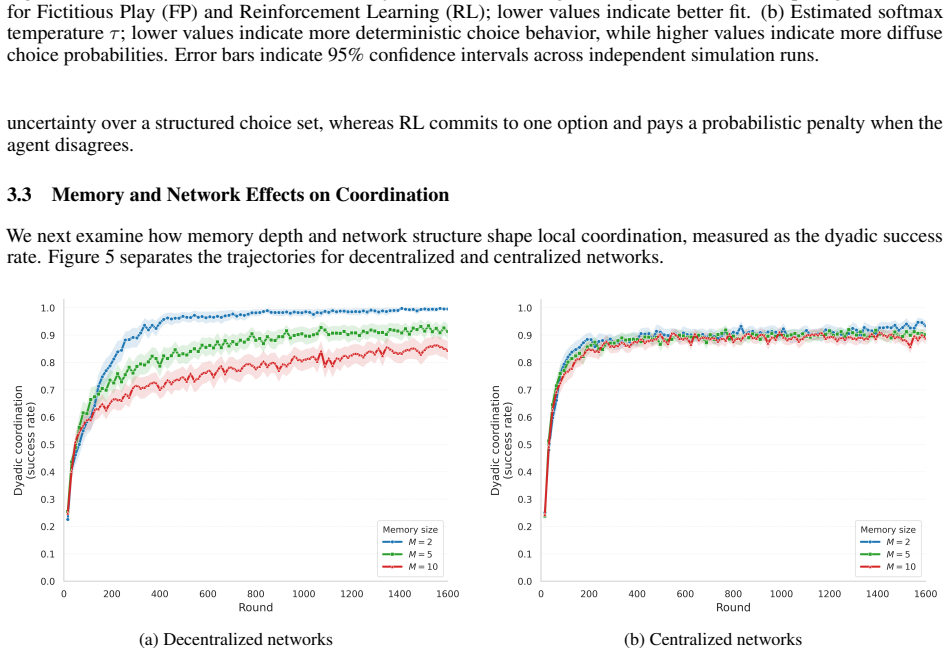
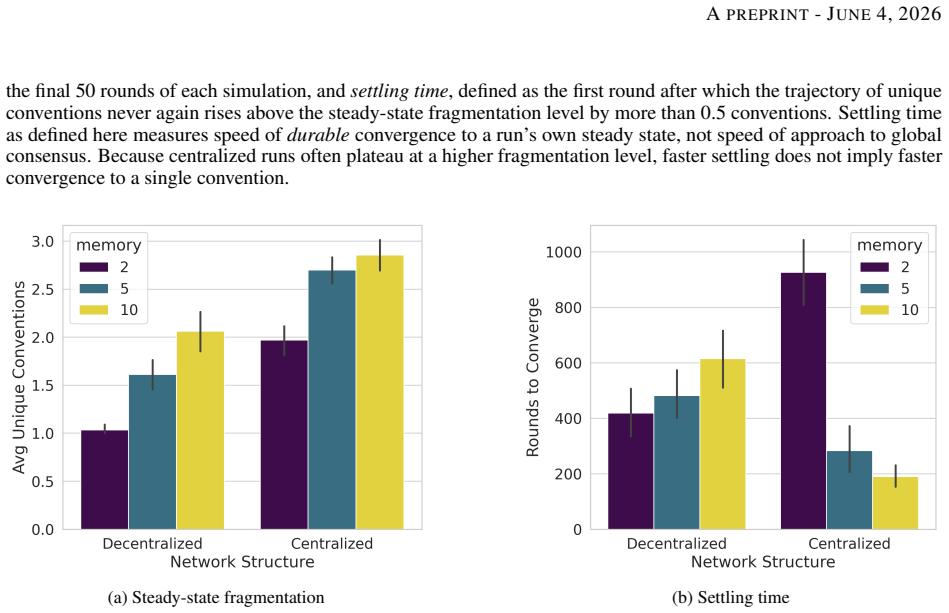
Longer memory slows steady state in decentralized networks but accelerates fragmentation in centralized ones when LLM agents form conventions.
A machine-rendered reading of the paper's core claim, the machinery that carries it, and where it could break.
Core claim
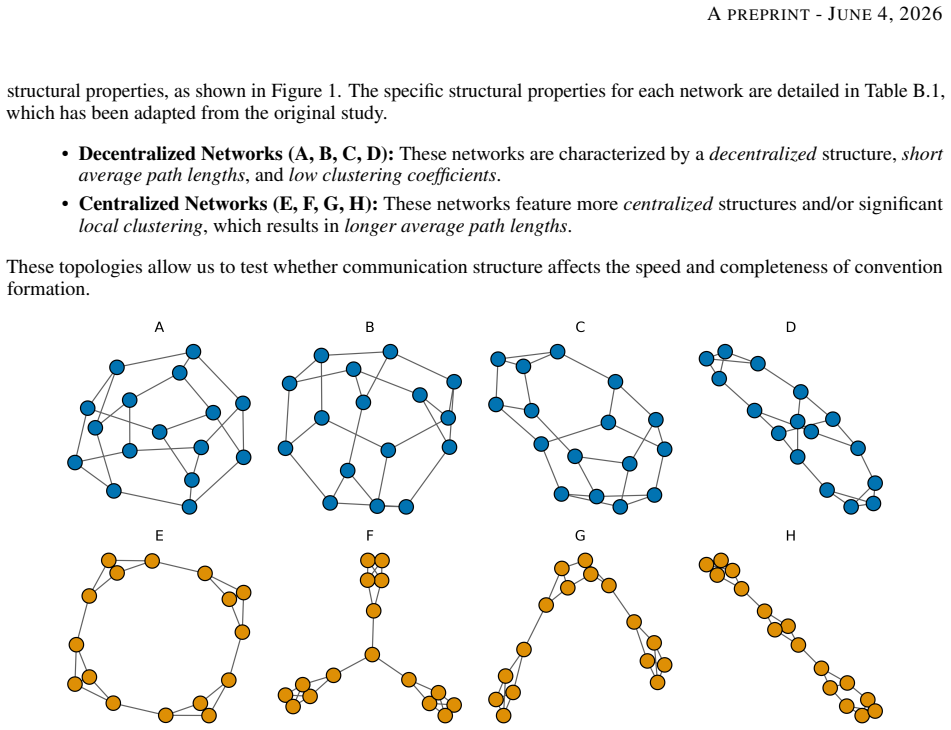
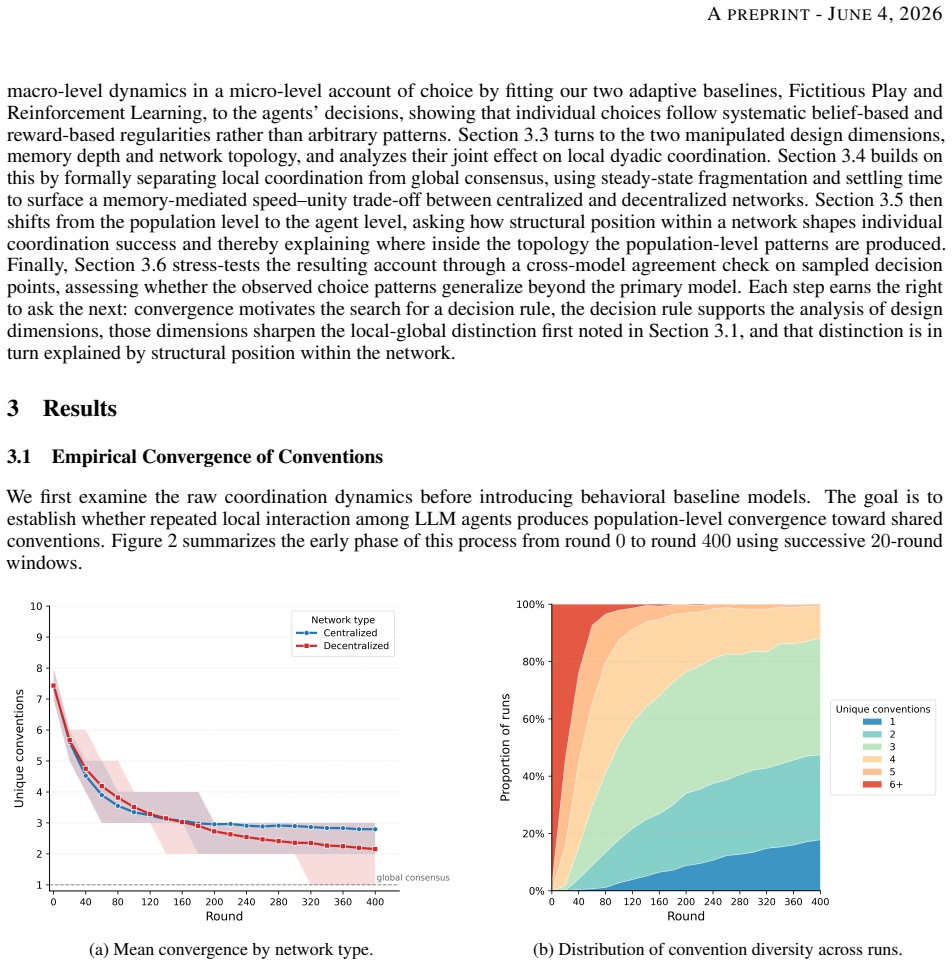
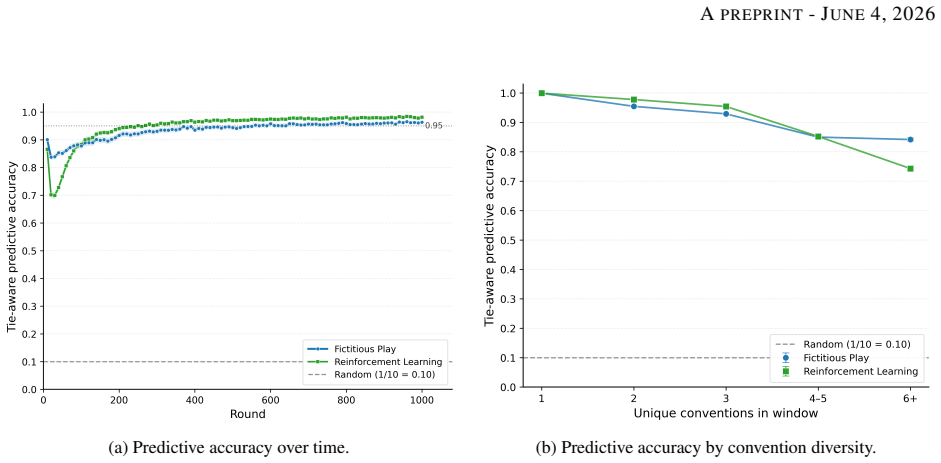
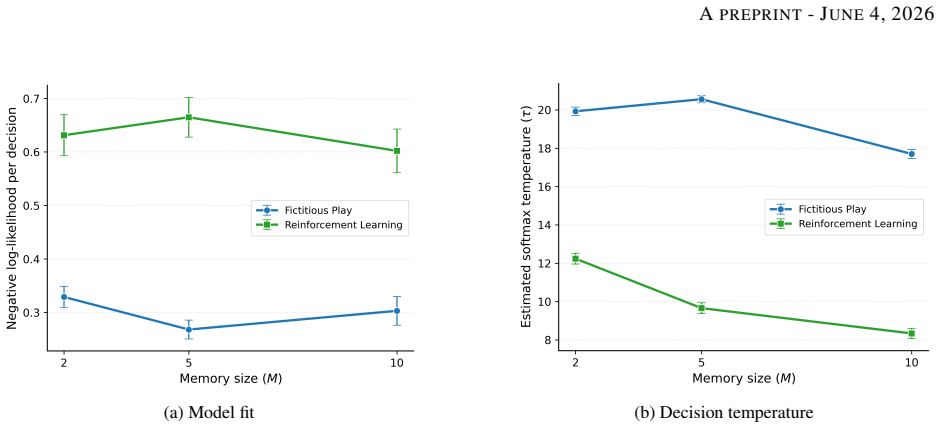
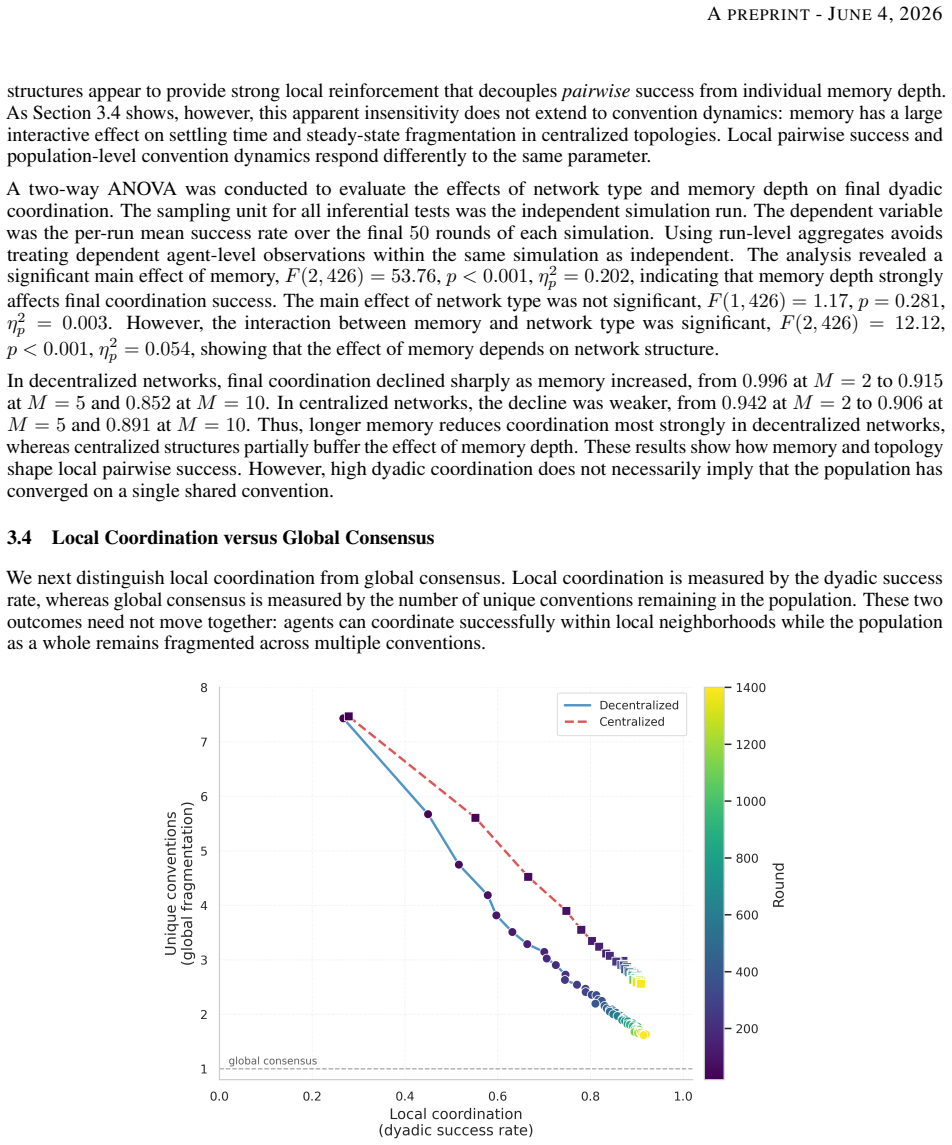
Across 432 simulation runs of a networked Naming Game on eight fixed 16-agent topologies, longer memory slows the time to reach steady state in decentralized networks but accelerates it in centralized ones. Critically, faster settling in centralized networks means locking in to a fragmented plateau more quickly, not reaching system-wide consensus. The simulations document a memory-mediated speed-unity trade-off in which centralized networks preserve more competing conventions, high-betweenness bridges suffer a brokerage penalty, and locally clustered agents achieve higher coordination success. Agent choices align with Fictitious Play, indicating belief-based adaptation.
What carries the argument
The interaction between memory depth and network topology in a networked naming game across eight fixed 16-agent structures.
If this is right
- Centralized networks reach fragmented steady states faster as memory depth increases.
- Decentralized networks take longer to settle with longer memory but preserve higher unity.
- Agents with high betweenness centrality experience lower coordination success.
- Agents in locally clustered neighborhoods achieve higher rates of convention alignment.
- Agent adaptation follows fictitious play rather than reward-based rules.
Where Pith is reading between the lines
- To promote system-wide consensus, short memory paired with decentralized topologies may be preferable.
- To sustain diverse conventions, long memory in centralized topologies could be used.
- The speed-unity trade-off may appear in other multi-agent coordination settings such as resource allocation.
- Experiments on networks larger than 16 agents would test whether the topology-memory reversal scales.
Load-bearing premise
The eight fixed 16-agent topologies and the particular naming-game rules used are representative of the coordination dynamics that arise when real LLM agents interact in larger or more open systems.
What would settle it
Running the naming game experiments on a new collection of topologies or with actual LLM calls for agent decisions and checking whether the sign reversal in memory's effect on settling time still appears.
Figures

read the original abstract
How much should an LLM agent remember, and how should multi-agent systems be connected when trying to reach consensus? We show these two design choices interact in a way that flips the sign of memory's effect on coordination. Across 432 simulation runs of a networked Naming Game on eight fixed 16-agent topologies, we vary memory depth and network structure. Longer memory slows the time to reach steady state in decentralized networks but accelerates it in centralized ones; the same parameter pushes the system in opposite directions depending on topology. Critically, "faster settling" in centralized networks means locking in to a fragmented plateau more quickly, not reaching system-wide consensus, which can be used to generate diverging opinions. We further document a memory-mediated speed-unity trade-off: centralized networks consistently preserve more competing conventions than decentralized networks, but their settling speed depends sharply on memory. At the agent level, within-network analyses show that high-betweenness bridges suffer a brokerage penalty while agents in locally clustered neighborhoods achieve higher coordination success. Finally, in search of analytically tractable generative mechanisms, we find that agents' choices are well captured by Fictitious Play, indicating belief-based rather than reward-based adaptation. The practical implication: memory depth and communication topology should be co-designed, not optimized in isolation.
Editorial analysis
A structured set of objections, weighed in public.
Referee Report
Summary. The paper claims that memory depth and network topology interact in a sign-flipping manner during consensus formation: across 432 simulation runs of a networked Naming Game on eight fixed 16-agent topologies, longer memory slows time to steady state in decentralized networks but accelerates it (to fragmentation) in centralized ones. It further reports a memory-mediated speed-unity trade-off, a brokerage penalty for high-betweenness agents, and that agent choices are captured by Fictitious Play rather than reward-based adaptation.
Significance. If the topology-dependent reversal holds beyond the specific model, the result would be significant for multi-agent LLM system design by showing that memory and topology must be co-optimized rather than tuned separately. The scale of 432 runs and the Fictitious Play match provide empirical and mechanistic grounding within the simulated setting.
major comments (3)
- [Abstract] Abstract: the headline interaction result (memory slows settling in decentralized topologies but accelerates it in centralized ones) is demonstrated only inside deterministic naming-game updates on eight fixed 16-node graphs; the model incorporates none of the LLM-specific mechanisms (prompt-dependent reasoning, temperature stochasticity, or context-window truncation) referenced in the title and introduction, so the sign-flip need not transfer to actual LLM agents.
- [Abstract] Abstract and methods description: the support for the central interaction claim rests on 432 simulation runs and a Fictitious Play match, yet no details are supplied on run initialization, error bars, definition of steady state, or data exclusion criteria, preventing verification that the reported topology-dependent effects are robust.
- [§4] §4 (agent-level analyses): the brokerage penalty and local-clustering success claims are presented as general findings, but they are derived from the same eight fixed topologies and naming-game rules; without an ablation that varies the update rule or scales the network size, it is unclear whether these agent-level patterns are load-bearing for the topology-memory interaction or artifacts of the chosen graphs.
minor comments (2)
- [Introduction] The abstract states that 'faster settling' in centralized networks means locking into a fragmented plateau; this distinction should be stated explicitly in the first paragraph of the introduction as well.
- Figure captions for the topology panels should include the exact edge lists or adjacency matrices used, rather than only qualitative labels (star, ring, etc.).
Simulated Author's Rebuttal
We thank the referee for the careful reading and constructive comments. We address each major point below, clarifying the scope of the stylized model while committing to revisions that improve transparency and reproducibility without altering the core simulation results.
read point-by-point responses
-
Referee: [Abstract] Abstract: the headline interaction result (memory slows settling in decentralized topologies but accelerates it in centralized ones) is demonstrated only inside deterministic naming-game updates on eight fixed 16-node graphs; the model incorporates none of the LLM-specific mechanisms (prompt-dependent reasoning, temperature stochasticity, or context-window truncation) referenced in the title and introduction, so the sign-flip need not transfer to actual LLM agents.
Authors: We agree that the implemented model uses deterministic naming-game updates on fixed graphs and does not incorporate prompt-dependent reasoning, temperature sampling, or context-window effects. The study is a controlled simulation designed to isolate memory-topology interactions in a multi-agent consensus setting inspired by LLM systems. The sign-flip result holds within this model. We will revise the abstract, title, and introduction to explicitly describe the work as a stylized naming-game simulation and to note that direct transfer to full LLM agents remains an open question for future work. revision: partial
-
Referee: [Abstract] Abstract and methods description: the support for the central interaction claim rests on 432 simulation runs and a Fictitious Play match, yet no details are supplied on run initialization, error bars, definition of steady state, or data exclusion criteria, preventing verification that the reported topology-dependent effects are robust.
Authors: We accept this criticism. The revised manuscript will include a new Methods subsection that specifies: (i) initialization procedure (random seeds, initial lexicon distributions, and number of independent runs per condition), (ii) exact definition of steady state (consecutive steps with no convention changes), (iii) error bars (standard deviation across the 432 runs), and (iv) any data exclusion rules. These additions will enable independent verification of the reported effects. revision: yes
-
Referee: [§4] §4 (agent-level analyses): the brokerage penalty and local-clustering success claims are presented as general findings, but they are derived from the same eight fixed topologies and naming-game rules; without an ablation that varies the update rule or scales the network size, it is unclear whether these agent-level patterns are load-bearing for the topology-memory interaction or artifacts of the chosen graphs.
Authors: The agent-level patterns are reported as observations within the eight chosen topologies, which were selected to span a spectrum from centralized to decentralized structures. We did not conduct ablations on alternative update rules or larger networks because the primary focus was the memory-topology interaction at this scale. In revision we will add an explicit limitations paragraph acknowledging that the brokerage and clustering results are tied to the current model and graphs, and we will suggest targeted ablations as future work. revision: partial
Circularity Check
Empirical simulations of naming game on fixed topologies show topology-dependent memory effects with no circular derivation
full rationale
The paper reports direct outcomes from 432 simulation runs of a standard networked Naming Game on eight fixed 16-agent topologies, varying memory depth as an input parameter. The headline result (memory slows settling in decentralized networks but accelerates it in centralized ones) is an observed empirical pattern from these runs, not a quantity obtained by fitting a model to a subset of the data and then relabeling the fit as a prediction. The post-hoc observation that choices are 'well captured by Fictitious Play' is an interpretive characterization after the simulations, not a load-bearing step used to generate or justify the primary topology-memory interaction findings. No self-citations, uniqueness theorems, or ansatzes appear in the provided text as central premises. The study is self-contained against external benchmarks as a simulation experiment.
Axiom & Free-Parameter Ledger
free parameters (2)
- memory depth
- network topology selection
axioms (2)
- domain assumption LLM agent behavior in the naming game is adequately modeled by the simulation rules used.
- domain assumption Fictitious Play captures the generative mechanism of agent choices.
Reference graph
Works this paper leans on
-
[1]
A survey on large language model based autonomous agents,
L. Wang, C. Ma, X. Feng, Z. Zhang, H. Yang, J. Zhang, Z. Chen, J. Tang, X. Chen, Y . Lin,et al., “A survey on large language model based autonomous agents,”Frontiers of Computer Science, vol. 18, no. 6, p. 186345, 2024
2024
-
[2]
WebArena: A Realistic Web Environment for Building Autonomous Agents
S. Zhou, F. F. Xu, H. Zhu, X. Zhou, R. Lo, A. Sridhar, X. Cheng, T. Ou, Y . Bisk, D. Fried, U. Alon, and G. Neubig, “Webarena: A realistic web environment for building autonomous agents,”arXiv preprint arXiv:2307.13854, 2023
work page internal anchor Pith review Pith/arXiv arXiv 2023
-
[3]
Mind2Web: Towards a Generalist Agent for the Web
X. Deng, Y . Gu, B. Zheng, S. Chen, S. Stevens, B. Wang, H. Sun, and Y . Su, “Mind2web: Towards a generalist agent for the web,”arXiv preprint arXiv:2306.06070, 2023
work page internal anchor Pith review Pith/arXiv arXiv 2023
-
[4]
ReAct: Synergizing Reasoning and Acting in Language Models
S. Yao, J. Zhao, D. Yu, N. Du, I. Shafran, K. Narasimhan, and Y . Cao, “React: Synergizing reasoning and acting in language models,”arXiv preprint arXiv:2210.03629, 2022
work page internal anchor Pith review Pith/arXiv arXiv 2022
-
[5]
Claude code overview
Anthropic, “Claude code overview.”https://code.claude.com/docs/en/overview, 2025. Accessed: 2026- 03-27
2025
-
[6]
Introducing codex
OpenAI, “Introducing codex.”https://openai.com/index/introducing-codex/, 2025. Accessed: 2026- 03-27
2025
-
[7]
Getting started with google antigravity
Google, “Getting started with google antigravity.” https://codelabs.developers.google.com/ getting-started-google-antigravity, 2025. Accessed: 2026-03-27
2025
-
[8]
Do As I Can, Not As I Say: Grounding Language in Robotic Affordances
M. Ahn, A. Brohan, N. Brown, Y . Chebotar, C. Cortes, B. David, C. Finn, C. Fu, K. Gopalakrishnan, K. Hausman, A. Herzog, D. Ho, J. Hsu, J. Ibarz, B. Ichter, A. Irpan, E. Jang, M. Ruano, P. Pastor, D. Quillen, Q. Vuong, F. Xia, T. Xiao, P. Xu, S. Xu, M. Yan, and A. Zeng, “Do as i can, not as i say: Grounding language in robotic affordances,” arXiv preprin...
work page internal anchor Pith review Pith/arXiv arXiv 2022
-
[9]
Camel: Communicative agents for “mind
G. Li, H. A. A. K. Hammoud, H. Itani, D. Khizbullin, and B. Ghanem, “Camel: Communicative agents for “mind” exploration of large language model society,” inAdvances in Neural Information Processing Systems, 2023
2023
-
[10]
AutoGen: Enabling Next-Gen LLM Applications via Multi-Agent Conversation
Q. Wu, G. Bansal, J. Zhang, Y . Wu, B. Li, E. Zhu, L. Jiang, X. Zhang, S. Zhang, J. Liu, A. H. Awadallah, R. W. White, D. Burger, and C. Wang, “Autogen: Enabling next-gen llm applications via multi-agent conversation,” arXiv preprint arXiv:2308.08155, 2023. 15 APREPRINT- JUNE4, 2026
work page internal anchor Pith review Pith/arXiv arXiv 2023
-
[11]
Reflective multi-agent collaboration based on large language models,
X. Bo, C. Zhang, Y . Li, Y . Xie, Y . Zhang, X. Peng, C. Qin, H. Liu, X. Qiu, Z. Liu,et al., “Reflective multi-agent collaboration based on large language models,” inAdvances in Neural Information Processing Systems, 2024
2024
-
[12]
Multi-Agent Collaboration Mechanisms: A Survey of LLMs
K.-T. Tran, D. Dao, M.-D. Nguyen, Q.-V . Pham, B. O’Sullivan, and H. D. Nguyen, “Multi-agent collaboration mechanisms: A survey of llms,”arXiv preprint arXiv:2501.06322, 2025
work page internal anchor Pith review Pith/arXiv arXiv 2025
-
[13]
D. K. Lewis,Convention: A Philosophical Study. Harvard University Press, 1969
1969
-
[14]
The evolution of conventions,
H. P. Young, “The evolution of conventions,”Econometrica: Journal of the Econometric Society, pp. 57–84, 1993
1993
-
[15]
Bicchieri,The grammar of society: The nature and dynamics of social norms
C. Bicchieri,The grammar of society: The nature and dynamics of social norms. Cambridge University Press, 2005
2005
-
[16]
Norm dynamics: Interdisciplinary perspectives on social norm emergence, persistence, and change,
M. J. Gelfand, S. Gavrilets, and N. Nunn, “Norm dynamics: Interdisciplinary perspectives on social norm emergence, persistence, and change,”Annual Review of Psychology, vol. 75, no. 1, pp. 341–378, 2024
2024
-
[17]
The emergence of consensus: a primer,
A. Baronchelli, “The emergence of consensus: a primer,”Royal Society open science, vol. 5, no. 2, p. 172189, 2018
2018
-
[18]
A self-organizing spatial vocabulary,
L. Steels, “A self-organizing spatial vocabulary,”Artificial life, vol. 2, no. 3, pp. 319–332, 1995
1995
-
[19]
Sharp transition towards shared vocabularies in multi-agent systems,
A. Baronchelli, M. Felici, V . Loreto, E. Caglioti, and L. Steels, “Sharp transition towards shared vocabularies in multi-agent systems,”Journal of Statistical Mechanics: Theory and Experiment, vol. 2006, no. 06, p. P06014, 2006
2006
-
[20]
The spontaneous emergence of conventions: An experimental study of cultural evolution,
D. Centola and A. Baronchelli, “The spontaneous emergence of conventions: An experimental study of cultural evolution,”Proceedings of the National Academy of Sciences, vol. 112, no. 7, pp. 1989–1994, 2015
1989
-
[21]
F. A. Hayek and R. Hamowy,The constitution of liberty: The definitive edition. Routledge, 2020
2020
-
[22]
Spontaneous order,
R. Sugden, “Spontaneous order,”Journal of Economic perspectives, vol. 3, no. 4, pp. 85–97, 1989
1989
-
[23]
Designing collective behavior in a termite-inspired robot construction team,
J. Werfel, K. Petersen, and R. Nagpal, “Designing collective behavior in a termite-inspired robot construction team,”Science, vol. 343, no. 6172, pp. 754–758, 2014
2014
-
[24]
Machine culture,
L. Brinkmann, F. Baumann, J.-F. Bonnefon, M. Derex, T. F. Müller, A.-M. Nussberger, A. Czaplicka, A. Acerbi, T. L. Griffiths, J. Henrich,et al., “Machine culture,”Nature Human Behaviour, vol. 7, no. 11, pp. 1855–1868, 2023
2023
-
[25]
Cooperative ai: machines must learn to find common ground,
A. Dafoe, Y . Bachrach, G. Hadfield, E. Horvitz, K. Larson, and T. Graepel, “Cooperative ai: machines must learn to find common ground,”Nature, vol. 593, no. 7857, pp. 33–36, 2021
2021
-
[26]
Consensus and cooperation in networked multi-agent systems,
R. Olfati-Saber, J. A. Fax, and R. M. Murray, “Consensus and cooperation in networked multi-agent systems,” Proceedings of the IEEE, vol. 95, no. 1, pp. 215–233, 2007
2007
-
[27]
The strength of weak ties,
M. S. Granovetter, “The strength of weak ties,”American journal of sociology, vol. 78, no. 6, pp. 1360–1380, 1973
1973
-
[28]
Fully decentralized multi-agent reinforcement learning with networked agents,
K. Zhang, Z. Yang, H. Liu, T. Zhang, and T. Basar, “Fully decentralized multi-agent reinforcement learning with networked agents,” inInternational conference on machine learning, pp. 5872–5881, PMLR, 2018
2018
-
[29]
Complex contagions and the weakness of long ties,
D. Centola and M. Macy, “Complex contagions and the weakness of long ties,”American journal of Sociology, vol. 113, no. 3, pp. 702–734, 2007
2007
-
[30]
arXiv preprint arXiv:2505.16067 , year=
Z. Xiong, Y . Lin, W. Xie, P. He, Z. Liu, J. Tang, H. Lakkaraju, and Z. Xiang, “How memory management impacts llm agents: An empirical study of experience-following behavior,”arXiv preprint arXiv:2505.16067, 2025
-
[31]
Meminsight: Autonomous memory augmentation for llm agents,
R. Salama, J. Cai, M. Yuan, A. Currey, M. Sunkara, Y . Zhang, and Y . Benajiba, “Meminsight: Autonomous memory augmentation for llm agents,”arXiv preprint arXiv:2503.21760, 2025
-
[32]
S. Liang, P. Cao, J. Zhao, W. Teng, X. Liao, J. Zhao, and K. Liu, “Learning how to remember: A meta-cognitive management method for structured and transferable agent memory,”arXiv preprint arXiv:2601.07470, 2026
-
[33]
Emergent social conventions and collective bias in llm populations,
A. F. Ashery, L. M. Aiello, and A. Baronchelli, “Emergent social conventions and collective bias in llm populations,” Science Advances, vol. 11, no. 20, p. eadu9368, 2025
2025
-
[34]
Newman,Networks
M. Newman,Networks. Oxford university press, 2018
2018
-
[35]
A survey on the memory mechanism of large language model-based agents,
Z. Zhang, Q. Dai, X. Bo, C. Ma, R. Li, X. Chen, J. Zhu, Z. Dong, and J.-R. Wen, “A survey on the memory mechanism of large language model-based agents,”ACM Transactions on Information Systems, vol. 43, no. 6, pp. 1–47, 2025
2025
-
[36]
MemGPT: Towards LLMs as Operating Systems
C. Packer, V . Fang, S. G. Patil, K. Lin, S. Wooders, and J. E. Gonzalez, “Memgpt: Towards llms as operating systems,”arXiv preprint arXiv:2310.08560, 2023. 16 APREPRINT- JUNE4, 2026
work page internal anchor Pith review Pith/arXiv arXiv 2023
-
[37]
Collaborative learning in networks,
W. Mason and D. J. Watts, “Collaborative learning in networks,”Proceedings of the National Academy of Sciences, vol. 109, no. 3, pp. 764–769, 2012
2012
-
[38]
Conversation, co-ordination and convention: An empirical investigation of how groups establish linguistic conventions,
S. Garrod and G. Doherty, “Conversation, co-ordination and convention: An empirical investigation of how groups establish linguistic conventions,”Cognition, vol. 53, no. 3, pp. 181–215, 1994
1994
-
[39]
Wittgenstein,Philosophical investigations
L. Wittgenstein,Philosophical investigations. John Wiley & Sons, 2009
2009
-
[40]
Towards pervasive distributed agentic generative ai–a state of the art,
G. Molinari and F. Ciravegna, “Towards pervasive distributed agentic generative ai–a state of the art,”arXiv preprint arXiv:2506.13324, 2025
-
[41]
Y . Jiang, Y . Zhang, X. Shen, M. Backes, and Y . Zhang, “" humans welcome to observe": A first look at the agent social network moltbook,”arXiv preprint arXiv:2602.10127, 2026
-
[42]
Agentic ai: Autonomous intelligence for complex goals—a compre- hensive survey,
D. B. Acharya, K. Kuppan, and B. Divya, “Agentic ai: Autonomous intelligence for complex goals—a compre- hensive survey,”IEEe Access, vol. 13, pp. 18912–18936, 2025
2025
-
[43]
Homophily-induced emergence of biased structures in llm-based multi-agent ai systems,
A. Mehdizadeh and M. Hilbert, “Homophily-induced emergence of biased structures in llm-based multi-agent ai systems,”Social Network Analysis and Mining, vol. 15, no. 1, pp. 1–25, 2025
2025
-
[44]
When your ai agent succumbs to peer-pressure: Studying opinion-change dynamics of llms,
A. Mehdizadeh and M. Hilbert, “When your ai agent succumbs to peer-pressure: Studying opinion-change dynamics of llms,”arXiv preprint arXiv:2510.19107, 2025
-
[45]
Nonequilibrium dynamics of language games on complex networks,
L. Dall’Asta, A. Baronchelli, A. Barrat, and V . Loreto, “Nonequilibrium dynamics of language games on complex networks,”Physical Review E, vol. 74, no. 3, p. 036105, 2006
2006
-
[46]
T. C. Schelling,The Strategy of Conflict. Harvard University Press, 1960
1960
-
[47]
J. C. Harsanyi and R. Selten,A General Theory of Equilibrium Selection in Games. MIT Press, 1988
1988
-
[48]
Fudenberg and D
D. Fudenberg and D. K. Levine,The Theory of Learning in Games. MIT Press, 1998
1998
-
[49]
Learning to cooperate: Stochastic and tacit collusion in social exchange,
M. W. Macy, “Learning to cooperate: Stochastic and tacit collusion in social exchange,”American Journal of Sociology, vol. 97, no. 3, pp. 808–843, 1991
1991
-
[50]
Learning, mutation, and long run equilibria in games,
M. Kandori, G. J. Mailath, and R. Rob, “Learning, mutation, and long run equilibria in games,”Econometrica, vol. 61, no. 1, pp. 29–56, 1993
1993
-
[51]
Sugden,The Economics of Rights, Co-operation and Welfare
R. Sugden,The Economics of Rights, Co-operation and Welfare. Basil Blackwell, 1986
1986
-
[52]
Contagion,
S. Morris, “Contagion,”The Review of Economic Studies, vol. 67, no. 1, pp. 57–78, 2000
2000
-
[53]
Games on networks,
M. O. Jackson and Y . Zenou, “Games on networks,” inHandbook of Game Theory with Economic Applications (H. P. Young and S. Zamir, eds.), vol. 4, pp. 95–163, Elsevier, 2015
2015
-
[54]
Limited memory can be beneficial for the evolution of cooperation,
G. Horvath, J. Kováˇrík, and F. Mengel, “Limited memory can be beneficial for the evolution of cooperation,” Journal of Theoretical Biology, vol. 300, pp. 193–205, 2012
2012
-
[55]
Role of memory effect in the evolution of cooperation based on spatial prisoner’s dilemma game,
W. Lu, J. Wang, and C.-Y . Xia, “Role of memory effect in the evolution of cooperation based on spatial prisoner’s dilemma game,”Physics Letters A, vol. 382, no. 44, pp. 3058–3063, 2018
2018
-
[56]
Limited memory optimizes cooperation in social dilemma experiments,
S. Ma, B. Zhang, S. Cao, J. S. Liu, and W.-X. Wang, “Limited memory optimizes cooperation in social dilemma experiments,”Royal Society Open Science, vol. 8, no. 8, p. 210653, 2021
2021
-
[57]
The elements of statistical learning: data mining, inference, and prediction,
T. Hastie, “The elements of statistical learning: data mining, inference, and prediction,” 2009
2009
-
[58]
Learning, bounded memory, and inertia,
W.-T. Juang, “Learning, bounded memory, and inertia,”Economics Letters, vol. 101, no. 1, pp. 71–73, 2008
2008
-
[59]
Learning to coordinate in a complex and non-stationary world,
M. Marsili, D. Challet, and R. Zecchina, “Learning to coordinate in a complex and non-stationary world,”Physica A: Statistical Mechanics and its Applications, vol. 299, no. 1–2, pp. 228–233, 2001
2001
-
[60]
Generative Agents: Interactive Simulacra of Human Behavior
J. S. Park, C. J. C. O’Brien, M. Chen, P. Liang, and M. S. Bernstein, “Generative agents: Interactive simulacra of human behavior,”arXiv preprint arXiv:2304.03442, 2023
work page internal anchor Pith review Pith/arXiv arXiv 2023
-
[61]
Iterative solution of games by fictitious play,
G. W. Brown, “Iterative solution of games by fictitious play,”Act. Anal. Prod Allocation, vol. 13, no. 1, p. 374, 1951
1951
-
[62]
An iterative method of solving a game,
J. Robinson, “An iterative method of solving a game,”Annals of Mathematics, vol. 54, no. 2, pp. 296–301, 1951
1951
-
[63]
Predicting how people play games: Reinforcement learning in experimental games with unique, mixed strategy equilibria,
I. Erev and A. E. Roth, “Predicting how people play games: Reinforcement learning in experimental games with unique, mixed strategy equilibria,”American Economic Review, vol. 88, no. 4, pp. 848–881, 1998
1998
-
[64]
Experience-weighted attraction learning in normal form games,
C. Camerer and T.-H. Ho, “Experience-weighted attraction learning in normal form games,”Econometrica, vol. 67, no. 4, pp. 827–874, 1999
1999
-
[65]
The role of reinforcement learning in the emergence of conven- tions: Simulation experiments with the repeated volunteer’s dilemma,
H. Nunner, W. Przepiorka, and C. Janssen, “The role of reinforcement learning in the emergence of conven- tions: Simulation experiments with the repeated volunteer’s dilemma,”Journal of Artificial Societies and Social Simulation, vol. 25, no. 1, p. 7, 2022. 17 APREPRINT- JUNE4, 2026
2022
-
[66]
R. S. Sutton and A. G. Barto,Reinforcement Learning: An Introduction. MIT Press, 2 ed., 2018
2018
-
[67]
Quantal response equilibria for normal form games,
R. D. McKelvey and T. R. Palfrey, “Quantal response equilibria for normal form games,”Games and Economic Behavior, vol. 10, no. 1, pp. 6–38, 1995
1995
-
[68]
Success-driven user activity contributes to online polarization,
S. Horn, S. Banisch, V . Batzdorfer, A. Reitenbach, F. Sartori, D. Schwabe, and M. Mäs, “Success-driven user activity contributes to online polarization,”Journal of Artificial Societies and Social Simulation, vol. 29, no. 2, p. 1, 2026
2026
-
[69]
Fitting linear mixed-effects models using lme4,
D. Bates, M. Mächler, B. Bolker, and S. Walker, “Fitting linear mixed-effects models using lme4,”Journal of statistical software, vol. 67, pp. 1–48, 2015
2015
-
[70]
An experimental study of the coloring problem on human subject networks,
M. Kearns, S. Suri, and N. Montfort, “An experimental study of the coloring problem on human subject networks,” science, vol. 313, no. 5788, pp. 824–827, 2006
2006
-
[71]
B. Yee and K. Sharma, “Molt dynamics: Emergent social phenomena in autonomous ai agent populations,”arXiv preprint arXiv:2603.03555, 2026
work page internal anchor Pith review Pith/arXiv arXiv 2026
-
[72]
Gender dynamics and homophily in a social network of llm agents,
F. Fadaei, J. C. Moran, and T. Yasseri, “Gender dynamics and homophily in a social network of llm agents,”arXiv preprint arXiv:2602.02606, 2026
-
[73]
Epistemic substitution: How grokipedia’s ai-generated encyclopedia restructures authority,
A. Mehdizadeh and M. Hilbert, “Epistemic substitution: How grokipedia’s ai-generated encyclopedia restructures authority,”arXiv preprint arXiv:2512.03337, 2025
-
[74]
Exploring silicon-based societies: An early study of the moltbook agent community,
Y .-Z. Lin, B. P.-J. Shih, H.-Y . A. Chien, S. Satam, J. H. Pacheco, S. Shao, S. Salehi, and P. Satam, “Exploring silicon-based societies: An early study of the moltbook agent community,”arXiv preprint arXiv:2602.02613, 2026
-
[75]
J. Luo, “Analyzing character and consciousness in ai-generated social content: A case study of chirper, the ai social network,”arXiv preprint arXiv:2309.08614, 2023
-
[76]
Towards a Science of Scaling Agent Systems
Y . Kim, K. Gu, C. Park, C. Park, S. Schmidgall, A. A. Heydari, Y . Yan, Z. Zhang, Y . Zhuang, M. Malhotra,et al., “Towards a science of scaling agent systems,”arXiv preprint arXiv:2512.08296, 2025
work page internal anchor Pith review Pith/arXiv arXiv 2025
-
[77]
Evolutionary games and spatial chaos,
M. A. Nowak and R. M. May, “Evolutionary games and spatial chaos,”nature, vol. 359, no. 6398, pp. 826–829, 1992
1992
-
[78]
Adaptive coevolutionary networks: a review,
T. Gross and B. Blasius, “Adaptive coevolutionary networks: a review,”Journal of the Royal Society Interface, vol. 5, no. 20, pp. 259–271, 2008
2008
-
[79]
Automating epistemology: how ai reconfigures truth, authority, and verification,
D. Shin, “Automating epistemology: how ai reconfigures truth, authority, and verification,”AI & SOCIETY, pp. 1–7, 2025. A Intrinsic Letter Bias in the LLM: First-Round Choices A challenge in studying convention formation is controlling for biases that might favor one arbitrary norm. We selected a 10-letter set {’C’, ’D’, ’F’, ’J’, ’M’, ’P’, ’Q’, ’R’, ’X’,...
2025
discussion (0)
Sign in with ORCID, Apple, or X to comment. Anyone can read and Pith papers without signing in.