Recognition: no theorem link
The neighboring stars of N6946-BH1 and the observational characteristics of failed supernovae
Pith reviewed 2026-05-10 19:43 UTC · model grok-4.3
The pith
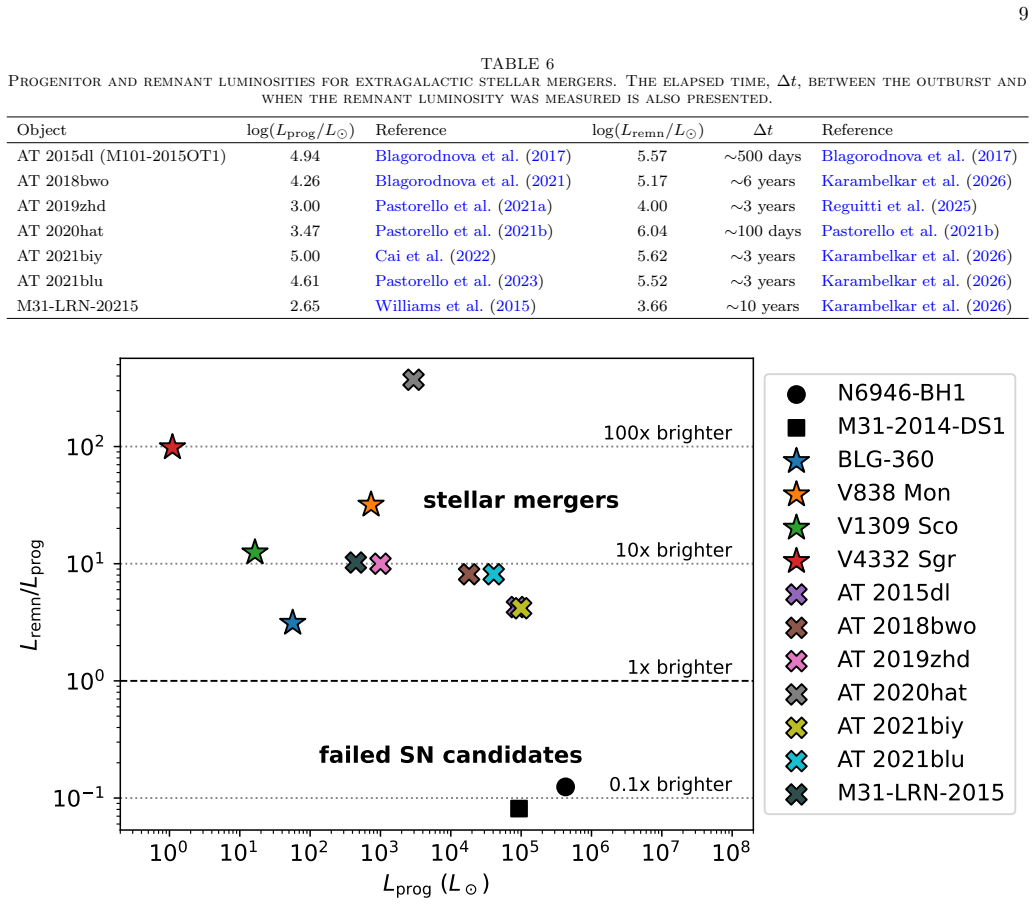
The failed supernova candidate N6946-BH1 shows a remnant about 10 times dimmer than its progenitor, unlike stellar mergers whose remnants brighten by factors of 10-100.
A machine-rendered reading of the paper's core claim, the machinery that carries it, and where it could break.
Core claim
The observational characteristics of N6946-BH1, including its mid-infrared luminosity and spectral energy distribution, are consistent with a failed supernova in which a star above roughly 15 solar masses collapses directly to a black hole, producing a remnant that is approximately 10 times less luminous than the progenitor. This behavior stands in clear contrast to stellar merger remnants, which are 10 to 100 times more luminous than their progenitors at comparable late evolutionary phases, and the difference cannot be explained by asymmetric dust geometries.
What carries the argument
The ratio of remnant luminosity to progenitor luminosity, obtained from silicate-dust-shell spectral energy distribution fits to JWST photometry and compared directly to stellar-merger evolutionary tracks.
If this is right
- Failed supernovae can be observationally separated from stellar mergers on the basis of whether the remnant fades or brightens relative to the progenitor.
- The mid-infrared source in N6946-BH1 is isolated from the neighboring stars and can be treated as a clean probe of the remnant.
- Additional vanishing-star candidates in other galaxies should exhibit similar luminosity drops if they are failed supernovae.
- Direct collapse to a black hole without a bright optical transient is supported for stars more massive than about 15 solar masses.
Where Pith is reading between the lines
- Infrared surveys of nearby galaxies could identify more failed-supernova candidates by searching for objects that have faded rather than brightened.
- Refined dust modeling or multi-epoch observations could test whether grain growth or geometry changes over time in these remnants.
- The distinction between the two classes of events constrains the relative rates at which massive stars end as black holes versus as merger products.
Load-bearing premise
The mid-infrared emission originates solely from the N6946-BH1 remnant and is unaffected by the four neighboring stars, together with the assumption that the adopted stellar-merger models accurately predict late-time luminosities.
What would settle it
Mid-infrared imaging at higher angular resolution that resolves the four neighboring stars and measures a significant fraction of the observed flux coming from them, or a stellar-merger calculation that produces a factor-of-100 luminosity drop rather than an increase.
Figures



read the original abstract
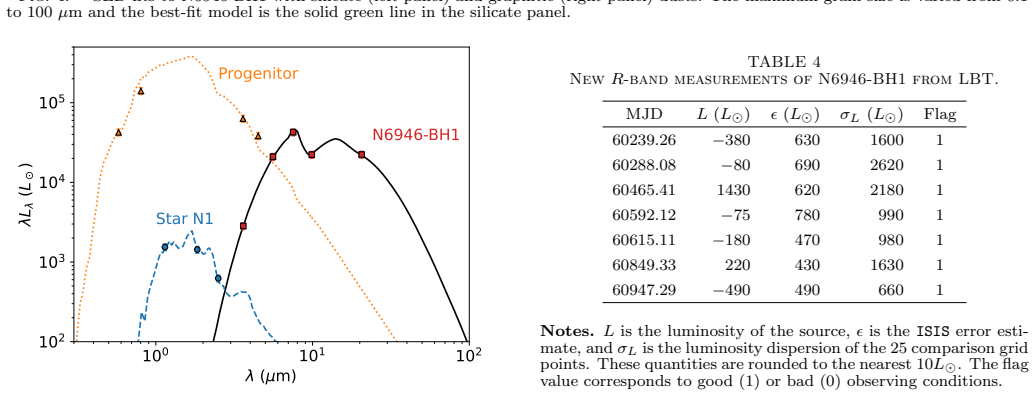
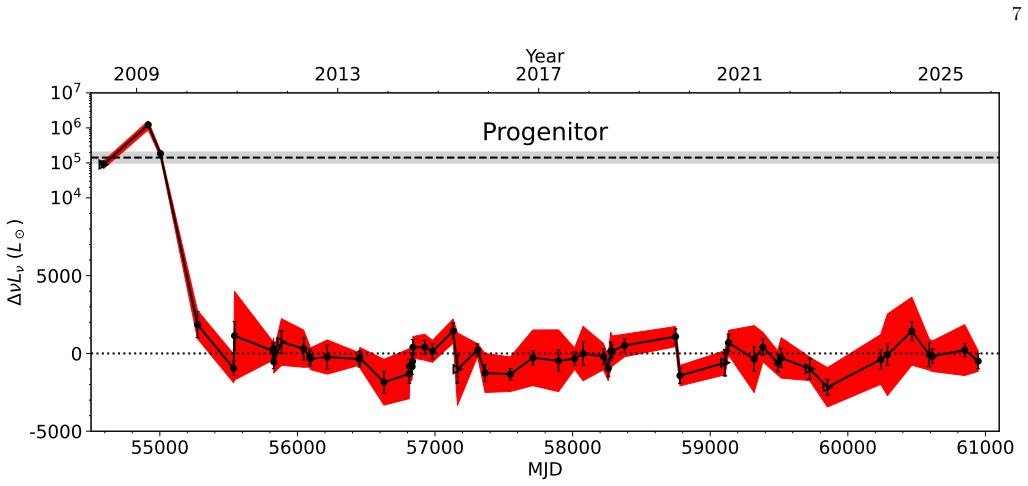
Stellar collapse models predict that some stars more massive than $\sim$15$M_\odot$ may collapse directly to a black hole, sometimes with a weak optical transient, a phenomenon known as a failed supernova. Detecting such events is challenging, but searches of vanishing stars have found two promising candidates, N6946-BH1 and M31-2014-DS1. We re-analyze the JWST data of N6946-BH1 to characterize the remnant emission of the object and its surrounding sources. We found four near-infrared stellar neighbors not related to the mid-infrared emission of the candidate. The SED of N6946-BH1 is well modeled by a $\sim$10$^{4.7}L_\odot$ source obscured by a silicate dust shell with a maximum grain size of $\sim$3 $\mu$m and producing negligible emission at $\lesssim$2 $\mu$m. We model the progenitor and remnant emission of four Galactic and seven extragalactic stellar mergers to compare their properties with those of failed supernova candidates. We found that the merger remnants are 10-100 times more luminous than their progenitors at these late phases while the remnants of failed supernovae are $\sim$10 times dimmer than their progenitors. Asymmetric (disky) dust distributions cannot explain the factor of $\sim$100 difference in the ratios of the progenitor and remnant luminosities.
Editorial analysis
A structured set of objections, weighed in public.
Referee Report
Summary. The paper re-analyzes JWST data for the failed supernova candidate N6946-BH1, identifying four near-infrared stellar neighbors that are unrelated to the mid-infrared emission. The SED is modeled as a 10^{4.7} L_⊙ source obscured by a silicate dust shell with maximum grain size ~3 μm, producing negligible short-wavelength emission. Comparisons with stellar merger events show that merger remnants are 10-100 times more luminous than progenitors at late times, while failed supernova remnants are about 10 times dimmer, and asymmetric dust cannot explain the large luminosity ratio difference.
Significance. This work helps distinguish failed supernovae from stellar mergers through luminosity ratio comparisons, using public data and standard modeling techniques. If the flux attribution holds, it provides a practical observational criterion for identifying direct collapse events.
major comments (3)
- [Section 3 (Neighboring stars analysis)] The claim that the four NIR neighbors are not related to the mid-IR emission of N6946-BH1 is load-bearing for the remnant luminosity of ~10^{4.7} L_⊙ but lacks quantitative verification such as comparison of positional offsets to the MIRI PSF FWHM or aperture photometry upper limits at neighbor locations. Any contribution from neighbors would reduce the inferred remnant luminosity and narrow the gap with merger model predictions.
- [Section 4 (SED fitting and dust modeling)] The conclusion that asymmetric (disky) dust distributions cannot explain the ~100 factor difference in luminosity ratios depends on the adopted remnant luminosity and the specific merger models; the paper should demonstrate this by showing the range of luminosity ratios predicted for disk geometries with varying inclinations and optical depths.
- [Section 5 (Comparison to extragalactic mergers)] The comparison to seven extragalactic merger cases requires explicit listing of the objects, their progenitor and remnant luminosities, and references to the data sources to allow independent verification of the 10-100x brightening claim.
minor comments (2)
- [Abstract] The abstract states the SED is 'well modeled' but a brief mention of the fit quality (e.g., chi-squared or residual levels) would strengthen the presentation.
- [Throughout] Ensure consistent use of luminosity units and clarify the time scales for 'late phases' in the merger comparisons.
Simulated Author's Rebuttal
We thank the referee for the constructive and detailed comments, which have helped us improve the clarity and robustness of the manuscript. We address each major comment point by point below, with revisions incorporated where they strengthen the analysis without altering the core conclusions.
read point-by-point responses
-
Referee: [Section 3 (Neighboring stars analysis)] The claim that the four NIR neighbors are not related to the mid-IR emission of N6946-BH1 is load-bearing for the remnant luminosity of ~10^{4.7} L_⊙ but lacks quantitative verification such as comparison of positional offsets to the MIRI PSF FWHM or aperture photometry upper limits at neighbor locations. Any contribution from neighbors would reduce the inferred remnant luminosity and narrow the gap with merger model predictions.
Authors: We agree that explicit quantitative checks strengthen the separation claim. In the revised manuscript, we have added a direct comparison of the measured positional offsets of the four NIR neighbors relative to the MIRI PSF FWHM (at both 5.6 and 7.7 μm), confirming all offsets exceed 2× the FWHM. We also performed aperture photometry centered on each neighbor position in the MIRI images, obtaining 3σ upper limits fully consistent with zero additional flux. These additions confirm negligible contribution from the neighbors to the mid-IR emission, preserving the remnant luminosity at ~10^{4.7} L_⊙. revision: yes
-
Referee: [Section 4 (SED fitting and dust modeling)] The conclusion that asymmetric (disky) dust distributions cannot explain the ~100 factor difference in luminosity ratios depends on the adopted remnant luminosity and the specific merger models; the paper should demonstrate this by showing the range of luminosity ratios predicted for disk geometries with varying inclinations and optical depths.
Authors: We appreciate the request for explicit demonstration. The revised Section 4 now includes a grid of disk-geometry models spanning inclinations from face-on to edge-on and optical depths from τ=1 to τ=100 at 1 μm. The resulting range of possible luminosity ratios (progenitor to remnant) is shown in a new figure; even the most extreme disk configurations suppress short-wavelength flux by at most a factor of ~10–20, insufficient to bridge the observed ~100× difference for N6946-BH1 or to reproduce the brightening trend in the merger sample. This supports the original conclusion while making the argument quantitative. revision: yes
-
Referee: [Section 5 (Comparison to extragalactic mergers)] The comparison to seven extragalactic merger cases requires explicit listing of the objects, their progenitor and remnant luminosities, and references to the data sources to allow independent verification of the 10-100x brightening claim.
Authors: We agree that an explicit compilation improves verifiability. The revised Section 5 now contains a dedicated table that lists all seven extragalactic merger objects, their progenitor and remnant luminosities (with uncertainties), the elapsed time since the merger event, and full references to the original photometric data sources. This table directly documents the 10–100× brightening and enables independent reproduction of the comparison. revision: yes
Circularity Check
No significant circularity in the derivation chain.
full rationale
The paper re-analyzes public JWST photometry of N6946-BH1, identifies four NIR neighbors by position and concludes they are unrelated to the mid-IR emission, fits the remnant SED to a ~10^{4.7} L_⊙ source with a silicate dust shell (a_max ~3 μm), and directly compares the observed progenitor/remnant luminosity ratio (~0.1) to independent literature models of four Galactic and seven extragalactic stellar mergers (which predict 10-100× brighter remnants). The central claim that asymmetric dust distributions cannot explain the ~100× difference follows from these external comparisons rather than any self-defined quantity, fitted parameter renamed as prediction, or load-bearing self-citation. No equations or results reduce to the input data by construction; the analysis is self-contained against external benchmarks.
Axiom & Free-Parameter Ledger
free parameters (2)
- source luminosity =
10^{4.7} L_odot
- maximum grain size =
~3 um
axioms (2)
- domain assumption Silicate dust opacity and grain-size distributions follow standard interstellar-medium models.
- domain assumption Late-time luminosities of stellar mergers are correctly predicted by existing observational templates.
Forward citations
Cited by 1 Pith paper
-
On the Origin of Mass Ejection in Failed Supernovae
Higher-Mach-number self-similar shock solutions in failed supernovae are unstable and strengthen asymptotically above a critical neutrino mass-loss threshold, explaining greater ejection in red supergiants versus comp...
Reference graph
Works this paper leans on
-
[1]
Adams, S. M., Kochanek, C. S., Gerke, J. R., & Stanek, K. Z. 2017a, MNRAS, 469, 1445, doi:10.1093/mnras/stx898
-
[2]
2017b, MNRAS, 468, 4968, doi:10.1093/mnras/stx816
Dai, X. 2017b, MNRAS, 468, 4968, doi:10.1093/mnras/stx816
-
[3]
2000, A&AS, 144, 363, doi:10.1051/aas:2000214
Alard, C. 2000, A&AS, 144, 363, doi:10.1051/aas:2000214
-
[4]
Alard, C., & Lupton, R. H. 1998, ApJ, 503, 325, doi:10.1086/305984
-
[5]
Anand, G. S., Rizzi, L., & Tully, R. B. 2018, AJ, 156, 105, doi:10.3847/1538-3881/aad3b2
-
[6]
Delayed explosions of red supergiants following 'failed' supernovae
Antoni, A., & Quataert, E. 2023, MNRAS, 525, 1229, doi:10.1093/mnras/stad2328
-
[7]
Banerjee, D. P. K., Geballe, T. R., Evans, A., et al. 2020, ApJ, 904, L23, doi:10.3847/2041-8213/abc885
-
[8]
Stanek, K. Z. 2021, MNRAS, 508, 1156, doi:10.1093/mnras/stab2620
-
[9]
R., Hosseinzadeh, G., Smith, N., et al
Beasor, E. R., Hosseinzadeh, G., Smith, N., et al. 2024, ApJ, 964, 171, doi:10.3847/1538-4357/ad21fa
-
[10]
R., Smith, N., Pearson, J., et al
Beasor, E. R., Smith, N., Pearson, J., et al. 2026, MNRAS, doi:10.1093/mnras/stag052
-
[11]
2017, ApJ, 834, 107, doi:10.3847/1538-4357/834/2/107
Blagorodnova, N., Kotak, R., Polshaw, J., et al. 2017, ApJ, 834, 107, doi:10.3847/1538-4357/834/2/107
-
[12]
2021, A&A, 653, A134, doi:10.1051/0004-6361/202140525
Blagorodnova, N., Klencki, J., Pejcha, O., et al. 2021, A&A, 653, A134, doi:10.1051/0004-6361/202140525
-
[13]
Botticella, M. T., Smartt, S. J., Kennicutt, R. C., et al. 2012, A&A, 537, A132, doi:10.1051/0004-6361/201117343
-
[14]
2012, MNRAS, 427, 127, doi: 10.1111/j.1365-2966.2012.21948.x
Bressan, A., Marigo, P., Girardi, L., et al. 2012, MNRAS, 427, 127, doi:10.1111/j.1365-2966.2012.21948.x
-
[15]
J., Waagen, E
Brown, N. J., Waagen, E. O., Scovil, C., et al. 2002, IAU Circ., 7785, 1
2002
-
[16]
Burrows, A., & Vartanyan, D. 2021, Nature, 589, 29, doi:10.1038/s41586-020-03059-w
-
[17]
2022, A&A, 667, A4, doi:10.1051/0004-6361/202244393
Cai, Y.-Z., Pastorello, A., Fraser, M., et al. 2022, A&A, 667, A4, doi:10.1051/0004-6361/202244393
-
[18]
Castelli, F., & Kurucz, R. L. 2003, in IAU Symposium, Vol. 210, Modelling of Stellar Atmospheres, ed. N. Piskunov, W. W. Weiss, & D. F. Gray, A20, doi:10.48550/arXiv.astro-ph/0405087
work page internal anchor Pith review doi:10.48550/arxiv.astro-ph/0405087 2003
-
[19]
2015, MNRAS, 452, 1068, doi: 10.1093/mnras/stv1281
Chen, Y., Bressan, A., Girardi, L., et al. 2015, MNRAS, 452, 1068, doi:10.1093/mnras/stv1281
-
[20]
Chen, Y., Girardi, L., Bressan, A., et al. 2014, MNRAS, 444, 2525, doi:10.1093/mnras/stu1605
-
[21]
Davies, B., & Beasor, E. R. 2020a, MNRAS, 493, 468, doi:10.1093/mnras/staa174 —. 2020b, MNRAS, 496, L142, doi:10.1093/mnrasl/slaa102
-
[22]
De, K., MacLeod, M., Jencson, J. E., et al. 2026a, Science, 391, 689, doi:10.1126/science.adt4853 —. 2026b, ApJ, 999, L25, doi:10.3847/2041-8213/ae468d
-
[23]
2016, DOLPHOT: Stellar photometry, Astrophysics Source Code Library, record ascl:1608.013
Dolphin, A. 2016, DOLPHOT: Stellar photometry, Astrophysics Source Code Library, record ascl:1608.013. http://ascl.net/1608.013
2016
-
[24]
Dolphin, A. E. 2000, PASP, 112, 1383, doi:10.1086/316630
-
[25]
Draine, B. T., & Lee, H. M. 1984, ApJ, 285, 89, doi:10.1086/162480
-
[26]
Elitzur, M., & Ivezi´ c,ˇZ. 2001, MNRAS, 327, 403, doi:10.1046/j.1365-8711.2001.04706.x
-
[27]
E., Sukhbold, T., & Ugliano, M
Ertl, T., Janka, H.-T., Woosley, S. E., Sukhbold, T., & Ugliano, M. 2016, ApJ, 818, 124, doi:10.3847/0004-637X/818/2/124
-
[28]
Evans, A., Gehrz, R. D., Woodward, C. E., et al. 2016, MNRAS, 457, 2871, doi:10.1093/mnras/stw352
-
[29]
Eyres, S. P. S., Evans, A., Zijlstra, A., et al. 2018, MNRAS, 481, 4931, doi:10.1093/mnras/sty2554
-
[30]
Faran, T., & Quataert, E. 2026, ApJ, 998, 22, doi:10.3847/1538-4357/ae30dc Fern´ andez, R., Quataert, E., Kashiyama, K., & Coughlin, E. R. 2018, MNRAS, 476, 2366, doi:10.1093/mnras/sty306
-
[31]
Gerke, J. R., Kochanek, C. S., & Stanek, K. Z. 2015, MNRAS, 450, 3289, doi:10.1093/mnras/stv776
-
[32]
Gustafsson, B., Edvardsson, B., Eriksson, K., et al. 2008, A&A, 486, 951, doi:10.1051/0004-6361:200809724
-
[33]
Hajduk, M., van Hoof, P. A. M., & Zijlstra, A. A. 2013, MNRAS, 432, 167, doi:10.1093/mnras/stt426
-
[34]
S., Yamamoto, M., & Hirosawa, K
Hayashi, S. S., Yamamoto, M., & Hirosawa, K. 1994, IAU Circ., 5942, 1
1994
-
[35]
2021, ApJ, 911, 6, doi:10.3847/1538-4357/abe59e Ivezi´ c, Z., & Elitzur, M
Ivanov, M., & Fern´ andez, R. 2021, ApJ, 911, 6, doi:10.3847/1538-4357/abe59e Ivezi´ c, Z., & Elitzur, M. 1997, MNRAS, 287, 799, doi:10.1093/mnras/287.4.799 Ivezi´ c, Z., Nenkova, M., & Elitzur, M. 1999, DUSTY: Radiation transport in a dusty environment, Astrophysics Source Code Library, record ascl:9911.001.http://ascl.net/9911.001
-
[36]
The maximum mass of a neutron star.Astrophys
Kalogera, V., & Baym, G. 1996, ApJ, 470, L61, doi:10.1086/310296 Kami´ nski, T., Menten, K. M., Tylenda, R., et al. 2015, Nature, 520, 322, doi:10.1038/nature14257 Kami´ nski, T., Schmidt, M., & Tylenda, R. 2010, A&A, 522, A75, doi:10.1051/0004-6361/201014406 Kami´ nski, T., Steffen, W., Bujarrabal, V., et al. 2021, A&A, 646, A1, doi:10.1051/0004-6361/202039634
-
[37]
Karambelkar, V., Kasliwal, M. M., Lau, R. M., et al. 2026, ApJ, 999, 16, doi:10.3847/1538-4357/ae38bf
-
[38]
2003, A&A, 399, 695, doi:10.1051/0004-6361:20021808
Kato, T. 2003, A&A, 399, 695, doi:10.1051/0004-6361:20021808
-
[39]
Kochanek, C. S. 2014a, ApJ, 785, 28, doi:10.1088/0004-637X/785/1/28 —. 2014b, MNRAS, 444, 2043, doi:10.1093/mnras/stu1559 —. 2020, MNRAS, 493, 4945, doi:10.1093/mnras/staa605 —. 2024, MNRAS, 529, 1958, doi:10.1093/mnras/stae589
-
[40]
Kochanek, C. S., Adams, S. M., & Belczynski, K. 2014, MNRAS, 443, 1319, doi:10.1093/mnras/stu1226
-
[41]
Kochanek, C. S., Beacom, J. F., Kistler, M. D., et al. 2008, ApJ, 684, 1336, doi:10.1086/590053
-
[42]
Kochanek, C. S., Neustadt, J. M. M., & Stanek, K. Z. 2024, ApJ, 962, 145, doi:10.3847/1538-4357/ad18d7
-
[43]
Kreidberg, L., Bailyn, C. D., Farr, W. M., & Kalogera, V. 2012, ApJ, 757, 36, doi:10.1088/0004-637X/757/1/36
-
[44]
2023, MNRAS, 526, 152, doi:10.1093/mnras/stad2710 Liebend¨ orfer, M., Messer, O
Kuroda, T., & Shibata, M. 2023, MNRAS, 526, 152, doi:10.1093/mnras/stad2710 Liebend¨ orfer, M., Messer, O. E. B., Mezzacappa, A., et al. 2004, ApJS, 150, 263, doi:10.1086/380191
-
[45]
Lovegrove, E., & Woosley, S. E. 2013, ApJ, 769, 109, doi:10.1088/0004-637X/769/2/109
-
[46]
Lovegrove, E., Woosley, S. E., & Zhang, W. 2017, ApJ, 845, 103, doi:10.3847/1538-4357/aa7b7d
-
[47]
2025, A&A, 704, A46, doi:10.1051/0004-6361/202555081
Luo, R., Zhu, C., L¨ u, G., et al. 2025, A&A, 704, A46, doi:10.1051/0004-6361/202555081
-
[48]
, archivePrefix = "arXiv", eprint =
Marigo, P., Girardi, L., Bressan, A., et al. 2017, ApJ, 835, 77, doi:10.3847/1538-4357/835/1/77
-
[49]
Martini, P., Wagner, R. M., Tomaney, A., et al. 1999, AJ, 118, 1034, doi:10.1086/300951
-
[50]
Mason, E., Diaz, M., Williams, R. E., Preston, G., & Bensby, T. 2010, A&A, 516, A108, doi:10.1051/0004-6361/200913610
-
[51]
Mathis, J. S., Rumpl, W., & Nordsieck, K. H. 1977, ApJ, 217, 425, doi:10.1086/155591
-
[52]
Maund, J. R., Reilly, E., & Mattila, S. 2014, MNRAS, 438, 938, doi:10.1093/mnras/stt2131
-
[53]
2014, AJ, 147, 11, doi:10.1088/0004-6256/147/1/11
McCollum, B., Laine, S., V¨ ais¨ anen, P., et al. 2014, AJ, 147, 11, doi:10.1088/0004-6256/147/1/11
-
[54]
Mezzacappa, A. 2005, Annual Review of Nuclear and Particle Science, 55, 467, doi:10.1146/annurev.nucl.55.090704.151608
-
[55]
2026, ApJ, 997, L9, doi:10.3847/2041-8213/ae2c73
Nakanishi, F., Abe, K., Abe, S., et al. 2026, ApJ, 997, L9, doi:10.3847/2041-8213/ae2c73
-
[56]
2008, Central Bureau Electronic Telegrams, 1496, 1
Nakano, S., Nishiyama, K., Kabashima, F., & Sakurai, Y. 2008, Central Bureau Electronic Telegrams, 1496, 1
2008
-
[57]
Neustadt, J. M. M., Kochanek, C. S., Stanek, K. Z., et al. 2021, MNRAS, 508, 516, doi:10.1093/mnras/stab2605 O’Connor, E., & Ott, C. D. 2011, ApJ, 730, 70, doi:10.1088/0004-637X/730/2/70 ¨Ozel, F., Psaltis, D., Narayan, R., & Santos Villarreal, A. 2012, ApJ, 757, 55, doi:10.1088/0004-637X/757/1/55
-
[58]
2019, MNRAS, 485, 5666, doi: 10.1093/mnras/stz725
Pastorelli, G., Marigo, P., Girardi, L., et al. 2019, MNRAS, 485, 5666, doi:10.1093/mnras/stz725 —. 2020, MNRAS, 498, 3283, doi:10.1093/mnras/staa2565
-
[59]
2021a, A&A, 646, A119, doi:10.1051/0004-6361/202039952
Pastorello, A., Fraser, M., Valerin, G., et al. 2021a, A&A, 646, A119, doi:10.1051/0004-6361/202039952
-
[60]
2021b, A&A, 647, A93, doi:10.1051/0004-6361/202039953 —
Pastorello, A., Valerin, G., Fraser, M., et al. 2021b, A&A, 647, A93, doi:10.1051/0004-6361/202039953 —. 2023, A&A, 671, A158, doi:10.1051/0004-6361/202244684
-
[61]
Pejcha, O., & Thompson, T. A. 2015, ApJ, 801, 90, doi:10.1088/0004-637X/801/2/90
-
[62]
2025, Classical and Quantum Gravity, 42, 215002, doi:10.1088/1361-6382/ae0dea
Powell, J., & M¨ uller, B. 2025, Classical and Quantum Gravity, 42, 215002, doi:10.1088/1361-6382/ae0dea
-
[63]
Reguitti, A., Pastorello, A., Smartt, S. J., et al. 2025, A&A, 698, A129, doi:10.1051/0004-6361/202554388
-
[64]
Measuring Reddening with SDSS Stellar Spectra and Recalibrating SFD
Schlafly, E. F., & Finkbeiner, D. P. 2011, ApJ, 737, 103, doi:10.1088/0004-637X/737/2/103 12
work page internal anchor Pith review doi:10.1088/0004-637x/737/2/103 2011
-
[65]
Shara, M. M., Moffat, A. F. J., & Webbink, R. F. 1985, ApJ, 294, 271, doi:10.1086/163296
-
[66]
Smartt, S. J. 2015, PASA, 32, e016, doi:10.1017/pasa.2015.17
-
[67]
Sparks, W. B., Bond, H. E., Cracraft, M., et al. 2008, AJ, 135, 605, doi:10.1088/0004-6256/135/2/605
-
[68]
2025, A&A, 699, A316, doi:10.1051/0004-6361/202554261
Steinmetz, T., Kami´ nski, T., Melis, C., et al. 2025, A&A, 699, A316, doi:10.1051/0004-6361/202554261
-
[69]
Sukhbold, T., Ertl, T., Woosley, S. E., Brown, J. M., & Janka, H.-T. 2016, ApJ, 821, 38, doi:10.3847/0004-637X/821/1/38
-
[70]
Tang, J., Bressan, A., Rosenfield, P., et al. 2014, MNRAS, 445, 4287, doi:10.1093/mnras/stu2029 The LIGO Scientific Collaboration, the Virgo Collaboration, & the KAGRA Collaboration. 2025, arXiv e-prints, arXiv:2508.18082, doi:10.48550/arXiv.2508.18082
work page internal anchor Pith review Pith/arXiv arXiv doi:10.1093/mnras/stu2029 2014
-
[71]
Tylenda, R., Crause, L. A., G´ orny, S. K., & Schmidt, M. R. 2005a, A&A, 439, 651, doi:10.1051/0004-6361:20041581
-
[72]
2016, A&A, 592, A134, doi:10.1051/0004-6361/201527700
Tylenda, R., & Kami´ nski, T. 2016, A&A, 592, A134, doi:10.1051/0004-6361/201527700
-
[73]
2024, A&A, 685, A49, doi:10.1051/0004-6361/202244896
Tylenda, R., Kami´ nski, T., & Smolec, R. 2024, A&A, 685, A49, doi:10.1051/0004-6361/202244896
-
[74]
2005b, A&A, 441, 1099, doi:10.1051/0004-6361:20042485
Tylenda, R., Soker, N., & Szczerba, R. 2005b, A&A, 441, 1099, doi:10.1051/0004-6361:20042485
-
[75]
2011, A&A, 528, A114, doi:10.1051/0004-6361/201016221
Tylenda, R., Hajduk, M., Kami´ nski, T., et al. 2011, A&A, 528, A114, doi:10.1051/0004-6361/201016221
-
[76]
2013, A&A, 555, A16, doi:10.1051/0004-6361/201321647
Tylenda, R., Kami´ nski, T., Udalski, A., et al. 2013, A&A, 555, A16, doi:10.1051/0004-6361/201321647
-
[77]
2012, ApJ, 757, 69, doi:10.1088/0004-637X/757/1/69
Ugliano, M., Janka, H.-T., Marek, A., & Arcones, A. 2012, ApJ, 757, 69, doi:10.1088/0004-637X/757/1/69
-
[78]
2025, A&A, 695, A122, doi:10.1051/0004-6361/202451483 Van Dyk, S
Ugolini, C., Limongi, M., Schneider, R., et al. 2025, A&A, 695, A122, doi:10.1051/0004-6361/202451483 Van Dyk, S. D., Davidge, T. J., Elias-Rosa, N., et al. 2012, AJ, 143, 19, doi:10.1088/0004-6256/143/1/19
-
[79]
White, C. J. 2023, Phys. Rev. D, 107, 103015, doi:10.1103/PhysRevD.107.103015
-
[80]
Weisz, D. R., Dolphin, A. E., Savino, A., et al. 2024, ApJS, 271, 47, doi:10.3847/1538-4365/ad2600
discussion (0)
Sign in with ORCID, Apple, or X to comment. Anyone can read and Pith papers without signing in.