Recognition: no theorem link
SkillGen: Verified Inference-Time Agent Skill Synthesis
Pith reviewed 2026-05-13 06:05 UTC · model grok-4.3
The pith
SkillGen generates human-readable, auditable skills from LLM agent trajectories by contrasting successes and failures, then verifies each skill's net effect through direct performance comparisons with and without it.
A machine-rendered reading of the paper's core claim, the machinery that carries it, and where it could break.
Core claim
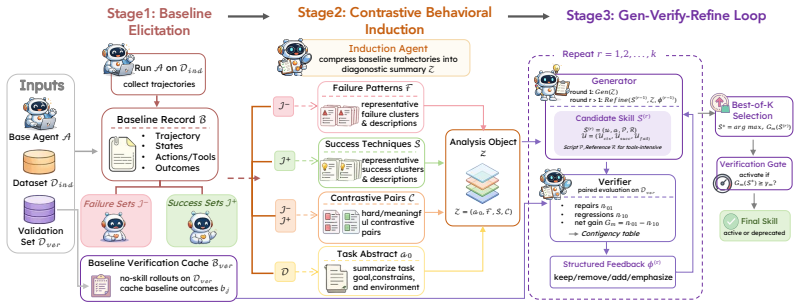
SkillGen synthesizes a single auditable skill from trajectories by using contrastive induction over successful and failed trajectories to identify reusable success patterns and recurring failure modes. It models skills as interventions and verifies them by comparing outcomes on the same instances with and without the skill, measuring both repairs and regressions. This approach leads to consistent improvements in held-out performance across agents and datasets, outperforming baselines and enabling transfer across models.
What carries the argument
The SkillGen multi-agent framework that performs contrastive induction on trajectories and empirically verifies skills as interventions by with/without comparisons.
Load-bearing premise
That patterns identified by contrasting successful and failed trajectories represent reusable skills whose benefits can be reliably measured by simple with-and-without tests without being distorted by task-specific biases or hidden factors.
What would settle it
An experiment showing that skills generated by SkillGen do not improve or even decrease performance on held-out tasks when compared to the base agent without them, or that they fail to transfer to new models.
Figures


read the original abstract
Skills are a promising way to improve LLM agent capabilities without retraining, while keeping the added procedure reusable and controllable. However, high-quality skills are still largely written by hand. We introduce SkillGen, a multi-agent framework that synthesizes a single auditable skill from trajectories generated by a base agent. The output is a human-readable artifact that can be inspected before use. Rather than merely summarizing trajectories, SkillGen leverages contrastive induction over both successful and failed trajectories to identify reusable success patterns, recurring failure modes, and behaviors that appear in nearby successes but are missing from failures. SkillGen then generates candidate skills and iteratively refines the skill. A key novelty in SkillGen is that we model agent skills as interventions to empirically verify the net effect of skills on the overall performance. Specifically, we compare outcomes on the same instances with and without the skill, so that we account for both repairs (cases where the skill fixes a baseline failure) and regressions (cases where the skill breaks a baseline success). Across a broad range of agents and datasets, SkillGen consistently improves held-out performance, outperforms existing skill-generation baselines, and produces skills that transfer across models.
Editorial analysis
A structured set of objections, weighed in public.
Referee Report
Summary. The paper introduces SkillGen, a multi-agent framework that synthesizes a single human-readable, auditable skill from trajectories of a base LLM agent. It performs contrastive induction over success and failure trajectories to extract reusable success patterns and recurring failure modes, generates and iteratively refines candidate skills, and verifies net effect by comparing agent outcomes on identical task instances with versus without the skill (explicitly accounting for both repairs and regressions). The central claim is that this procedure yields consistent held-out performance gains across agents and datasets, outperforms existing skill-generation baselines, and produces skills that transfer across models.
Significance. If the verification methodology is shown to isolate skill effects without hidden confounders, the work would provide a practical, inference-time method for improving agent capabilities while producing inspectable artifacts. The explicit modeling of skills as interventions with repair/regression accounting is a methodological strength that could support more reliable skill reuse than purely summarization-based approaches.
major comments (2)
- [Section 3] Verification procedure (Section 3): the with/without comparison on identical instances does not hold the underlying trajectory distribution fixed. Inserting the skill alters agent behavior from early steps onward, shifting the distribution of visited states, actions, and failure modes relative to the baseline trajectories used for contrastive induction. Consequently, measured net gains may partly reflect avoidance of certain paths rather than the reusable success patterns claimed, and this risk is highest for unconditional inference-time application.
- [Section 4] Empirical evaluation (Section 4): the manuscript reports consistent outperformance and transfer but supplies no quantitative results, error bars, dataset sizes, number of runs, or explicit accounting of how regressions are balanced against repairs in the net-effect metric. Without these details the central claim that SkillGen 'consistently improves held-out performance' cannot be assessed for magnitude or reliability.
minor comments (1)
- [Abstract] Abstract: the claim of broad applicability would be strengthened by at least naming the specific agents, datasets, and baseline methods evaluated.
Simulated Author's Rebuttal
We thank the referee for their constructive and detailed feedback. We address each major comment below and indicate the corresponding revisions to the manuscript.
read point-by-point responses
-
Referee: [Section 3] Verification procedure (Section 3): the with/without comparison on identical instances does not hold the underlying trajectory distribution fixed. Inserting the skill alters agent behavior from early steps onward, shifting the distribution of visited states, actions, and failure modes relative to the baseline trajectories used for contrastive induction. Consequently, measured net gains may partly reflect avoidance of certain paths rather than the reusable success patterns claimed, and this risk is highest for unconditional inference-time application.
Authors: We appreciate the referee's careful analysis of the verification procedure. The design in Section 3 treats the skill explicitly as an intervention and measures its net impact on final task outcomes for identical instances. This captures both repairs and regressions in a single metric, which is the quantity most relevant for practical inference-time use. We agree that the trajectory distribution shifts because the skill influences early decisions and can steer the agent away from failure modes observed in the base trajectories. This shift is inherent to any behavioral intervention and is not a hidden confounder but the intended mechanism by which the contrastively induced patterns improve performance. The verification therefore reports the overall empirical effect rather than an isolated contribution of the patterns under a fixed distribution. We will add a clarifying paragraph in the revised Section 3 that explicitly discusses this distributional change and its implications for interpreting the results as net intervention effects. This is a textual clarification only. revision: partial
-
Referee: [Section 4] Empirical evaluation (Section 4): the manuscript reports consistent outperformance and transfer but supplies no quantitative results, error bars, dataset sizes, number of runs, or explicit accounting of how regressions are balanced against repairs in the net-effect metric. Without these details the central claim that SkillGen 'consistently improves held-out performance' cannot be assessed for magnitude or reliability.
Authors: We thank the referee for highlighting the need for more transparent reporting. While the manuscript describes the overall trends, we acknowledge that the specific quantitative values, error bars, dataset sizes, number of runs, and explicit repair/regression breakdown were not presented with sufficient prominence or in a dedicated table. We will revise Section 4 to include a clear summary table with mean performance gains and standard deviations (across 5 runs), dataset sizes, experimental run counts, and a breakdown of how repairs and regressions contribute to the net-effect metric. These details will be added in the next version of the manuscript. revision: yes
Circularity Check
No significant circularity: empirical verification on held-out instances is independent of induction inputs
full rationale
The paper's core chain generates candidate skills via contrastive induction over success/failure trajectories, then applies them as interventions and measures net performance change by direct with/without comparison on the same task instances (accounting for repairs and regressions). This measurement is an external empirical outcome on held-out data, not a quantity defined in terms of the induction process or any fitted parameter. No equations reduce the reported improvement to the input trajectories by construction, no self-citation is invoked as a uniqueness theorem or load-bearing premise, and no ansatz is smuggled in. The derivation therefore remains self-contained against external benchmarks.
Axiom & Free-Parameter Ledger
Reference graph
Works this paper leans on
-
[1]
Evoskill: Automated skill discovery for multi-agent systems.arXiv preprint arXiv:2603.02766, 2026
Salaheddin Alzubi, Noah Provenzano, Jaydon Bingham, Weiyuan Chen, and Tu Vu. EvoSkill: Automated skill discovery for multi-agent systems.arXiv preprint arXiv:2603.02766,
-
[2]
Autobench-v: Can large vision-language models benchmark themselves?arXiv preprint arXiv:2410.21259,
Han Bao, Yue Huang, Yanbo Wang, Jiayi Ye, Xiangqi Wang, Xiuying Chen, Yue Zhao, Tianyi Zhou, Mohamed Elhoseiny, and Xiangliang Zhang. Autobench-v: Can large vision-language models benchmark themselves?arXiv preprint arXiv:2410.21259,
-
[3]
arXiv preprint arXiv:2310.05915 , year=
Baian Chen, Chang Shu, Ehsan Shareghi, Nigel Collier, Karthik Narasimhan, and Shunyu Yao. FireAct: Toward language agent fine-tuning.arXiv preprint arXiv:2310.05915,
-
[4]
Agent-FLAN: Designing data and methods of effective agent tuning for large language models
Zehui Chen, Kuikun Liu, Qiuchen Wang, Wenwei Zhang, Jiangning Liu, Dahua Lin, Kai Chen, and Feng Zhao. Agent-FLAN: Designing data and methods of effective agent tuning for large language models. InFindings of the Association for Computational Linguistics: ACL 2024,
work page 2024
-
[5]
Suriya Gunasekar, Yi Zhang, Jyoti Aneja, Caio César Teodoro Mendes, Allie Del Giorno, Sivakanth Gopi, Mojan Javaheripi, Piero Kauffmann, Gustavo de Rosa, Olli Saarikivi, et al. Textbooks are all you need.arXiv preprint arXiv:2306.11644,
work page internal anchor Pith review Pith/arXiv arXiv
-
[6]
Building a foundational guardrail for general agentic systems via synthetic data
Yue Huang, Hang Hua, Yujun Zhou, Pengcheng Jing, Manish Nagireddy, Inkit Padhi, Greta Dolcetti, Zhangchen Xu, Subhajit Chaudhury, Ambrish Rawat, Liubov Nedoshivina, Pin-Yu Chen, Prasanna Sattigeri, and Xiangliang Zhang. Building a foundational guardrail for general agentic systems via synthetic data.arXiv preprint arXiv:2510.09781, 2025a. Yue Huang, Zheng...
-
[7]
Haoran Li, Qingxiu Dong, Zhengyang Tang, Chaojun Wang, Xingxing Zhang, Haoyang Huang, Shaohan Huang, Xiaolong Huang, Zeqiang Huang, Dongdong Zhang, Yuxian Gu, Xin Cheng, Xun Wang, Si-Qing Chen, Li Dong, Wei Lu, Zhifang Sui, Benyou Wang, Wai Lam, and Furu Wei. Synthetic data (almost) from scratch: Generalized instruction tuning for language models.arXiv pr...
-
[8]
Agentin- struct: Toward generative teaching with agentic flows,
Arindam Mitra, Luciano Del Corro, Guoqing Zheng, Shweti Mahajan, Dany Rouhana, Andres Codas, Yadong Lu, Wei ge Chen, Olga Vrousgos, Corby Rosset, Fillipe Silva, Hamed Khanpour, Yash Lara, and Ahmed Awadallah. AgentInstruct: Toward generative teaching with agentic flows.arXiv preprint arXiv:2407.03502,
-
[9]
Orca: Progressive Learning from Complex Explanation Traces of GPT-4
Subhabrata Mukherjee, Arindam Mitra, Ganesh Jawahar, Sahaj Agarwal, Hamid Palangi, and Ahmed Awadallah. Orca: Progressive learning from complex explanation traces of GPT-4.arXiv preprint arXiv:2306.02707,
work page internal anchor Pith review arXiv
-
[10]
Trace2Skill: Distill Trajectory-Local Lessons into Transferable Agent Skills
Jingwei Ni, Yihao Liu, Xinpeng Liu, Yutao Sun, Mengyu Zhou, Pengyu Cheng, Dexin Wang, Xiaoxi Jiang, and Guanjun Jiang. Trace2skill: Distill trajectory-local lessons into transferable agent skills. arXiv preprint arXiv:2603.25158,
work page internal anchor Pith review Pith/arXiv arXiv
-
[11]
Fung, Yujia Qin, Zhiyuan Liu, and Heng Ji
Cheng Qian, Chi Han, Yi R. Fung, Yujia Qin, Zhiyuan Liu, and Heng Ji. CREATOR: Tool creation for disentangling abstract and concrete reasoning of large language models. InFindings of the Association for Computational Linguistics: EMNLP 2023,
work page 2023
-
[12]
Toolformer: Language Models Can Teach Themselves to Use Tools
Timo Schick, Jane Dwivedi-Yu, Roberto Dessì, Roberta Raileanu, Maria Lomeli, Luke Zettlemoyer, Nicola Cancedda, and Thomas Scialom. Toolformer: Language models can teach themselves to use tools.arXiv preprint arXiv:2302.04761,
work page internal anchor Pith review Pith/arXiv arXiv
-
[13]
SkillX: Automatically Constructing Skill Knowledge Bases for Agents
URLhttps://crfm.stanford.edu/2023/03/13/alpaca.html. Chenxi Wang, Zhuoyun Yu, Xin Xie, Wuguannan Yao, Runnan Fang, Shuofei Qiao, Kexin Cao, Guozhou Zheng, Xiang Qi, Peng Zhang, and Shumin Deng. SkillX: Automatically constructing skill knowledge bases for agents.arXiv preprint arXiv:2604.04804, 2026a. Guanzhi Wang, Yuqi Xie, Yunfan Jiang, Ajay Mandlekar, C...
work page internal anchor Pith review Pith/arXiv arXiv 2023
-
[14]
Agent Skills for Large Language Models: Architecture, Acquisition, Security, and the Path Forward
Renjun Xu and Yang Yan. Agent skills for large language models: Architecture, acquisition, security, and the path forward.arXiv preprint arXiv:2602.12430,
work page internal anchor Pith review arXiv
-
[15]
arXiv preprint arXiv:2603.01145 , year=
Yutao Yang, Junsong Li, Qianjun Pan, Bihao Zhan, Yuxuan Cai, Lin Du, Jie Zhou, Kai Chen, Qin Chen, Xin Li, Bo Zhang, and Liang He. AutoSkill: Experience-driven lifelong learning via skill self-evolution.arXiv preprint arXiv:2603.01145,
-
[16]
AgentTuning: Enabling generalized agent abilities for LLMs
Aohan Zeng, Mingdao Liu, Rui Lu, Bowen Wang, Xiao Liu, Yuxiao Dong, and Jie Tang. AgentTuning: Enabling generalized agent abilities for LLMs. InFindings of the Association for Computational Linguistics: ACL 2024,
work page 2024
-
[17]
CoEvoSkills: Self-Evolving Agent Skills via Co-Evolutionary Verification
URL https://www.anthropic.com/engineering/ equipping-agents-for-the-real-world-with-agent-skills. Hanrong Zhang, Shicheng Fan, Henry Peng Zou, Yankai Chen, Zhenting Wang, Jiayu Zhou, Chengze Li, Wei-Chieh Huang, Yifei Yao, Kening Zheng, Xue Liu, Xiaoxiao Li, and Philip S. Yu. EvoSkills: Self-evolving agent skills via co-evolutionary verification.arXiv pre...
work page internal anchor Pith review Pith/arXiv arXiv
-
[18]
SkillWeaver: Web Agents can Self-Improve by Discovering and Honing Skills
Boyuan Zheng, Michael Y . Fatemi, Xiaolong Jin, Zora Zhiruo Wang, Apurva Gandhi, Yueqi Song, Yu Gu, Jayanth Srinivasa, Gaowen Liu, Graham Neubig, and Yu Su. SkillWeaver: Web agents can self-improve by discovering and honing skills.arXiv preprint arXiv:2504.07079,
work page internal anchor Pith review arXiv
-
[19]
13 A Algorithm Algorithm 1 summarizes the full SKILLGENconstruction procedure. Algorithm 1SKILLGEN: contrastive induction with generation-verification-refinement loop Require: induction subset Dind, construction-time verification subset Dver, base agent A, evaluator E, round budgetK≥1, gate parametersg abs ∈Z ≥0 andg rel ∈[0,1] Ensure:skills ⋆ markedactiv...
work page 2023
-
[20]
or tool creation (Qian et al., 2023), while interaction-based agents such as ReAct (Yao et al., 2023), Reflexion (Shinn et al., 2023), ExpeL (Zhao et al., 2024), and V oyager (Wang et al., 2023a) showed that trajectories can support reusable reasoning and action routines. Agent skills provide a first-class abstraction that often follows the Anthropic Agen...
work page 2023
-
[21]
study web, dialogue, and RL deployment regimes. SKILLGENdiffers by making failure analysis central: it clusters error patterns, identifies capability boundaries, and verifies induced skills through multi-agent collaboration with a construction-time deployment rule over paired repairs and regressions. Synthetic data for LLM agents.Self-Instruct (Wang et al...
work page 2023
-
[22]
and risk-injected safety trajectories (Huang et al., 2025a). For agent-specific capabilities, AgentTuning (Zeng et al., 2024), Agent-FLAN (Chen et al., 2024), FireAct (Chen et al., 2023), and Instruct-SkillMix (Kaur et al.,
work page 2024
-
[23]
17 C.6 Skill-Generation Baselines Trace2Skill.For Trace2Skill (Ni et al., 2026), we run one no-skill rollout over the training pool. Success-branch and error-branch analysts process trajectories in parallel, and their proposed patches are consolidated through hierarchical LLM merging. We preserve the original prompt structure and do not impose an addition...
work page 2026
discussion (0)
Sign in with ORCID, Apple, or X to comment. Anyone can read and Pith papers without signing in.