Recognition: no theorem link
SkillX: Automatically Constructing Skill Knowledge Bases for Agents
Pith reviewed 2026-05-10 18:38 UTC · model grok-4.3
The pith
SkillX automatically builds a reusable hierarchical skill knowledge base from strong-agent trajectories that raises success rates in weaker agents.
A machine-rendered reading of the paper's core claim, the machinery that carries it, and where it could break.
Core claim
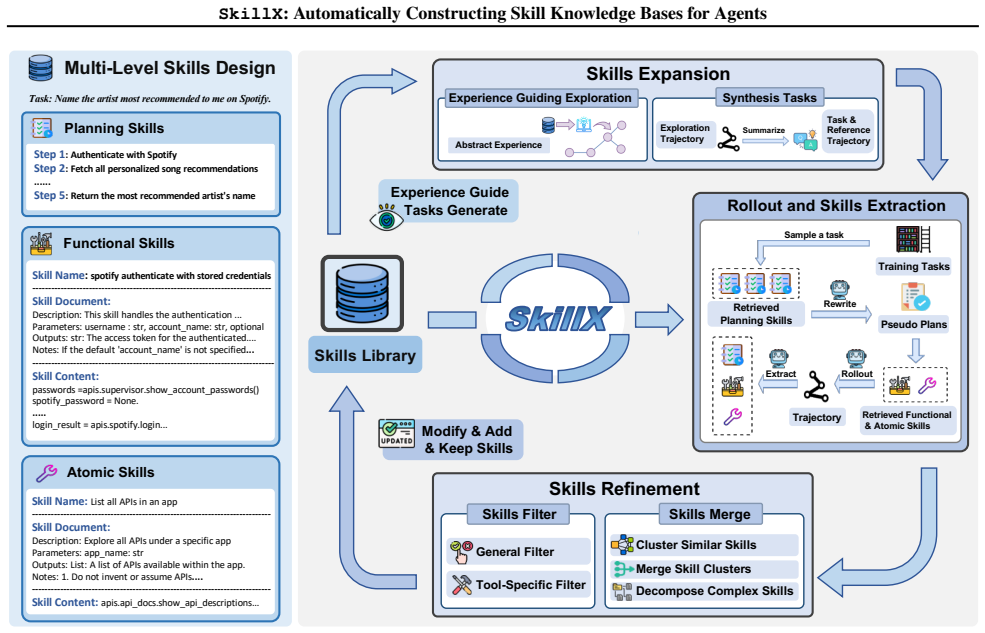
SkillX is a fully automated pipeline that distills raw trajectories into a three-tiered hierarchy of strategic plans, functional skills, and atomic skills, then iteratively refines them with execution feedback and expands coverage through proactive generation and validation, yielding a SkillKB that transfers to weaker agents and raises task success and efficiency on AppWorld, BFCL-v3, and τ²-Bench.
What carries the argument
The SkillX pipeline of multi-level skill distillation into a three-tier hierarchy, iterative refinement from execution feedback, and exploratory expansion of new skills to produce a transferable SkillKB.
If this is right
- Weaker base agents achieve higher task success rates when the SkillKB is inserted.
- Execution becomes more efficient because agents reuse already-refined skills instead of rediscovering them.
- The hierarchical structure supports generalization to new environments and user interactions beyond the original training trajectories.
- Automated construction and refinement remove the need for manual skill curation in agent development.
Where Pith is reading between the lines
- Public repositories of validated skills could let different agent teams build on one another's experience rather than starting from scratch.
- The same distillation approach might be tested on non-LLM agents to see whether hierarchical skills transfer across learning paradigms.
- Iterative refinement could be extended to run continuously in deployed agents, allowing the library to evolve with real-world use.
- Measuring performance when the SkillKB is added to agents of varying capability levels would reveal the boundaries of useful transfer.
Load-bearing premise
Skills distilled and refined from a strong agent's trajectories will transfer usefully and without harm when plugged into weaker agents in new environments.
What would settle it
If weaker agents show no gain or a drop in success rate and efficiency after receiving the SkillKB on the reported benchmarks, the transfer claim would be falsified.
Figures



read the original abstract
Learning from experience is critical for building capable large language model (LLM) agents, yet prevailing self-evolving paradigms remain inefficient: agents learn in isolation, repeatedly rediscover similar behaviors from limited experience, resulting in redundant exploration and poor generalization. To address this problem, we propose SkillX, a fully automated framework for constructing a \textbf{plug-and-play skill knowledge base} that can be reused across agents and environments. SkillX operates through a fully automated pipeline built on three synergistic innovations: \textit{(i) Multi-Level Skills Design}, which distills raw trajectories into three-tiered hierarchy of strategic plans, functional skills, and atomic skills; \textit{(ii) Iterative Skills Refinement}, which automatically revises skills based on execution feedback to continuously improve library quality; and \textit{(iii) Exploratory Skills Expansion}, which proactively generates and validates novel skills to expand coverage beyond seed training data. Using a strong backbone agent (GLM-4.6), we automatically build a reusable skill library and evaluate its transferability on challenging long-horizon, user-interactive benchmarks, including AppWorld, BFCL-v3, and $\tau^2$-Bench. Experiments show that SkillKB consistently improves task success and execution efficiency when plugged into weaker base agents, highlighting the importance of structured, hierarchical experience representations for generalizable agent learning. Our code will be publicly available soon at https://github.com/zjunlp/SkillX.
Editorial analysis
A structured set of objections, weighed in public.
Referee Report
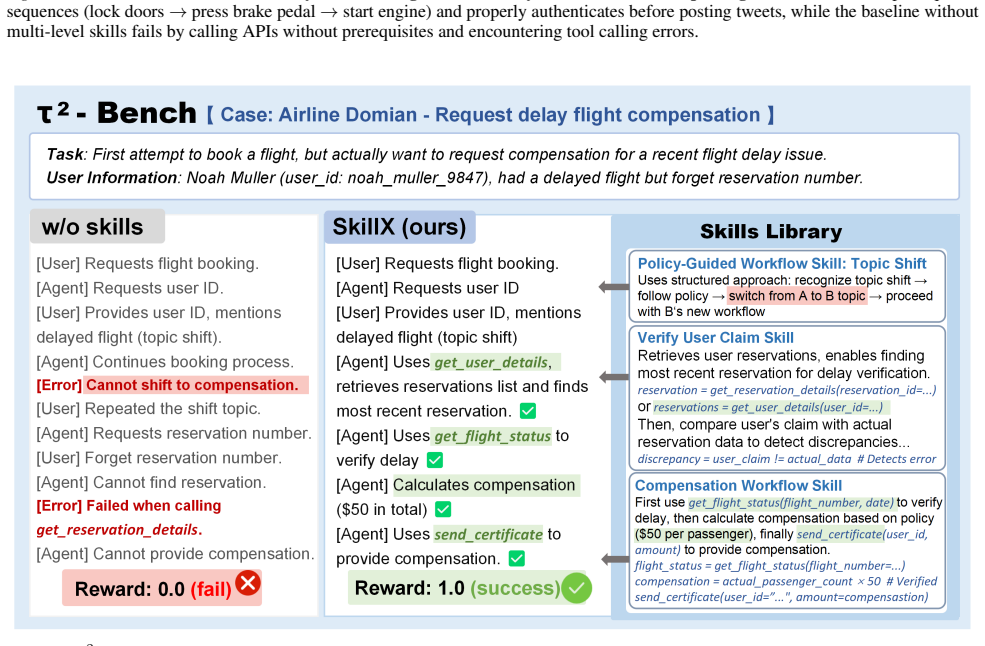
Summary. The paper introduces SkillX, a fully automated framework for constructing a reusable plug-and-play skill knowledge base (SkillKB) for LLM agents. It distills trajectories from a strong backbone agent (GLM-4.6) into a three-tier hierarchy of strategic plans, functional skills, and atomic skills via multi-level design, then applies iterative refinement based on execution feedback and exploratory expansion to generate and validate new skills. The resulting SkillKB is plugged into weaker base agents and evaluated on AppWorld, BFCL-v3, and τ²-Bench, with the claim that it consistently improves task success and execution efficiency, underscoring the value of structured hierarchical experience representations for generalizable agent learning.
Significance. If the empirical results hold with proper quantification and transfer analysis, this could meaningfully advance LLM agent research by providing an efficient way to accumulate and reuse experience across models and environments, reducing redundant exploration in self-evolving systems. The automated pipeline and emphasis on hierarchical skills represent a practical step toward more generalizable agents, and the planned public code release would support reproducibility.
major comments (3)
- Abstract: The abstract states that 'Experiments show that SkillKB consistently improves task success and execution efficiency' but supplies no quantitative numbers, specific metrics (e.g., success rates, efficiency gains), error bars, ablation results, or details on how skills are validated or filtered. This absence is load-bearing for the central claim and prevents assessment of whether the data actually support consistent gains.
- Abstract: The transferability claim—that skills distilled and refined from GLM-4.6 trajectories improve weaker agents without introducing harmful behaviors—is central but unsupported by any reported analysis of skill invocation rates, error types (e.g., invalid API calls or stalled execution) when skills are used versus ignored, or controls for whether weaker agents would have succeeded without the library.
- Abstract: The framework relies on external execution feedback and a separate strong backbone for skill construction and refinement, yet provides no evidence that the resulting hierarchical skills are model-agnostic or that weaker agents can correctly interpret and execute them at test time without the refinement loop.
minor comments (1)
- Abstract: The code availability statement ('Our code will be publicly available soon at https://github.com/zjunlp/SkillX') could be strengthened by including a specific commit or DOI if available at the time of submission.
Simulated Author's Rebuttal
We thank the referee for the constructive feedback and for recognizing the potential of SkillX to advance reusable experience in LLM agents. We agree that the abstract requires strengthening with quantitative details and clearer support for transferability claims. Below we respond point by point to the major comments and outline the revisions we will implement.
read point-by-point responses
-
Referee: Abstract: The abstract states that 'Experiments show that SkillKB consistently improves task success and execution efficiency' but supplies no quantitative numbers, specific metrics (e.g., success rates, efficiency gains), error bars, ablation results, or details on how skills are validated or filtered. This absence is load-bearing for the central claim and prevents assessment of whether the data actually support consistent gains.
Authors: We agree that the current abstract is too high-level and does not convey the concrete evidence supporting the central claim. The full manuscript reports quantitative results in Section 4, including success rates and execution efficiency metrics across AppWorld, BFCL-v3, and τ²-Bench, along with ablations and validation procedures. We will revise the abstract to include key quantitative findings (e.g., average success-rate improvements and efficiency gains) and brief references to the validation and filtering steps, while preserving conciseness. revision: yes
-
Referee: Abstract: The transferability claim—that skills distilled and refined from GLM-4.6 trajectories improve weaker agents without introducing harmful behaviors—is central but unsupported by any reported analysis of skill invocation rates, error types (e.g., invalid API calls or stalled execution) when skills are used versus ignored, or controls for whether weaker agents would have succeeded without the library.
Authors: The manuscript demonstrates transfer by plugging the SkillKB into weaker base agents and reporting improved task success on the three benchmarks. We acknowledge that finer-grained analysis of invocation rates, error-type reductions, and explicit controls (with vs. without the library) is currently limited. We will add this analysis to the experiments section, including invocation statistics, breakdowns of error types such as invalid calls, and direct comparisons against the no-library baseline, to more rigorously substantiate the transferability claim. revision: partial
-
Referee: Abstract: The framework relies on external execution feedback and a separate strong backbone for skill construction and refinement, yet provides no evidence that the resulting hierarchical skills are model-agnostic or that weaker agents can correctly interpret and execute them at test time without the refinement loop.
Authors: Skill construction uses the strong backbone and feedback loop, but the resulting SkillKB is applied in a plug-and-play manner by the base agents at test time with no further refinement. The hierarchical skills are expressed in natural language and evaluated directly on weaker agents, which show performance gains. We will clarify this separation of phases in the abstract and methods, add explicit statements on the model-agnostic design of the skill representations, and reference the successful execution results on weaker agents to address the concern. revision: yes
Circularity Check
No significant circularity in derivation chain
full rationale
The paper presents an empirical framework (SkillX) that distills trajectories from an external strong backbone agent (GLM-4.6) into a hierarchical skill library via multi-level design, iterative refinement using execution feedback, and exploratory expansion. No mathematical derivations, equations, fitted parameters, or first-principles results are described that reduce to self-defined quantities or self-citations. The central claim of improved transfer to weaker agents is evaluated on external benchmarks (AppWorld, BFCL-v3, τ²-Bench) and relies on observable execution outcomes rather than any internal redefinition or renaming of inputs as outputs. The framework is self-contained against external validation and contains no load-bearing self-referential steps.
Axiom & Free-Parameter Ledger
Forward citations
Cited by 7 Pith papers
-
From Context to Skills: Can Language Models Learn from Context Skillfully?
Ctx2Skill lets language models autonomously evolve context-specific skills via multi-agent self-play, improving performance on context learning tasks without human supervision.
-
SkillOps: Managing LLM Agent Skill Libraries as Self-Maintaining Software Ecosystems
SkillOps maintains LLM skill libraries via Skill Contracts and ecosystem graphs, raising ALFWorld task success to 79.5% as a standalone agent and improving retrieval baselines by up to 2.9 points with near-zero librar...
-
SkillSafetyBench: Evaluating Agent Safety under Skill-Facing Attack Surfaces
SkillSafetyBench shows that localized non-user attacks via skills and artifacts can consistently induce unsafe agent behavior across domains and model backends, independent of user intent.
-
Evidence Over Plans: Online Trajectory Verification for Skill Distillation
PDI-guided distillation from environment-verified trajectories yields skills that surpass no-skill baselines and human-written skills across 86 tasks with far lower inference cost.
-
SkillGen: Verified Inference-Time Agent Skill Synthesis
SkillGen synthesizes auditable skills from agent trajectories via contrastive induction on successes and failures, then verifies net performance impact by comparing outcomes with and without the skill on identical tasks.
-
From Skill Text to Skill Structure: The Scheduling-Structural-Logical Representation for Agent Skills
SSL representation disentangles skill scheduling, structure, and logic using an LLM normalizer, improving skill discovery MRR@50 from 0.649 to 0.729 and risk assessment macro F1 from 0.409 to 0.509 over text baselines.
-
Ace-Skill: Bootstrapping Multimodal Agents with Prioritized and Clustered Evolution
Ace-Skill boosts multimodal agent self-evolution via prioritized rollouts with lazy-decay tracking and semantic knowledge clustering, yielding up to 35% relative gains on tool-use benchmarks and zero-shot transfer to ...
Reference graph
Works this paper leans on
-
[1]
URL https://github.com/anthropics/ skills. GitHub repository. Barres, V ., Dong, H., Ray, S., Si, X., and Narasimhan, K. τ 2-bench: Evaluating conversational agents in a dual- control environment, 2025. URL https://arxiv. 9 SkillX: Automatically Constructing Skill Knowledge Bases for Agents org/abs/2506.07982. Cai, Y ., Cai, S., Shi, Y ., Xu, Z., Chen, L....
work page internal anchor Pith review doi:10.48550/arxiv 2025
-
[2]
3.No-Python-libraries: Check whether additional Python libraries are introduced in the skill
Over-encapsulation: Check whether the skill’s implementation merely calls a single other skill (i.e., it is just a thin wrapper). 3.No-Python-libraries: Check whether additional Python libraries are introduced in the skill. 4.Reusability: Check whether the parameters are specific. 5.No-Functional style: Check whether a functional style is being used (e.g....
-
[3]
The AI assistant’s reasoning and action
-
[4]
The resulting environment feedback after the action Summary Guidelines
-
[5]
Summarize what the environment feedback conveys in light of the AI assistant’s intent
-
[6]
Preserve details that are tightly relevant to the intent verbatim when possible; compress other redundant information
-
[7]
Summarize only factual content from the environment feedback—do not invent anything
-
[8]
Output Format <feedback> Your summary of the environment feedback </feedback> Table 5.Prompt for summarizing environment feedback from agent interactions
Write the summary in the tone of the environment feedback. Output Format <feedback> Your summary of the environment feedback </feedback> Table 5.Prompt for summarizing environment feedback from agent interactions. 19 SkillX: Automatically Constructing Skill Knowledge Bases for Agents C.3. Tool Schema Filter Prompt Tool Schema Filter Prompt You are a tool-...
-
[9]
Parameter validation: Check whether the invocation parameters comply with the specifications (e.g., missing required parameters, unsupported/nonexistent parameters, wrong types or formats, invalid values, etc.)
-
[10]
If there is no dependency between the calls, ignore this check
Call dependency: For multiple tool calls, verify that their order does not violate logical dependencies. If there is no dependency between the calls, ignore this check. 3.Comment–function alignment: Ensure the logic described in any comments matches what the tool is designed to do. 4.Output Format: Provide your reasoning and conclude with either ’correct’...
-
[11]
Instead, describe the underlying sub-goal behind each action segment
Focus • Do not simply restate each API function step-by-step using technical jargon. Instead, describe the underlying sub-goal behind each action segment
-
[12]
Remove Non-Essential Steps • Exclude capability exploration, debugging, and failed steps
-
[13]
Reusability • The plan must be precise enough for other models to reuse
-
[14]
• Use a compact writing style for each sub-step, while listing the key APIs involved in that step (one or more)
Conciseness • Merge steps from the interaction history that share the same objective into a single sub-step in the plan. • Use a compact writing style for each sub-step, while listing the key APIs involved in that step (one or more). • Do not omit any critical, potentially required API keys. OUTPUT FORMAT For each task, output exactly one plan and follow ...
-
[15]
Focus on skills with similar names and similar skillality
-
[16]
Merge Guidelines
Carefully analyze the concrete implementation differences between similar skills. Merge Guidelines
-
[17]
The merged skill should use a generic name, and its Notesand implementation should cover all plausible variants and edge cases
Generality: Merge skills that have similar names and similar skillality. The merged skill should use a generic name, and its Notesand implementation should cover all plausible variants and edge cases
-
[18]
Atomicity: If skills have a containment relationship (one skill’s skillality subsumes or builds on another), follow the skill definitions to preserve atomicity and avoid merging
-
[19]
Decompose Guidelines
Merge Constraints: Any merged skill must comply with the skill definition rules, especially atomicity and reusability, and should avoid being tied to a specific task or scenario. Decompose Guidelines
-
[20]
Atomicity: Only decompose skills whose skillality is overly complex (e.g., they include skillality already covered by other provided skills) into smaller sub-skills
-
[21]
Generality: The decomposed skills must follow the skill-definition rules and remain reusable—avoid coupling them to any specific task or scenario. Output Format Output a list containing the skills (with one or multiple skills) from merging and/or decomposing the skills in the input skill list as follows: <skill> [ ”skill 1”, ... ] </skill> Note: You don’t...
-
[22]
•skills library: A collection of all currently available skills that can be directly reused
Inputs Description •User Task •Trajectory: A record of an agent’s interactions successfully with the environment as it attempts to complete a user task. •skills library: A collection of all currently available skills that can be directly reused. •Specific-Tool: Given a specific tool, extract only one reusable skill for the specified tool
-
[23]
1.name: the specific tool’s name
Skill Definition Rule • Skill is a dictionary with four keys:name,document,contentandtools. 1.name: the specific tool’s name. 2.document: the tool’s functionality, the key parameters, the final output of the skill, and any important notes. 3.content: the tool’s usage examples, and examples of combining it with other tools (if applicable). 4.tools: the key...
-
[24]
You have three options:[modify, add, keep] • modify: revise an existing skill to make it more effective (e.g., improving documents)
Update Existing Skills Your goal is to ensure the system retains actionable skills that help it behave correctly in the future. You have three options:[modify, add, keep] • modify: revise an existing skill to make it more effective (e.g., improving documents). Only changecontent when necessary, and ensure the resulting skill remains broadly general-purpos...
-
[25]
• Avoid duplication: If a skills library is provided, do not add new skills that are similar to existing ones—usekeepormodify instead
Requirements for each skill that is modified or added. • Avoid duplication: If a skills library is provided, do not add new skills that are similar to existing ones—usekeepormodify instead. •Ensure domain specificity: The skill must contain domain-specific tool. •Specific-Tool guided extraction: Only focus on the specified tool in the trajectory when extr...
-
[27]
] ``` Note that your updated skills may not need to cover all the options
Output Format You will finish by returning in this JSON format as follows: ```json [ { ”option”: ”modify”, ”skill”: ”the modified skill”, ”modified from”: ”spotify get all user playlists” # specify the skill name of existing skills that is modified }, { ”option”: ”add”, ”skill”: ”the added skill”, }, 22 SkillX: Automatically Constructing Skill Knowledge B...
-
[28]
✓Optimality— Ensure each skill meets the required definition standards
CHECKLIST BEFORE FINALIZING ✓Reusability— Ensure no critical steps are missing, each skill is modular, all parameters are abstract rather than specific. ✓Optimality— Ensure each skill meets the required definition standards. ✓Agent-centered— Add helpful notes in each skill to guide other models in using it correctly. ✓Specific-Tool focus— Whether the extr...
-
[29]
•skills library: A collection of all currently available skills that can be directly reused
Inputs Description •User Task •Trajectory: A record of an agent’s interactions successfully with the environment as it attempts to complete a user task. •skills library: A collection of all currently available skills that can be directly reused. •Specific-step: Given a concrete step, extract only one reusable skill for the specified step
-
[30]
1.name: the skill’s name
Skill Definition Rule • Skill is a dictionary with four keys:name,document,contentandtools. 1.name: the skill’s name. 2.document: the skill’s functionality, the key parameters, the final output of the skill and any important notes. 3.content: the concrete implementation of the skill. 4.tools: the key tools used in the skill (list). • The skill is abstract...
-
[31]
You have three options:[modify, add, keep] • modify: revise an existing skill to make it more effective (e.g., improving documents)
Update Existing Skills Your goal is to ensure the system retains actionable skills that help it behave correctly in the future. You have three options:[modify, add, keep] • modify: revise an existing skill to make it more effective (e.g., improving documents). Only changecontent when necessary, and ensure the resulting skill remains broadly reusable/gener...
-
[32]
• Avoid duplication: If a skills library is provided, do not add new skills that are similar to existing ones—usekeepormodify instead
Requirements for each skill that is modified or added. • Avoid duplication: If a skills library is provided, do not add new skills that are similar to existing ones—usekeepormodify instead. •Exclude non-solution behavior: Do not include capability exploration, debugging activities, or any failed/incorrect steps. •Ensure domain specificity: The skill must ...
-
[33]
Good Skill Example {example}
-
[34]
] ``` Note that your updated skills may not need to cover all the options
Output Format You will finish by returning in this JSON format as follows: ```json [ { ”option”: ”modify”, ”skill”: ”the modified skill”, ”modified from”: ”spotify get all user playlists” # specify the skill name of existing skills that is modified }, { ”option”: ”add”, ”skill”: ”the added skill”, }, { ”option”: ”keep”, ”skill name”: ”the kept skill name”...
-
[35]
✓Optimality— Ensure each skill meets the required definition standards
CHECKLIST BEFORE FINALIZING ✓Reusability— Ensure no critical steps are missing, each skill is modular, all parameters are abstract rather than specific. ✓Optimality— Ensure each skill meets the required definition standards. ✓Agent-centered— Add helpful notes in each skill to guide other models in using it correctly. ✓Specific-step focus— Whether the extr...
discussion (0)
Sign in with ORCID, Apple, or X to comment. Anyone can read and Pith papers without signing in.