Mock Catalogs of Strongly Lensed Gravitational Waves via a Halo Model Approach with Space-borne Detectors
Pith reviewed 2026-06-27 15:56 UTC · model grok-4.3
The pith
Halo model mocks predict LISA could detect 0 to 131 strongly lensed gravitational waves in four years.
A machine-rendered reading of the paper's core claim, the machinery that carries it, and where it could break.
Core claim
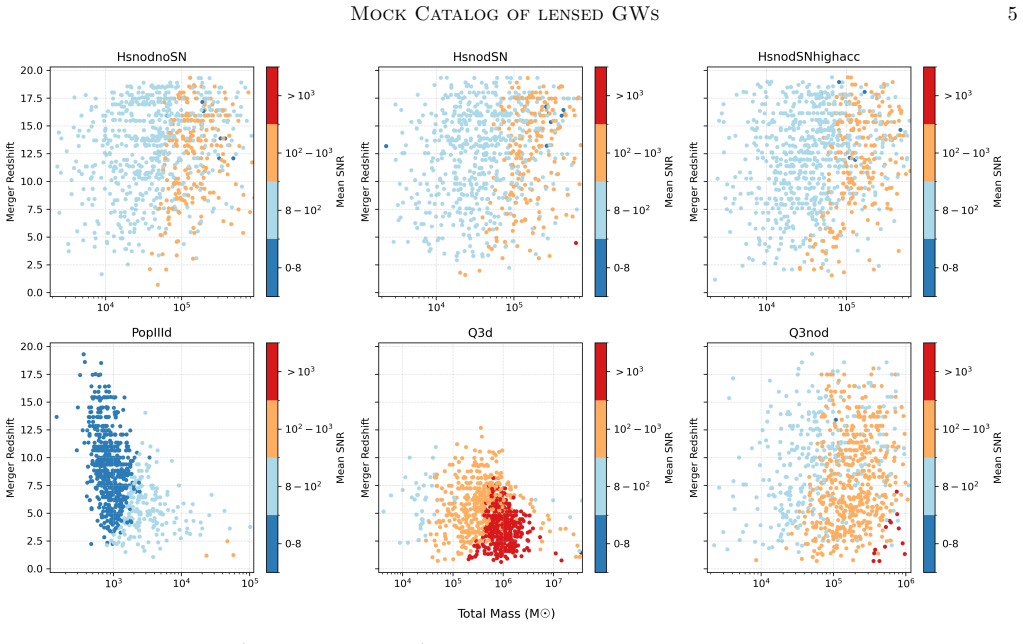
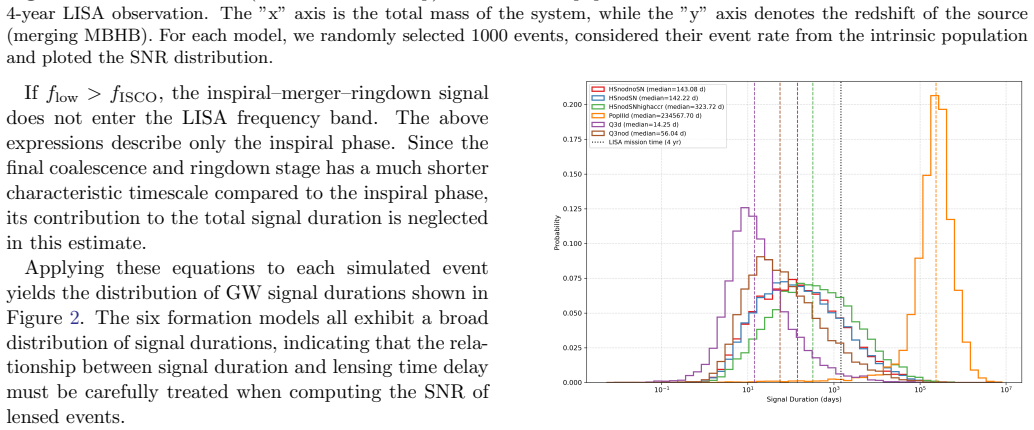
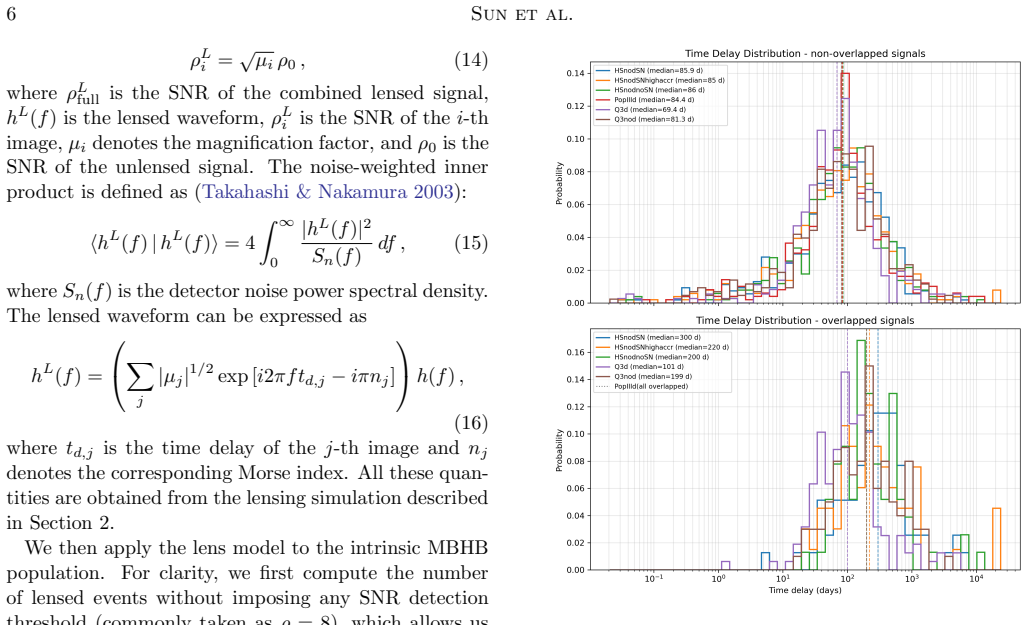
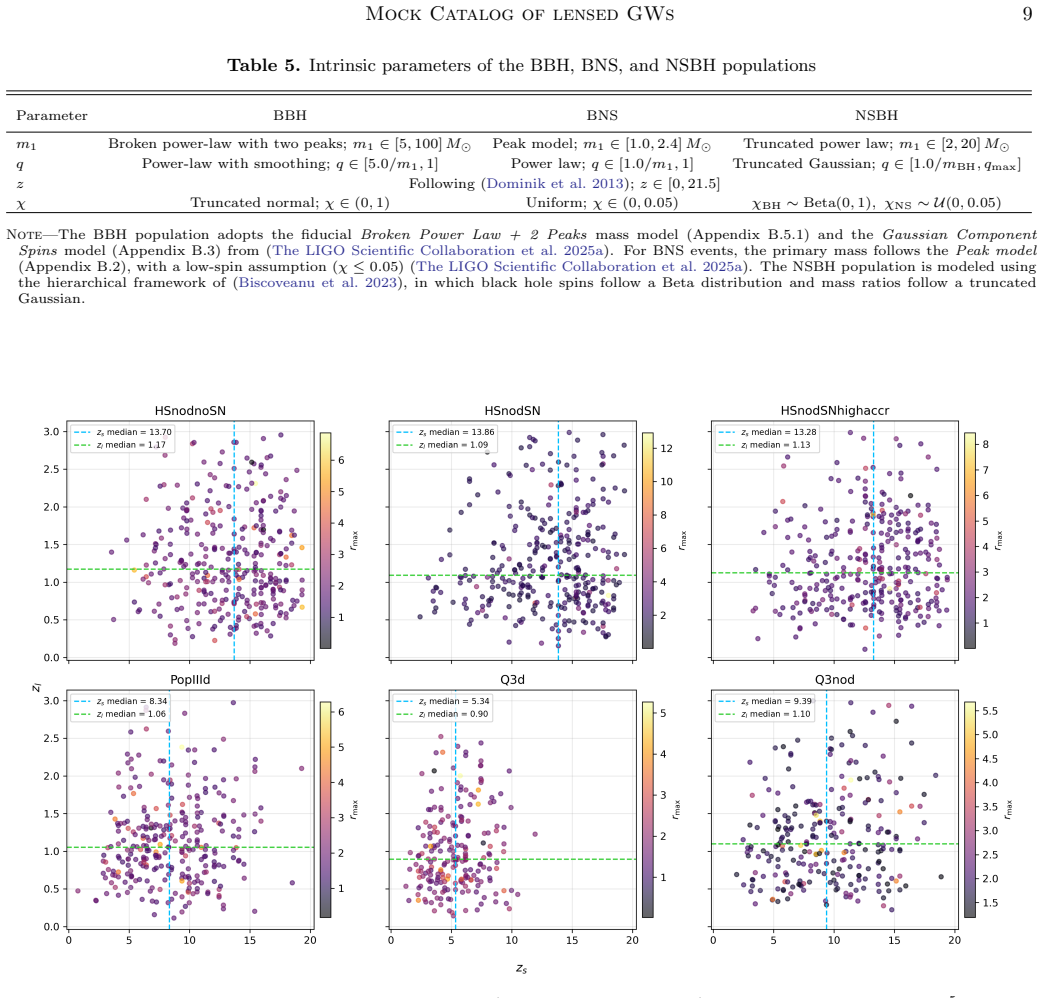
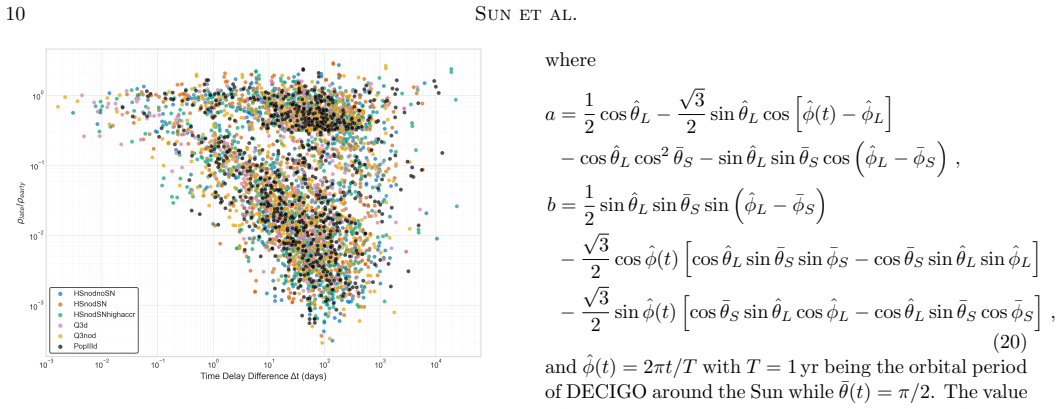
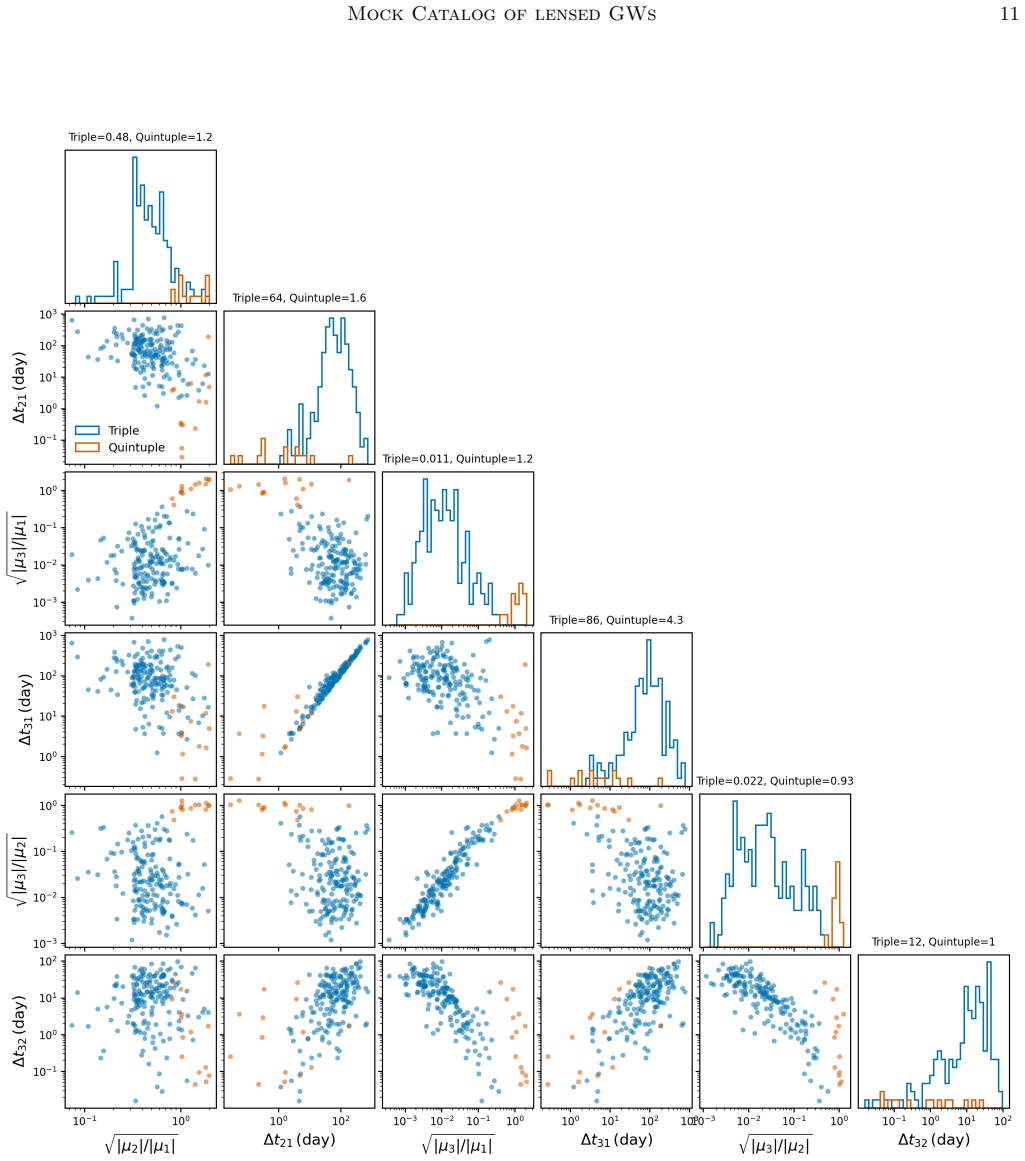
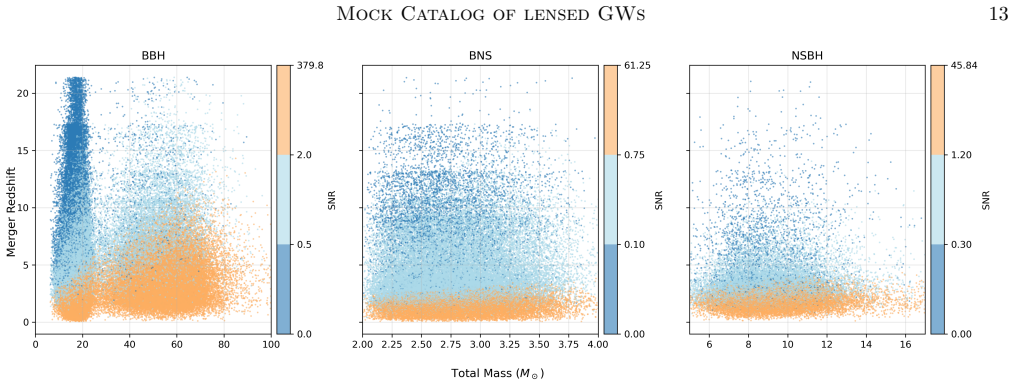
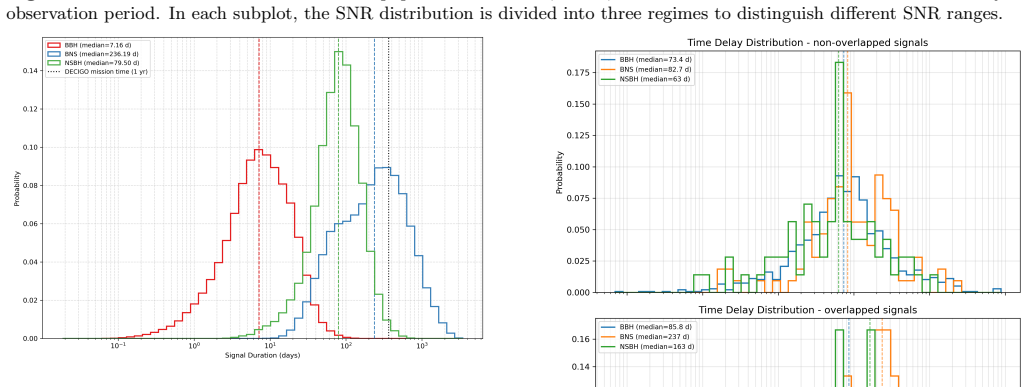
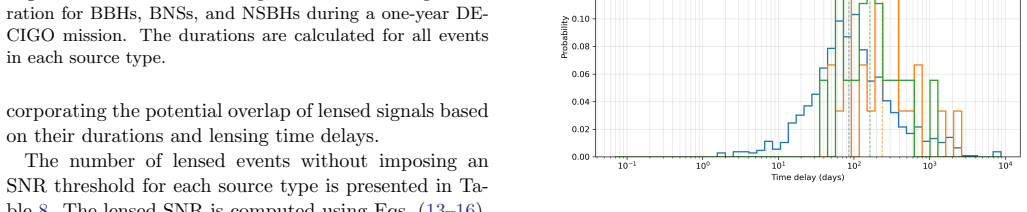
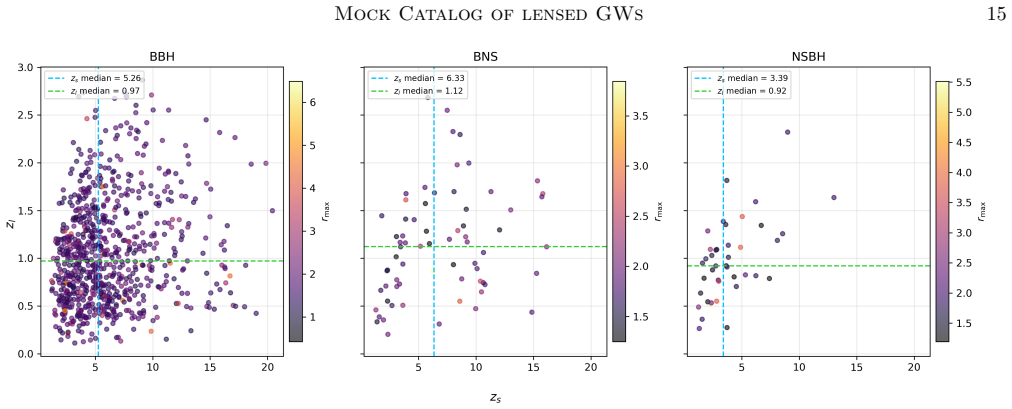
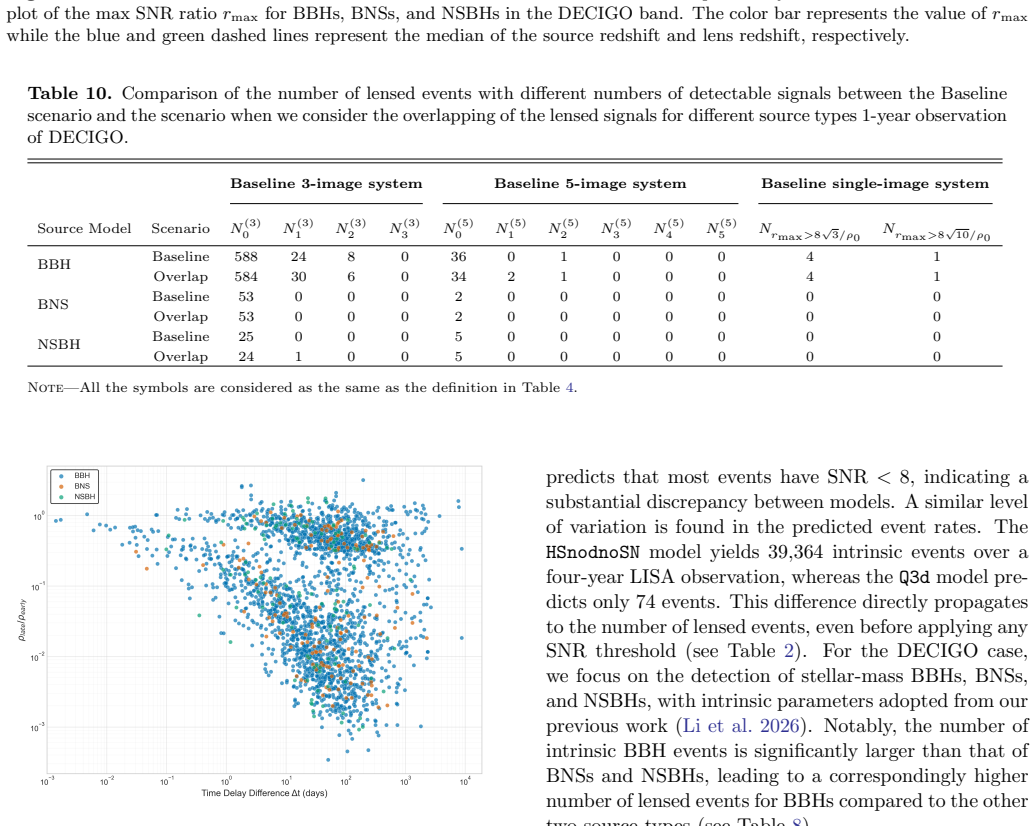
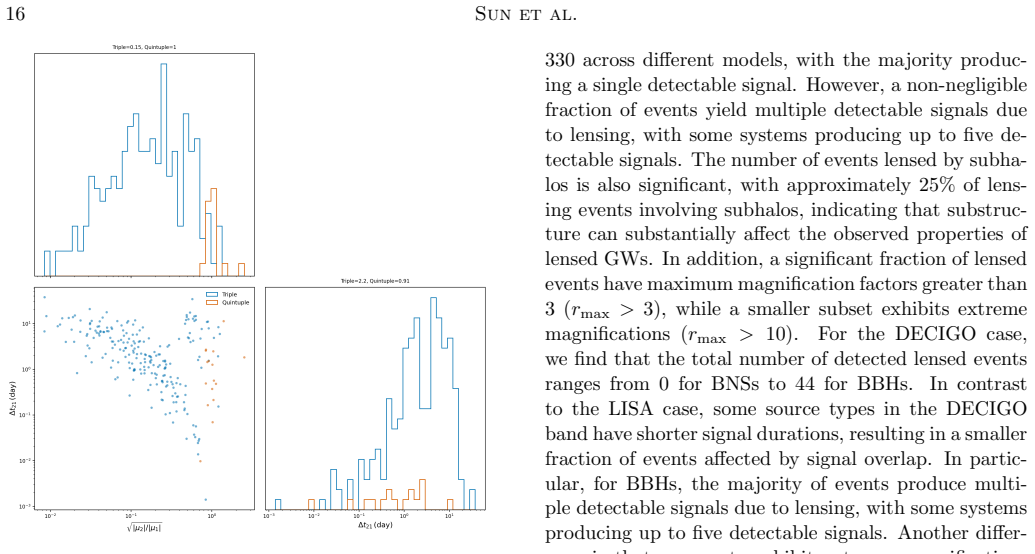
Based on realistic astrophysical models for both the source population and the lens distribution, we construct mock catalogs of lensed GW events. For a four-year LISA observation, the expected number of lensed events ranges from 0 to 131, depending on the adopted formation model of massive black hole binaries. The corresponding lensing probability for MBHBs can reach up to ∼0.3%. For DECIGO, the number of lensed events in a one-year observation is expected to lie in the range of 0--44, with a lensing probability of ∼0.15% for stellar-mass binary black holes, binary neutron stars, and neutron star--black hole binaries. We further show that the overlap of lensed signals is a common feature in
What carries the argument
Halo model approach to the lens distribution integrated with source population models to generate the GW-LMC-Space mock catalogs of strongly lensed events.
If this is right
- Four years of LISA data are expected to contain between zero and 131 lensed massive black hole binary events.
- The lensing probability for massive black hole binaries can reach approximately 0.3 percent.
- One year of DECIGO data should contain between zero and 44 lensed stellar-mass binary events at roughly 0.15 percent probability.
- Overlapping lensed signals occur commonly enough to change signal-to-noise ratio estimates and event identification procedures.
Where Pith is reading between the lines
- The wide range in predicted event numbers implies that actual detections will help discriminate among competing massive black hole binary formation models.
- Analysis pipelines will need to incorporate methods that handle simultaneous arrival of multiple images rather than treating each image in isolation.
- The mock catalogs can be used to test and calibrate algorithms for identifying strong lensing in real gravitational-wave data streams.
- Longer observation campaigns or joint analyses across detectors would likely increase the total yield of identifiable lensed events beyond the quoted single-detector figures.
Load-bearing premise
The chosen astrophysical models for source populations and the halo model for lens distributions accurately represent reality and can be used directly to generate the mock catalogs.
What would settle it
A four-year LISA data set containing a number of strongly lensed events well outside the 0-131 range, or a DECIGO data set outside the 0-44 range, or an absence of overlapping images in any confirmed multiply-imaged events.
Figures
read the original abstract
Future space-borne gravitational-wave (GW) detectors, such as LISA and DECIGO, are expected to detect a large number of GW events, a fraction of which may be strongly lensed by intervening galaxies or galaxy clusters. In this work, we develop a comprehensive framework to simulate strongly lensed GWs in the context of space-borne detectors. Based on realistic astrophysical models for both the source population and the lens distribution, we construct mock catalogs of lensed GW events, referred to as \textbf{GW-LMC-Space}. Our results show that, for a four-year LISA observation, the expected number of lensed events ranges from $0$ to $131$, depending on the adopted formation model of massive black hole binaries (MBHBs). The corresponding lensing probability for MBHBs can reach up to $\sim 0.3\%$. For DECIGO, we find that the number of lensed events in a one-year observation is expected to lie in the range of $0$--$44$, with a lensing probability of $\sim 0.15\%$ for stellar-mass binary black holes (BBHs), binary neutron stars (BNSs), and neutron star--black hole binaries (NSBHs). We further show that the overlap of lensed signals is a common feature in space-borne detectors, which can significantly affect both the signal-to-noise ratio (SNR) estimation and event identification. These results highlight the importance of accounting for signal overlap in the analysis of strongly lensed GW events in future space-borne GW observations.
Editorial analysis
A structured set of objections, weighed in public.
Referee Report
Summary. The manuscript develops a halo-model framework for lens distributions combined with astrophysical source-population models to generate mock catalogs (GW-LMC-Space) of strongly lensed GW events detectable by LISA and DECIGO. It reports that, for a 4-year LISA mission, the expected number of lensed MBHB events ranges from 0 to 131 depending on the MBHB formation model, with lensing probability up to ~0.3%; for a 1-year DECIGO mission the corresponding numbers are 0–44 with ~0.15% probability for stellar-mass binaries. The work additionally shows that overlapping lensed signals are common and affect SNR estimation and event identification.
Significance. If the input models are representative, the generated mock catalogs constitute a concrete resource for developing and testing lensing-search pipelines for space-borne detectors. The explicit demonstration that signal overlap is a generic feature of long-duration space-borne waveforms supplies a practical motivation for SNR and identification algorithms that incorporate this effect. The transparent conditioning of all numerical results on the choice of formation models is a methodological strength.
minor comments (2)
- [Abstract] Abstract: the quoted ranges (0–131, 0–44) are not accompanied by the number or identities of the formation models that produce the extremes; adding this information would make the dependence on model choice immediately quantifiable.
- The manuscript states that overlap affects SNR estimation but does not quantify the typical fractional change in SNR or the fraction of events for which overlap occurs; a short table or figure summarizing these statistics would strengthen the claim.
Simulated Author's Rebuttal
We thank the referee for the positive summary of our work on mock catalogs of strongly lensed GW events for space-borne detectors and for recommending minor revision. No specific major comments were provided in the report.
Circularity Check
No significant circularity
full rationale
The paper constructs mock catalogs by feeding external astrophysical models (cited formation scenarios for MBHBs, BBHs, BNSs, NSBHs and a halo-model lens distribution) into a simulation pipeline; the reported ranges (0-131 events for LISA, 0-44 for DECIGO) and probabilities are direct numerical outputs of that pipeline conditioned on the choice of input models. No equation or result is shown to be equivalent to its own inputs by construction, no fitted parameter is relabeled as a prediction, and no load-bearing premise rests on a self-citation chain. The overlap statement is a qualitative consequence of signal duration rather than a derived quantity. The derivation is therefore self-contained against the cited external benchmarks.
Axiom & Free-Parameter Ledger
free parameters (1)
- MBHB formation model choice
axioms (1)
- domain assumption Halo model provides a sufficiently accurate description of the intervening galaxy/cluster distribution for strong-lensing optical depth calculations of GWs.
Forward citations
Cited by 1 Pith paper
-
Finite-Core Signatures in LISA-Band Wave-Optics Lensing by Low-Mass Dark Matter Halos
Finite cores in low-mass dark matter halos produce distinct complex residuals in LISA-band wave-optics amplification that cannot be fully mimicked by lower-concentration NFW profiles and peak at rc/rs ≃ 0.25-0.3.
Reference graph
Works this paper leans on
-
[1]
The Science of the Einstein Telescope
Abac, A., Abramo, R., Albanesi, S., et al. 2025, arXiv e-prints, arXiv:2503.12263, doi: 10.48550/arXiv.2503.12263
work page internal anchor Pith review Pith/arXiv arXiv doi:10.48550/arxiv.2503.12263 2025
-
[2]
Abbott, B. P., Abbott, R., Abbott, T. D., et al. 2016, PhRvL, 116, 061102, doi: 10.1103/PhysRevLett.116.061102
-
[3]
T., Oguri, M., Birrer, S., et al
Abe, K. T., Oguri, M., Birrer, S., et al. 2025, The Open Journal of Astrophysics, 8, 8, doi: 10.33232/001c.128482
-
[4]
Laser Interferometer Space Antenna
Amaro-Seoane, P., Audley, H., Babak, S., et al. 2017, arXiv e-prints, arXiv:1702.00786, doi: 10.48550/arXiv.1702.00786
work page internal anchor Pith review Pith/arXiv arXiv doi:10.48550/arxiv.1702.00786 2017
-
[5]
2015, ApJ, 812, 72, doi: 10.1088/0004-637X/812/1/72
Antonini, F., Barausse, E., & Silk, J. 2015, ApJ, 812, 72, doi: 10.1088/0004-637X/812/1/72
-
[6]
Barausse, E. 2012, MNRAS, 423, 2533, doi: 10.1111/j.1365-2966.2012.21057.x
-
[7]
2023, PhRvD, 108, 103034, doi: 10.1103/PhysRevD.108.103034
Barausse, E., Dey, K., Crisostomi, M., et al. 2023, PhRvD, 108, 103034, doi: 10.1103/PhysRevD.108.103034
-
[8]
2020a, ApJ, 904, 16, doi: 10.3847/1538-4357/abba7f
Bonetti, M. 2020a, ApJ, 904, 16, doi: 10.3847/1538-4357/abba7f
-
[9]
2020b, General Relativity and Gravitation, 52, 81, doi: 10.1007/s10714-020-02691-1
Barausse, E., Berti, E., Hertog, T., et al. 2020b, General Relativity and Gravitation, 52, 81, doi: 10.1007/s10714-020-02691-1
-
[10]
Behroozi, P., Wechsler, R. H., Hearin, A. P., & Conroy, C. 2019, MNRAS, 488, 3143, doi: 10.1093/mnras/stz1182
-
[11]
Behroozi, P. S., Wechsler, R. H., & Conroy, C. 2013, ApJL, 762, L31, doi: 10.1088/2041-8205/762/2/L31
-
[12]
2023, MNRAS, 518, 5298, doi: 10.1093/mnras/stac3052
Biscoveanu, S., Landry, P., & Vitale, S. 2023, MNRAS, 518, 5298, doi: 10.1093/mnras/stac3052
-
[13]
Cousins, B., Schumacher, K., Chung, A. K.-W., et al. 2026, PhRvL, 136, 101003, doi: 10.1103/4lzh-bm7y
-
[14]
2018, ApJS, 239, 35, doi: 10.3847/1538-4365/aaee8c
Diemer, B. 2018, ApJS, 239, 35, doi: 10.3847/1538-4365/aaee8c
-
[15]
2019, ApJ, 871, 168, doi: 10.3847/1538-4357/aafad6
Diemer, B., & Joyce, M. 2019, ApJ, 871, 168, doi: 10.3847/1538-4357/aafad6
-
[16]
Diemer, B., & Kravtsov, A. V. 2015, ApJ, 799, 108, doi: 10.1088/0004-637X/799/1/108
-
[17]
2013, ApJ, 779, 72, doi: 10.1088/0004-637X/779/1/72
Dominik, M., Belczynski, K., Fryer, C., et al. 2013, ApJ, 779, 72, doi: 10.1088/0004-637X/779/1/72
-
[18]
A Horizon Study for Cosmic Explorer: Science, Observatories, and Community
Evans, M., Adhikari, R. X., Afle, C., et al. 2021, arXiv e-prints, arXiv:2109.09882, doi: 10.48550/arXiv.2109.09882 Guti´ errez, J., & Lagos, M. 2025, PhRvD, 112, 123512, doi: 10.1103/yd5h-ql5f
work page internal anchor Pith review Pith/arXiv arXiv doi:10.48550/arxiv.2109.09882 2021
-
[19]
2019, PhRvD, 100, 084002, doi: 10.1103/PhysRevD.100.084002
Hohmann, M., J¨ arv, L., Krˇ sˇ s´ ak, M., & Pfeifer, C. 2019, PhRvD, 100, 084002, doi: 10.1103/PhysRevD.100.084002
-
[20]
2021, Galaxies, 9, 14, doi: 10.3390/galaxies9010014
Ishikawa, T., Iwaguchi, S., Michimura, Y., et al. 2021, Galaxies, 9, 14, doi: 10.3390/galaxies9010014
-
[21]
2020, MNRAS, 492, 3662, doi: 10.1093/mnras/staa069
Ishiyama, T., & Ando, S. 2020, MNRAS, 492, 3662, doi: 10.1093/mnras/staa069
-
[22]
2016, PhRvD, 93, 024003, doi: 10.1103/PhysRevD.93.024003 LensedGW
Klein, A., Barausse, E., Sesana, A., et al. 2016, PhRvD, 93, 024003, doi: 10.1103/PhysRevD.93.024003 LensedGW. 2026, LensedGW/GW-LMC-Space: GW-LMC-Space, v2.0, Zenodo, doi: 10.5281/zenodo.20540878
-
[23]
2025, PhRvD, 112, 023546, doi: 10.1103/5kk7-7f4n
Lester, E., & Bolejko, K. 2025, PhRvD, 112, 023546, doi: 10.1103/5kk7-7f4n
-
[24]
Li, Y., Liao, K., Sun, M., et al. 2026, arXiv e-prints, arXiv:2603.09289, doi: 10.48550/arXiv.2603.09289 18Sun et al
work page internal anchor Pith review Pith/arXiv arXiv doi:10.48550/arxiv.2603.09289 2026
-
[25]
2017, Nature Communications, 8, 1148, doi: 10.1038/s41467-017-01152-9
Liao, K., Fan, X.-L., Ding, X., Biesiada, M., & Zhu, Z.-H. 2017, Nature Communications, 8, 1148, doi: 10.1038/s41467-017-01152-9
-
[26]
2016, Classical and Quantum Gravity, 33, 035010, doi: 10.1088/0264-9381/33/3/035010
Luo, J., Chen, L.-S., Duan, H.-Z., et al. 2016, Classical and Quantum Gravity, 33, 035010, doi: 10.1088/0264-9381/33/3/035010 Macci` o, A. V., Dutton, A. A., van den Bosch, F. C., et al. 2007, Mon. Not. R. Astron. Soc., 378, 55, doi: 10.1111/j.1365-2966.2007.11720.x
-
[27]
Marsat, S., Baker, J. G., & Canton, T. D. 2021, PhRvD, 103, 083011, doi: 10.1103/PhysRevD.103.083011
-
[28]
Mukherjee, S., Wandelt, B. D., & Silk, J. 2020, MNRAS, 494, 1956, doi: 10.1093/mnras/staa827
-
[29]
Navarro, J. F., Frenk, C. S., & White, S. D. M. 1996, ApJ, 462, 563, doi: 10.1086/177173
-
[30]
2018, MNRAS, 480, 3842, doi: 10.1093/mnras/sty2145 —
Oguri, M. 2018, MNRAS, 480, 3842, doi: 10.1093/mnras/sty2145 —. 2021, PASP, 133, 074504, doi: 10.1088/1538-3873/ac12db
-
[31]
2020, ApJ, 901, 58, doi: 10.3847/1538-4357/abafab
Oguri, M., & Takahashi, R. 2020, ApJ, 901, 58, doi: 10.3847/1538-4357/abafab
-
[32]
2020, MNRAS, 496, 2591, doi: 10.1093/mnras/staa1479
Okabe, T., Oguri, M., Peirani, S., et al. 2020, MNRAS, 496, 2591, doi: 10.1093/mnras/staa1479
-
[33]
Peters, P. C., & Mathews, J. 1963, Physical Review, 131, 435, doi: 10.1103/PhysRev.131.435 Pi´ orkowska-Kurpas, A., Hou, S., Biesiada, M., et al. 2021, ApJ, 908, 196, doi: 10.3847/1538-4357/abd482 Planck Collaboration, Aghanim, N., Akrami, Y., et al. 2020, A&A, 641, A6, doi: 10.1051/0004-6361/201833910
-
[34]
2020, International Journal of Modern Physics A, 35, 2050075, doi: 10.1142/S0217751X2050075X
Ruan, W.-H., Guo, Z.-K., Cai, R.-G., & Zhang, Y.-Z. 2020, International Journal of Modern Physics A, 35, 2050075, doi: 10.1142/S0217751X2050075X
-
[35]
2010, PhRvL, 105, 251101, doi: 10.1103/PhysRevLett.105.251101
Sereno, M., Sesana, A., Bleuler, A., et al. 2010, PhRvL, 105, 251101, doi: 10.1103/PhysRevLett.105.251101
-
[36]
2025, PhRvD, 112, 023002, doi: 10.1103/xll3-68j2
Sun, M., & Liao, K. 2025, PhRvD, 112, 023002, doi: 10.1103/xll3-68j2
-
[37]
Detection of Multiband Lensed Gravitational Waves from Dark Matter Halos with Deep Learning
Sun, M., Wu, J., Li, J., et al. 2025, arXiv e-prints, arXiv:2511.09107, doi: 10.48550/arXiv.2511.09107
work page internal anchor Pith review Pith/arXiv arXiv doi:10.48550/arxiv.2511.09107 2025
-
[38]
2003, ApJ, 595, 1039, doi: 10.1086/377430 The LIGO Scientific Collaboration, The Virgo
Takahashi, R., & Nakamura, T. 2003, ApJ, 595, 1039, doi: 10.1086/377430 The LIGO Scientific Collaboration, The Virgo
-
[39]
GWTC-4.0: Population Properties of Merging Compact Binaries
Collaboration, The KAGRA Collaboration, Abac, A. G., et al. 2025a, GWTC-4.0: Population Properties of Merging Compact Binaries. https://arxiv.org/abs/2508.18083 The LIGO Scientific Collaboration, the Virgo Collaboration, the KAGRA Collaboration, et al. 2025b, arXiv e-prints, arXiv:2508.18082, doi: 10.48550/arXiv.2508.18082 —. 2025c, arXiv e-prints, arXiv:...
work page internal anchor Pith review Pith/arXiv arXiv doi:10.48550/arxiv.2508.18082
-
[40]
Tinker, J., Kravtsov, A. V., Klypin, A., et al. 2008, ApJ, 688, 709, doi: 10.1086/591439 van der Wel, A., Martorano, M., H¨ außler, B., et al. 2024, ApJ, 960, 53, doi: 10.3847/1538-4357/ad02ee
work page internal anchor Pith review doi:10.1086/591439 2008
-
[41]
2011, PhRvD, 83, 044011, doi: 10.1103/PhysRevD.83.044011
Yagi, K., & Seto, N. 2011, PhRvD, 83, 044011, doi: 10.1103/PhysRevD.83.044011
-
[42]
2020, MNRAS, 497, L56, doi: 10.1093/mnrasl/slaa107
Yang, T., Birrer, S., & Hu, B. 2020, MNRAS, 497, L56, doi: 10.1093/mnrasl/slaa107
-
[43]
2019, ApJ, 880, 50, doi: 10.3847/1538-4357/ab271e
Yang, T., Hu, B., Cai, R.-G., & Wang, B. 2019, ApJ, 880, 50, doi: 10.3847/1538-4357/ab271e
-
[44]
2025, arXiv e-prints, arXiv:2505.09507, doi: 10.48550/arXiv.2505.09507
Ying, X., & Yang, T. 2025, arXiv e-prints, arXiv:2505.09507, doi: 10.48550/arXiv.2505.09507
discussion (0)
Sign in with ORCID, Apple, or X to comment. Anyone can read and Pith papers without signing in.