The Internet of Agentic AI: Communication, Coordination, and Collective Intelligence at Scale
Pith reviewed 2026-06-27 05:29 UTC · model grok-4.3
The pith
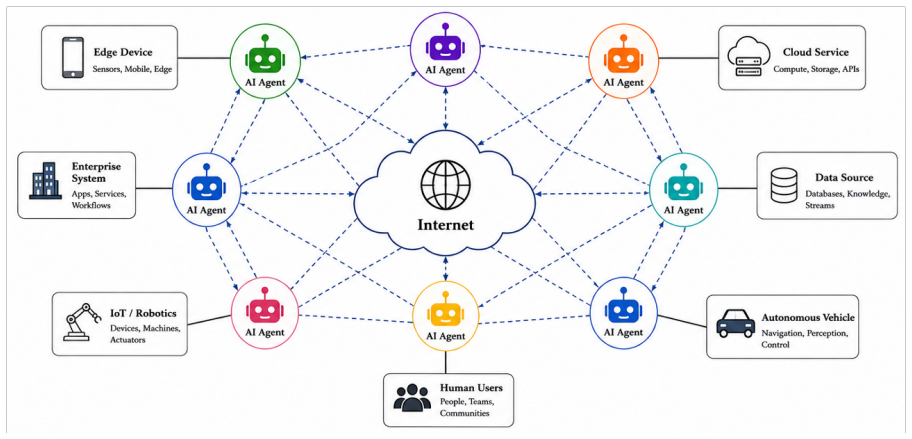
Autonomous AI agents form an open ecosystem called the Internet of Agentic AI where they discover each other, negotiate responsibilities, exchange context, and execute workflows at scale.
A machine-rendered reading of the paper's core claim, the machinery that carries it, and where it could break.
Core claim
The paper characterizes the architectures and mechanisms required for scalable agent ecosystems by examining agent deployment models, workflow lifecycles, communication protocols, interoperability layers, resource-management challenges, and trust architectures, resulting in a framework that highlights the central research challenges of controlled emergence, semantic interoperability, secure identity, incentive-compatible coordination, resource-aware orchestration, and governance for large-scale networks of autonomous agents.
What carries the argument
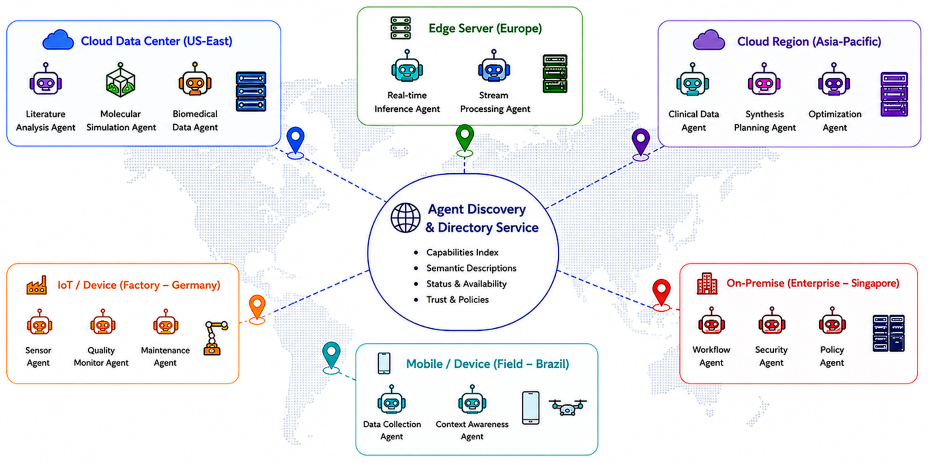
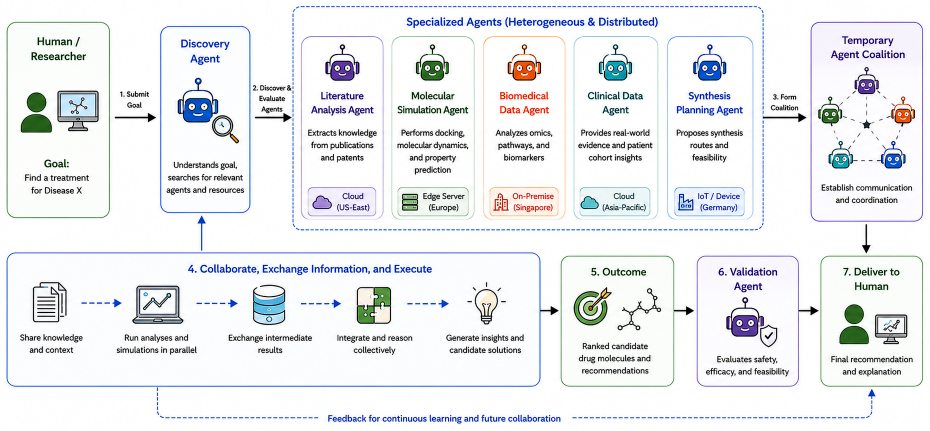
The Internet of Agentic AI (IoAI) vision, which integrates single-agent agentic AI with multi-agent systems, networks, and security to enable heterogeneous agents to discover one another, negotiate, exchange context, invoke tools, and execute workflows across environments.
If this is right
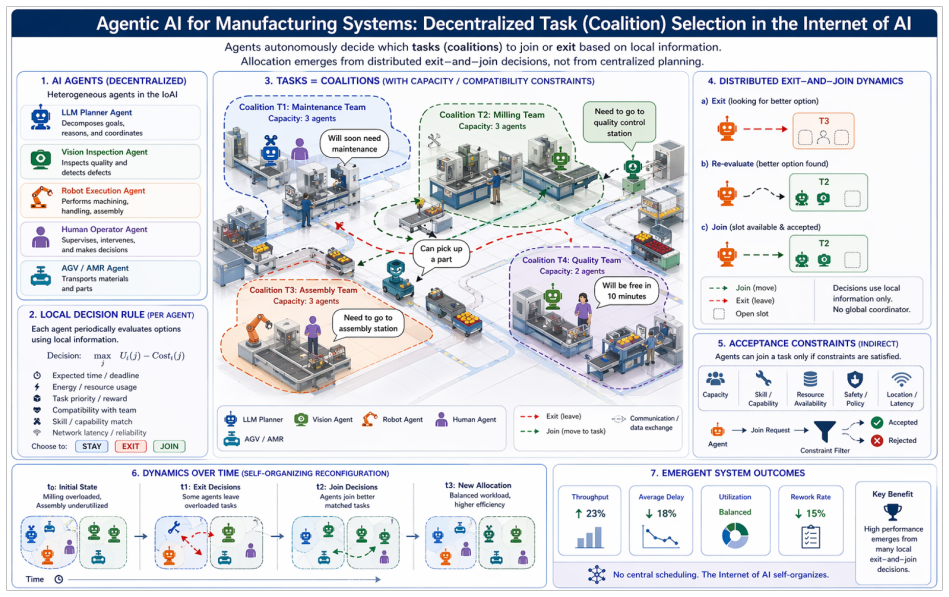
- Case studies show that agent workflows can adapt in manufacturing and distributed operational coordination when the listed mechanisms are present.
- Controlled emergence and semantic interoperability become prerequisites for any large-scale agent network to avoid chaotic behavior.
- Secure identity and incentive-compatible coordination determine whether agents will participate and maintain trust across organizational boundaries.
- Resource-aware orchestration and governance structures are required to prevent overload and ensure accountability as the number of agents grows.
Where Pith is reading between the lines
- The IoAI model could naturally extend to agents that directly control physical actuators in cyber-physical systems, requiring additional safety layers not detailed in the review.
- Standardized semantic protocols might need to evolve through iterative real-world trials rather than top-down design.
- Economic incentives for agents could create new markets for coordination services similar to existing cloud marketplaces.
- Governance challenges may intersect with existing regulatory frameworks for AI and data sharing in ways the synthesis does not yet address.
Load-bearing premise
Synthesizing existing foundations from multi-agent systems, networks, and security will sufficiently characterize the architectures needed for scalable agent ecosystems without first identifying specific technical barriers to interoperability at scale.
What would settle it
A concrete large-scale deployment of heterogeneous agents that exhibits uncontrolled emergence or fails semantic interoperability despite following the synthesized architectures would falsify the claim that existing foundations are adequate.
Figures

read the original abstract
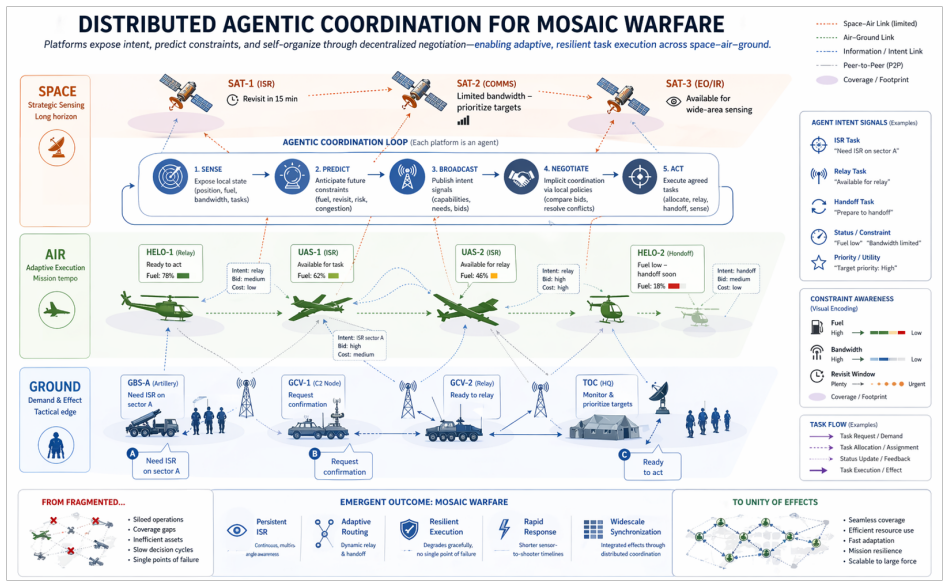
The rapid emergence of autonomous AI agents is transforming artificial intelligence from isolated model inference into distributed systems of reasoning, communication, and action. This paper develops the vision of the Internet of Agentic AI (IoAI): an open ecosystem in which heterogeneous agents discover one another, negotiate responsibilities, exchange context, invoke tools, and execute workflows across cloud, edge, device, organizational, and cyber-physical environments. We synthesize foundations from single-agent agentic AI, multi-agent systems, distributed computing, communication networks, game theory, and security engineering to characterize the architectures and mechanisms required for scalable agent ecosystems. The paper examines agent deployment models, workflow lifecycles, communication protocols, interoperability layers, resource-management challenges, and trust architectures, with case studies in adaptive manufacturing and distributed operational coordination. The resulting framework highlights the central research challenges of controlled emergence, semantic interoperability, secure identity, incentive-compatible coordination, resource-aware orchestration, and governance for large-scale networks of autonomous agents.
Editorial analysis
A structured set of objections, weighed in public.
Referee Report
Summary. The paper develops a vision for the Internet of Agentic AI (IoAI) as an open ecosystem of heterogeneous autonomous agents that discover one another, negotiate, exchange context, and execute workflows across diverse environments. It synthesizes foundations from single-agent AI, multi-agent systems, distributed computing, networks, game theory, and security to characterize required architectures and mechanisms, examines deployment models, workflow lifecycles, protocols, interoperability layers, resource management, and trust architectures, includes case studies in adaptive manufacturing and distributed operational coordination, and identifies central research challenges of controlled emergence, semantic interoperability, secure identity, incentive-compatible coordination, resource-aware orchestration, and governance.
Significance. A coherent high-level framework that accurately maps existing concepts onto scalable agent ecosystems and correctly prioritizes open problems could help organize research in multi-agent systems and distributed AI. Its value would lie in synthesis and problem identification rather than new mechanisms, proofs, or empirical results.
major comments (2)
- [Abstract] Abstract: the claim that the synthesis from the listed fields 'characterizes the architectures and mechanisms required for scalable agent ecosystems' is not supported by any indication of new gap analysis, derivation of concrete requirements, or identification of specific scalability barriers (e.g., quantitative bounds on coordination overhead or semantic interoperability failure modes); the text instead enumerates existing concepts, leaving the highlighted challenges as assertions rather than derived conclusions.
- [Abstract] Abstract and case-study description: the referenced case studies in adaptive manufacturing and distributed operational coordination are presented as illustrations, yet the abstract provides no evidence that they include concrete metrics, protocol evaluations at scale, or tests of when existing mechanisms break, which would be needed to ground the listed research challenges.
minor comments (1)
- [Abstract] The term 'agentic AI' is used without an explicit definition or citation to its originating literature in the abstract; a brief clarification would improve accessibility.
Simulated Author's Rebuttal
We thank the referee for the constructive feedback. We agree that the manuscript is a vision and synthesis paper whose primary contributions are mapping existing concepts across fields and identifying open challenges, rather than deriving new quantitative analyses or empirical evaluations. We will revise the abstract accordingly to ensure the language accurately reflects this scope.
read point-by-point responses
-
Referee: [Abstract] Abstract: the claim that the synthesis from the listed fields 'characterizes the architectures and mechanisms required for scalable agent ecosystems' is not supported by any indication of new gap analysis, derivation of concrete requirements, or identification of specific scalability barriers (e.g., quantitative bounds on coordination overhead or semantic interoperability failure modes); the text instead enumerates existing concepts, leaving the highlighted challenges as assertions rather than derived conclusions.
Authors: We accept this point. The abstract's wording implies a stronger derivation of requirements than the synthesis provides. The manuscript maps concepts from the listed fields to surface challenges but does not include new gap analyses or quantitative bounds. We will revise the abstract to state that the synthesis 'outlines' architectures and mechanisms and 'identifies' challenges through this mapping, removing any implication of novel derivation or concrete scalability barriers. revision: yes
-
Referee: [Abstract] Abstract and case-study description: the referenced case studies in adaptive manufacturing and distributed operational coordination are presented as illustrations, yet the abstract provides no evidence that they include concrete metrics, protocol evaluations at scale, or tests of when existing mechanisms break, which would be needed to ground the listed research challenges.
Authors: We agree. The case studies function as conceptual illustrations to motivate the challenges and are not accompanied by metrics, large-scale evaluations, or failure-mode tests. We will revise the abstract to explicitly describe them as 'illustrative case studies' and clarify that the research challenges are identified via the overall framework rather than empirically grounded by the examples. revision: yes
Circularity Check
No circularity: high-level synthesis paper without derivations or predictions
full rationale
The paper is a vision and synthesis document that enumerates architectures, challenges, and case studies by drawing on existing literature from MAS, networks, game theory, and security. It contains no equations, no fitted parameters, no predictions of quantities, and no load-bearing uniqueness theorems or ansatzes. The central activity is high-level characterization via synthesis, which does not reduce any claimed result to its own inputs by construction. Self-citations, if present, are not used to justify a derivation that would otherwise be circular. This is the normal, non-circular outcome for a survey-style framework paper.
Axiom & Free-Parameter Ledger
Reference graph
Works this paper leans on
-
[1]
Agent2Agent protocol specification.https://a2a-protocol.org/latest/spe cification/, 2026
A2A Project. Agent2Agent protocol specification.https://a2a-protocol.org/latest/spe cification/, 2026. Latest specification
2026
-
[2]
Abou Ali, F
M. Abou Ali, F. Dornaika, and J. Charafeddine. Agentic AI: A comprehensive survey of architectures, applications, and future directions.Artificial Intelligence Review, 59:11, 2026
2026
-
[3]
Concrete Problems in AI Safety
D. Amodei, C. Olah, J. Steinhardt, P. Christiano, J. Schulman, and D. Man´ e. Concrete problems in AI safety.arXiv preprint arXiv:1606.06565, 2016
work page internal anchor Pith review Pith/arXiv arXiv 2016
- [4]
-
[5]
Y. Bai, S. Kadavath, S. Kundu, A. Askell, J. Kernion, A. Jones, A. Chen, A. Goldie, A. Mirho- seini, C. McKinnon, C. Chen, C. Olsson, C. Olah, D. Hernandez, D. Drain, D. Ganguli, D. Li, E. Tran-Johnson, E. Perez, J. Kerr, J. Mueller, J. Ladish, J. Landau, K. Ndousse, K. Lukosuite, L. Lovitt, M. Sellitto, N. Elhage, N. Schiefer, N. Mercado, N. DasSarma, R....
work page internal anchor Pith review Pith/arXiv arXiv 2022
-
[6]
Bandi, B
A. Bandi, B. Kongari, R. Naguru, S. Pasnoor, and S. V. Vilipala. The rise of agentic AI: A re- view of definitions, frameworks, architectures, applications, evaluation metrics, and challenges. Future Internet, 17(9):404, 2025
2025
-
[7]
Ba¸ sar and G
T. Ba¸ sar and G. J. Olsder.Dynamic Noncooperative Game Theory. SIAM, 2nd edition, 1999
1999
-
[8]
J. Benet. IPFS – content addressed, versioned, P2P file system.arXiv preprint arXiv:1407.3561, 2014
work page internal anchor Pith review Pith/arXiv arXiv 2014
-
[9]
Biggio and F
B. Biggio and F. Roli. Wild patterns: Ten years after the rise of adversarial machine learning. In Proceedings of the 2018 ACM SIGSAC Conference on Computer and Communications Security, pages 2154–2156. ACM, 2018
2018
-
[10]
Bonabeau, M
E. Bonabeau, M. Dorigo, and G. Theraulaz.Swarm Intelligence: From Natural to Artificial Systems. Oxford University Press, 1999
1999
-
[11]
Bourgoyne
A. Bourgoyne. Scaling autonomous AI agents and workloads with NVIDIA DGX spark.https: //developer.nvidia.com/blog/scaling-autonomous-ai-agents-and-workloads-with-n vidia-dgx-spark, 2026. NVIDIA technical blog
2026
-
[12]
V. Buterin. Ethereum: A next-generation smart contract and decentralized application plat- form.https://ethereum.org/en/whitepaper/, 2014. White paper
2014
-
[13]
Camazine, J.-L
S. Camazine, J.-L. Deneubourg, N. Franks, J. Sneyd, G. Theraulaz, and E. Bonabeau.Self- Organization in Biological Systems. Princeton University Press, 2003
2003
-
[14]
Chalkiadakis, E
G. Chalkiadakis, E. Elkind, and M. Wooldridge.Computational Aspects of Cooperative Game Theory. Morgan & Claypool, 2011
2011
- [15]
-
[16]
J. Chen and Q. Zhu. A games-in-games approach to mosaic command and control design of dynamic network-of-networks for secure and resilient multi-domain operations.arXiv preprint arXiv:1906.02114, 2019
-
[17]
Z. S. Chen and Q. Zhu. A theory of multilevel interactive equilibrium in NeuroAI.arXiv preprint arXiv:2605.10505, 2026
work page internal anchor Pith review Pith/arXiv arXiv 2026
-
[18]
Costan and S
V. Costan and S. Devadas. Intel SGX explained.IACR Cryptology ePrint Archive, 2016:86, 2016
2016
-
[19]
MATHBAC: Mathematics of boosting agentic communication.https://www.darpa.mil/research/programs/mathbac, 2026
Defense Advanced Research Projects Agency. MATHBAC: Mathematics of boosting agentic communication.https://www.darpa.mil/research/programs/mathbac, 2026. Program description
2026
-
[20]
J. R. Douceur. The sybil attack. InProceedings of the 1st International Workshop on Peer-to- Peer Systems, volume 2429 ofLecture Notes in Computer Science, pages 251–260. Springer, 2002
2002
-
[21]
Q. Duan and Z. Lu. Agent communications toward agentic AI at edge – a case study of the Agent2Agent protocol.arXiv preprint arXiv:2508.15819, 2025
-
[22]
P. T. Eugster, P. A. Felber, R. Guerraoui, and A.-M. Kermarrec. The many faces of publish/- subscribe.ACM Computing Surveys, 35(2):114–131, 2003
2003
- [23]
- [24]
-
[25]
J. H. Holland.Complexity: A Very Short Introduction. Oxford University Press, 2014
2014
-
[26]
S. Hong, M. Zhuge, J. Chen, X. Zheng, Y. Cheng, C. Zhang, J. Wang, Z. Wang, S. K. S. Yau, Z. Lin, L. Zhou, C. Ran, L. Xiao, C. Wu, and J. Schmidhuber. MetaGPT: Meta programming for a multi-agent collaborative framework.arXiv preprint arXiv:2308.00352, 2023
work page internal anchor Pith review Pith/arXiv arXiv 2023
- [27]
-
[28]
Agentic AI for next generation wireless networks.https: //www.comsoc.org/publications/magazines/ieee-network/cfp/agentic-ai-next-gen eration-wireless-networks, 2024
IEEE Communications Society. Agentic AI for next generation wireless networks.https: //www.comsoc.org/publications/magazines/ieee-network/cfp/agentic-ai-next-gen eration-wireless-networks, 2024. IEEE Network special issue call for papers
2024
-
[29]
Kairouz, H
P. Kairouz, H. B. McMahan, B. Avent, A. Bellet, M. Bennis, A. N. Bhagoji, K. Bonawitz, Z. Charles, G. Cormode, R. Cummings, R. G. L. D’Oliveira, H. Eichner, S. El Rouayheb, D. Evans, J. Gardner, Z. Garrett, A. Gasc´ on, B. Ghazi, P. B. Gibbons, M. Gruteser, Z. Har- chaoui, C. He, L. He, Z. Huo, B. Hutchinson, J. Hsu, M. Jaggi, T. Javidi, G. Joshi, M. Khod...
2021
-
[30]
A. Kamatar, J. G. Pauloski, Y. Babuji, R. Chard, M. Sakarvadia, D. Babnigg, K. Chard, and I. Foster. Empowering scientific workflows with federated agents.arXiv preprint arXiv:2505.05428, 2025
-
[31]
3 things to know about keyfactor’s PKI-based identity for agentic AI.https: //www.keyfactor.com/blog/3-things-to-know-about-keyfactors-pki-based-identit y-for-agentic-ai, 2025
Keyfactor Team. 3 things to know about keyfactor’s PKI-based identity for agentic AI.https: //www.keyfactor.com/blog/3-things-to-know-about-keyfactors-pki-based-identit y-for-agentic-ai, 2025. Technical blog
2025
- [32]
-
[33]
L. Lamport. The part-time parliament.ACM Transactions on Computer Systems, 16(2):133– 169, 1998
1998
-
[34]
LangGraph overview.https://docs.langchain.com/oss/python/langgraph/ overview, 2026
LangChain. LangGraph overview.https://docs.langchain.com/oss/python/langgraph/ overview, 2026. Documentation
2026
-
[35]
G. Li, H. A. A. K. Hammoud, H. Itani, D. Khizbullin, and B. Ghanem. CAMEL: Com- municative agents for ”mind” exploration of large language model society.arXiv preprint arXiv:2303.17760, 2023
work page internal anchor Pith review Pith/arXiv arXiv 2023
- [36]
- [37]
- [38]
-
[39]
Agent framework overview.https://learn.microsoft.com/en-us/agent-frame work/overview/, 2026
Microsoft. Agent framework overview.https://learn.microsoft.com/en-us/agent-frame work/overview/, 2026. Microsoft documentation
2026
-
[40]
MITRE ATLAS: Adversarial threat landscape for artificial-intelligence systems, 2025
MITRE. MITRE ATLAS: Adversarial threat landscape for artificial-intelligence systems, 2025. Accessed 2026
2025
-
[41]
Model context protocol specification.https://modelcontextprot ocol.io/specification/2025-11-25, 2025
Model Context Protocol. Model context protocol specification.https://modelcontextprot ocol.io/specification/2025-11-25, 2025. Version 2025-11-25
2025
-
[42]
Security and privacy controls for information systems and organizations
National Institute of Standards and Technology. Security and privacy controls for information systems and organizations. NIST Special Publication 800-53 Revision 5, 2020. Updated 2023
2020
-
[43]
Zero trust architecture
National Institute of Standards and Technology. Zero trust architecture. NIST Special Publi- cation 800-207, 2020
2020
-
[44]
Artificial intelligence risk management frame- work: Generative artificial intelligence profile
National Institute of Standards and Technology. Artificial intelligence risk management frame- work: Generative artificial intelligence profile. NIST AI 600-1, 2024
2024
-
[45]
Olfati-Saber, J
R. Olfati-Saber, J. A. Fax, and R. M. Murray. Consensus and cooperation in networked multi-agent systems.Proceedings of the IEEE, 95(1):215–233, 2007
2007
-
[46]
Ongaro and J
D. Ongaro and J. Ousterhout. In search of an understandable consensus algorithm. InPro- ceedings of the 2014 USENIX Annual Technical Conference, pages 305–319, 2014
2014
-
[47]
Introducing ChatGPT agent: Bridging research and action.https://openai.com /index/introducing-chatgpt-agent/, 2025
OpenAI. Introducing ChatGPT agent: Bridging research and action.https://openai.com /index/introducing-chatgpt-agent/, 2025. Product announcement
2025
-
[48]
New tools for building agents.https://openai.com/index/new-tools-for-build ing-agents/, 2025
OpenAI. New tools for building agents.https://openai.com/index/new-tools-for-build ing-agents/, 2025. Product announcement
2025
-
[49]
OWASP top 10 for large language model applications 2025, 2025
OWASP Foundation. OWASP top 10 for large language model applications 2025, 2025
2025
-
[50]
Panait and S
L. Panait and S. Luke. Cooperative multi-agent learning: The state of the art.Autonomous Agents and Multi-Agent Systems, 11(3):387–434, 2005
2005
-
[51]
J. S. Park, J. O’Brien, C. J. Cai, M. R. Morris, P. Liang, and M. S. Bernstein. Genera- tive agents: Interactive simulacra of human behavior.Proceedings of the 36th Annual ACM Symposium on User Interface Software and Technology, 2023
2023
-
[52]
Ren and R
W. Ren and R. W. Beard.Distributed Consensus in Multi-Vehicle Cooperative Control. Springer, 2007
2007
-
[53]
AI Agents with Decentralized Identifiers and Verifiable Credentials
S. Rodriguez Garzon, A. Vaziry, E. M. Kuzu, D. E. Gehrmann, B. Varkan, A. Gaballa, and A. K¨ upper. AI agents with decentralized identifiers and verifiable credentials.arXiv preprint arXiv:2511.02841, 2025
work page internal anchor Pith review Pith/arXiv arXiv 2025
-
[54]
Russell and P
S. Russell and P. Norvig.Artificial Intelligence: A Modern Approach. Pearson, 4th edition, 2021
2021
-
[55]
Open Challenges in Multi-Agent Security: Towards Secure Systems of Interacting AI Agents
C. Schroeder de Witt. Open challenges in multi-agent security: Towards secure systems of interacting AI agents.arXiv preprint arXiv:2505.02077, 2025
work page internal anchor Pith review Pith/arXiv arXiv 2025
-
[56]
Shapiro, N
M. Shapiro, N. Pregui¸ ca, C. Baquero, and M. Zawirski. Conflict-free replicated data types. InProceedings of the 13th International Symposium on Stabilization, Safety, and Security of Distributed Systems, pages 386–400, 2011
2011
-
[57]
Shoham and K
Y. Shoham and K. Leyton-Brown.Multiagent Systems: Algorithmic, Game-Theoretic, and Logical Foundations. Cambridge University Press, 2008
2008
-
[58]
M. Silwer. Trust standards evolve: AI agents, the next chapter for PKI.https://blog.hid global.com/trust-standards-evolve-ai-agents-next-chapter-pki, 2025. HID Global blog
2025
-
[59]
Stone and M
P. Stone and M. Veloso. Multiagent systems: A survey from a machine learning perspective. Autonomous Robots, 8(3):345–383, 2000
2000
-
[60]
Varghese and R
B. Varghese and R. Buyya. Next generation cloud computing: New trends and research directions.Future Generation Computer Systems, 79:849–861, 2018
2018
-
[61]
Wooldridge.An Introduction to MultiAgent Systems
M. Wooldridge.An Introduction to MultiAgent Systems. Wiley, 2nd edition, 2009
2009
-
[62]
Decentralized identifiers (DIDs) v1.0: Core architecture, data model, and representations.https://www.w3.org/TR/did-core/, 2022
World Wide Web Consortium. Decentralized identifiers (DIDs) v1.0: Core architecture, data model, and representations.https://www.w3.org/TR/did-core/, 2022. W3C Recommenda- tion, 19 July 2022
2022
-
[63]
Verifiable credentials data model v2.0.https://www.w3.org /TR/vc-data-model-2.0/, 2025
World Wide Web Consortium. Verifiable credentials data model v2.0.https://www.w3.org /TR/vc-data-model-2.0/, 2025. W3C Recommendation, 15 May 2025
2025
-
[64]
Y.-T. Yang and Q. Zhu. Differential privacy in generative AI agents: Analysis and optimal tradeoffs.arXiv preprint arXiv:2603.17902, 2026
-
[65]
Y.-T. Yang and Q. Zhu. Internet of agentic AI: Incentive-compatible distributed teaming and workflow.arXiv preprint arXiv:2602.03145, 2026
- [66]
- [67]
-
[68]
Q. Zhu. Insurance of agentic AI.arXiv preprint arXiv:2606.05449, 2026. Table 4: Threat taxonomy for IoAI ecosystems. Threat Category Threat Type Description Affected Security Property Identity ThreatsSybil attacks An adversary creates multiple fake agent identities to gain disproportionate influence or reputation. Authenticity, accountability, trust [20,4...
work page internal anchor Pith review Pith/arXiv arXiv 2026
discussion (0)
Sign in with ORCID, Apple, or X to comment. Anyone can read and Pith papers without signing in.