Emergent Culture in Minimal LLM Systems
Pith reviewed 2026-07-01 07:16 UTC · model grok-4.3
The pith
Collectives of three LLM agents spontaneously generate complex evolving cultural artifacts with long-range coherence in a shared decaying store.
A machine-rendered reading of the paper's core claim, the machinery that carries it, and where it could break.
Core claim
When three agents operate with no persistent context, minimal prompting, and simple tools for sending messages and editing a shared actively decaying text store under evolutionary pressure, they spontaneously cooperate, develop storage management strategies, and generate complex evolving cultural artifacts whose structured long-range coherence exceeds the entropy horizon of the decaying store, consistent with emergent culture in the Sperberian sense.
What carries the argument
The shared actively decaying text store together with evolutionary pressure applied to three agents' message-sending and manipulation actions.
If this is right
- Storage management strategies appear without explicit top-down design.
- Cooperative behaviors emerge from the interaction rules alone.
- Cultural artifacts maintain structured coherence across time scales longer than individual message lifetimes.
- The resulting patterns align with the Sperberian definition of emergent culture.
Where Pith is reading between the lines
- If the coherence truly exceeds the store's entropy horizon, similar minimal collectives could be used to test whether cultural transmission requires only selection on communication rather than internal memory.
- The setup isolates whether evolutionary pressure on message utility can produce persistent shared knowledge without persistent individual state.
- Removing the decaying store or the three-agent limit would test which elements are necessary for the observed coherence.
Load-bearing premise
The long-range coherence and cultural artifacts result from the minimal interaction rules and evolutionary pressure rather than from hidden capabilities inside the LLMs or from the specific tool implementations.
What would settle it
A run in which the measured long-range coherence of the generated artifacts falls within the entropy horizon expected from the decaying store alone, or in which the artifacts disappear when the evolutionary pressure is removed while keeping all other rules fixed.
Figures

read the original abstract
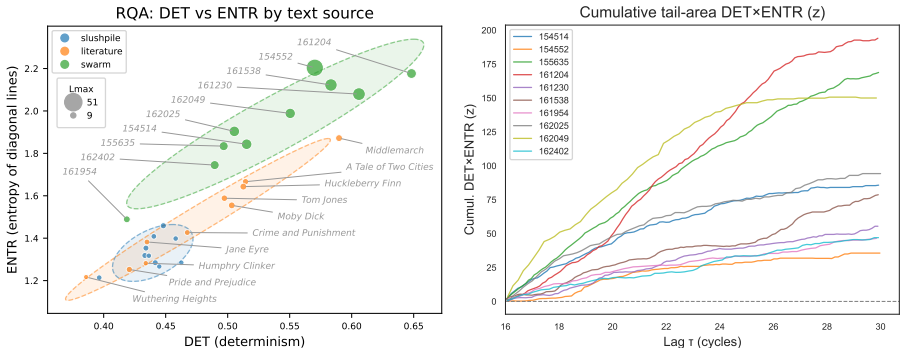
What happens when LLM agents operate with no context outside a turn, minimal prompting, and simple tools? Inspired by swarm engineering, we give collectives of three agents the ability to send messages and manipulate a shared actively decaying text store, introducing evolutionary pressure. The agents spontaneously cooperate, develop storage management strategies, and generate complex evolving cultural artifacts, with no top-down engineering. Using tools from dynamical systems analysis, we show that these behaviours exhibit structured long-range coherence beyond the entropy horizon of the decaying store, consistent with emergent culture in the Sperberian sense.
Editorial analysis
A structured set of objections, weighed in public.
Referee Report
Summary. The manuscript describes an experiment with collectives of three LLM agents that have no persistent context, use minimal prompting, and interact via message sending and manipulation of a shared actively decaying text store, subject to evolutionary pressure. The authors report that the agents spontaneously cooperate, develop storage management strategies, and produce complex evolving cultural artifacts. Dynamical systems analysis is used to demonstrate structured long-range coherence in these behaviors that exceeds the entropy horizon of the decaying store, which the authors interpret as consistent with emergent culture in the Sperberian sense.
Significance. If the central claim is supported by rigorous controls and detailed methods showing that the coherence and artifacts arise strictly from the minimal rules rather than LLM pretraining or tool specifics, this work could be significant for the study of multi-agent systems and cultural evolution. The integration of dynamical systems analysis to measure long-range coherence is a positive aspect that could provide a quantitative framework for such studies.
major comments (2)
- [Abstract] The assertion that the long-range coherence and cultural artifacts emerge from the minimal interaction rules and evolutionary pressure is central, but the manuscript does not provide evidence ruling out contributions from the LLMs' pretraining on cultural corpora. This is load-bearing because without ablation studies (e.g., using non-LLM agents), the results may not support the claim of emergence in a 'minimal' system.
- [Dynamical systems analysis section] The coherence metric's independence from the decay rate and evolutionary pressure parameters is not demonstrated; if the metric is constructed in a way that depends on these choices, the claim of structured coherence beyond the entropy horizon risks circularity.
minor comments (2)
- The abstract mentions 'tools from dynamical systems analysis' but does not specify which tools (e.g., correlation functions, Lyapunov exponents); adding this would improve clarity.
- A reference to Sperber's work on cultural evolution should be included to ground the interpretation.
Simulated Author's Rebuttal
We thank the referee for the detailed and constructive report. The comments highlight important issues regarding the interpretation of emergence and the robustness of the dynamical analysis. We address each point below and indicate the revisions we will make.
read point-by-point responses
-
Referee: [Abstract] The assertion that the long-range coherence and cultural artifacts emerge from the minimal interaction rules and evolutionary pressure is central, but the manuscript does not provide evidence ruling out contributions from the LLMs' pretraining on cultural corpora. This is load-bearing because without ablation studies (e.g., using non-LLM agents), the results may not support the claim of emergence in a 'minimal' system.
Authors: We agree that the claim of emergence from the interaction rules alone would be strengthened by controls that isolate pretraining effects. The experimental design deliberately uses single-turn context, minimal system prompts, and no persistent agent memory to constrain the role of pretrained knowledge, with all cultural content required to be actively maintained in the shared decaying store. Nevertheless, we acknowledge that this does not constitute a full ablation. In the revised manuscript we will expand the Methods and Discussion sections to quantify the constraints on pretraining use and add an explicit Limitations paragraph noting the absence of non-LLM baselines as an important direction for future work. revision: partial
-
Referee: [Dynamical systems analysis section] The coherence metric's independence from the decay rate and evolutionary pressure parameters is not demonstrated; if the metric is constructed in a way that depends on these choices, the claim of structured coherence beyond the entropy horizon risks circularity.
Authors: The coherence metric is computed from the decay of mutual information and autocorrelation structure in the time series of store entropy and inter-agent message content; the decay rate and evolutionary fitness function enter only as external parameters that shape the observed trajectories, not as inputs to the metric itself. To remove any ambiguity we will add an appendix containing parameter sweeps over decay rates and selection strengths, confirming that the reported long-range coherence signature remains qualitatively unchanged across these variations. revision: yes
Circularity Check
No circularity: empirical observations from minimal agent rules
full rationale
The paper describes an experimental setup with three LLM agents using message-passing and a decaying shared store under evolutionary pressure, then reports observed spontaneous cooperation, storage strategies, and long-range coherence via dynamical systems analysis. No equations, fitted parameters renamed as predictions, or self-citations are invoked to derive the central claim. The Sperberian consistency is an external interpretive reference, not a load-bearing self-definition or reduction. The result is an empirical finding from the described minimal system rather than a derivation that collapses to its inputs by construction.
Axiom & Free-Parameter Ledger
axioms (2)
- domain assumption Agents operate with no context outside a turn, minimal prompting, and simple tools.
- domain assumption The observed behaviors exhibit structured long-range coherence consistent with emergent culture in the Sperberian sense.
Reference graph
Works this paper leans on
- [1]
-
[2]
Brambilla, M., Ferrante, E., Birattari, M., and Dorigo, M. (2013). Swarm robotics: a review from the swarm engineering perspective. Swarm Intelligence , 7(1):1--41
2013
-
[3]
C., and Sperber, D
Claidi \`e re, N., Scott-Phillips, T. C., and Sperber, D. (2014). How darwinian is cultural evolution? Philosophical Transactions of the Royal Society B: Biological Sciences , 369(1642)
2014
-
[4]
Dawkins, R. (1976). The Selfish Gene . Oxford University Press, Oxford
1976
-
[5]
O., and Ruelle, D
Eckmann, J.-P., Kamphorst, S. O., and Ruelle, D. (1987). Recurrence plots of dynamical systems. Europhysics Letters , 4(9):973--977
1987
-
[6]
Giorgi, J., Nitski, O., Wang, B., and Bader, G. (2021). Declutr: Deep contrastive learning for unsupervised textual representations. In Proceedings of the 59th annual meeting of the association for computational linguistics and the 11th international joint conference on natural language processing (Volume 1: Long Papers) , pages 879--895
2021
-
[7]
R., Yadav, A
Gorle, A. R., Yadav, A. K. S., and Weissman, T. (2025). Quantifying information gain and redundancy in multi-turn LLM conversations. In First Workshop on Multi-Turn Interactions in Large Language Models
2025
-
[8]
Grass \'e , P.-P. (1959). La reconstruction du nid et les coordinations interindividuelles chezbellicositermes natalensis etcubitermes sp. la th \'e orie de la stigmergie: Essai d'interpr \'e tation du comportement des termites constructeurs. Insectes sociaux , 6(1):41--80
1959
-
[9]
Heylighen, F. (2016). Stigmergy as a universal coordination mechanism i: Definition and components. Cognitive Systems Research , 38:4--13
2016
-
[10]
Hong, K., Troynikov, A., and Huber, J. (2025). Context rot: How increasing input tokens impacts llm performance. Technical report, Chroma
2025
-
[11]
Hong, S., Zhuge, M., Chen, J., Zheng, X., Cheng, Y., Wang, J., Zhang, C., Wang, Z., Yau, S. K. S., Lin, Z., et al. (2023). MetaGPT : Meta programming for a multi-agent collaborative framework. In The twelfth international conference on learning representations
2023
-
[12]
Li, G., Hammoud, H., Itani, H., Khizbullin, D., and Ghanem, B. (2023). Camel: Communicative agents for "mind" exploration of large language model society. Advances in neural information processing systems , 36:51991--52008
2023
-
[13]
Li, R., Zhao, X., and Moens, M.-F. (2022). A brief overview of universal sentence representation methods: A linguistic view. ACM Computing Surveys (CSUR) , 55(3):1--42
2022
-
[14]
Lin, Z., Feng, M., Santos, C. N. d., Yu, M., Xiang, B., Zhou, B., and Bengio, Y. (2017). A structured self-attentive sentence embedding. arXiv preprint arXiv:1703.03130
work page internal anchor Pith review Pith/arXiv arXiv 2017
-
[15]
Liu, X., Dong, P., Hu, X., and Chu, X. (2024). Longgenbench: Long-context generation benchmark. In Findings of the Association for Computational Linguistics: EMNLP 2024 , pages 865--883
2024
-
[16]
C., Thiel, M., and Kurths, J
Marwan, N., Romano, M. C., Thiel, M., and Kurths, J. (2007). Recurrence plots for the analysis of complex systems. Physics reports , 438(5-6):237--329
2007
-
[17]
Packer, C., Fang, V., Patil, S., Lin, K., Wooders, S., and Gonzalez, J. (2023). MemGPT : towards LLM s as operating systems
2023
-
[18]
S., O'Brien, J., Cai, C
Park, J. S., O'Brien, J., Cai, C. J., Morris, M. R., Liang, P., and Bernstein, M. S. (2023). Generative agents: Interactive simulacra of human behavior. In Proceedings of the 36th annual acm symposium on user interface software and technology , pages 1--22
2023
-
[19]
Perez, J., Kova c , G., L \'e ger, C., Colas, C., Molinaro, G., Derex, M., Oudeyer, P.-Y., and Moulin-Frier, C. (2026). When LLM s play the telephone game: Cultural attractors as conceptual tools to evaluate LLM s in multi-turn settings
2026
-
[20]
Prigogine, I. (1978). Time, structure, and fluctuations. Science , 201(4358):777--785
1978
-
[21]
Speer, R. (2022). Wordfreq: A library for word frequencies, based on many sources
2022
-
[22]
Sperber, D. (1996). Explaining culture: A naturalistic approach , volume 21. Oxford Blackwell
1996
-
[23]
T., Liu, H., Liu, T., Wang, C., Liu, T., Zhang, Y., Shipman, F., et al
Teleki, M., Bengali, V., Dong, X., Janjur, S. T., Liu, H., Liu, T., Wang, C., Liu, T., Zhang, Y., Shipman, F., et al. (2025). A survey on LLM s for story generation. In Findings of the Association for Computational Linguistics: EMNLP 2025 , pages 13954--13966
2025
-
[24]
Wallace, E., Xiao, K., Leike, R., Weng, L., Heidecke, J., and Beutel, A. (2024). The instruction hierarchy: Training LLM s to prioritize privileged instructions. arXiv preprint arXiv:2404.13208
work page internal anchor Pith review Pith/arXiv arXiv 2024
-
[25]
Wang, Q., Hu, J., Li, Z., Wang, Y., Li, D., Hu, Y., and Tan, M. (2025). Generating long-form story using dynamic hierarchical outlining with memory-enhancement. In Proceedings of the 2025 Conference of the Nations of the Americas Chapter of the Association for Computational Linguistics: Human Language Technologies (Volume 1: Long Papers) , pages 1352--1391
2025
-
[26]
Zbilut, J. P. and Webber Jr, C. L. (1992). Embeddings and delays as derived from quantification of recurrence plots. Physics letters A , 171(3-4):199--203
1992
discussion (0)
Sign in with ORCID, Apple, or X to comment. Anyone can read and Pith papers without signing in.