REVIEW 2 major objections 6 minor 25 references
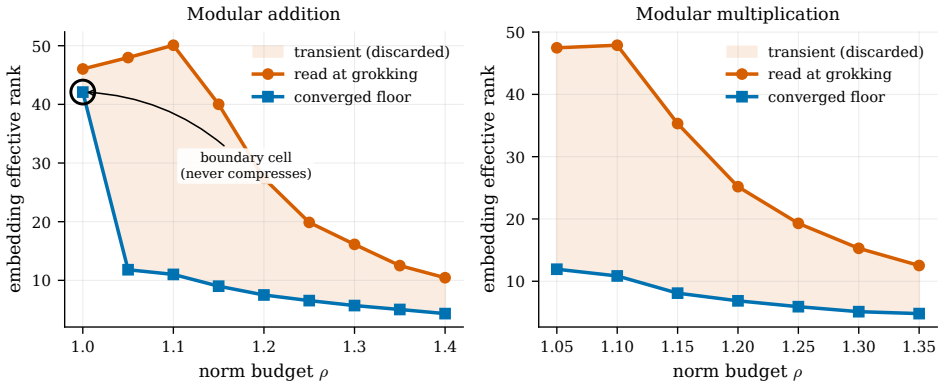
Reading embedding effective rank at the grokking transition overstates the converged circuit by several fold, because compression keeps going long after accuracy jumps.
Reviewed by Pith at T0; open to challenge. T0 means a machine referee read the full paper against a public rubric. the ladder, T0–T4 →
T0 review · grok-4.5
2026-07-11 00:45 UTC pith:CBPNUM3C
load-bearing objection Solid measurement paper: at-grok rank is a real transient, compression lags by ~T_grok, LayerNorm sets the lag size, and they ship a usable audit with adversarial tests and self-corrections. the 2 major comments →
At-Grok Is Not Converged:A Measurement-Validity Audit for Grokking Representation Metrics
The pith
A machine-rendered reading of the paper's core claim, the machinery that carries it, and where it could break.
Core claim
On modular arithmetic, a network’s embedding keeps compressing for tens of thousands of steps after it has already generalized. A value of embedding effective rank read at the grokking transition is therefore a transient: it overstates the converged floor by 3–5× on an MLP (and hides which cells compress) and by 1.3–1.5× on a transformer trained to true convergence. Compression lags the accuracy transition by an amount of order T_grok rather than coinciding with it, and the size of that lag is controlled by the normalization scheme—specifically, LayerNorm defers most of the compression past the grok step.
What carries the argument
The compression-clock audit: two clocks T_grok (first step test accuracy crosses the grokking threshold) and T_compress (first post-onset step at which the representation metric settles near its plateaued floor), plus a boundary gate, a floor-plateau check, a censoring flag, and the summary quantity frac-pre (fraction of total rank drop already completed by the grok step). Together they decide when a transition-time reading can be trusted.
Load-bearing premise
That the spectral effective rank of the embedding (or related spectral measures) is a faithful proxy for the representational compression that matters, so dating when that rank reaches its floor is the same as dating when the generalizing circuit has settled.
What would settle it
Train the same modular models past the accuracy jump, log embedding effective rank (or participation ratio / stable rank) to a true plateau, and check whether the at-grok value still sits several-fold above the floor and whether T_compress still lags T_grok by order T_grok; if the two clocks coincide and the at-grok value already equals the floor, the central claim fails.
Editorial analysis
A structured set of objections, weighed in public.
Referee Report
Summary. The paper argues that, on modular arithmetic, embedding effective rank read at the grokking transition is a transient: it overstates the long-train floor by ~3–5× on a modular MLP (and erases which norm-budget cells compress) and by ~1.3–1.5× on a transformer trained to convergence. Separately, rank compression lags the accuracy transition by an amount of order T_grok (≥10^4 steps) rather than coinciding with it. A one-variable free-decay ablation (MLP vs LayerNorm-free transformer vs the same transformer with LayerNorm) shows that LayerNorm moves frac-pre (fraction of rank compression already done by T_grok) from 0.87 to 0.25 and enlarges the lag; a pre-registered RMSNorm-on-embedding control rejects per-token scale invariance as the mechanism. The authors package an operational audit (T_grok vs T_compress, boundary gate, censoring flag, floor-plateau check, order-statistic-backed verdicts) with an adversarial suite and a third-party adapter, and report a secondary MLP-only “depth law” as a negative generality result (fails on a transformer; sign flips under free weight decay).
Significance. If the empirical claims hold—and the multi-task, multi-protocol, multi-architecture evidence plus self-correction and pre-registration make that plausible—this is a useful measurement-validity contribution to the grokking literature. The field increasingly reads representation structure at transition-time checkpoints; documenting a large, architecture-modulated transient and lag for a standard spectral metric, and shipping a tested procedure that refuses undefined orderings, is more valuable than another unguarded complexity curve. Explicit strengths: (i) separation of a measurement hazard from a timing claim with a named referent (Yunis et al.); (ii) pre-registered negative control on scale invariance; (iii) self-correction of an earlier small-grid “one-clock” reading; (iv) adversarial suite that caught a false-confidence regression; (v) released analyzer, adapter, sample data, and figure scripts. The secondary depth-law is correctly demoted rather than oversold.
major comments (2)
- [Abstract / Sec. 3 / Sec. 8] Abstract and §1 frame the contribution as an audit for “grokking representation metrics,” but the operational clock (Sec. 3: T_compress = first post-onset step within ε of a final-plateau floor) assumes a quantity that falls and settles. The paper itself documents that other representation quantities move the opposite way across the same transition (Fourier circuit-synchronization leads; H1 persistence rises; §2, §8, [19,7]). Metric-agnostic checks in §4 cover only participation ratio and stable rank—same spectral family. For the toolkit claim to match the title, the manuscript should state as a hard precondition (in the abstract takeaways and in the analyzer contract) that the audited metric must be monotone-compressing toward a floor, and that rising clocks require a dual definition; otherwise third-party use on PH/Fourier will silently mis-date.
- [Abstract / Sec. 6 / Sec. 7] The abstract and contribution bullets report the LayerNorm frac-pre shift 0.87→0.25 and the associated lag enlargement as a main positive finding, but §6 explicitly scopes that harness as low-powered (few seeds, 6×10^4-step budget) and notes that the dramatic ~3.2× LayerNorm transient is not the well-powered number (Sec. 7 gives 1.3–1.5× on the embedding). The direction is corroborated by Sec. 7’s lag/T_grok≈0.63, which is enough for a qualitative mechanism claim, but the headline coefficients in the abstract should carry the same power caveat already present in the body, or be replaced by the better-powered transformer lag figure, so the central positive result is not overstated relative to the evidence tier the authors themselves assign.
minor comments (6)
- [Table 1 / Sec. 2] Table 1’s “coinc.” for Yunis et al. is fair as a reading of their claim, but a short footnote clarifying that their simultaneous low-rank discovery is across weight matrices (not specifically the embedding) would reduce the risk of overstating the correction.
- [Sec. 3 / Appendix B] Appendix B Table 3: the lag/T_grok column uses ratio-of-medians while Table 2 uses median-of-ratios; the footnote explains the ~0.04 discrepancy, but putting both definitions once in Sec. 3 would help readers who only skim the main text.
- [Sec. 4 / Sec. 6 / Fig. 4] Figure 4C’s second late collapse is important for the floor-plateau check; a one-sentence pointer in the Sec. 4 “denominator can also mislead” paragraph to the exact floor-plateau criterion used by the analyzer would make the guard reproducible without reading the code.
- [Sec. 7 / Fig. 6] Sec. 7: “only 16 of 21 clamp cells and 14 of 18 free-decay cells reach 0.90” is appropriately flagged; consider stating in the figure captions for Fig. 6 how many seeds underlie each median so the generalization check’s power is visible at a glance.
- [Title / Figs. 1–3] Typos/style: title missing space after the colon (“Converged:A”); occasional “½” in figure axis labels appears to be a ρ rendering artifact in the manuscript text dump—verify in the camera-ready figures.
- [References] References include several 2026 arXiv items and the authors’ own related preprints [24,25]; ensure citation dates and versions are stable at camera-ready, and that [25] is cited in the main text if it is load-bearing for the spectral-entropy framing.
Circularity Check
No significant circularity: operational clocks measure empirical lag and transient; self-citations are complementary, not load-bearing.
full rationale
The paper’s central claims are empirical measurement facts about embedding (and related spectral) effective rank under long training: the at-grok value overstates the converged floor, compression lags T_grok by order T_grok, and LayerNorm moves frac-pre. T_grok (first step with median test accuracy ≥0.9) and T_compress (first post-onset step within ε of the plateaued floor) are independent operational definitions; the lag is not forced by construction—the adversarial suite includes compression-before-grok, censoring, high-floor boundary, and rebound cases, and the analyzer can decline ordering or return partially-separated/large-lag verdicts. Frac-pre is a descriptive ratio of observed ranks, not a fitted parameter renamed as a prediction. The secondary MLP depth law is self-falsified by pre-registered architecture and protocol tests rather than protected. Self-citations to the authors’ norm-separation delay law [24] are explicitly scoped as complementary (when grokking happens vs. whether a transition-time metric has converged) and as a future scaling check, not as premises that force the present lag or transient. No uniqueness theorem, ansatz smuggled via self-citation, or self-definitional reduction of a claimed first-principles result is present. The work is self-contained against its own multi-architecture/protocol runs, boundary/floor-plateau gates, and released adversarial suite.
Axiom & Free-Parameter Ledger
free parameters (5)
- compression tolerance ε =
0.10 (default)
- boundary drop-threshold (gate thr) =
0.25
- floor-averaging window (floor frac) =
0.10
- grokking accuracy threshold =
0.90
- norm-budget clamp values ρ =
ρ ∈ [1.00,1.40] (MLP); [0.9,1.4] (transformer)
axioms (4)
- domain assumption Variance-normalized spectral-entropy effective rank of a weight matrix is a valid proxy for representational complexity/compression in grokking circuits.
- domain assumption The global parameter-norm clamp ρ∥W∥_c is a valid control knob that isolates post-grok representation dynamics without changing the generalizing solution class.
- ad hoc to paper T_grok = first step with median test accuracy ≥ threshold; T_compress = first post-onset step within ε of the final-plateau floor.
- domain assumption Modular arithmetic (p=59) with two-layer MLP / one-layer attention is a representative setting for studying grokking representation dynamics.
invented entities (2)
-
frac-pre (fraction of embedding-rank compression completed by the grok step)
independent evidence
-
compression-clock audit (T_grok / T_compress with boundary gate, censoring flag, floor-plateau check)
independent evidence
read the original abstract
On modular arithmetic, a network's embedding keeps compressing for tens of thousands of steps after it has already generalized. Reading effective rank at the grokking transition overstates the converged value by 3-5x on an MLP, and by 1.3-1.5x on a transformer trained to convergence; on the MLP it also erases which cells compress at all. Compression lags the accuracy transition by an amount on the order of the time-to-grok, at least 10,000 steps, rather than coinciding with it. A one-variable ablation shows what sets the lag size: adding LayerNorm to an otherwise identical transformer moves the fraction of compression done by the grok step from 0.87 to 0.25, and a pre-registered control rules out scale invariance as the mechanism. We package this as an audit that separates onset from compression, flags censoring, excludes boundary cells that never fully generalize, and checks that the reference floor has plateaued, with an adversarial suite that caught a false-confidence bug in our own branch. A secondary, MLP-specific depth law linking norm budget to converged floor fails a generality test on a transformer and flips sign under free weight decay. Code and the toolkit are released.
Figures



Reference graph
Works this paper leans on
-
[1]
Grokking: Generalization Beyond Overfitting on Small Algorithmic Datasets
A. Power, Y. Burda, H. Edwards, I. Babuschkin, V. Misra. Grokking: Generalization beyond overfitting on small algorithmic datasets.arXiv:2201.02177, 2022
work page internal anchor Pith review Pith/arXiv arXiv 2022
-
[2]
Z. Liu, E. J. Michaud, M. Tegmark. Omnigrok: Grokking beyond algorithmic data.ICLR, 2023. arXiv:2210.01117
work page internal anchor Pith review Pith/arXiv arXiv 2023
-
[3]
Explaining grokking through circuit efficiency
V. Varma, R. Shah, Z. Kenton, J. Kram´ ar, R. Kumar. Explaining grokking through circuit efficiency. arXiv:2309.02390, 2023
work page internal anchor Pith review Pith/arXiv arXiv 2023
-
[4]
Grokking as the Transition from Lazy to Rich Training Dynamics
T. Kumar, B. Bordelon, S. J. Gershman, C. Pehlevan. Grokking as the transition from lazy to rich training dynamics.ICLR, 2024.arXiv:2310.06110
work page internal anchor Pith review Pith/arXiv arXiv 2024
- [5]
-
[6]
The Complexity Dynamics of Grokking
B. DeMoss, S. Sapora, J. Foerster, N. Hawes, I. Posner. The complexity dynamics of grokking. arXiv:2412.09810;Physica D, 2025
work page internal anchor Pith review Pith/arXiv arXiv 2025
-
[7]
Y. Tang, Q. Wang, I. Garc´ ıa-Redondo, A. Monod. Topological signatures of grokking.arXiv:2605.06352, 2026
work page internal anchor Pith review Pith/arXiv arXiv 2026
-
[8]
Approaching Deep Learning through the Spectral Dynamics of Weights
D. Yunis, K. K. Patel, S. Wheeler, P. Savarese, G. Vardi, K. Livescu, M. Maire, M. R. Walter. Approach- ing deep learning through the spectral dynamics of weights.arXiv:2408.11804, 2024
work page internal anchor Pith review Pith/arXiv arXiv 2024
-
[9]
Mechanistic Insights into Grokking from the Embedding Layer
H. AlQuabeh, V. Bojkovi´ c, M. Nwadike, K. Inui. Mechanistic insights into grokking from the embedding layer.arXiv:2505.15624, 2025
work page internal anchor Pith review Pith/arXiv arXiv 2025
-
[10]
Measuring Sharpness in Grokking
J. Miller, P. Gleeson, C. O’Neill, T. Bui, N. Levi. Measuring sharpness in grokking.arXiv:2402.08946, 2024
work page internal anchor Pith review Pith/arXiv arXiv 2024
-
[11]
Z. Wang, Y. Ying, T. Kanamori. Distributional spectral diagnostics for localizing grokking transitions. arXiv:2605.08237, 2026
work page internal anchor Pith review Pith/arXiv arXiv 2026
-
[12]
L. Verma. Weight decay regimes in grokking transformers: cheap online diagnostics.arXiv:2605.20441, 2026
work page internal anchor Pith review Pith/arXiv arXiv 2026
-
[13]
Y. Xu. Early-warning signals of grokking via loss-landscape geometry.arXiv:2602.16967, 2026. 21
work page internal anchor Pith review Pith/arXiv arXiv 2026
-
[14]
Y. Xu. The geometry of multi-task grokking: transverse instability, superposition, and weight decay phase structure.arXiv:2602.18523, 2026
work page internal anchor Pith review Pith/arXiv arXiv 2026
-
[15]
P. Wang. Grokking as dimensional phase transition in neural networks.arXiv:2604.04655, 2026
work page internal anchor Pith review Pith/arXiv arXiv 2026
- [16]
-
[17]
O. Roy, M. Vetterli. The effective rank: a measure of effective dimensionality.EUSIPCO, 2007
work page 2007
-
[18]
B. C. A. Brown, J. Juravsky, A. L. Caterini, G. Loaiza-Ganem. Relating regularization and gener- alization through the intrinsic dimension of activations.NeurIPS 2022 Workshop on Optimization for Machine Learning (OPT2022), 2022.arXiv:2211.13239
work page internal anchor Pith review Pith/arXiv arXiv 2022
-
[19]
Circuit Synchronization Precedes Generalization: A Causal Precursor to Grokking
A. Sivasankar. Circuit synchronization precedes generalization: a causal precursor to grokking. arXiv:2606.12966, 2026
work page internal anchor Pith review Pith/arXiv arXiv 2026
-
[20]
S. Golwala. ILDR: geometric early detection of grokking.arXiv:2604.20923, 2026
work page internal anchor Pith review Pith/arXiv arXiv 2026
- [21]
-
[22]
M. Li. Low-rank decay for grokking in scale-invariant transformers: a spectral-geometric view. arXiv:2606.04405, 2026
work page internal anchor Pith review Pith/arXiv arXiv 2026
-
[23]
I. T. Ersoy, K. Wiesner. Noise-driven escape from metastable phases explains grokking in deep neural networks.HiLD Workshop, 2026.arXiv:2606.17120
work page internal anchor Pith review Pith/arXiv arXiv 2026
-
[24]
X. K. Truong, Q. H. Truong, D. T. Luu, T. D. Phan. The norm-separation delay law of grokking: a first-principles theory of delayed generalization.arXiv:2603.13331, 2026
work page internal anchor Pith review Pith/arXiv arXiv 2026
-
[25]
X. K. Truong, Q. H. Truong, D. T. Luu, T. D. Phan. Spectral entropy collapse as an empirical signature of delayed generalisation in grokking.arXiv:2604.13123, 2026. 22 A The norm-budget depth law (MLP-specific, self-falsified) This appendix collects the secondary observation that the norm budget sets the depth of compres- sion on the modular MLP, and the ...
work page internal anchor Pith review Pith/arXiv arXiv 2026
discussion (0)
Sign in with ORCID, Apple, or X to comment. Anyone can read and Pith papers without signing in.