Assessment of the Mass Loss and Radius Change of 3I/ATLAS Based on Observed Production Rates
Pith reviewed 2026-06-28 16:02 UTC · model grok-4.3
The pith
3I/ATLAS lost between 1.05 and 6.56 meters of its surface during its passage through the Solar System.
A machine-rendered reading of the paper's core claim, the machinery that carries it, and where it could break.
Core claim
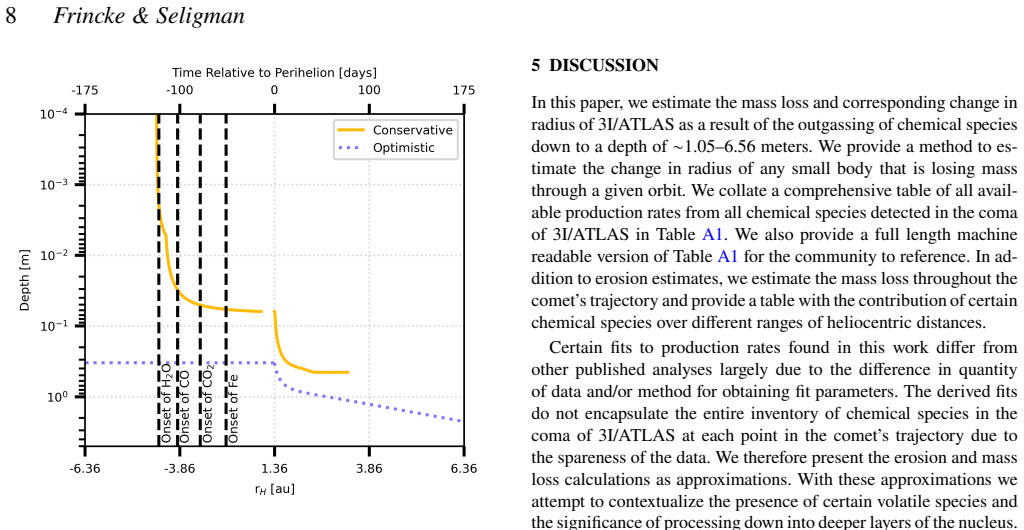
Applying the radius-change equations to the full set of reported production rates shows that 3I/ATLAS lost between 1.05 and 6.56 meters of surface material, equivalent to 10^9 to 10^10 kg or 0.10 to 1.13 percent of its total mass. The figures are presented as lower bounds if the dust-to-gas ratio in the outflow remained high. Conservative estimates use the onset of observed activity; optimistic estimates use the typical sublimation distances of each species. Post-perihelion observations are inferred to sample layers that experienced some galactic cosmic-ray processing.
What carries the argument
Equations that integrate observed production rates of volatiles and refractories over chosen heliocentric distance intervals, convert the total mass lost into a radius decrement for a body of assumed density, and apply the result to an arbitrary orbital path.
If this is right
- The same production-rate data and radius-change equations can be used to estimate the subsurface depths from which each species originates inside the nucleus.
- Post-perihelion measurements of 3I/ATLAS likely sample layers that still retain some galactic cosmic-ray processing.
- If the dust-to-gas ratio stayed high throughout the passage, the reported mass-loss and radius-change values are underestimates.
Where Pith is reading between the lines
- The framework can be applied to other comets or interstellar objects to compare erosion amounts across different dynamical histories.
- The small fractional mass loss implies that interstellar comets largely retain their original formation composition after solar-system passage.
- Refined activity-onset distances from future observations could tighten the conservative versus optimistic bounds used here.
Load-bearing premise
The published production rates capture the entire mass loss including any sustained high dust component, and the chosen heliocentric ranges bracket all significant activity without missing other contributions.
What would settle it
A direct measurement of the nucleus radius or total mass immediately before and after the solar-system passage, or a complete inventory of dust mass-loss rates, would confirm or refute the integrated mass-loss totals.
Figures

read the original abstract
Formed from the debris of planet formation, interstellar comets provide invaluable insights into the chemical compositions of planetary systems outside of our Solar System. Spectroscopic observations of 3I/ATLAS, the third interstellar object, reveal production of numerous volatiles and refractory species throughout its trajectory. In this paper we present a framework to calculate the change in radius of an object on an arbitrary trajectory at any point in its orbit, applicable to any small body experiencing mass-loss. We next provide a comprehensive, machine readable table containing volatile and refractory production rates from all reported observations of 3I/ATLAS pre- and post-perihelion. Applying these equations to 3I/ATLAS, we calculate that it has lost $\sim$ 1.05 -- 6.56 meters of its surface during its passage through the Solar System, corresponding to $\sim$ 10$^9$ -- 10$^{10}$ kg and $\sim$ 0.10 -- 1.13% of its total mass. These numbers could be lower estimates if the dust-to-gas ratio of its outflow was sustained at a high level. Conservative and optimistic estimates were calculated over a range of heliocentric distances defined by the onset of activity in reported observations and the typical onset of sublimation distance for each species, respectively. The reported production rates combined with the change in radius calculation can be used to estimate subsurface locations of various species within the nucleus of 3I/ATLAS. Post-perihelion measurements of 3I/ATLAS likely originated from layers which still experienced some level of galactic cosmic ray processing.
Editorial analysis
A structured set of objections, weighed in public.
Referee Report
Summary. The manuscript presents a general framework for calculating the radius change of a small body experiencing mass loss along an arbitrary trajectory. It compiles a machine-readable table of observed volatile and refractory production rates for the interstellar comet 3I/ATLAS from all reported pre- and post-perihelion observations. Applying the framework yields estimates that 3I/ATLAS lost ∼1.05–6.56 m of surface material (∼10^9–10^10 kg, or 0.10–1.13% of total mass) during its Solar System passage, with conservative and optimistic bounds based on different heliocentric distance ranges; the abstract notes these may be underestimates if the dust-to-gas ratio was high.
Significance. If the integration and conversion steps hold, the work supplies quantitative mass-loss and radius-change estimates for an interstellar comet that can be compared with Solar System comets and used to constrain subsurface layering. The machine-readable production-rate table is a clear strength for reproducibility and community reuse.
major comments (3)
- [Framework and application sections] Framework equations (as applied in the 3I/ATLAS calculation): the cumulative mass-loss integrals rely on discrete tabulated rates plus chosen heliocentric cutoffs (onset of observed activity vs. species-specific sublimation distances) without a sensitivity test for gaps between observations or possible pre-onset activity; this assumption is load-bearing for the reported 1.05–6.56 m range.
- [Application to 3I/ATLAS] Mass-to-radius conversion step: the translation of integrated mass loss into Δr and the 0.10–1.13% mass fraction uses fixed nucleus radius and density values whose uncertainties are not propagated or varied; the abstract provides no derivation or adopted numerical values, leaving the central numerical claim difficult to assess.
- [Abstract and discussion] Dust-to-gas discussion: the abstract flags that sustained high dust-to-gas ratios could make the quoted mass-loss figures lower bounds, yet supplies neither a quantitative bound nor an alternative integration that incorporates elevated dust contributions; this directly affects interpretation of the 10^9–10^10 kg range.
minor comments (2)
- [Production-rate table] The machine-readable table would benefit from explicit column headers or metadata documenting the exact heliocentric distances, observation epochs, and source references for each entry.
- [Abstract] A short statement of the adopted nucleus radius and bulk density (with references) should be added to the abstract or methods for immediate context.
Simulated Author's Rebuttal
We thank the referee for the constructive report and recommendation for major revision. We address each major comment below, agreeing where the manuscript requires clarification or additional analysis, and have outlined specific revisions to improve rigor and transparency.
read point-by-point responses
-
Referee: [Framework and application sections] Framework equations (as applied in the 3I/ATLAS calculation): the cumulative mass-loss integrals rely on discrete tabulated rates plus chosen heliocentric cutoffs (onset of observed activity vs. species-specific sublimation distances) without a sensitivity test for gaps between observations or possible pre-onset activity; this assumption is load-bearing for the reported 1.05–6.56 m range.
Authors: The conservative and optimistic bounds are designed to bracket uncertainties in activity onset. We agree that explicit sensitivity tests for observational gaps and interpolation choices would strengthen the results. In revision we will add a dedicated subsection performing such tests (varying start distances by ±0.5 au and using linear interpolation between tabulated rates) and report the resulting range in total mass loss. revision: yes
-
Referee: [Application to 3I/ATLAS] Mass-to-radius conversion step: the translation of integrated mass loss into Δr and the 0.10–1.13% mass fraction uses fixed nucleus radius and density values whose uncertainties are not propagated or varied; the abstract provides no derivation or adopted numerical values, leaving the central numerical claim difficult to assess.
Authors: The adopted values (R = 2.5 km, ρ = 500 kg m^{-3}) are stated in Section 3 but omitted from the abstract and lack uncertainty propagation. We will revise the abstract to include these values with citations, add an explicit derivation of the spherical-shell approximation used for Δr, and include a brief propagation of plausible ±20% uncertainties in R and ρ to show the effect on the reported percentages. revision: yes
-
Referee: [Abstract and discussion] Dust-to-gas discussion: the abstract flags that sustained high dust-to-gas ratios could make the quoted mass-loss figures lower bounds, yet supplies neither a quantitative bound nor an alternative integration that incorporates elevated dust contributions; this directly affects interpretation of the 10^9–10^10 kg range.
Authors: Current observations of 3I/ATLAS do not provide a complete set of simultaneous dust and gas rates across the orbit, precluding a data-driven quantitative bound or alternative integration. We will expand the discussion section to explain this data limitation explicitly and note that the quoted range should be interpreted as a gas-based lower limit, while adding a qualitative estimate based on typical Solar-System comet dust-to-gas ratios for context. revision: partial
Circularity Check
Mass loss and radius change computed directly from observed production rates with no reduction to inputs by construction.
full rationale
The paper presents a framework for radius change on arbitrary trajectories and applies it by integrating tabulated observed production rates (pre- and post-perihelion) over chosen heliocentric distance ranges to obtain cumulative mass loss, then converts to Δr using assumed nucleus density and radius. This is a direct computation from external observational inputs; no equations reduce the output to a fitted parameter, self-definition, or self-citation chain. The abstract notes possible underestimates from high dust-to-gas ratios but provides no self-referential structure. No load-bearing steps match the enumerated circularity patterns.
Axiom & Free-Parameter Ledger
Reference graph
Works this paper leans on
-
[1]
Spectroscopy and thermal modelling of the first interstellar object 1I/2017 U1 'Oumuamua
Spectroscopy and thermal modelling of the first interstellar object 1I/2017 U1 `Oumuamua. Nature Astronomy , keywords =. doi:10.1038/s41550-017-0361-4 , archivePrefix =. 1712.06552 , primaryClass =
work page internal anchor Pith review Pith/arXiv arXiv doi:10.1038/s41550-017-0361-4 2017
-
[2]
Potential Thermal Profiles of The Third Interstellar Object 3I/ATLAS. arXiv e-prints , keywords =. doi:10.48550/arXiv.2510.25945 , archivePrefix =. 2510.25945 , primaryClass =
-
[3]
The Volatile Carbon-to-oxygen Ratio as a Tracer for the Formation Locations of Interstellar Comets. , keywords =. doi:10.3847/PSJ/ac75b5 , archivePrefix =. 2204.13211 , primaryClass =
-
[4]
The Kinematic Age of 3I/ATLAS and Its Implications for Early Planet Formation. , keywords =. doi:10.3847/2041-8213/adfa28 , archivePrefix =. 2507.08111 , primaryClass =
-
[5]
arXiv e-prints , keywords =
SPHEREx Pre-Perihelion Mapping of H_2O , CO_2 , and CO in Interstellar Object 3I/ATLAS. arXiv e-prints , keywords =
-
[6]
The Astrophysical Journal , keywords =
JWST Detection of a Carbon-dioxide-dominated Gas Coma Surrounding Interstellar Object 3I/ATLAS. , keywords =. doi:10.3847/2041-8213/ae0647 , archivePrefix =. 2508.18209 , primaryClass =
-
[7]
Interstellar Comet 3I/ATLAS: Evidence for Galactic Cosmic Ray Processing. arXiv e-prints , keywords =. doi:10.48550/arXiv.2510.26308 , archivePrefix =. 2510.26308 , primaryClass =
-
[8]
ATLAS: A High-Cadence All-Sky Survey System
ATLAS: A High-cadence All-sky Survey System. , keywords =. doi:10.1088/1538-3873/aabadf , archivePrefix =. 1802.00879 , primaryClass =
work page internal anchor Pith review Pith/arXiv arXiv doi:10.1088/1538-3873/aabadf
-
[9]
MPEC , year = 2025, month = jul, number =
3I/ATLAS = C/2025 N1 (ATLAS). MPEC , year = 2025, month = jul, number =
2025
-
[10]
Discovery and Preliminary Characterization of a Third Interstellar Object: 3I/ATLAS. , keywords =. doi:10.3847/2041-8213/adf49a , archivePrefix =. 2507.02757 , primaryClass =
-
[11]
Dust Properties of the Interstellar Object 3I/ATLAS Revealed by Optical and Near-Infrared Polarimetry. arXiv e-prints , keywords =. doi:10.48550/arXiv.2601.08591 , archivePrefix =. 2601.08591 , primaryClass =
-
[12]
JCMT detection of HCN emission from 3I/ATLAS at 2.1 AU. arXiv e-prints , keywords =. doi:10.48550/arXiv.2510.02817 , archivePrefix =. 2510.02817 , primaryClass =
-
[13]
Water Production of Interstellar Comet 3I/ATLAS from SOHO/SWAN Observations after Perihelion. arXiv e-prints , keywords =. doi:10.48550/arXiv.2512.22354 , archivePrefix =. 2512.22354 , primaryClass =
-
[14]
arXiv e-prints , keywords =
Perihelion Asymmetry in the Water Production Rate of the Interstellar Object 3I/ATLAS. arXiv e-prints , keywords =
-
[15]
arXiv e-prints , keywords =
Post-Perihelion Integral Field Spectroscopy of the Interstellar Comet 3I/ATLAS. arXiv e-prints , keywords =
-
[16]
SPHEREx Re-Observation of Interstellar Object 3I/ATLAS in December 2025: Detection of Increased Post-Perihelion Activity, Refractory Coma Dust, and New Coma Gas Species. arXiv e-prints , keywords =. doi:10.48550/arXiv.2601.06759 , archivePrefix =. 2601.06759 , primaryClass =
-
[17]
Research Notes of the American Astronomical Society , keywords =
Breakthrough Listen Observations of 3I/ATLAS with the Green Bank Telescope at 1─12 GHz. Research Notes of the American Astronomical Society , keywords =. doi:10.3847/2515-5172/ae3083 , archivePrefix =. 2512.19763 , primaryClass =
-
[18]
A Search for Radio Technosignatures from Interstellar Object 3I/ATLAS with the Allen Telescope Array
A Search for Radio Technosignatures from Interstellar Object 3I/ATLAS with the Allen Telescope Array. arXiv e-prints , keywords =. doi:10.48550/arXiv.2512.18142 , archivePrefix =. 2512.18142 , primaryClass =
work page internal anchor Pith review Pith/arXiv arXiv doi:10.48550/arxiv.2512.18142
-
[19]
Pre-perihelion detection of a wobbling high-latitude jet in the interstellar comet 3I/ATLAS. arXiv e-prints , keywords =. doi:10.48550/arXiv.2512.12819 , archivePrefix =. 2512.12819 , primaryClass =
-
[20]
Pre-perihelion Volatile Evolution of Interstellar Comet 3I/ATLAS Indicating Significant Contribution from Extended Source in the Coma. arXiv e-prints , keywords =. doi:10.48550/arXiv.2602.14218 , archivePrefix =. 2602.14218 , primaryClass =
-
[21]
Pre-perihelion Emergence of the CN Gas Coma in 3I/ATLAS Temporally and Spatially Resolved by the 7-Dimensional Telescope. arXiv e-prints , keywords =. doi:10.48550/arXiv.2602.12930 , archivePrefix =. 2602.12930 , primaryClass =
-
[22]
A Two-Dimensional Analytic Solution for the Generation of Hyperbolic Trajectories Via A Single Close Encounter with Applications To Interstellar Objects. arXiv e-prints , keywords =. doi:10.48550/arXiv.2602.04806 , archivePrefix =. 2602.04806 , primaryClass =
-
[23]
The Volatile Inventory of 3I/ATLAS as seen with JWST/MIRI
The Volatile Inventory of 3I/ATLAS as seen with JWST/MIRI. arXiv e-prints , keywords =. doi:10.48550/arXiv.2601.22034 , archivePrefix =. 2601.22034 , primaryClass =
work page internal anchor Pith review Pith/arXiv arXiv doi:10.48550/arxiv.2601.22034
-
[24]
The Astrophysical Journal , keywords =
Hubble Space Telescope Observations of the Interstellar Interloper 3I/ATLAS. , keywords =. doi:10.3847/2041-8213/adf8d8 , archivePrefix =. 2508.02934 , primaryClass =
-
[25]
HATPI Pre-Perihelion Time-series Photometry of the Interstellar Comet 3I/ATLAS. arXiv e-prints , keywords =. doi:10.48550/arXiv.2602.21586 , archivePrefix =. 2602.21586 , primaryClass =
-
[26]
Nucleus and Postperihelion Activity of Interstellar Object 3I/ATLAS Observed by Hubble Space Telescope. arXiv e-prints , keywords =. doi:10.48550/arXiv.2601.21569 , archivePrefix =. 2601.21569 , primaryClass =
-
[27]
Research Notes of the American Astronomical Society , keywords =
The Size of 3I/ATLAS from Non-gravitational Acceleration. Research Notes of the American Astronomical Society , keywords =. doi:10.3847/2515-5172/ae3747 , archivePrefix =. 2512.18341 , primaryClass =
-
[28]
Research Notes of the American Astronomical Society , keywords =
Effect of Different Non-gravitational Accelerations on the Trajectory of Interstellar Comet 3I/ATLAS. Research Notes of the American Astronomical Society , keywords =. doi:10.3847/2515-5172/ae3c09 , archivePrefix =. 2601.17083 , primaryClass =
-
[29]
University of Hawaii 88-inch Telescope Observations of the Interstellar Comet 3I/ATLAS: Spectrophotometric Blue-Sensitive Spectral Time Series Spanning Two Months from Discovery. arXiv e-prints , keywords =. doi:10.48550/arXiv.2512.09020 , archivePrefix =. 2512.09020 , primaryClass =
-
[30]
JCMT Constraints on the Early-Time HCN and CO Emission and HCN Temporal Evolution of 3I/ATLAS
JCMT Constraints on the Early-Time HCN and CO Emission and HCN Temporal Evolution of 3I/ATLAS. arXiv e-prints , keywords =. doi:10.48550/arXiv.2512.02106 , archivePrefix =. 2512.02106 , primaryClass =
work page internal anchor Pith review Pith/arXiv arXiv doi:10.48550/arxiv.2512.02106
-
[31]
CH _3 OH and HCN in Interstellar Comet 3I/ATLAS Mapped with the ALMA Atacama Compact Array: Distinct Outgassing Behaviors and a Remarkably High CH _3 OH/HCN Production Rate Ratio. arXiv e-prints , keywords =. doi:10.48550/arXiv.2511.20845 , archivePrefix =. 2511.20845 , primaryClass =
-
[32]
Research Notes of the American Astronomical Society , keywords =
Tracking the Activity of the Interstellar Object 3I/ATLAS through Its Perihelion. Research Notes of the American Astronomical Society , keywords =. doi:10.3847/2515-5172/ae23c8 , archivePrefix =. 2511.20810 , primaryClass =
-
[33]
Spectrophotometric evidence for a metal-bearing, carbonaceous, and pristine interstellar comet 3I/ATLAS. arXiv e-prints , keywords =. doi:10.48550/arXiv.2511.19112 , archivePrefix =. 2511.19112 , primaryClass =
-
[34]
Rapid Brightening of 3I/ATLAS Ahead of Perihelion. , keywords =. doi:10.1088/1538-3873/ae2e88 , archivePrefix =. 2510.25035 , primaryClass =
-
[35]
Preperihelion Development of Interstellar Comet 3I/ATLAS. , keywords =. doi:10.3847/2041-8213/ae1832 , archivePrefix =. 2510.18769 , primaryClass =
-
[36]
Research Notes of the American Astronomical Society , keywords =
Prospects for the Crossing of Comet 3I/ATLAS's Ion Tail. Research Notes of the American Astronomical Society , keywords =. doi:10.3847/2515-5172/ae12e6 , archivePrefix =. 2510.13222 , primaryClass =
-
[37]
Systematic and Statistical Uncertainties in the Non-Gravitational Acceleration of 3I/ATLAS. arXiv e-prints , keywords =. doi:10.48550/arXiv.2603.00782 , archivePrefix =. 2603.00782 , primaryClass =
-
[38]
Contemporaneous Optical and Near-Infrared Observations of the Interstellar Comet 3I/ATLAS Pre- and Post-Perihelion. arXiv e-prints , keywords =. doi:10.48550/arXiv.2602.23586 , archivePrefix =. 2602.23586 , primaryClass =
-
[39]
Spatial Profiles of 3I/ATLAS CN and Ni Outgassing from Keck/KCWI Integral Field Spectroscopy. arXiv e-prints , keywords =. doi:10.48550/arXiv.2510.11779 , archivePrefix =. 2510.11779 , primaryClass =
-
[40]
Pre-perihelion evolution of the NiI/FeI abundance ratio in the coma of the interstellar comet 3I/ATLAS: From extreme to normal. , keywords =. doi:10.1051/0004-6361/202557484 , archivePrefix =. 2509.26053 , primaryClass =
-
[41]
Prediscovery Activity of New Interstellar Object 3I/ATLAS: Rapid Brightening from 6 to 4 au. , keywords =. doi:10.3847/2041-8213/ae147b , archivePrefix =. 2509.08792 , primaryClass =
-
[42]
3I/ATLAS: In Search of the Witnesses to Its Voyage
3I/ATLAS: In Search of the Witnesses to Its Voyage. arXiv e-prints , keywords =. doi:10.48550/arXiv.2509.07678 , archivePrefix =. 2509.07678 , primaryClass =
work page internal anchor Pith review Pith/arXiv arXiv doi:10.48550/arxiv.2509.07678
-
[43]
ATLAS Photometry of Interstellar Object 3I/ATLAS. , keywords =. doi:10.3847/2041-8213/ae1f12 , archivePrefix =. 2509.05562 , primaryClass =
-
[44]
Extreme Negative Polarization of New Interstellar Comet 3I/ATLAS. , keywords =. doi:10.3847/2041-8213/ae0c08 , archivePrefix =. 2509.05181 , primaryClass =
-
[45]
Search for Past Stellar Encounters and the Origin of 3I/ATLAS. , keywords =. doi:10.3847/1538-3881/ae1833 , archivePrefix =. 2509.03361 , primaryClass =
-
[46]
Onset of CN Emission in 3I/ATLAS: Evidence for Strong Carbon-chain Depletion. , keywords =. doi:10.3847/2041-8213/ae1232 , archivePrefix =. 2509.01647 , primaryClass =
-
[47]
Very Large Telescope Observations of Interstellar Comet 3I/ATLAS. II. From Quiescence to Glow: Dramatic Rise of Ni I Emission and Incipient CN Outgassing at Large Heliocentric Distances. , keywords =. doi:10.3847/2041-8213/ae1cbc , archivePrefix =. 2508.18382 , primaryClass =
-
[48]
3I/ATLAS (C/2025 N1): Direct Spacecraft Exploration of a Possible Relic of Planetary Formation at ``Cosmic Noon''. arXiv e-prints , keywords =. doi:10.48550/arXiv.2508.15768 , archivePrefix =. 2508.15768 , primaryClass =
-
[49]
Simultaneous visible spectrophotometry of interstellar object 3I/ATLAS with Seimei/TriCCS. , keywords =. doi:10.1093/pasj/psaf097 , archivePrefix =. 2508.08829 , primaryClass =
-
[50]
Water Production Rates of the Interstellar Object 3I/ATLAS. , keywords =. doi:10.3847/2041-8213/ae08ab , archivePrefix =. 2508.04675 , primaryClass =
-
[51]
Spectral Characteristics of Interstellar Object 3I/ATLAS from SOAR Observations. , keywords =. doi:10.3847/2041-8213/adfa0b , archivePrefix =. 2508.02777 , primaryClass =
-
[52]
Temporal evolution of the third interstellar comet 3I/ATLAS: Spin, color, spectra, and dust activity. , keywords =. doi:10.1051/0004-6361/202556717 , archivePrefix =. 2508.00808 , primaryClass =
-
[53]
Precovery Observations of 3I/ATLAS from TESS Suggest Possible Distant Activity. , keywords =. doi:10.3847/2041-8213/adfd4d , archivePrefix =. 2507.21967 , primaryClass =
-
[54]
The Feasibility of a Spacecraft Flyby with the Third Interstellar Object 3I/ATLAS from Earth or Mars. , keywords =. doi:10.3847/1538-4357/ae11b2 , archivePrefix =. 2507.15755 , primaryClass =
-
[55]
The Astrophysical Journal , keywords =
Spectroscopic Characterization of Interstellar Object 3I/ATLAS: Water Ice in the Coma. , keywords =. doi:10.3847/2041-8213/ae08a7 , archivePrefix =. 2507.14916 , primaryClass =
-
[56]
NSF-DOE Vera C. Rubin Observatory Observations of Interstellar Comet 3I/ATLAS (C/2025 N1)
NSF-DOE Vera C. Rubin Observatory Observations of Interstellar Comet 3I/ATLAS (C/2025 N1). arXiv e-prints , keywords =. doi:10.48550/arXiv.2507.13409 , archivePrefix =. 2507.13409 , primaryClass =
work page internal anchor Pith review Pith/arXiv arXiv doi:10.48550/arxiv.2507.13409 2025
-
[57]
Astronomy and Astrophysics , keywords =
Assessing interstellar comet 3I/ATLAS with the 10.4 m Gran Telescopio Canarias and the Two-meter Twin Telescope. , keywords =. doi:10.1051/0004-6361/202556439 , archivePrefix =. 2507.12922 , primaryClass =
-
[58]
The Astrophysical Journal , keywords =
Near-discovery Observations of Interstellar Comet 3I/ATLAS with the NASA Infrared Telescope Facility. , keywords =. doi:10.3847/2041-8213/adfbdf , archivePrefix =. 2507.12234 , primaryClass =
-
[59]
Research Notes of the American Astronomical Society , keywords =
Palomar and Apache Point Spectrophotometry of Interstellar Comet 3I/ATLAS. Research Notes of the American Astronomical Society , keywords =. doi:10.3847/2515-5172/adf059 , archivePrefix =. 2507.11720 , primaryClass =
-
[60]
X-SHOOTER spectrum of comet 3I/ATLAS: Insights into a distant interstellar visitor. , keywords =. doi:10.1051/0004-6361/202556338 , archivePrefix =. 2507.07312 , primaryClass =
-
[61]
From a Different Star: 3I/ATLAS in the Context of the \= O tautahi Oxford Interstellar Object Population Model. , keywords =. doi:10.3847/2041-8213/adfbf4 , archivePrefix =. 2507.05318 , primaryClass =
-
[62]
Snapshot of a new interstellar comet: 3I/ATLAS has a red and featureless spectrum. , keywords =. doi:10.1093/mnrasl/slaf095 , archivePrefix =. 2507.05226 , primaryClass =
-
[63]
Near-discovery SOAR photometry of the third interstellar object: 3I/ATLAS. , keywords =. doi:10.1093/mnras/staf1994 , archivePrefix =. 2509.02813 , primaryClass =
-
[64]
[2020] , series =
Curtis, Howard D., , title =. [2020] , series =
2020
-
[65]
Research Notes of the American Astronomical Society , keywords =
SPHEREx Discovery of Strong Water Ice Absorption and an Extended Carbon Dioxide Coma in 3I/ATLAS. Research Notes of the American Astronomical Society , keywords =. doi:10.3847/2515-5172/ae0293 , archivePrefix =. 2508.15469 , primaryClass =
-
[66]
Time-Domain Photometry and Activity Evolution of Interstellar Comet 3I/ATLAS with BHTOM. arXiv e-prints , keywords =. doi:10.48550/arXiv.2603.01383 , archivePrefix =. 2603.01383 , primaryClass =
-
[67]
Isotopic Evidence for a Cold and Distant Origin of the Interstellar Object 3I/ATLAS. arXiv e-prints , keywords =. doi:10.48550/arXiv.2603.06911 , archivePrefix =. 2603.06911 , primaryClass =
-
[68]
The Astrophysical Journal Letters , abstract =
Jewitt, David and Luu, Jane and Rajagopal, Jayadev and Kotulla, Ralf and Ridgway, Susan and Liu, Wilson and Augusteijn, Thomas , title =. The Astrophysical Journal Letters , abstract =. 2017 , month =. doi:10.3847/2041-8213/aa9b2f , url =
-
[69]
Spitzer Observations of Interstellar Object 1I/`Oumuamua
Spitzer Observations of Interstellar Object 1I/ Oumuamua. , keywords =. doi:10.3847/1538-3881/aae88f , archivePrefix =. 1811.08072 , primaryClass =
work page internal anchor Pith review Pith/arXiv arXiv doi:10.3847/1538-3881/aae88f
-
[70]
Water D/H in 3I/ATLAS as a Probe of Formation Conditions in Another Planetary System
Water D/H in 3I/ATLAS as a probe of formation conditions in another planetary system. Nature Astronomy , keywords =. doi:10.1038/s41550-026-02850-5 , archivePrefix =. 2603.07026 , primaryClass =
work page internal anchor Pith review Pith/arXiv arXiv doi:10.1038/s41550-026-02850-5
-
[71]
High nitrogen and carbon isotopic ratios in the interstellar comet 3I/ATLAS. arXiv e-prints , keywords =. doi:10.48550/arXiv.2603.07187 , archivePrefix =. 2603.07187 , primaryClass =
-
[72]
Post-perihelion Coma Composition of the Interstellar Comet 3I/ATLAS from Optical Spectroscopy
Post-perihelion Coma Composition of the Interstellar Comet 3I/ATLAS from Optical Spectroscopy. arXiv e-prints , keywords =. doi:10.48550/arXiv.2603.07718 , archivePrefix =. 2603.07718 , primaryClass =
work page internal anchor Pith review Pith/arXiv arXiv doi:10.48550/arxiv.2603.07718
-
[73]
Interstellar Object 3I/ATLAS Observed from Mars by China's Tianwen-1 Spacecraft
Interstellar Object 3I/ATLAS Observed from Mars by China's Tianwen-1 Spacecraft. arXiv e-prints , keywords =. doi:10.48550/arXiv.2603.10350 , archivePrefix =. 2603.10350 , primaryClass =
work page internal anchor Pith review Pith/arXiv arXiv doi:10.48550/arxiv.2603.10350
-
[74]
Narrowband Radio Technosignature Search toward 3I/ATLAS with FAST
Narrowband Radio Technosignature Search toward 3I/ATLAS with FAST. arXiv e-prints , keywords =. doi:10.48550/arXiv.2603.19023 , archivePrefix =. 2603.19023 , primaryClass =
work page internal anchor Pith review Pith/arXiv arXiv doi:10.48550/arxiv.2603.19023
-
[75]
Isotopic Signature of Organic Molecules from Beyond the Solar System: An Enriched Methane D/H Ratio in the Interstellar Object 3I/ATLAS. arXiv e-prints , keywords =. doi:10.48550/arXiv.2603.20445 , archivePrefix =. 2603.20445 , primaryClass =
-
[76]
Perihelion observations of interstellar comet 3I/ATLAS with the IRAM 30-m telescope
Perihelion observations of interstellar comet 3I/ATLAS with the IRAM 30-m telescope. arXiv e-prints , keywords =. doi:10.48550/arXiv.2603.23240 , archivePrefix =. 2603.23240 , primaryClass =
work page internal anchor Pith review Pith/arXiv arXiv doi:10.48550/arxiv.2603.23240
-
[77]
A post-perihelion constraint on the CO _ 2 /H _ 2 O ratio of interstellar comet 3I/ATLAS from [O I] forbidden lines. arXiv e-prints , keywords =. doi:10.48550/arXiv.2603.25002 , archivePrefix =. 2603.25002 , primaryClass =
-
[78]
Secular Light Curve of Exocomet 3I/ATLAS, and its Location on a Comet Evolutionary Diagram
Secular Light Curve of Exocomet 3I/ATLAS, and its Location on a Comet Evolutionary Diagram. arXiv e-prints , keywords =. doi:10.48550/arXiv.2604.09941 , archivePrefix =. 2604.09941 , primaryClass =
work page internal anchor Pith review Pith/arXiv arXiv doi:10.48550/arxiv.2604.09941
-
[79]
arXiv e-prints , keywords =
Origin and evolution of NiI and FeI in the coma of the interstellar comet 3I/ATLAS throughout its trajectory. arXiv e-prints , keywords =
-
[80]
Central Bureau Electronic Telegrams , year = 2017, month = oct, volume =
Minor Planets 2017 SN\_33 and 2017 U1. Central Bureau Electronic Telegrams , year = 2017, month = oct, volume =
2017
discussion (0)
Sign in with ORCID, Apple, or X to comment. Anyone can read and Pith papers without signing in.