REVIEW 2 major objections 1 minor 1 cited by
Vision-language models enable pixel-level attribution for iterative retrieval-augmented generation by reasoning directly over document screenshots.
Reviewed by Pith at T0; open to challenge. T0 means a machine referee read the full paper against a public rubric. the ladder, T0–T4 →
T0 review · grok-4.3
2026-07-01 00:37 UTC pith:FFZKSTMR
load-bearing objection CoE shows a workable retriever-agnostic path to pixel-level bounding-box attribution in iRAG by feeding VLMs raw screenshots instead of parsed text. the 2 major comments →
Chain of Evidence: Pixel-Level Visual Attribution for Iterative Retrieval-Augmented Generation
The pith
A machine-rendered reading of the paper's core claim, the machinery that carries it, and where it could break.
Core claim
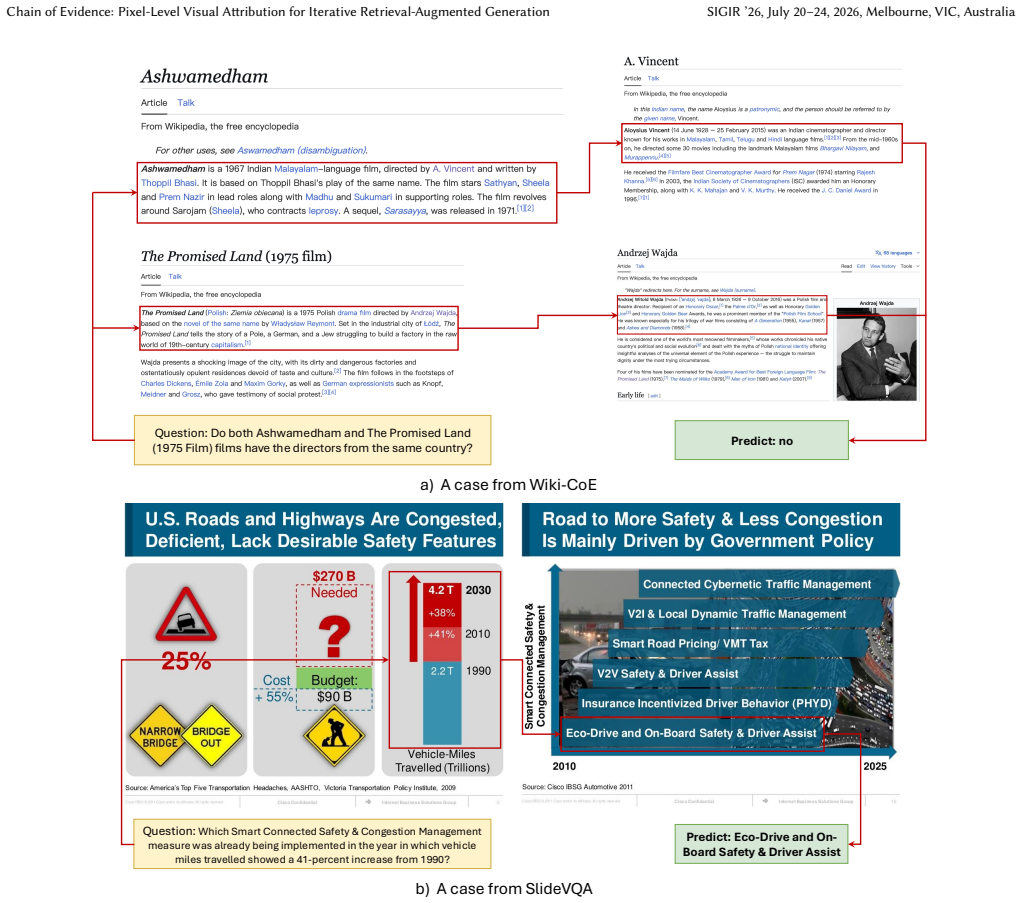
Chain of Evidence is a retriever-agnostic visual attribution framework that leverages Vision-Language Models to reason directly over screenshots of retrieved document candidates, eliminating format-specific parsing and outputting precise bounding boxes to visualize the complete reasoning chain within the retrieved candidate set.
What carries the argument
Chain of Evidence (CoE) framework, which uses vision-language models to process raw screenshots and output bounding boxes for evidence chains.
Load-bearing premise
Vision-language models can reliably extract and chain evidence from raw screenshots without format-specific parsing or loss of spatial logic.
What would settle it
An experiment showing that the model frequently outputs inaccurate bounding boxes or misses key evidence on slides with free-form layouts would undermine the performance claims.
If this is right
- Removes the need for format-specific parsing in iRAG systems.
- Achieves better performance than text baselines on tasks requiring visual layout understanding.
- Provides interpretable pixel-level citations for multi-hop questions.
- Applies to both structured web pages and complex presentation slides.
- Establishes a solution for pixel-level interpretable iRAG that is independent of the retriever.
Where Pith is reading between the lines
- Similar screenshot-based reasoning could extend to other visual documents like scientific papers with figures.
- Integrating CoE with existing text retrievers might create hybrid systems that handle both parsed and visual content.
- Testing the framework on real-world user queries beyond the benchmarks could reveal practical usability limits.
Editorial analysis
A structured set of objections, weighed in public.
Referee Report
Summary. The paper introduces Chain of Evidence (CoE), a retriever-agnostic framework for pixel-level visual attribution in iterative Retrieval-Augmented Generation (iRAG). It uses Vision-Language Models to reason directly over screenshots of retrieved documents, outputting bounding boxes to visualize evidence chains without format-specific parsing. The approach is evaluated on two new benchmarks—Wiki-CoE (derived from 2WikiMultiHopQA) and SlideVQA—and claims that fine-tuned Qwen3-VL-8B-Instruct achieves robust performance and significantly outperforms text-based baselines in scenarios requiring visual layout understanding.
Significance. If the empirical results hold, the work could meaningfully advance interpretable iRAG by addressing coarse-grained attribution and visual semantic loss in visually rich documents. The retriever-agnostic design, focus on pixel-level outputs, introduction of Wiki-CoE and SlideVQA benchmarks, and public code release are notable strengths that support reproducibility and potential adoption.
major comments (2)
- [Abstract] Abstract and evaluation description: the central claim that fine-tuned Qwen3-VL-8B-Instruct 'significantly outperforming text-based baselines' is load-bearing, yet the provided text contains no quantitative results, metrics (e.g., bounding-box IoU, attribution precision), baseline details, error analysis, or statistical significance tests, preventing verification of the outperformance.
- [Abstract] Abstract: the weakest assumption—that VLMs can reliably extract and chain evidence from raw screenshots without format-specific parsing or loss of spatial logic—is stated but not supported by any ablation studies, failure-case analysis, or comparison to parsing-based alternatives in the available description.
minor comments (1)
- [Abstract] The abstract would be clearer if it named the exact evaluation metrics and dataset sizes for Wiki-CoE and SlideVQA.
Simulated Author's Rebuttal
We thank the referee for the constructive comments on the abstract. We address each point below and will revise the manuscript to strengthen the presentation of results and supporting evidence.
read point-by-point responses
-
Referee: [Abstract] Abstract and evaluation description: the central claim that fine-tuned Qwen3-VL-8B-Instruct 'significantly outperforming text-based baselines' is load-bearing, yet the provided text contains no quantitative results, metrics (e.g., bounding-box IoU, attribution precision), baseline details, error analysis, or statistical significance tests, preventing verification of the outperformance.
Authors: We agree the abstract as written does not contain the specific quantitative results. The full manuscript reports bounding-box IoU, attribution precision, recall, and F1 on both Wiki-CoE and SlideVQA, with direct comparisons to text-based baselines, error analysis, and statistical significance tests (paired t-tests, p<0.01) confirming outperformance. We will revise the abstract to include the key metrics (e.g., IoU improvements and precision gains) and a brief reference to the evaluation protocol. revision: yes
-
Referee: [Abstract] Abstract: the weakest assumption—that VLMs can reliably extract and chain evidence from raw screenshots without format-specific parsing or loss of spatial logic—is stated but not supported by any ablation studies, failure-case analysis, or comparison to parsing-based alternatives in the available description.
Authors: The abstract summarizes the core assumption. The full manuscript contains ablation studies isolating the effect of screenshot input versus parsed text, direct comparisons to parsing-based attribution pipelines, and failure-case analysis highlighting layout preservation. We will revise the abstract to briefly note that these supporting experiments are presented in the paper. revision: yes
Circularity Check
No significant circularity
full rationale
The paper presents an empirical framework (CoE) for pixel-level visual attribution using VLMs on screenshots, evaluated on newly constructed benchmarks (Wiki-CoE, SlideVQA). No equations, derivations, fitted parameters renamed as predictions, or load-bearing self-citations appear in the provided text. Central claims rest on experimental comparisons of fine-tuned Qwen3-VL-8B-Instruct against text baselines, which are externally falsifiable via the released code and do not reduce to self-definition or ansatz smuggling. This is the expected non-finding for a methods-plus-benchmarks paper without mathematical derivation chains.
Axiom & Free-Parameter Ledger
read the original abstract
Iterative Retrieval-Augmented Generation (iRAG) has emerged as a powerful paradigm for answering complex multi-hop questions by progressively retrieving and reasoning over external documents. However, current systems predominantly operate on parsed text, which creates two critical bottlenecks: (1) \textit{Coarse-grained attribution}, where users are burdened with manually locating evidence within lengthy documents based on vague text-level citations; and (2) \textit{Visual semantic loss}, where the conversion of visually rich documents (e.g., slides, PDFs with charts) into text discards spatial logic and layout cues essential for reasoning. To bridge this gap, we present \textbf{Chain of Evidence (CoE)}, a retriever-agnostic visual attribution framework that leverages Vision-Language Models to reason directly over screenshots of retrieved document candidates. CoE eliminates format-specific parsing and outputs precise bounding boxes, visualizing the complete reasoning chain within the retrieved candidate set. We evaluate CoE on two distinct benchmarks: \textbf{Wiki-CoE}, a large-scale dataset of structured web pages derived from 2WikiMultiHopQA, and \textbf{SlideVQA}, a challenging dataset of presentation slides featuring complex diagrams and free-form layouts. Experiments demonstrate that fine-tuned Qwen3-VL-8B-Instruct achieves robust performance, significantly outperforming text-based baselines in scenarios requiring visual layout understanding, while establishing a retriever-agnostic solution for pixel-level interpretable iRAG. Our code is available at https://github.com/PeiYangLiu/CoE.git.
Figures


Forward citations
Cited by 1 Pith paper
-
Multi-Granularity Reasoning for Natural Language Inference
Stacking element-wise multi-layer BERT interactions and DenseNet yields modest NLI gains over BERT/RoBERTa baselines on standard benchmarks.
Reference graph
Works this paper leans on
-
[1]
Josh Achiam, Steven Adler, Sandhini Agarwal, Lama Ahmad, Ilge Akkaya, Floren- cia Leoni Aleman, Diogo Almeida, Janko Altenschmidt, Sam Altman, Shyamal Anadkat, et al. 2023. Gpt-4 technical report.arXiv preprint arXiv:2303.08774 (2023)
work page internal anchor Pith review Pith/arXiv arXiv 2023
-
[2]
Lameck Mbangula Amugongo, Pietro Mascheroni, Steven Brooks, Stefan Doering, and Jan Seidel. 2025. Retrieval augmented generation for large language models in healthcare: A systematic review.PLOS Digital Health4, 6 (2025), e0000877
work page 2025
-
[3]
Akari Asai, Zeqiu Wu, Yizhong Wang, Avirup Sil, and Hannaneh Hajishirzi. 2024. Self-RAG: Learning to Retrieve, Generate, and Critique through Self-Reflection. InThe Twelfth International Conference on Learning Representations, ICLR 2024, Vienna, Austria, May 7-11, 2024. OpenReview.net. https://openreview.net/forum? id=hSyW5go0v8
work page 2024
-
[4]
Jinze Bai, Shuai Bai, Yunfei Chu, Zeyu Cui, Kai Dang, Xiaodong Deng, Yang Fan, Wenbin Ge, Yu Han, Fei Huang, et al. 2023. Qwen technical report.arXiv preprint arXiv:2309.16609(2023)
work page internal anchor Pith review Pith/arXiv arXiv 2023
-
[5]
Bernd Bohnet, Vinh Q Tran, Pat Verga, Roee Aharoni, Daniel Andor, Livio Baldini Soares, Massimiliano Ciaramita, Jacob Eisenstein, Kuzman Ganchev, Jonathan Herzig, et al. 2022. Attributed question answering: Evaluation and modeling for attributed large language models.arXiv preprint arXiv:2212.08037(2022)
- [6]
-
[7]
2003.HTML for the world wide web
Elizabeth Castro. 2003.HTML for the world wide web. Peachpit Press
work page 2003
-
[8]
Bhanu Chander, Chinju John, Lekha Warrier, and Kumaravelan Gopalakrish- nan. 2025. Toward trustworthy artificial intelligence (TAI) in the context of explainability and robustness.Comput. Surveys57, 6 (2025), 1–49
work page 2025
-
[9]
Zhiwei Chen, Yupeng Hu, Zhiheng Fu, Zixu Li, Jiale Huang, Qinlei Huang, and Yinwei Wei. 2026. INTENT: Invariance and Discrimination-aware Noise Miti- gation for Robust Composed Image Retrieval. InFortieth AAAI Conference on Artificial Intelligence, Thirty-Eighth Conference on Innovative Applications of Ar- tificial Intelligence, Sixteenth Symposium on Edu...
- [10]
-
[11]
Jinyuan Fang, Zaiqiao Meng, and Craig MacDonald. 2025. KiRAG: Knowledge- Driven Iterative Retriever for Enhancing Retrieval-Augmented Generation. In Proceedings of the 63rd Annual Meeting of the Association for Computational Linguistics (Volume 1: Long Papers), ACL 2025, Vienna, Austria, July 27 - August 1, 2025, Wanxiang Che, Joyce Nabende, Ekaterina Shu...
work page 2025
-
[12]
Tianyu Gao, Howard Yen, Jiatong Yu, and Danqi Chen. 2023. Enabling Large Language Models to Generate Text with Citations. InProceedings of the 2023 Conference on Empirical Methods in Natural Language Processing, EMNLP 2023, Singapore, December 6-10, 2023, Houda Bouamor, Juan Pino, and Kalika Bali (Eds.). Association for Computational Linguistics, 6465–648...
-
[13]
Yunfan Gao, Yun Xiong, Xinyu Gao, Kangxiang Jia, Jinliu Pan, Yuxi Bi, Yixin Dai, Jiawei Sun, Haofen Wang, and Haofen Wang. 2023. Retrieval-augmented generation for large language models: A survey.arXiv preprint arXiv:2312.10997 2, 1 (2023)
work page internal anchor Pith review Pith/arXiv arXiv 2023
-
[14]
Boni García. 2022.Hands-On Selenium WebDriver with Java. " O’Reilly Media, Inc. "
work page 2022
-
[15]
Ruediger Glott, Philipp Schmidt, and Rishab Ghosh. 2010. Wikipedia survey– overview of results.United Nations University: Collaborative Creativity Group8 (2010), 1158–1178
work page 2010
-
[16]
Qiushan Guo, Shalini De Mello, Hongxu Yin, Wonmin Byeon, Ka Chun Cheung, Yizhou Yu, Ping Luo, and Sifei Liu. 2024. Regiongpt: Towards region under- standing vision language model. InProceedings of the IEEE/CVF Conference on Computer Vision and Pattern Recognition. 13796–13806
work page 2024
-
[17]
Xanh Ho, Anh-Khoa Duong Nguyen, Saku Sugawara, and Akiko Aizawa. 2020. Constructing A Multi-hop QA Dataset for Comprehensive Evaluation of Reason- ing Steps. InProceedings of the 28th International Conference on Computational Linguistics, COLING 2020, Barcelona, Spain (Online), December 8-13, 2020, Do- nia Scott, Núria Bel, and Chengqing Zong (Eds.). Inte...
-
[18]
Yupeng Hu, Zixu Li, Zhiwei Chen, Qinlei Huang, Zhiheng Fu, Mingzhu Xu, and Liqiang Nie. 2026. Refine: Composed video retrieval via shared and differ- ential semantics enhancement.ACM Transactions on Multimedia Computing, Communications and Applications(2026)
work page 2026
-
[19]
Lei Huang, Weijiang Yu, Weitao Ma, Weihong Zhong, Zhangyin Feng, Haotian Wang, Qianglong Chen, Weihua Peng, Xiaocheng Feng, Bing Qin, et al. 2025. A survey on hallucination in large language models: Principles, taxonomy, chal- lenges, and open questions.ACM Transactions on Information Systems43, 2 (2025), 1–55
work page 2025
-
[20]
Soyeong Jeong, Jinheon Baek, Sukmin Cho, Sung Ju Hwang, and Jong C Park
-
[21]
Adaptive-rag: Learning to adapt retrieval-augmented large language models through question complexity.arXiv preprint arXiv:2403.14403(2024)
work page Pith review arXiv 2024
-
[22]
Ziwei Ji, Nayeon Lee, Rita Frieske, Tiezheng Yu, Dan Su, Yan Xu, Etsuko Ishii, Ye Jin Bang, Andrea Madotto, and Pascale Fung. 2023. Survey of hallucination in natural language generation.ACM computing surveys55, 12 (2023), 1–38
work page 2023
-
[23]
Zhengbao Jiang, Frank F Xu, Luyu Gao, Zhiqing Sun, Qian Liu, Jane Dwivedi-Yu, Yiming Yang, Jamie Callan, and Graham Neubig. 2023. Active retrieval augmented generation. InProceedings of the 2023 Conference on Empirical Methods in Natural Language Processing. 7969–7992
work page 2023
- [24]
-
[25]
Patrick Lewis, Ethan Perez, Aleksandra Piktus, Fabio Petroni, Vladimir Karpukhin, Naman Goyal, Heinrich Küttler, Mike Lewis, Wen-tau Yih, Tim Rocktäschel, et al. 2020. Retrieval-augmented generation for knowledge-intensive nlp tasks. Advances in neural information processing systems33 (2020), 9459–9474
work page 2020
-
[26]
Bo Li, Tian Tian, Zhenghua Xu, Hao Cheng, Shikun Zhang, and Wei Ye. 2026. Modeling Uncertainty Trends for Timely Retrieval in Dynamic RAG. InFortieth AAAI Conference on Artificial Intelligence, Thirty-Eighth Conference on Innovative Applications of Artificial Intelligence, Sixteenth Symposium on Educational Ad- vances in Artificial Intelligence, AAAI 2026...
work page 2026
-
[27]
Bo Li, Mingda Wang, Gexiang Fang, Shikun Zhang, and Wei Ye. 2026. Retrieval as Generation: A Unified Framework with Self-Triggered Information Planning. arXiv:2604.11407 [cs.CL] https://arxiv.org/abs/2604.11407
work page internal anchor Pith review Pith/arXiv arXiv 2026
-
[28]
Bo Li, Mingda Wang, Shikun Zhang, and Wei Ye. 2026. Instruction Data Selection via Answer Divergence. arXiv:2604.10448 [cs.CL] https://arxiv.org/abs/2604. 10448 Chain of Evidence: Pixel-Level Visual Attribution for Iterative Retrieval-Augmented Generation SIGIR ’26, July 20–24, 2026, Melbourne, VIC, Australia
work page internal anchor Pith review Pith/arXiv arXiv 2026
-
[29]
Bo Li, Shikun Zhang, and Wei Ye. 2026. Data Selection for Multi-turn Dialogue Instruction Tuning. arXiv:2604.07892 [cs.CL] https://arxiv.org/abs/2604.07892
work page internal anchor Pith review Pith/arXiv arXiv 2026
-
[30]
Xiping Li and Jianghong Ma. 2025. AIMCoT: Active Information-driven Multi- modal Chain-of-Thought for Vision-Language Reasoning
work page 2025
-
[31]
Xiping Li, Jianghong Ma, Kangzhe Liu, Shanshan Feng, Haijun Zhang, and Yutong Wang. 2024. Category-based and popularity-guided video game recommendation: a balance-oriented framework. InProceedings of the ACM Web Conference 2024. 3734–3744
work page 2024
-
[32]
Xiping Li, Aier Yang, Jianghong Ma, Kangzhe Liu, Shanshan Feng, Haijun Zhang, and Yi Zhao. 2026. CPGRec+: A Balance-oriented Framework for Personalized Video Game Recommendations.ACM Transactions on Information Systems44, 3 (2026), 1–44
work page 2026
-
[33]
Aixin Liu, Bei Feng, Bing Xue, Bingxuan Wang, Bochao Wu, Chengda Lu, Cheng- gang Zhao, Chengqi Deng, Chenyu Zhang, Chong Ruan, et al. 2024. Deepseek-v3 technical report.arXiv preprint arXiv:2412.19437(2024)
work page internal anchor Pith review Pith/arXiv arXiv 2024
-
[34]
Peiyang Liu. 2024. Unsupervised corrupt data detection for text training.Expert Systems with Applications248 (2024), 123335
work page 2024
-
[35]
Peiyang Liu, Zhirui Chen, Xi Wang, Di Liang, Youru Li, Zhi Cai, and Wei Ye. 2026. Learning from Contrasts: Synthesizing Reasoning Paths from Diverse Search Trajectories. arXiv:2604.11365 [cs.AI] https://arxiv.org/abs/2604.11365
work page internal anchor Pith review Pith/arXiv arXiv 2026
- [36]
-
[37]
Peiyang Liu, Sen Wang, Xi Wang, Wei Ye, and Shikun Zhang. 2021. Quadruplet- BERT: An efficient model for embedding-based large-scale retrieval. InProceed- ings of the 2021 Conference of the North American Chapter of the Association for Computational Linguistics: Human Language Technologies. 3734–3739
work page 2021
-
[38]
Peiyang Liu, Xi Wang, Ziqiang Cui, and Wei Ye. 2025. Queries Are Not Alone: Clustering Text Embeddings for Video Search. InProceedings of the 48th Inter- national ACM SIGIR Conference on Research and Development in Information Retrieval. 874–883
work page 2025
-
[39]
Peiyang Liu, Xi Wang, Lin Wang, Wei Ye, Xiangyu Xi, and Shikun Zhang. 2021. Distilling knowledge from bert into simple fully connected neural networks for efficient vertical retrieval. InProceedings of the 30th ACM International Conference on Information & Knowledge Management. 3965–3975
work page 2021
-
[40]
Peiyang Liu, Xi Wang, Sen Wang, Wei Ye, Xiangyu Xi, and Shikun Zhang. 2021. Improving embedding-based large-scale retrieval via label enhancement. InFind- ings of the Association for Computational Linguistics: EMNLP 2021. 133–142
work page 2021
-
[41]
Peiyang Liu, Xiangyu Xi, Wei Ye, and Shikun Zhang. 2022. Label smoothing for text mining. InProceedings of the 29th international conference on computational linguistics. 2210–2219
work page 2022
-
[42]
Peiyang Liu, Jinyu Yang, Lin Wang, Sen Wang, Yunlai Hao, and Huihui Bai. 2023. Retrieval-Based Unsupervised Noisy Label Detection on Text Data. InProceed- ings of the 32nd ACM International Conference on Information and Knowledge Management. 4099–4104
work page 2023
-
[43]
Peiyang Liu, Wei Ye, Xiangyu Xi, Tong Wang, Jinglei Zhang, and Shikun Zhang
-
[44]
In2020 International Joint Conference on Neural Networks (IJCNN)
Not all synonyms are created equal: Incorporating similarity of synonyms to enhance word embeddings. In2020 International Joint Conference on Neural Networks (IJCNN). IEEE, 1–8
-
[45]
Xueguang Ma, Shengyao Zhuang, Bevan Koopman, Guido Zuccon, Wenhu Chen, and Jimmy Lin. 2025. VISA: Retrieval Augmented Generation with Visual Source Attribution. InProceedings of the 63rd Annual Meeting of the Association for Computational Linguistics (Volume 1: Long Papers), ACL 2025, Vienna, Austria, July 27 - August 1, 2025, Wanxiang Che, Joyce Nabende,...
work page 2025
- [46]
-
[47]
Karen Ka Yan Ng, Izuki Matsuba, and Peter Chengming Zhang. 2025. RAG in health care: a novel framework for improving communication and decision- making by addressing LLM limitations.Nejm Ai2, 1 (2025), AIra2400380
work page 2025
- [48]
-
[49]
Hannah Rashkin, Vitaly Nikolaev, Matthew Lamm, Lora Aroyo, Michael Collins, Dipanjan Das, Slav Petrov, Gaurav Singh Tomar, Iulia Turc, and David Reitter
-
[50]
Measuring attribution in natural language generation models.Computa- tional Linguistics49, 4 (2023), 777–840
work page 2023
-
[51]
Vipula Rawte, Amit Sheth, and Amitava Das. 2023. A survey of hallucination in large foundation models.arXiv preprint arXiv:2309.05922(2023)
work page internal anchor Pith review Pith/arXiv arXiv 2023
-
[52]
Gaurav Shinde, Anuradha Ravi, Emon Dey, Shadman Sakib, Milind Rampure, and Nirmalya Roy. 2025. A Survey on Efficient Vision-Language Models.Wiley Interdisciplinary Reviews: Data Mining and Knowledge Discovery15, 3 (2025), e70036
work page 2025
-
[53]
Weihang Su, Yichen Tang, Qingyao Ai, Zhijing Wu, and Yiqun Liu. 2024. DRAGIN: Dynamic Retrieval Augmented Generation based on the Real-time Information Needs of Large Language Models. InProceedings of the 62nd Annual Meeting of the Association for Computational Linguistics (Volume 1: Long Papers), ACL 2024, Bangkok, Thailand, August 11-16, 2024, Lun-Wei K...
-
[54]
Ryota Tanaka, Kyosuke Nishida, Kosuke Nishida, Taku Hasegawa, Itsumi Saito, and Kuniko Saito. 2023. SlideVQA: A Dataset for Document Visual Question Answering on Multiple Images. InAAAI
work page 2023
-
[55]
Harsh Trivedi, Niranjan Balasubramanian, Tushar Khot, and Ashish Sabharwal
-
[56]
Interleaving Retrieval with Chain-of-Thought Reasoning for Knowledge- Intensive Multi-Step Questions. InProceedings of the 61st Annual Meeting of the Association for Computational Linguistics (Volume 1: Long Papers), ACL 2023, Toronto, Canada, July 9-14, 2023, Anna Rogers, Jordan L. Boyd-Graber, and Naoaki Okazaki (Eds.). Association for Computational Lin...
work page 2023
- [57]
-
[58]
Liang Wang, Haonan Chen, Nan Yang, Xiaolong Huang, Zhicheng Dou, and Furu Wei. 2025. Chain-of-Retrieval Augmented Generation.CoRRabs/2501.14342 (2025). arXiv:2501.14342 doi:10.48550/ARXIV.2501.14342
-
[59]
Haoran Wei, Yaofeng Sun, and Yukun Li. 2025. DeepSeek-OCR: Contexts Optical Compression.arXiv preprint arXiv:2510.18234(2025)
work page internal anchor Pith review Pith/arXiv arXiv 2025
-
[60]
Nirmalie Wiratunga, Ramitha Abeyratne, Lasal Jayawardena, Kyle Martin, Stew- art Massie, Ikechukwu Nkisi-Orji, Ruvan Weerasinghe, Anne Liret, and Bruno Fleisch. 2024. CBR-RAG: case-based reasoning for retrieval augmented gen- eration in LLMs for legal question answering. InInternational Conference on Case-Based Reasoning. Springer, 445–460
work page 2024
- [61]
-
[62]
Guangzhi Xiong, Qiao Jin, Zhiyong Lu, and Aidong Zhang. 2024. Benchmarking retrieval-augmented generation for medicine. InFindings of the Association for Computational Linguistics ACL 2024. 6233–6251
work page 2024
-
[63]
Zijun Yao, Weijian Qi, Liangming Pan, Shulin Cao, Linmei Hu, Weichuan Liu, Lei Hou, and Juanzi Li. 2025. SeaKR: Self-aware Knowledge Retrieval for Adaptive Retrieval Augmented Generation. InProceedings of the 63rd Annual Meeting of the Association for Computational Linguistics (Volume 1: Long Papers), ACL 2025, Vienna, Austria, July 27 - August 1, 2025, W...
work page 2025
-
[64]
Xi Ye, Ruoxi Sun, Sercan Ö. Arik, and Tomas Pfister. 2024. Effective Large Lan- guage Model Adaptation for Improved Grounding and Citation Generation. In Proceedings of the 2024 Conference of the North American Chapter of the Associ- ation for Computational Linguistics: Human Language Technologies (Volume 1: Long Papers), NAACL 2024, Mexico City, Mexico, ...
-
[65]
Yue Yu, Wei Ping, Zihan Liu, Boxin Wang, Jiaxuan You, Chao Zhang, Moham- mad Shoeybi, and Bryan Catanzaro. 2024. Rankrag: Unifying context ranking with retrieval-augmented generation in llms.Advances in Neural Information Processing Systems37 (2024), 121156–121184
work page 2024
-
[66]
Jingyi Zhang, Jiaxing Huang, Sheng Jin, and Shijian Lu. 2024. Vision-language models for vision tasks: A survey.IEEE transactions on pattern analysis and machine intelligence46, 8 (2024), 5625–5644
work page 2024
-
[67]
Mingyu Zhang, Zixu Li, Zhiwei Chen, Zhiheng Fu, Xiaowei Zhu, Jiajia Nie, Yinwei Wei, and Yupeng Hu. 2026. Hint: Composed image retrieval with dual- path compositional contextualized network. (2026), 13002–13006
work page 2026
- [68]
-
[69]
Penghao Zhao, Hailin Zhang, Qinhan Yu, Zhengren Wang, Yunteng Geng, Fangcheng Fu, Ling Yang, Wentao Zhang, Jie Jiang, and Bin Cui. 2024. Retrieval- augmented generation for ai-generated content: A survey.arXiv preprint arXiv:2402.19473(2024)
work page internal anchor Pith review Pith/arXiv arXiv 2024
-
[70]
Deyao Zhu, Jun Chen, Xiaoqian Shen, Xiang Li, and Mohamed Elhoseiny. 2023. Minigpt-4: Enhancing vision-language understanding with advanced large lan- guage models.arXiv preprint arXiv:2304.10592(2023)
work page internal anchor Pith review Pith/arXiv arXiv 2023
discussion (0)
Sign in with ORCID, Apple, or X to comment. Anyone can read and Pith papers without signing in.