Impact of facility timing and coordination for next-generation gravitational-wave detectors
Pith reviewed 2026-05-18 07:09 UTC · model grok-4.3
The pith
Delays in one next-generation gravitational-wave detector impact localization metrics as severely as network-wide interruptions in two-facility setups, while sensitivity metrics like signal-to-noise ratio remain largely unaffected.
A machine-rendered reading of the paper's core claim, the machinery that carries it, and where it could break.
Core claim
For networks consisting of two next-generation facilities, delays in one detector behave like network-wide interruptions for the localization metrics, whereas purely sensitivity-driven metrics such as the signal-to-noise ratio are not strongly affected by delays between facilities. This pattern holds across fiducial populations of binary black holes, binary neutron stars, and primordial black-hole binaries when observation times needed to meet scientific targets are mapped via bootstrapping of simulated events.
What carries the argument
Fisher information formalism applied to simulated populations of binary mergers to estimate parameter uncertainties and the observation times required to reach scientific targets for sensitivity and localization metrics under different network timing scenarios.
If this is right
- Localization of gravitational-wave sources requires simultaneous operation of at least two next-generation detectors rather than staggered schedules.
- Adding a supporting current-generation detector such as LIGO India substantially reduces the localization penalties caused by delays in next-generation facilities.
- Multi-messenger science and searches for stochastic gravitational-wave backgrounds gain from coordinated facility timelines.
- Sensitivity goals can be pursued independently of precise coordination, but localization goals cannot.
Where Pith is reading between the lines
- Construction schedules for next-generation facilities may need to be aligned internationally as tightly as their individual sensitivity targets are optimized.
- Networks with three or more next-generation detectors could show different sensitivity to staggered start times than the two-detector case examined here.
- The same timing considerations could apply to other science targets such as tests of general relativity that rely on precise sky localization.
Load-bearing premise
The Fisher information formalism accurately captures the expected parameter uncertainties and observation times for the chosen fiducial populations of binary black holes, binary neutron stars, and primordial black-hole binaries.
What would settle it
Direct comparison of predicted localization uncertainties from the simulations against measured localization errors in actual gravitational-wave data from a two next-generation detector network where one facility begins observations several years after the other.
Figures


read the original abstract
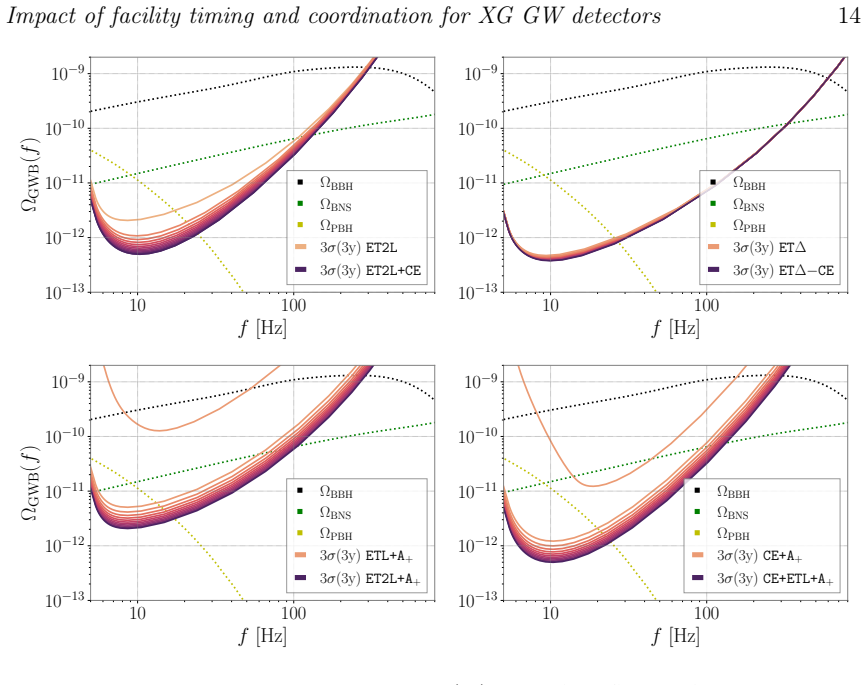
While the Einstein Telescope and Cosmic Explorer proposals for next-generation, ground-based detectors promise vastly improved sensitivities to gravitational-wave signals, only joint observations are expected to enable the full scientific potential of these facilities, making timing and coordination between the efforts crucial to avoid missed opportunities. This study investigates the impact of long-term delays on the scientific capabilities of next-generation detector networks. We use the Fisher information formalism to simulate the performance of a set of detector networks for large, fiducial populations of binary black holes, binary neutron stars, and primordial black-hole binaries. Bootstrapping the simulated populations, we map the expected observation times required to reach a number of observations fulfilling scientific targets for key sensitivity and localization metrics across various network configurations. We also investigate the sensitivity to stochastic backgrounds. We find that purely sensitivity-driven metrics such as the signal-to-noise ratio are not strongly affected by delays between facilities. This is contrasted by the localization metrics, which are very sensitive to the number of detectors in the network and, by extension, to delayed observation campaigns for a detector. Effectively, delays in one detector behave like network-wide interruptions for the localization metrics for networks consisting of two next-generation facilities. We examine the impact of a supporting, current-generation detector such as LIGO India operating concurrently with next-generation facilities and find such an addition will greatly mitigate the negative effects of delays for localization metrics, with important consequences on multi-messenger science and stochastic searches.
Editorial analysis
A structured set of objections, weighed in public.
Referee Report
Summary. The manuscript investigates the effects of long-term delays in the operation of next-generation gravitational-wave detectors (Einstein Telescope and Cosmic Explorer) on scientific performance using Fisher information formalism applied to fiducial populations of binary black holes, binary neutron stars, and primordial black hole binaries. It finds that sensitivity metrics like signal-to-noise ratio are minimally affected by delays, whereas localization metrics are highly sensitive, such that a delay in one detector acts similarly to a network-wide interruption for two-facility networks. The addition of a supporting detector like LIGO India is shown to mitigate these effects, with implications for multi-messenger astronomy and stochastic background searches.
Significance. If the quantitative results hold, this work provides actionable insights for the coordination of next-generation detector projects, emphasizing the importance of overlapping observation periods to achieve localization and multi-messenger science goals. The use of large-scale forward simulations with bootstrapping on fiducial populations and explicit consideration of stochastic backgrounds strengthens the planning recommendations.
major comments (2)
- [§4.2] §4.2 (Localization metrics and bootstrapping): The headline equivalence between single-facility delays and network-wide interruptions for localization thresholds is obtained by counting events that meet localization criteria under Fisher-matrix uncertainties. This count includes the single-NG-detector regime, where the approximation is least reliable because the timing baseline is absent, network SNR is lower, and posteriors are known to be non-Gaussian. A direct comparison of Fisher uncertainties against full likelihood sampling for a representative subset of events in the single-detector configuration is required to support the central claim.
- [§3.1] §3.1 (Fiducial populations): The quantitative mapping of observation times to scientific targets for localization depends on the specific mass, spin, and redshift distributions of the BBH, BNS, and PBH populations. These assumptions are stated only at a high level; without explicit parameter values or robustness checks against variations, the bootstrapped results for delayed networks cannot be fully assessed.
minor comments (2)
- [Abstract and §2] The abstract and §2 should explicitly state the noise curves and frequency bands adopted for each detector configuration to allow reproduction of the SNR and Fisher calculations.
- [Figure captions] Figure captions for the bootstrapped observation-time plots would benefit from a brief note on the number of resamples used and the percentile range shown.
Simulated Author's Rebuttal
We thank the referee for their careful reading of the manuscript and for the constructive comments, which have helped us identify areas for clarification and improvement. We address each major comment below.
read point-by-point responses
-
Referee: [§4.2] §4.2 (Localization metrics and bootstrapping): The headline equivalence between single-facility delays and network-wide interruptions for localization thresholds is obtained by counting events that meet localization criteria under Fisher-matrix uncertainties. This count includes the single-NG-detector regime, where the approximation is least reliable because the timing baseline is absent, network SNR is lower, and posteriors are known to be non-Gaussian. A direct comparison of Fisher uncertainties against full likelihood sampling for a representative subset of events in the single-detector configuration is required to support the central claim.
Authors: We agree that the Fisher-matrix approximation is known to be less accurate in the single next-generation detector regime, where the absence of a timing baseline and lower network SNR can produce non-Gaussian posteriors. Our central result—that delays in one facility affect localization metrics similarly to a network-wide interruption—is nevertheless a population-level statement driven primarily by the change in network geometry and the number of events that cross a fixed localization threshold. We will revise §4.2 to include an explicit discussion of the limitations of the Fisher formalism in this regime, together with references to existing validation studies. A direct comparison against full likelihood sampling for a representative subset would be a valuable addition but requires substantial additional computational resources that lie outside the scope of the present work; we therefore treat this as a partial revision by strengthening the caveats rather than performing the sampling. revision: partial
-
Referee: [§3.1] §3.1 (Fiducial populations): The quantitative mapping of observation times to scientific targets for localization depends on the specific mass, spin, and redshift distributions of the BBH, BNS, and PBH populations. These assumptions are stated only at a high level; without explicit parameter values or robustness checks against variations, the bootstrapped results for delayed networks cannot be fully assessed.
Authors: We thank the referee for this observation. In the revised manuscript we will expand §3.1 to list the explicit functional forms and parameter values adopted for the mass, spin, and redshift distributions of the three fiducial populations. We will also add a short robustness subsection that varies the dominant parameters (e.g., the BBH mass power-law index and the redshift evolution slope) and shows that the reported trends in observation time required to meet localization targets remain qualitatively unchanged. revision: yes
Circularity Check
No significant circularity detected
full rationale
The paper conducts forward simulations of fiducial BBH, BNS, and PBH populations using the Fisher information matrix to compute parameter uncertainties and observation times under different network configurations with and without delays. Bootstrapping is then applied to these simulated event counts to determine when localization and sensitivity targets are reached. No parameters are fitted to the target metrics themselves, no self-citations are invoked as load-bearing uniqueness theorems, and the core equivalence (delays in one detector acting like network interruptions for localization) emerges directly from comparing the simulated counts across configurations rather than by definitional reduction or renaming of prior results.
Axiom & Free-Parameter Ledger
free parameters (1)
- fiducial binary population parameters
axioms (1)
- domain assumption Fisher information matrix provides a reliable approximation to the covariance matrix of parameter estimates for gravitational-wave signals from compact binaries.
Lean theorems connected to this paper
-
IndisputableMonolith/Cost/FunctionalEquation.leanwashburn_uniqueness_aczel unclear?
unclearRelation between the paper passage and the cited Recognition theorem.
We use the Fisher information formalism to simulate the performance of a set of detector networks for large, fiducial populations of binary black holes, binary neutron stars, and primordial black-hole binaries. Bootstrapping the simulated populations, we map the expected observation times required to reach a number of observations fulfilling scientific targets for key sensitivity and localization metrics
-
IndisputableMonolith/Foundation/AlexanderDuality.leanalexander_duality_circle_linking unclear?
unclearRelation between the paper passage and the cited Recognition theorem.
The localization metrics, which are very sensitive to the number of detectors in the network and, by extension, to delayed observation campaigns for a detector. Effectively, delays in one detector behave like network-wide interruptions for the localization metrics for networks consisting of two next-generation facilities.
What do these tags mean?
- matches
- The paper's claim is directly supported by a theorem in the formal canon.
- supports
- The theorem supports part of the paper's argument, but the paper may add assumptions or extra steps.
- extends
- The paper goes beyond the formal theorem; the theorem is a base layer rather than the whole result.
- uses
- The paper appears to rely on the theorem as machinery.
- contradicts
- The paper's claim conflicts with a theorem or certificate in the canon.
- unclear
- Pith found a possible connection, but the passage is too broad, indirect, or ambiguous to say the theorem truly supports the claim.
Forward citations
Cited by 1 Pith paper
-
Not too close! Evaluating the impact of the baseline on the localization of binary black holes by next-generation gravitational-wave detectors
Baselines of 8-11 ms light travel time for two CE detectors provide a reasonable compromise for BBH sky localization, with third detectors eliminating multimodality for most or all events.
Reference graph
Works this paper leans on
-
[1]
C. S. Unnikrishnan,IndIGO and LIGO-India: Scope and plans for gravitational wave research and precision metrology in India,Int. J. Mod. Phys. D22(2013) 1341010 [1510.06059]
work page internal anchor Pith review Pith/arXiv arXiv 2013
-
[2]
LIGO Scientific, VirgoCollaboration,GWTC-1: A Gravitational-Wave Transient Catalog of Compact Binary Mergers Observed by LIGO and Virgo during the First and Second Observing Runs,Phys. Rev. X9(2019) 031040 [1811.12907]. [6]LIGO Scientific, VirgoCollaboration,GWTC-2: Compact Binary Coalescences Observed by LIGO and Virgo During the First Half of the Third ...
work page internal anchor Pith review Pith/arXiv arXiv 2019
-
[3]
LIGO Scientific, Virgo, KAGRACollaboration,GWTC-3: Compact Binary Coalescences Observed by LIGO and Virgo during the Second Part of the Third Observing Run,Phys. Rev. X13(2023) 041039 [2111.03606]. [8]LIGO Scientific, VIRGO, KAGRACollaboration,GWTC-4.0: Updating the Gravitational-Wave Transient Catalog with Observations from the First Part of the Fourth L...
work page internal anchor Pith review Pith/arXiv arXiv 2023
-
[4]
P. Fritschel, K. Kuns, J. Driggers, A. Effler, B. Lantz, D. Ottaway et al.,Report from the lsc post-o5 study group,Tech. Rep. LIGO-T2200287(2022)
work page 2022
-
[5]
Punturo et al.,The Einstein Telescope: A third-generation gravitational wave observatory, Class
M. Punturo et al.,The Einstein Telescope: A third-generation gravitational wave observatory, Class. Quant. Grav.27(2010) 194002
work page 2010
-
[6]
The Science of the Einstein Telescope
A. Abac et al.,The Science of the Einstein Telescope,Tech. Rep. ET-0036C-25(2025) [2503.12263]
work page internal anchor Pith review Pith/arXiv arXiv 2025
-
[7]
Cosmic Explorer: The U.S. Contribution to Gravitational-Wave Astronomy beyond LIGO
D. Reitze et al.,Cosmic Explorer: The U.S. Contribution to Gravitational-Wave Astronomy beyond LIGO,Bull. Am. Astron. Soc.51(2019) 035 [1907.04833]
work page internal anchor Pith review Pith/arXiv arXiv 2019
-
[8]
S. Borhanian and B. S. Sathyaprakash,Listening to the Universe with next generation ground-based gravitational-wave detectors,Phys. Rev. D110(2024) 083040 [2202.11048]
-
[9]
F. Iacovelli, M. Mancarella, S. Foffa and M. Maggiore,Forecasting the Detection Capabilities of Third-generation Gravitational-wave Detectors Using GWFAST,Astrophys. J.941(2022) 208 [2207.02771]
-
[10]
S. Ronchini, M. Branchesi, G. Oganesyan, B. Banerjee, U. Dupletsa, G. Ghirlanda et al., Perspectives for multimessenger astronomy with the next generation of gravitational-wave detectors and high-energy satellites,Astron. Astrophys.665(2022) A97 [2204.01746]
- [11]
-
[12]
Science with the Einstein Telescope: a comparison of different designs
M. Branchesi et al.,Science with the Einstein Telescope: a comparison of different designs,J. Cosmology Astropart. Phys.07(2023) 068 [2303.15923]
work page internal anchor Pith review Pith/arXiv arXiv 2023
-
[13]
A Horizon Study for Cosmic Explorer: Science, Observatories, and Community
M. Evans et al.,A Horizon Study for Cosmic Explorer: Science, Observatories, and Community,Tech. Rep. CE-P2100003(2021) [2109.09882]. Impact of facility timing and coordination for XG GW detectors26
work page internal anchor Pith review Pith/arXiv arXiv 2021
-
[14]
Evans et al.,Cosmic Explorer: A Submission to the NSF MPSAC ngGW Subcommittee, [2306.13745]
M. Evans et al.,Cosmic Explorer: A Submission to the NSF MPSAC ngGW Subcommittee, [2306.13745]
-
[15]
Characterization of binary black holes by heterogeneous gravitational-wave networks
S. Vitale and C. Whittle,Characterization of binary black holes by heterogeneous gravitational-wave networks,Phys. Rev. D98(2018) 024029 [1804.07866]
work page internal anchor Pith review Pith/arXiv arXiv 2018
-
[16]
S. Pandey, I. Gupta, K. Chandra and B. S. Sathyaprakash,The Critical Role of LIGO-India in the Era of Next-generation Observatories,Astrophys. J. Lett.985(2025) L17 [2411.10349]. [23]PlanckCollaboration,Planck 2018 results. VI. Cosmological parameters,Astron. Astrophys. 641(2020) A6 [1807.06209]
-
[17]
Borhanian,GWBENCH: a novel Fisher information package for gravitational-wave benchmarking,Class
S. Borhanian,GWBENCH: a novel Fisher information package for gravitational-wave benchmarking,Class. Quantum Grav.38(2021) 175014 [2010.15202]
-
[18]
C. Cutler and E. E. Flanagan,Gravitational waves from merging compact binaries: How accurately can one extract the binary’s parameters from the inspiral wave form?,Phys. Rev. D49(1994) 2658 [gr-qc/9402014]
work page internal anchor Pith review Pith/arXiv arXiv 1994
-
[19]
E. Poisson and C. M. Will,Gravitational waves from inspiraling compact binaries: Parameter estimation using second postNewtonian wave forms,Phys. Rev. D52(1995) 848 [gr-qc/9502040]
work page internal anchor Pith review Pith/arXiv arXiv 1995
-
[20]
R. Balasubramanian, B. S. Sathyaprakash and S. V. Dhurandhar,Gravitational waves from coalescing binaries: Detection strategies and Monte Carlo estimation of parameters,Phys. Rev. D53(1996) 3033 [gr-qc/9508011]
work page internal anchor Pith review Pith/arXiv arXiv 1996
-
[21]
V. De Renzis, F. Iacovelli, D. Gerosa, M. Mancarella and C. Pacilio,Forecasting the population properties of merging black holes,Phys. Rev. D111(2025) 044048 [2410.17325]
-
[22]
M. Vallisneri,Use and abuse of the Fisher information matrix in the assessment of gravitational-wave parameter-estimation prospects,Phys. Rev. D77(2008) 042001 [gr-qc/0703086]. [30]LIGO Scientific, VIRGO, KAGRACollaboration,GWTC-4.0: Population Properties of Merging Compact Binaries, [2508.18083]
work page internal anchor Pith review Pith/arXiv arXiv 2008
-
[23]
Ž. Ivezić, A. J. Connolly, J. T. VanderPlas and A. Gray,Statistics, Data Mining, and Machine Learning in Astronomy. A Practical Python Guide for the Analysis of Survey Data. Princeton, 2020, 10.1515/9780691197050
-
[24]
Sensitivity curves for searches for gravitational-wave backgrounds
E. Thrane and J. D. Romano,Sensitivity curves for searches for gravitational-wave backgrounds,Phys. Rev. D88(2013) 124032 [1310.5300]
work page internal anchor Pith review Pith/arXiv arXiv 2013
-
[25]
J. D. Romano and N. J. Cornish,Detection methods for stochastic gravitational-wave backgrounds: a unified treatment,Living Rev. Relativ.20(2017) 2 [1608.06889]
work page internal anchor Pith review Pith/arXiv arXiv 2017
-
[26]
C. García-Quirós, M. Colleoni, S. Husa, H. Estellés, G. Pratten, A. Ramos-Buades et al., Multimode frequency-domain model for the gravitational wave signal from nonprecessing black-hole binaries,Phys. Rev. D102(2020) 064002 [2001.10914]
-
[27]
C. García-Quirós, S. Husa, M. Mateu-Lucena and A. Borchers,Accelerating the evaluation of inspiral–merger–ringdown waveforms with adapted grids,Class. Quantum Grav.38(2021) 015006 [2001.10897]
- [28]
- [29]
-
[30]
2014, ARA&A, 52, 415, doi: 10.1146/annurev-astro-081811-125615
P. Madau and M. Dickinson,Cosmic Star Formation History,Annu. Rev. Astron. Astrophys. 52(2014) 415 [1403.0007]
work page internal anchor Pith review Pith/arXiv arXiv 2014
- [31]
-
[32]
A unified equation of state of dense matter and neutron star structure
F. Douchin and P. Haensel,A unified equation of state of dense matter and neutron star structure,Astron. Astrophys.380(2001) 151 [astro-ph/0111092]
work page internal anchor Pith review Pith/arXiv arXiv 2001
-
[33]
Bilby: A user-friendly Bayesian inference library for gravitational-wave astronomy
G. Ashton et al.,BILBY: A user-friendly Bayesian inference library for gravitational-wave astronomy,Astrophys. J. Supp. S.241(2019) 27 [1811.02042]
work page internal anchor Pith review Pith/arXiv arXiv 2019
- [34]
-
[35]
A. Escrivà, F. Kuhnel and Y. Tada,Primordial Black Holes, inBlack Holes in the Era of Gravitational-Wave Astronomy, Elsevier, (11, 2022), [2211.05767], DOI
-
[36]
T. Suyama and C.-M. Yoo,Overall Picture: A Beginner’s Guide to Primordial Black Hole Formation, inPrimordial Black Holes, Springer, (2025), DOI
work page 2025
-
[37]
M. Andrés-Carcasona, A. J. Iovino, V. Vaskonen, H. Veermäe, M. Martínez, O. Pujolàs et al., Constraints on primordial black holes from LIGO-Virgo-KAGRA O3 events,Phys. Rev. D 110(2024) 023040 [2405.05732]
- [38]
-
[39]
P. S. Cole and C. T. Byrnes,Extreme scenarios: the tightest possible constraints on the power spectrum due to primordial black holes,J. Cosmology Astropart. Phys.02(2018) 019 [1706.10288]
work page internal anchor Pith review Pith/arXiv arXiv 2018
-
[40]
Z.-C. Chen and A. Hall,Confronting Primordial Black Holes with LIGO-Virgo-KAGRA and the Einstein Telescope, inPrimordial Black Holes, Springer, (2025), [2402.03934], DOI
-
[41]
F. Iacovelli and M. Maggiore,Gravitational-Wave Observations and Primordial Black Holes, in Primordial Black Holes, Springer, (2025), [2407.21442], DOI
-
[42]
Formation and Evolution of Primordial Black Hole Binaries in the Early Universe
M. Raidal, C. Spethmann, V. Vaskonen and H. Veermäe,Formation and Evolution of Primordial Black Hole Binaries in the Early Universe,J. Cosmology Astropart. Phys.02 (2019) 018 [1812.01930]
work page internal anchor Pith review Pith/arXiv arXiv 2019
-
[43]
Gravitational Waves from Primordial Black Hole Mergers
M. Raidal, V. Vaskonen and H. Veermäe,Gravitational Waves from Primordial Black Hole Mergers,J. Cosmology Astropart. Phys.09(2017) 037 [1707.01480]
work page internal anchor Pith review Pith/arXiv arXiv 2017
-
[44]
S. Mukherjee and J. Silk,Can we distinguish astrophysical from primordial black holes via the stochastic gravitational wave background?,Mon. Not. R. Astron. Soc.506(2021) 3977 [2105.11139]
-
[45]
S. Mukherjee, M. S. P. Meinema and J. Silk,Prospects of discovering subsolar primordial black holes using the stochastic gravitational wave background from third-generation detectors, Mon. Not. R. Astron. Soc.510(2022) 6218 [2107.02181]
-
[46]
The astrophysical gravitational wave stochastic background
T. Regimbau,The astrophysical gravitational wave stochastic background,Res. Astron. Astrophys.11(2011) 369 [1101.2762]
work page internal anchor Pith review Pith/arXiv arXiv 2011
-
[47]
T. Callister, M. Fishbach, D. Holz and W. Farr,Shouts and Murmurs: Combining Individual Gravitational-Wave Sources with the Stochastic Background to Measure the History of Binary Black Hole Mergers,Astrophys. J. Lett.896(2020) L32 [2003.12152]
-
[48]
T. Regimbau,The Quest for the Astrophysical Gravitational-Wave Background with Terrestrial Detectors,Symmetry14(2022) 270
work page 2022
- [49]
-
[50]
M. Ebersold, T. Regimbau and N. Christensen,Next-generation global gravitational-wave detector network: Impact of detector orientation on compact binary coalescence and stochastic gravitational-wave background searches,Phys. Rev. D110(2024) 122006 [2408.06032]
-
[51]
E. S. Phinney,A Practical theorem on gravitational wave backgrounds, [astro-ph/0108028]. Impact of facility timing and coordination for XG GW detectors28
work page internal anchor Pith review Pith/arXiv arXiv
- [52]
- [53]
-
[54]
dcc.cosmicexplorer.org/CE-T2000017-v7
CE 40km noise curve. dcc.cosmicexplorer.org/CE-T2000017-v7
-
[55]
dcc.cosmicexplorer.org/public/0163/T2000007/005
A+ noise curve. dcc.cosmicexplorer.org/public/0163/T2000007/005
- [56]
-
[57]
M. Mancarella, F. Iacovelli and D. Gerosa,Inferring, not just detecting: Metrics for high-redshift sources observed with third-generation gravitational-wave detectors,Phys. Rev. D107(2023) L101302 [2303.16323]
- [58]
-
[59]
Stasenko,Redshift evolution of primordial black hole merger rate,Phys
V. Stasenko,Redshift evolution of primordial black hole merger rate,Phys. Rev. D109(2024) 123546 [2403.11325]
-
[60]
B. Allen and J. D. Romano,Detecting a stochastic background of gravitational radiation: Signal processing strategies and sensitivities,Phys. Rev. D59(1999) 102001 [gr-qc/9710117]
work page internal anchor Pith review Pith/arXiv arXiv 1999
- [61]
-
[62]
M. Muratore, O. Hartwig, D. Vetrugno, S. Vitale and W. J. Weber,Effectiveness of null time-delay interferometry channels as instrument noise monitors in LISA,Phys. Rev. D107 (2023) 082004 [2207.02138]
-
[63]
T. Regimbau, M. Evans, N. Christensen, E. Katsavounidis, B. Sathyaprakash and S. Vitale, Digging deeper: Observing primordial gravitational waves below the binary black hole produced stochastic background,Phys. Rev. Lett.118(2017) 151105 [1611.08943]
work page internal anchor Pith review Pith/arXiv arXiv 2017
-
[64]
S. Sachdev, T. Regimbau and B. S. Sathyaprakash,Subtracting compact binary foreground sources to reveal primordial gravitational-wave backgrounds,Phys. Rev. D102(2020) 024051 [2002.05365]
-
[65]
K. Martinovic, P. M. Meyers, M. Sakellariadou and N. Christensen,Simultaneous estimation of astrophysical and cosmological stochastic gravitational-wave backgrounds with terrestrial detectors,Phys. Rev. D103(2021) 043023 [2011.05697]
-
[66]
S. Biscoveanu, C. Talbot, E. Thrane and R. Smith,Measuring the primordial gravitational-wave background in the presence of astrophysical foregrounds,Phys. Rev. Lett. 125(2020) 241101 [2009.04418]
- [67]
- [68]
- [69]
-
[70]
E. Belgacem, F. Iacovelli, M. Maggiore, M. Mancarella and N. Muttoni,Confusion noise from astrophysical backgrounds at third-generation gravitational-wave detector networks, [2411.04029]
-
[71]
H. Zhong, L. Reali, B. Zhou, E. Berti and V. Mandic,Two-Step Procedure to Detect Cosmological Gravitational Wave Backgrounds with Next-Generation Terrestrial Gravitational-Wave Detectors,Phys. Rev. Lett.135(2025) 111401 [2501.17717]. Impact of facility timing and coordination for XG GW detectors29
- [72]
-
[73]
S. Bhagwat, C. Pacilio, P. Pani and M. Mapelli,Landscape of stellar-mass black-hole spectroscopy with third-generation gravitational-wave detectors,Phys. Rev. D108(2023) 043019 [2304.02283]
-
[74]
Black hole spectroscopy: from theory to experiment
E. Berti et al.,Black hole spectroscopy: from theory to experiment, [2505.23895]
work page internal anchor Pith review Pith/arXiv arXiv
-
[75]
M. Maggiore, F. Iacovelli, E. Belgacem, M. Mancarella and N. Muttoni,Comparison of global networks of third-generation gravitational-wave detectors, [2411.05754]
discussion (0)
Sign in with ORCID, Apple, or X to comment. Anyone can read and Pith papers without signing in.