Creating Impactful Autonomous Driving Datasets: A Strategic Guide from Research Gap to Benchmark
Pith reviewed 2026-07-02 14:13 UTC · model grok-4.3
The pith
Impactful autonomous driving datasets begin with diagnosing whether a research question faces a data problem or an evaluation problem, then applying the cheapest operators to close the gap.
A machine-rendered reading of the paper's core claim, the machinery that carries it, and where it could break.
Core claim
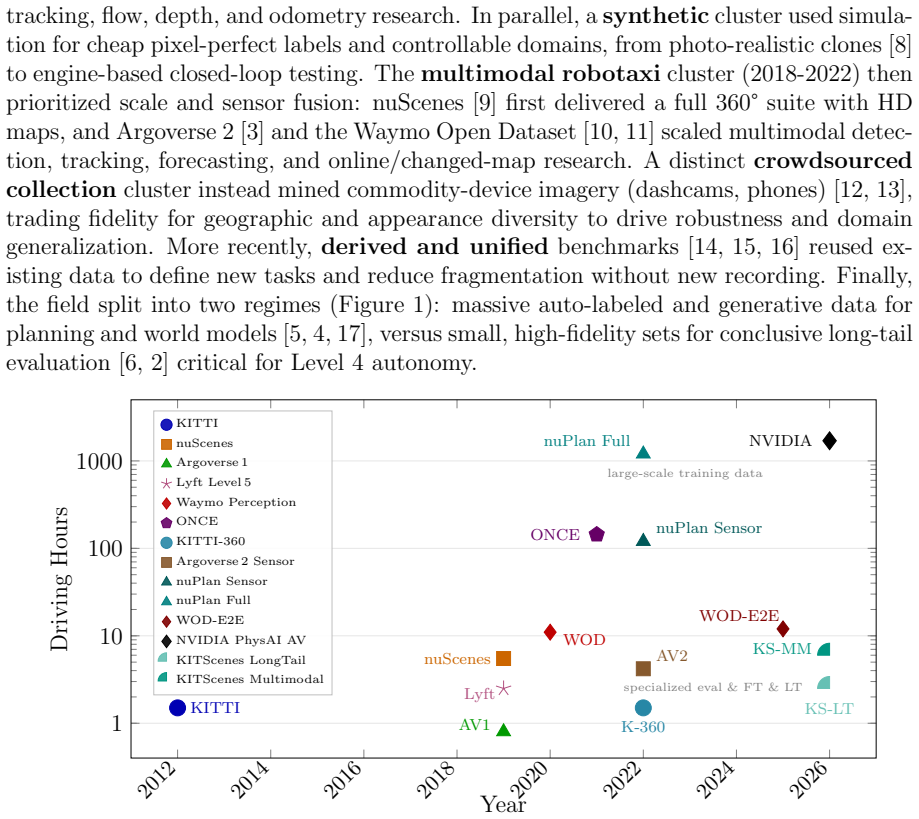
The central claim is that impactful dataset creation begins with a diagnosis: whether a research question is blocked by a data problem or an evaluation problem, and proceeds by selecting the minimal data operator(s) that closes the resulting gap, recording new data only when no cheaper operator(s) suffices. The authors analyze the evolution of major autonomous driving datasets through this lens and distill a strategic framework spanning gap identification, operator choice, sensor suite design, and annotation strategy, which they ground in their KITScenes case study.
What carries the argument
The diagnosis step that distinguishes data problems from evaluation problems, followed by selection of the minimal data operator(s) needed to close the identified gap.
If this is right
- Dataset projects should begin by stating the precise research question and classifying its blockage before choosing sensors or collection methods.
- Re-annotation, augmentation, or re-use of existing recordings should be evaluated first whenever they can close the gap at lower cost.
- Sensor suite and annotation decisions follow from the chosen operators rather than preceding them.
- Analysis of past datasets reveals which operator sequences produced lasting benchmarks and which did not.
- Smaller teams can allocate resources more predictably by treating new data recording as the final rather than default option.
Where Pith is reading between the lines
- The same diagnosis-plus-minimal-operator logic could be tested in non-driving domains such as medical imaging or natural language datasets to check transferability.
- Impact metrics such as citation patterns or downstream algorithm improvements could be compared between datasets that followed the framework and those that did not.
- The framework implies that many existing datasets may contain excess data whose collection could have been avoided by earlier operator choices.
Load-bearing premise
The primary and generalizable method for creating impactful datasets is this initial diagnosis of the blockage type followed by minimal operator selection.
What would settle it
A dataset created without performing the gap diagnosis or without restricting itself to minimal operators that nevertheless produces higher research impact than comparable datasets built with the process would undermine the claim.
Figures
read the original abstract
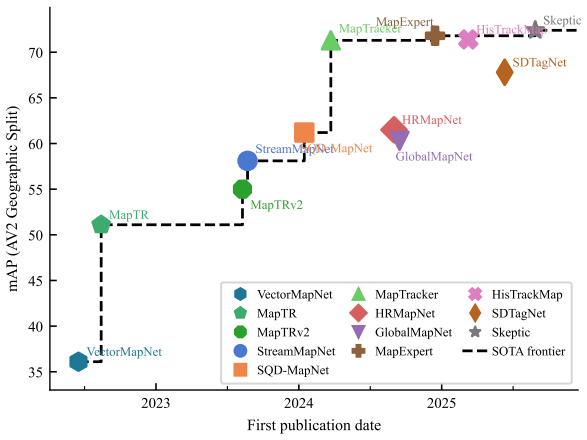
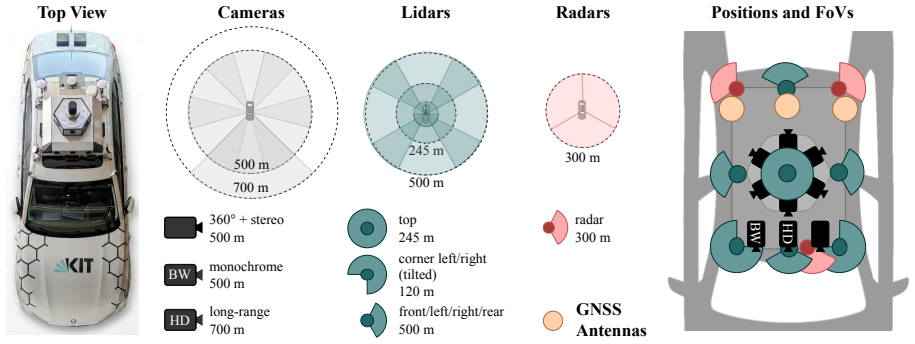
Well-designed autonomous driving datasets have fundamentally shaped research progress, yet existing literature primarily describes what datasets contain rather than how to strategically design impactful ones. This is especially limiting for small and medium-sized labs and startups that cannot afford to misallocate scarce resources. We argue that impactful dataset creation begins with a diagnosis: whether a research question is blocked by a data problem or an evaluation problem, and proceeds by selecting the minimal data operator(s) that closes the resulting gap, recording new data only when no cheaper operator(s) suffices. We analyze the evolution of major autonomous driving (AD) datasets through this lens and distill a strategic framework spanning gap identification, operator choice, sensor suite design, and annotation strategy. We ground the framework in a running case study of our KITScenes dataset family. The datasets are available at: https://kitscenes.com/
Editorial analysis
A structured set of objections, weighed in public.
Referee Report
Summary. The paper claims that impactful autonomous driving (AD) dataset creation begins with diagnosing whether a research question faces a data problem or an evaluation problem, followed by selecting the minimal data operator(s) to close the gap, with new data recording used only when cheaper operators are insufficient. It supports this by retrospectively analyzing the evolution of major AD datasets through this lens, distilling a framework covering gap identification, operator choice, sensor suite design, and annotation strategy, and grounding the approach in a case study of the authors' KITScenes dataset family.
Significance. If the proposed diagnosis-plus-minimal-operator framework holds and generalizes, it could help smaller labs and startups allocate resources more efficiently when creating AD datasets, potentially increasing the rate of targeted, high-impact contributions. The paper's open release of the KITScenes datasets is a concrete positive contribution that enables community follow-up.
major comments (3)
- [§4 and §5] §4 (framework distillation) and §5 (KITScenes case study): The central claim that the diagnosis step plus minimal-operator selection reliably yields more impactful datasets than alternatives rests on post-hoc reframing of existing datasets and a single self-authored case study. No forward test, controlled comparison against alternative design processes, or external replication is reported, so the optimality of the minimality criterion remains unverified.
- [§3] §3 (evolution analysis): The mapping of historical dataset decisions onto the proposed 'data operator' taxonomy is presented as evidence for the framework, but the taxonomy itself is introduced in the same section; this creates a risk that the analysis is shaped by the framework rather than independently motivating it.
- [§2] §2 (gap identification): The distinction between 'data problem' and 'evaluation problem' is introduced without an operational, reproducible procedure or decision criteria; without such a procedure the diagnosis step cannot be applied consistently by other teams, undermining the claim that the framework is strategic and generalizable.
minor comments (2)
- The abstract states that the datasets are available at https://kitscenes.com/; the manuscript should include a permanent DOI or archival link in addition to the URL.
- Notation for 'data operators' is introduced without a compact tabular summary of all operators considered; adding such a table would improve readability when the framework is applied to new research questions.
Simulated Author's Rebuttal
We thank the referee for the constructive feedback highlighting areas where the framework's presentation and evidential basis can be strengthened. We address each major comment below, proposing targeted revisions to improve clarity, structure, and operational guidance while preserving the paper's core contribution as a retrospective strategic guide.
read point-by-point responses
-
Referee: [§4 and §5] §4 (framework distillation) and §5 (KITScenes case study): The central claim that the diagnosis step plus minimal-operator selection reliably yields more impactful datasets than alternatives rests on post-hoc reframing of existing datasets and a single self-authored case study. No forward test, controlled comparison against alternative design processes, or external replication is reported, so the optimality of the minimality criterion remains unverified.
Authors: We agree that the framework's support is retrospective, drawn from historical dataset analysis and our KITScenes case study, without prospective or controlled validation of optimality. The manuscript presents this as a distilled strategic approach rather than an empirically proven optimal method. In revision we will add an explicit limitations subsection in §4 or §6 clarifying the evidential basis, tempering claims about reliability, and outlining the need for future forward tests or external replications. This addresses the concern without requiring new experiments. revision: partial
-
Referee: [§3] §3 (evolution analysis): The mapping of historical dataset decisions onto the proposed 'data operator' taxonomy is presented as evidence for the framework, but the taxonomy itself is introduced in the same section; this creates a risk that the analysis is shaped by the framework rather than independently motivating it.
Authors: The taxonomy was derived bottom-up from patterns observed across dataset histories, but we recognize the risk of circular presentation. We will restructure §3 to first describe the raw evolution and decision patterns in major AD datasets independently of the taxonomy, then introduce the taxonomy as a formalization of those patterns, and finally map the datasets onto it. This separation will make the independent motivation explicit. revision: yes
-
Referee: [§2] §2 (gap identification): The distinction between 'data problem' and 'evaluation problem' is introduced without an operational, reproducible procedure or decision criteria; without such a procedure the diagnosis step cannot be applied consistently by other teams, undermining the claim that the framework is strategic and generalizable.
Authors: We accept that greater operational detail is needed for reproducibility. In the revised §2 we will include explicit decision criteria, a step-by-step checklist, and a simple flowchart for distinguishing data versus evaluation problems, illustrated with examples drawn from the historical analysis in §3. This will make the diagnosis step actionable for other teams. revision: yes
Circularity Check
No significant circularity; framework derived from external dataset analysis
full rationale
The paper derives its strategic framework by analyzing the evolution of major existing autonomous driving datasets through the proposed diagnosis-and-minimal-operator lens, then illustrates the framework via its own KITScenes case study. No equations, fitted parameters, or self-citation chains are present that reduce any central claim to its own inputs by construction. The derivation remains self-contained against the analyzed external datasets and does not rely on renaming, smuggling ansatzes, or load-bearing self-references that would force the result.
Axiom & Free-Parameter Ledger
axioms (2)
- domain assumption Research questions in autonomous driving can be classified as blocked by either a data problem or an evaluation problem.
- ad hoc to paper Selecting the minimal data operator(s) is the optimal way to close the gap.
invented entities (1)
-
data operator
no independent evidence
Reference graph
Works this paper leans on
-
[1]
The Road Ahead in Autonomous Driving: The KITScenes Multimodal Dataset
R. Schwarzkopf, F. Immel, A. Blumberg, J. Merkert, N. Rack, K. Wang, F. Konstantinidis, J. Truetsch, C. Fernandez, A. B¨ atz, K. R¨ osch, M. Steiner, W. Poh, Y. Shen, R. Wagner, F. Hauser, D. Strutz, J. Villa, G. Stepanov, H. Caesar, ¨Omer S ¸ahin Ta¸ s, F. Bieder, J.-H. Pauls, and C. Stiller, “The road ahead in autonomous driving: The kitscenes multimoda...
work page internal anchor Pith review Pith/arXiv arXiv 2026
-
[2]
LongTail Driving Scenarios with Reasoning Traces: The KITScenes LongTail Dataset
R. Wagner, O. S. Tas, J. Villa, F. Hauser, Y. Shen, M. Steiner, D. Strutz, C. Fernandez, C. Kinzig, G. S. Guitierrez-Cabello, H. K¨ onigshof, F. Immel, R. Schwarzkopf, N. A. Rack, K. R¨ osch, K. Wang, J.-H. Pauls, M. Lauer, I. Gilitschenski, H. Caesar, and C. Stiller, “Longtail driving scenarios with reasoning traces: The kitscenes longtail dataset,” 2026...
work page internal anchor Pith review Pith/arXiv arXiv 2026
-
[3]
Argoverse 2: Next generation datasets for self- driving perception and forecasting,
B. Wilson, W. Qi, T. Agarwal, J. Lambert, J. Singh, S. Khandelwal, B. Pan, R. Kumar, A. Hartnett, J. K. Pontes, D. Ramanan, P. Carr, and J. Hays, “Argoverse 2: Next generation datasets for self- driving perception and forecasting,” inProceedings of the Neural Information Processing Systems Track on Datasets and Benchmarks (NeurIPS Datasets and Benchmarks ...
2021
-
[4]
NVIDIA Autonomous Vehicle Dataset,
PhysicalAI Autonomous Vehicles, “NVIDIA Autonomous Vehicle Dataset,” 2025, accessed: 2026-01-
2025
-
[5]
Available: https://huggingface.co/datasets/nvidia/PhysicalAI-Autonomous-Vehicles
[Online]. Available: https://huggingface.co/datasets/nvidia/PhysicalAI-Autonomous-Vehicles
-
[6]
Towards learning-based planning: The nuplan benchmark for real-world autonomous driving,
N. Karnchanachari, D. Geromichalos, K. S. Tan, N. Li, C. Eriksen, S. Yaghoubi, N. Mehdipour, G. Bernasconi, W. K. Fong, Y. Guo, and H. Caesar, “Towards learning-based planning: The nuplan benchmark for real-world autonomous driving,” in2024 IEEE International Conference on Robotics and Automation (ICRA), 2024, pp. 629–636
2024
-
[7]
Vision-based End-to-End Driving Challenge 2025,
Waymo Open Dataset, “Vision-based End-to-End Driving Challenge 2025,” 2025, accessed: 2025-11-01. [Online]. Available: https://waymo.com/open/challenges/2025/e2e-driving
2025
-
[8]
Are we ready for autonomous driving? the kitti vision bench- mark suite,
A. Geiger, P. Lenz, and R. Urtasun, “Are we ready for autonomous driving? the kitti vision bench- mark suite,” in2012 IEEE Conference on Computer Vision and Pattern Recognition, 2012, pp. 3354–3361
2012
-
[9]
Virtual worlds as proxy for multi-object tracking analysis,
A. Gaidon, Q. Wang, Y. Cabon, and E. Vig, “Virtual worlds as proxy for multi-object tracking analysis,” inCVPR, 2016
2016
-
[10]
nuscenes: A multimodal dataset for autonomous driving,
H. Caesar, V. Bankiti, A. H. Lang, S. Vora, V. E. Liong, Q. Xu, A. Krishnan, Y. Pan, G. Baldan, and O. Beijbom, “nuscenes: A multimodal dataset for autonomous driving,” inProceedings of the IEEE/CVF Conference on Computer Vision and Pattern Recognition (CVPR), June 2020
2020
-
[11]
Scalability in perception for autonomous driving: Waymo open dataset,
P. Sun, H. Kretzschmar, X. Dotiwalla, A. Chouard, V. Patnaik, P. Tsui, J. Guo, Y. Zhou, Y. Chai, B. Caine, V. Vasudevan, W. Han, J. Ngiam, H. Zhao, A. Timofeev, S. Ettinger, M. Krivokon, A. Gao, A. Joshi, Y. Zhang, J. Shlens, Z. Chen, and D. Anguelov, “Scalability in perception for autonomous driving: Waymo open dataset,” inProceedings of the IEEE/CVF Con...
2020
-
[12]
Large scale interactive motion forecasting for autonomous driving: The waymo open motion da- taset,
S. Ettinger, S. Cheng, B. Caine, C. Liu, H. Zhao, S. Pradhan, Y. Chai, B. Sapp, C. R. Qi, Y. Zhou, Z. Yang, A. Chouard, P. Sun, J. Ngiam, V. Vasudevan, A. McCauley, J. Shlens, and D. Anguelov, “Large scale interactive motion forecasting for autonomous driving: The waymo open motion da- taset,” inProceedings of the IEEE/CVF International Conference on Comp...
2021
-
[13]
BDD100K: A diverse driving dataset for heterogeneous multitask learning,
F. Yu, H. Chen, X. Wang, W. Xian, Y. Chen, F. Liu, V. Madhavan, and T. Darrell, “BDD100K: A diverse driving dataset for heterogeneous multitask learning,” inProceedings of the IEEE/CVF Conference on Computer Vision and Pattern Recognition (CVPR), 2020
2020
-
[14]
The mapillary vistas dataset for semantic understanding of street scenes,
G. Neuhold, T. Ollmann, S. Rota Bul` o, and P. Kontschieder, “The mapillary vistas dataset for semantic understanding of street scenes,” inProceedings of the IEEE International Conference on Computer Vision (ICCV), 2017, pp. 5000–5009
2017
-
[15]
Openlane- v2: A topology reasoning benchmark for unified 3d hd mapping,
H. Wang, T. Li, Y. Li, L. Chen, C. Sima, Z. Liu, B. Wang, P. Jia, Y. Wang, S. Jianget al., “Openlane- v2: A topology reasoning benchmark for unified 3d hd mapping,” inThirty-seventh Conference on Neural Information Processing Systems Datasets and Benchmarks Track, 2023
2023
-
[16]
Argotweak: Towards self-updating hd maps through struc- tured priors,
L. Wild, R. Valencia, and P. Jensfelt, “Argotweak: Towards self-updating hd maps through struc- tured priors,” inProceedings of the IEEE/CVF International Conference on Computer Vision (ICCV), 2025
2025
-
[17]
123D: Unifying Multi-Modal Autonomous Driving Data at Scale
D. Dauner, V. Charraut, B. Berle, T. Li, L. Nguyen, J. Wang, C. Jing, M. Igl, H. Caesar, B. Ivanovic, A. Geiger, and K. Chitta, “123d: Unifying multi-modal autonomous driving data at scale,”arXiv preprint arXiv:2605.08084, 2026
work page internal anchor Pith review Pith/arXiv arXiv 2026
-
[18]
Cosmos-drive-dreams: Scalable synthetic driving data generation with world foundation models,
X. Ren, Y. Lu, T. Cao, R. Gao, S. Huang, A. Sabour, T. Shen, T. Pfaff, J. Z. Wu, R. Chen, S. W. Kim, J. Gao, L. Leal-Taixe, M. Chen, S. Fidler, and H. Ling, “Cosmos-drive-dreams: Scalable synthetic driving data generation with world foundation models,” 2025. [Online]. Available: https://arxiv.org/abs/2506.09042
-
[19]
Lanelet2: A high-definition map framework for the future of automated driving,
F. Poggenhans, J.-H. Pauls, J. Janosovits, S. Orf, M. Naumann, F. Kuhnt, and M. Mayr, “Lanelet2: A high-definition map framework for the future of automated driving,” in2018 21st International Conference on Intelligent Transportation Systems (ITSC), Hawaii, USA, November 2018, pp. 1672–1679. [Online]. Available: http://www.mrt.kit.edu/z/publ/download/ 201...
2018
-
[20]
The cityscapes dataset for semantic urban scene understanding,
M. Cordts, M. Omran, S. Ramos, T. Rehfeld, M. Enzweiler, R. Benenson, U. Franke, S. Roth, and B. Schiele, “The cityscapes dataset for semantic urban scene understanding,” inProc. of the IEEE Conference on Computer Vision and Pattern Recognition (CVPR), 2016
2016
-
[21]
KITTI-360: A novel dataset and benchmarks for urban scene understanding in 2d and 3d,
Y. Liao, J. Xie, and A. Geiger, “KITTI-360: A novel dataset and benchmarks for urban scene understanding in 2d and 3d,”Pattern Analysis and Machine Intelligence (PAMI), 2022
2022
-
[22]
Se- manticKITTI: A dataset for semantic scene understanding of LiDAR sequences,
J. Behley, M. Garbade, A. Milioto, J. Quenzel, S. Behnke, C. Stachniss, and J. Gall, “Se- manticKITTI: A dataset for semantic scene understanding of LiDAR sequences,” inProceedings of the IEEE/CVF International Conference on Computer Vision (ICCV), 2019
2019
-
[23]
The ApolloScape open dataset for autonomous driving and its application,
X. Huang, P. Wang, X. Cheng, D. Zhou, Q. Geng, and R. Yang, “ The ApolloScape Open Dataset for Autonomous Driving and Its Application ,”IEEE Transactions on Pattern Analysis & Machine Intelligence, vol. 42, no. 10, pp. 2702–2719, Oct. 2020. [Online]. Available: https://doi.ieeecomputersociety.org/10.1109/TPAMI.2019.2926463
-
[24]
CARLA: An open urban driving simulator,
A. Dosovitskiy, G. Ros, F. Codevilla, A. Lopez, and V. Koltun, “CARLA: An open urban driving simulator,” inProceedings of the 1st Annual Conference on Robot Learning (CoRL), ser. Proceedings of Machine Learning Research, vol. 78. PMLR, 2017, pp. 1–16
2017
-
[25]
Bench2drive: Towards multi-ability benchmarking of closed-loop end-to-end autonomous driving,
X. Jia, Z. Yang, Q. Li, Z. Zhang, and J. Yan, “Bench2drive: Towards multi-ability benchmarking of closed-loop end-to-end autonomous driving,” inNeurIPS 2024 Datasets and Benchmarks Track, 2024
2024
-
[26]
Argoverse: 3d tracking and forecasting with rich maps,
M.-F. Chang, J. W. Lambert, P. Sangkloy, J. Singh, S. Bak, A. Hartnett, D. Wang, P. Carr, S. Lucey, D. Ramanan, and J. Hays, “Argoverse: 3d tracking and forecasting with rich maps,” inConference on Computer Vision and Pattern Recognition (CVPR), 2019
2019
-
[27]
One thousand and one hours: Self-driving motion prediction dataset,
J. Houston, G. Zuidhof, L. Bergamini, Y. Ye, L. Chen, A. Jain, S. Omari, V. Iglovikov, and P. On- druska, “One thousand and one hours: Self-driving motion prediction dataset,” inProceedings of the 2020 Conference on Robot Learning (CoRL), ser. Proceedings of Machine Learning Research, vol
2020
-
[28]
PMLR, 2021, pp. 409–418
2021
-
[29]
One million scenes for autonomous driving: Once dataset,
J. Mao, N. Minzhe, C. Jiang, h. liang, J. Chen, X. Liang, Y. Li, C. Ye, W. Zhang, Z. Li, J. Yu, C. XU, and H. Xu, “One million scenes for autonomous driving: Once dataset,” inProceedings of the Neural Information Processing Systems Track on Datasets and Benchmarks, J. Vanschoren and S. Yeung, Eds., vol. 1, 2021. [Online]. Available: https://datasets-bench...
2021
-
[30]
Zenseact open dataset: A large-scale and diverse multimodal dataset for autonomous driving,
M. Alibeigi, W. Ljungbergh, A. Tonderski, G. Hess, A. Lilja, C. Lindstrom, D. Motorniuk, J. Fu, J. Widahl, and C. Petersson, “Zenseact open dataset: A large-scale and diverse multimodal dataset for autonomous driving,” inProceedings of the IEEE/CVF International Conference on Computer Vision, 2023
2023
-
[31]
PandaSet: Advanced sensor suite dataset for autonomous driving,
P. Xiao, Z. Shao, S. Hao, Z. Zhang, X. Chai, J. Jiao, Z. Li, J. Wu, K. Sun, K. Jiang, Y. Wang, and D. Yang, “PandaSet: Advanced sensor suite dataset for autonomous driving,” in2021 IEEE International Intelligent Transportation Systems Conference (ITSC), 2021, pp. 3095–3101
2021
-
[32]
A2D2: Audi autonomous driving dataset,
J. Geyer, Y. Kassahun, M. Mahmudi, X. Ricou, R. Durgesh, A. S. Chung, L. Hauswald, V. H. Pham, M. M¨ uhlegg, S. Dorn, T. Fernandez, M. J¨ anicke, S. Mirashi, C. Savani, M. Sturm, O. Vorobiov, M. Oelker, S. Garreis, and P. Schuberth, “A2D2: Audi autonomous driving dataset,”
-
[33]
Available: https://www.a2d2.audi
[Online]. Available: https://www.a2d2.audi
-
[34]
A commute in data: The comma2k19 dataset,
H. Schafer, E. Santana, A. Haden, and R. Biasini, “A commute in data: The comma2k19 dataset,” 2018
2018
-
[35]
NAVSIM: Data-driven non-reactive autonomous vehicle simulation and benchmarking,
D. Dauner, M. Hallgarten, T. Li, X. Weng, Z. Huang, Z. Yang, H. Li, I. Gilitschenski, B. Ivanovic, M. Pavone, A. Geiger, and K. Chitta, “NAVSIM: Data-driven non-reactive autonomous vehicle simulation and benchmarking,” inAdvances in Neural Information Processing Systems (NeurIPS), 2024
2024
-
[36]
NeuroNCAP: Photorealistic closed-loop safety testing for autonomous driving,
W. Ljungbergh, A. Tonderski, J. Johnander, H. Caesar, K. ˚Astr¨ om, M. Felsberg, and C. Petersson, “NeuroNCAP: Photorealistic closed-loop safety testing for autonomous driving,” inProceedings of the European Conference on Computer Vision (ECCV). Springer, 2024, pp. 161–177
2024
-
[37]
Maptr: Structured modeling and learning for online vectorized hd map construction,
B. Liao, S. Chen, X. Wang, T. Cheng, Q. Zhang, W. Liu, and C. Huang, “Maptr: Structured modeling and learning for online vectorized hd map construction,” inThe Eleventh International Conference on Learning Representations, 2022
2022
-
[38]
Maptrv2: An end-to-end framework for online vectorized hd map construction,
B. Liao, S. Chen, Y. Zhang, B. Jiang, Q. Zhang, W. Liu, C. Huang, and X. Wang, “Maptrv2: An end-to-end framework for online vectorized hd map construction,”International Journal of Computer Vision, Oct 2024. [Online]. Available: https://doi.org/10.1007/s11263-024-02235-z
-
[39]
Streammapnet: Streaming mapping network for vectorized online hd map construction,
T. Yuan, Y. Liu, Y. Wang, Y. Wang, and H. Zhao, “Streammapnet: Streaming mapping network for vectorized online hd map construction,” inProceedings of the IEEE/CVF Winter Conference on Applications of Computer Vision, 2024, pp. 7356–7365
2024
-
[40]
Stream query denoising for vectorized hd-map construction,
S. Wang, F. Jia, W. Mao, Y. Liu, Y. Zhao, Z. Chen, T. Wang, C. Zhang, X. Zhang, and F. Zhao, “Stream query denoising for vectorized hd-map construction,” inEuropean Conference on Computer Vision. Springer, 2024, pp. 203–220
2024
-
[41]
Maptracker: Tracking with strided memory fusion for consistent vector hd mapping,
J. Chen, Y. Wu, J. Tan, H. Ma, and Y. Furukawa, “Maptracker: Tracking with strided memory fusion for consistent vector hd mapping,” inComputer Vision – ECCV 2024, A. Leonardis, E. Ricci, S. Roth, O. Russakovsky, T. Sattler, and G. Varol, Eds. Cham: Springer Nature Switzerland, 2025, pp. 90–107
2024
-
[42]
Enhancing vectorized map perception with historical rasterized maps,
X. Zhang, G. Liu, Z. Liu, N. Xu, Y. Liu, and J. Zhao, “Enhancing vectorized map perception with historical rasterized maps,” inEuropean Conference on Computer Vision. Springer, 2024, pp. 422–439
2024
-
[43]
Globalmapnet: An online framework for vectorized global hd map construction,
A. Shi, Y. Cai, X. Chen, J. Pu, Z. Fu, and H. Lu, “Globalmapnet: An online framework for vectorized global hd map construction,”arXiv preprint arXiv:2409.10063, 2024
-
[44]
Mapexpert: Online hd map construction with simple and efficient sparse map element expert,
D. Zhang, D. Chen, P. Zhi, Y. Chen, Z. Yuan, C. Li, R. Zhou, Q. Zhouet al., “Mapexpert: Online hd map construction with simple and efficient sparse map element expert,” inProceedings of the AAAI Conference on Artificial Intelligence, vol. 39, no. 14, 2025, pp. 14 745–14 753
2025
-
[45]
Histrackmap: Global vectorized high-definition map construction via history map tracking,
J. Yang, S. Yang, X. Tan, and H. Wang, “Histrackmap: Global vectorized high-definition map construction via history map tracking,”arXiv preprint arXiv:2503.07168, 2025
-
[46]
SDTagnet: Leveraging text-annotated navigation maps for online HD map construction,
F. Immel, J.-H. Pauls, R. Fehler, F. Bieder, J. Merkert, and C. Stiller, “SDTagnet: Leveraging text-annotated navigation maps for online HD map construction,” inThe Thirty-ninth Annual Conference on Neural Information Processing Systems, 2025. [Online]. Available: https://openreview.net/forum?id=N3E1cU8Cv3
2025
-
[47]
Mapping like a skeptic: Probabilistic bev projection for online hd mapping,
F. Erdo˘ gan, M. R. Barın, and F. G¨ uney, “Mapping like a skeptic: Probabilistic bev projection for online hd mapping,”arXiv preprint arXiv:2508.21689, 2025
-
[48]
Gtsign-220: A crowd-sourced, stvo-aligned benchmark for fine-grained german traffic sign recognition,
M. L. Carnot, E. Fastermann, J. Kunze, E. Peukert, A. Ludwig, and B. Franczyk, “Gtsign-220: A crowd-sourced, stvo-aligned benchmark for fine-grained german traffic sign recognition,” inIntelli- gent Vehicles Symposium (IV), 2026
2026
-
[49]
Automatic mapping of tailored landmark representations for automated driving and map learning,
J.-H. Pauls, B. Schmidt, and C. Stiller, “Automatic mapping of tailored landmark representations for automated driving and map learning,” in2021 IEEE International Conference on Robotics and Automation (ICRA), 2021, pp. 6725–6731
2021
-
[50]
Autoware,
Autoware Foundation, “Autoware,” https://github.com/autowarefoundation/autoware, accessed: 2026-05-02
2026
-
[51]
ASAM e.V.,ASAM OpenDRIVE 1.8.0 Specification, November 2023, published November 22,
2023
-
[52]
Available: https://www.asam.net/standards/detail/opendrive/
[Online]. Available: https://www.asam.net/standards/detail/opendrive/
discussion (0)
Sign in with ORCID, Apple, or X to comment. Anyone can read and Pith papers without signing in.