First M87 Event Horizon Telescope Results. VI. The Shadow and Mass of the Central Black Hole
Pith reviewed 2026-05-25 15:14 UTC · model grok-4.3
The pith
EHT observations of M87 show a bright crescent with a central dark region whose size matches the shadow of a 6.5-billion-solar-mass Kerr black hole.
A machine-rendered reading of the paper's core claim, the machinery that carries it, and where it could break.
Core claim
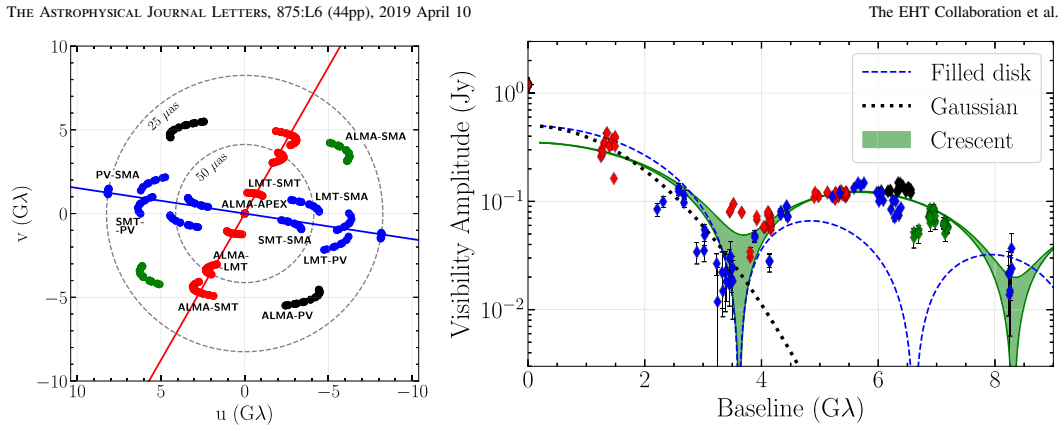
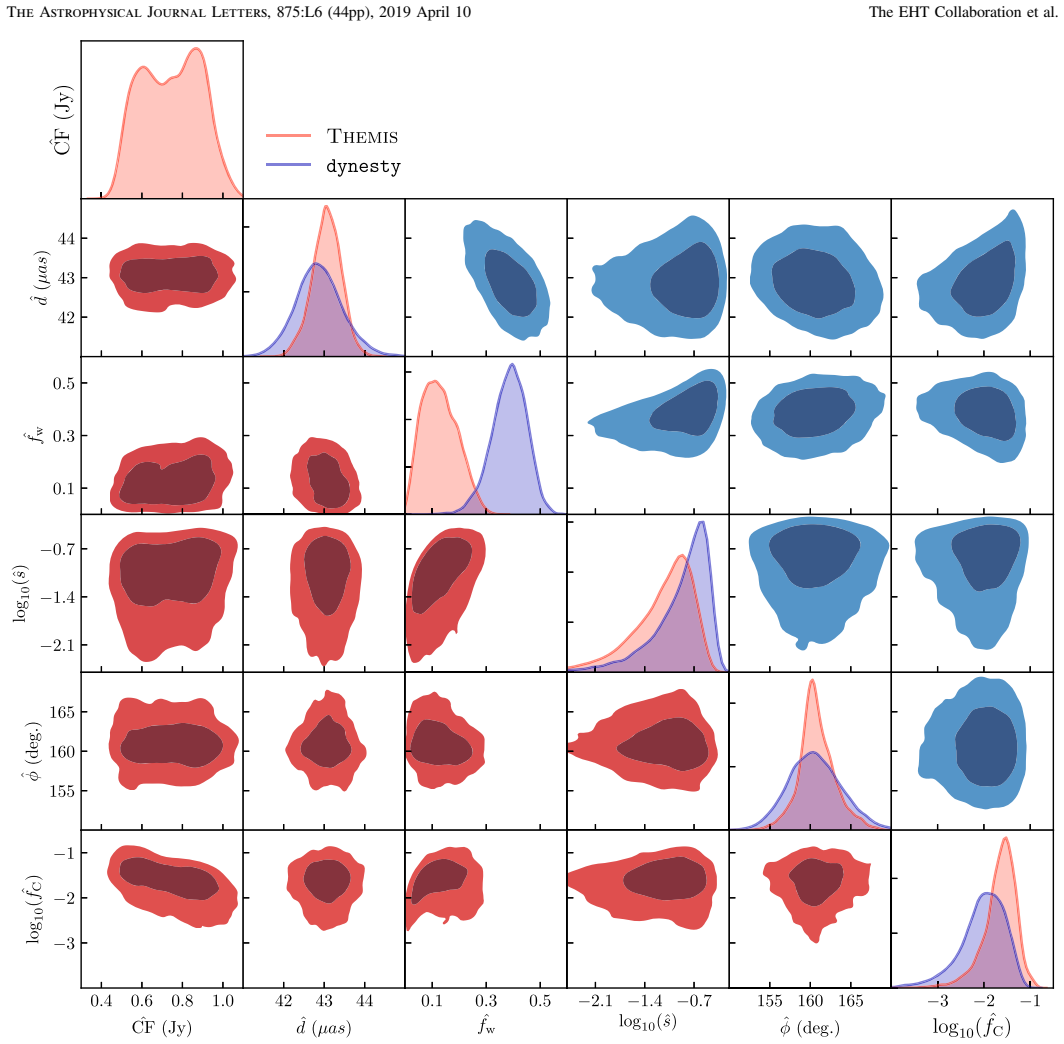
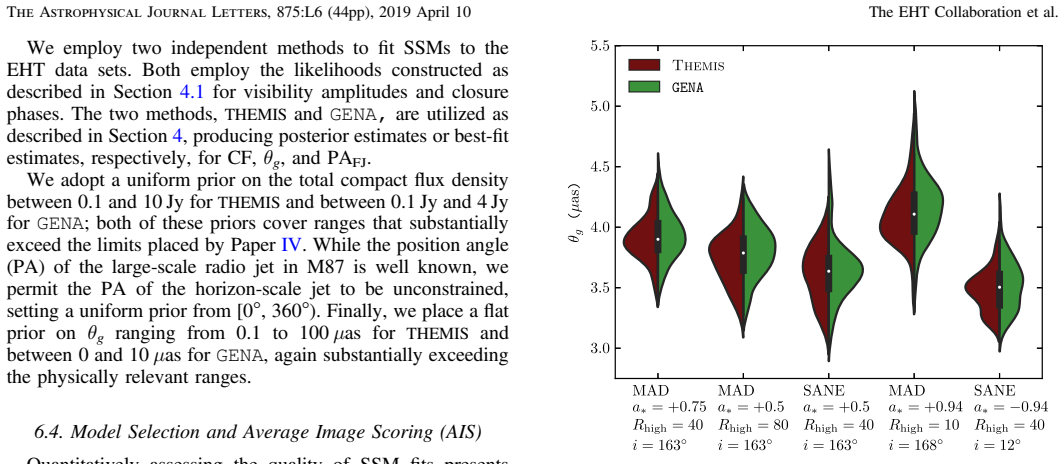
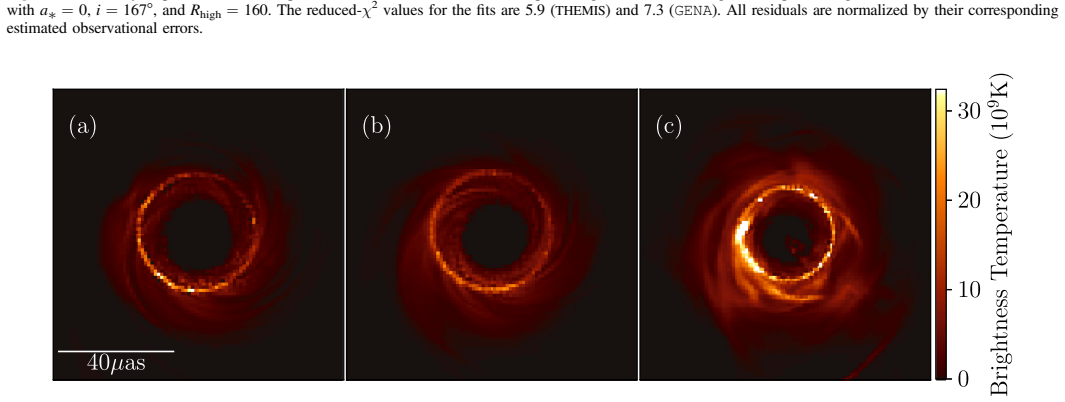
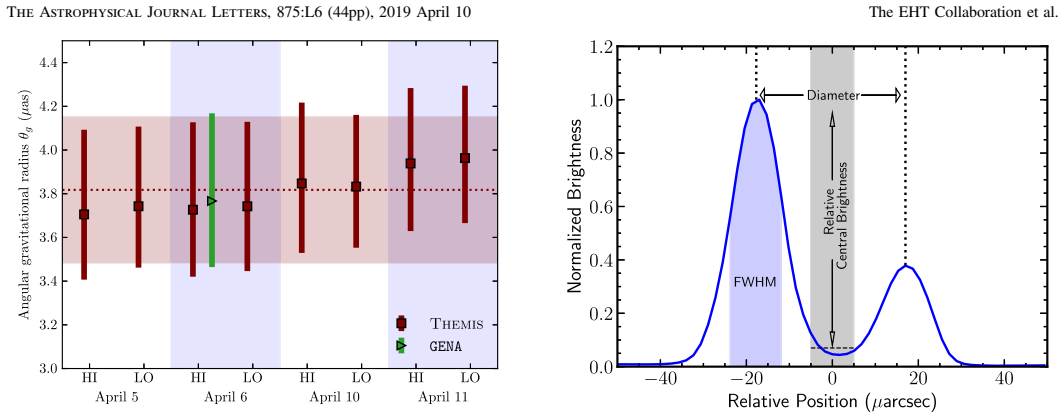
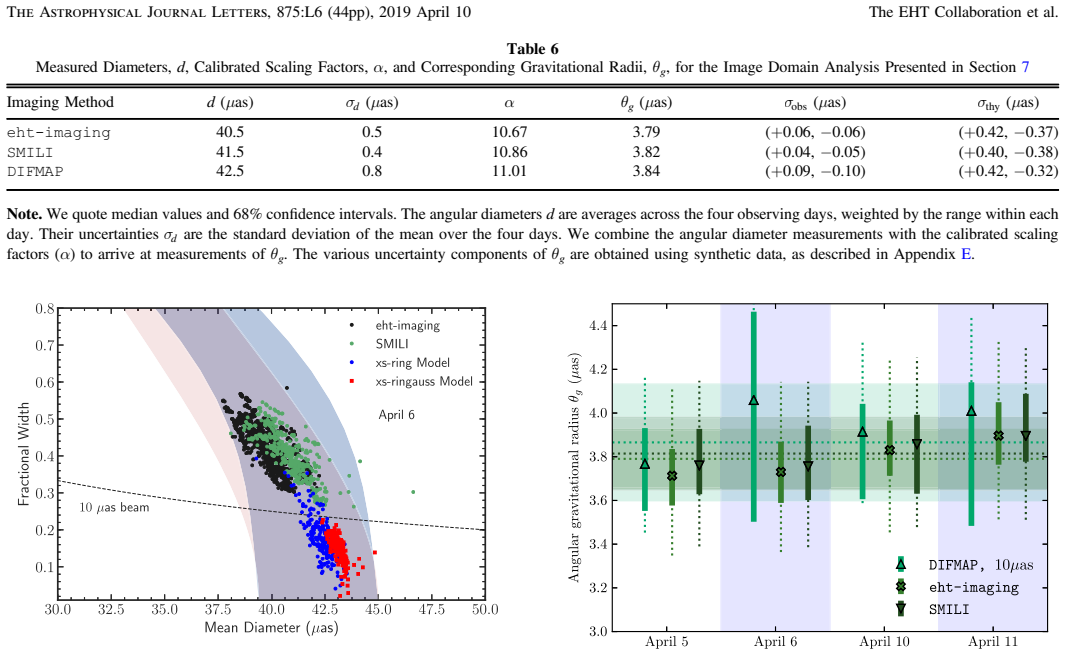
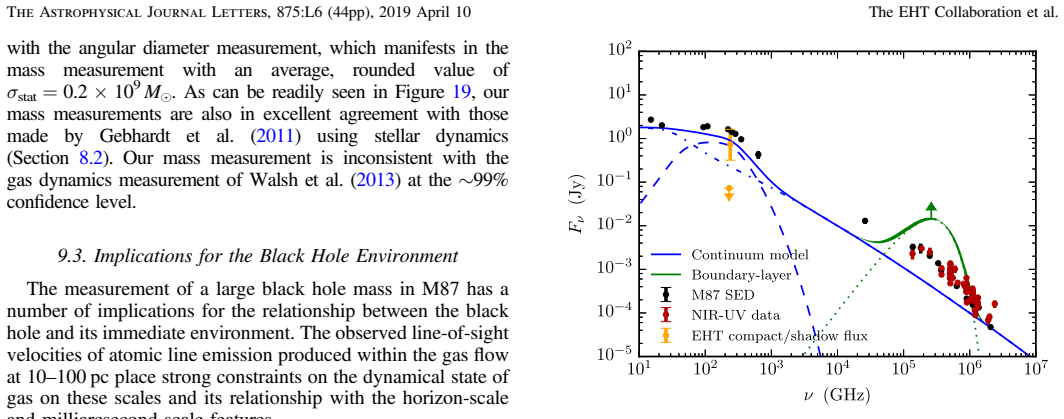
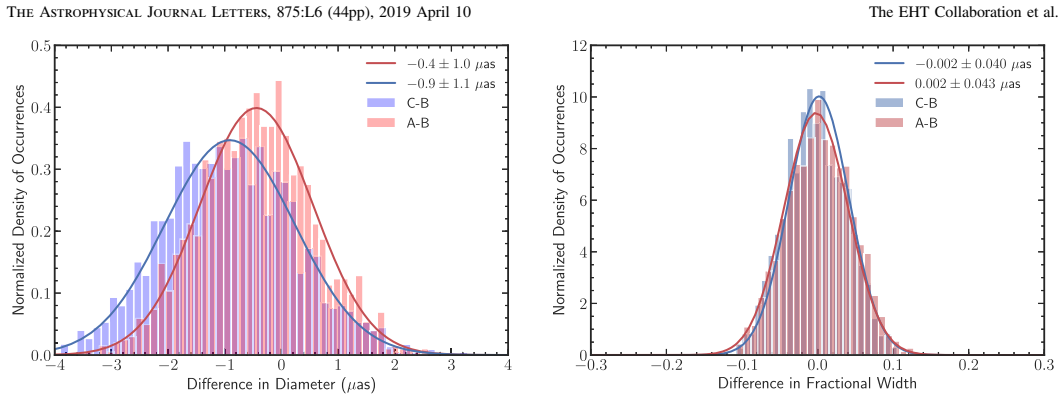
Across all methods the data show a crescent of diameter 42 plus or minus 3 microarcseconds whose interior is suppressed by more than a factor of ten; associating this feature with lensed emission around the photon ring yields an angular gravitational radius of 3.8 plus or minus 0.4 microarcseconds and a mass of 6.5 plus or minus 0.2 statistical plus or minus 0.7 systematic times 10 to the ninth solar masses, consistent with a central Kerr black hole.
What carries the argument
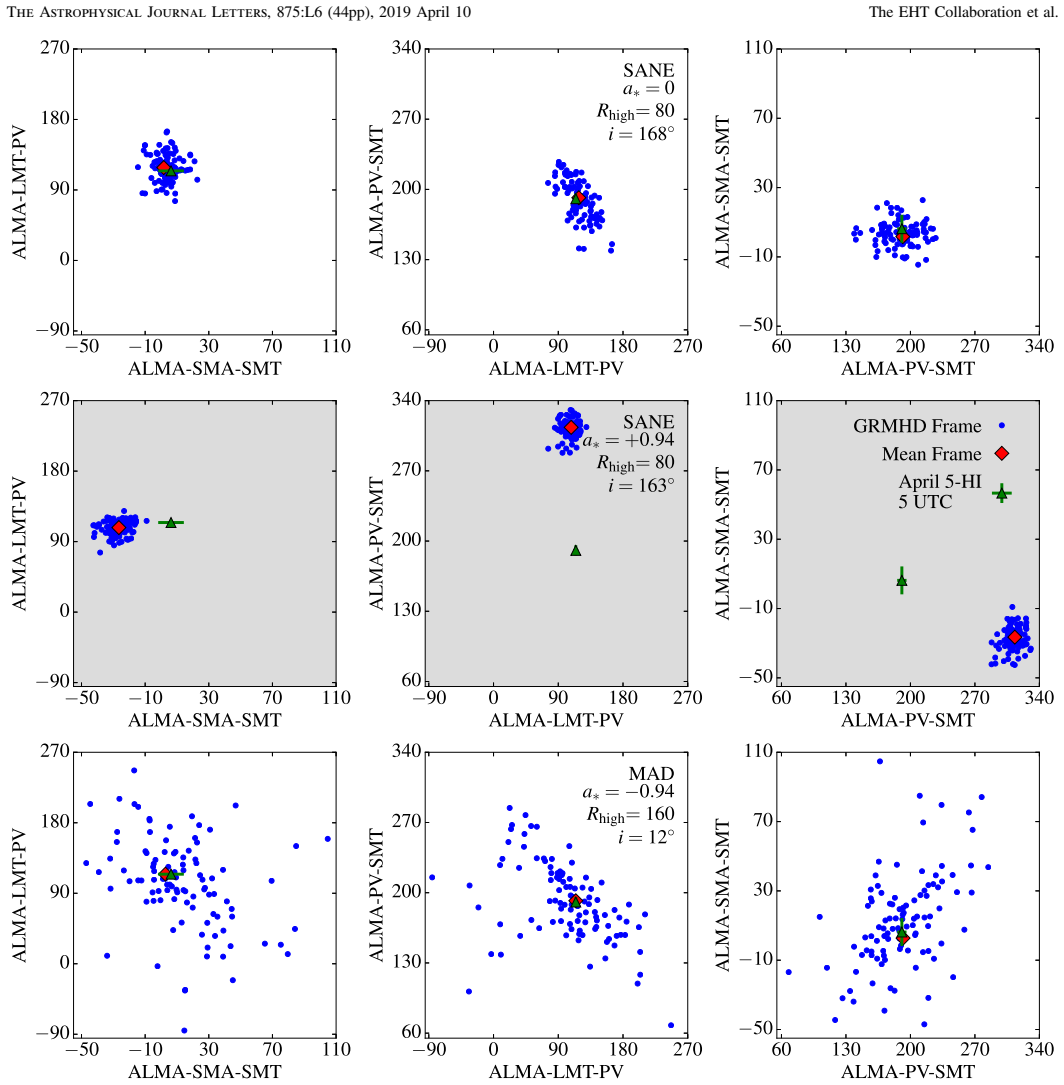
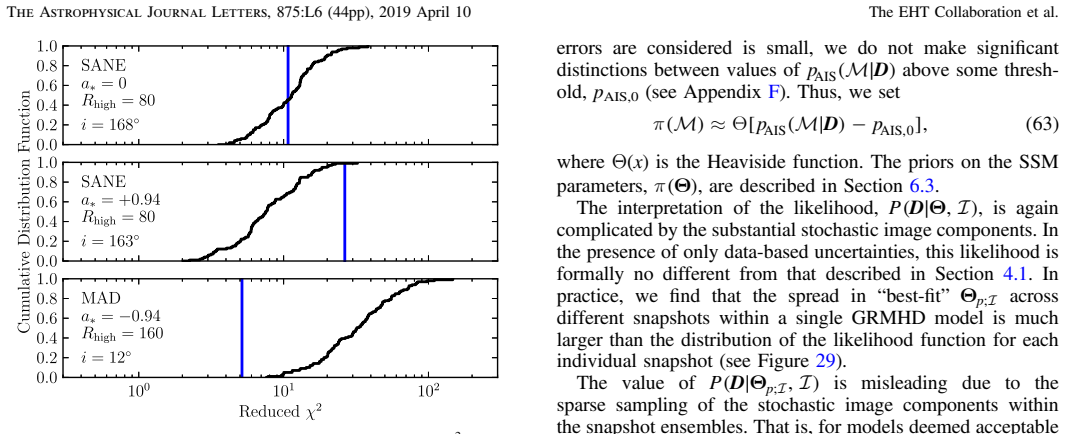
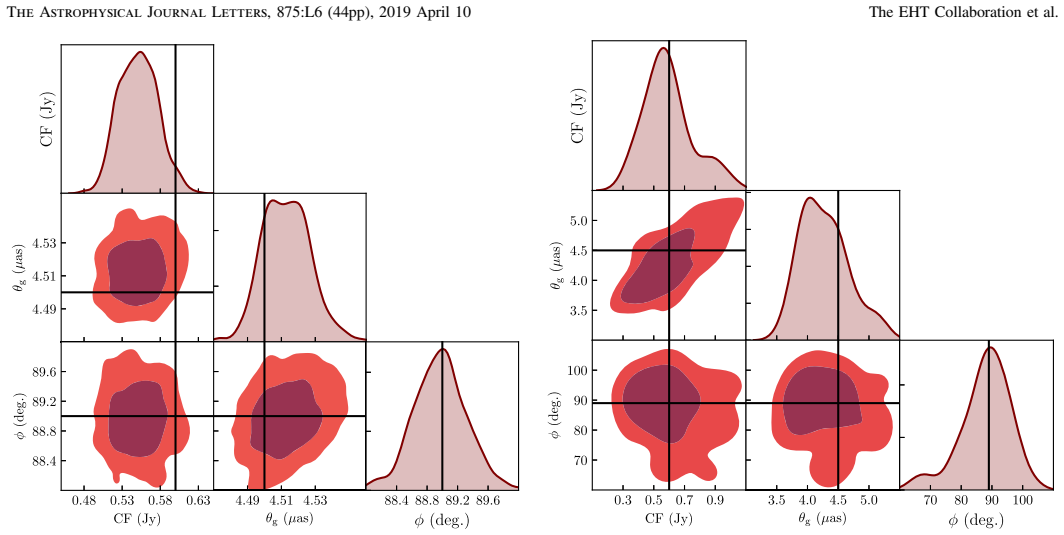
Asymmetric crescent (ring with interior brightness depression) models fitted directly to visibility data and calibrated against GRMHD simulations of the emission region.
If this is right
- More than 50 percent of the total flux at arcsecond scales originates from within a few gravitational radii of the horizon.
- Emission interior to the shadow region is suppressed by a factor greater than 10.
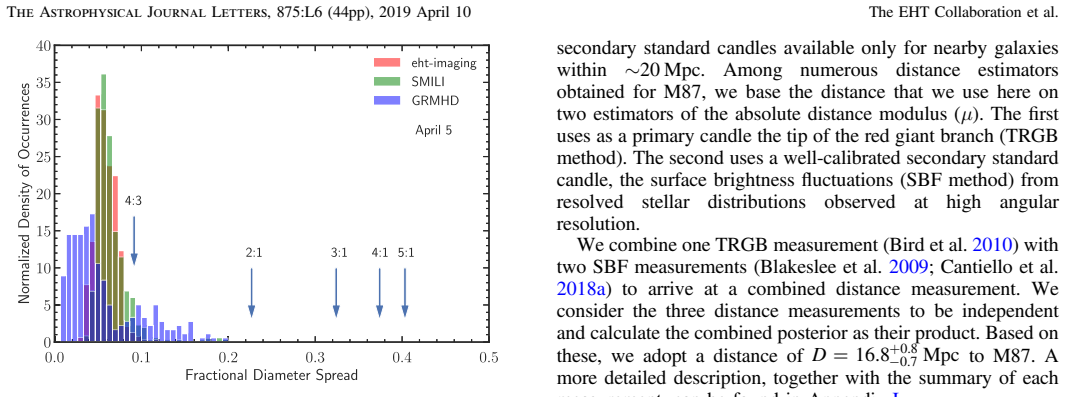
- The fractional width of the crescent is constrained to be less than 0.5.
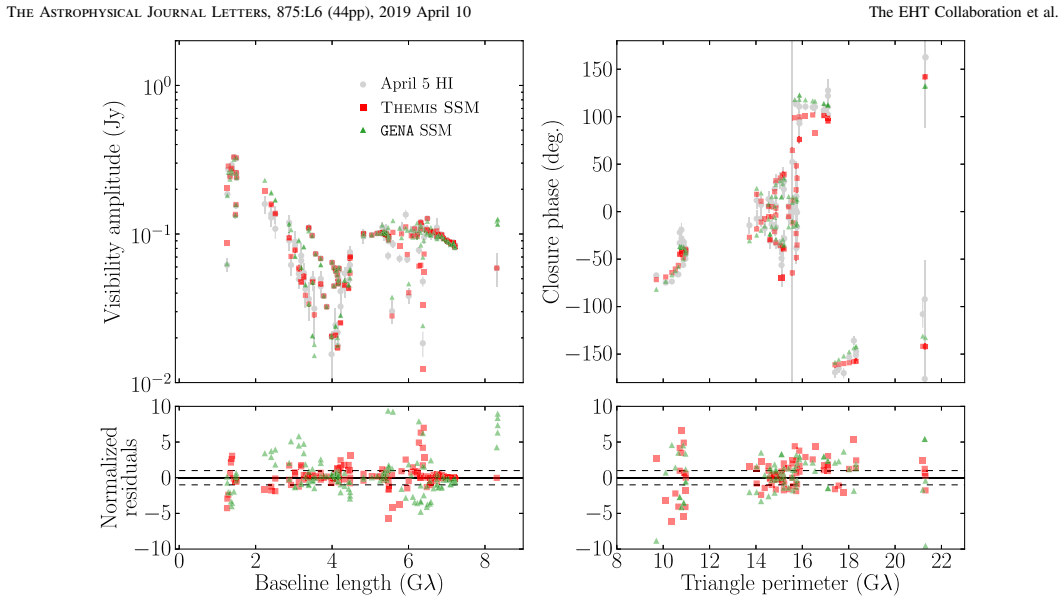
- All analysis pipelines and data sets return statistically consistent values for the ring diameter and inferred mass.
Where Pith is reading between the lines
- Future multi-epoch or multi-frequency EHT observations could test whether the shadow size remains stable as predicted by the Kerr metric.
- The same crescent-fitting approach could be applied to other nearby low-luminosity AGN once comparable resolution is achieved.
- The mass value supplies an independent anchor for dynamical models of the M87 stellar cluster and jet.
Load-bearing premise
That the observed crescent is produced by lensed emission immediately outside the black-hole shadow rather than by some unrelated astrophysical structure.
What would settle it
An independent mass measurement from stellar or gas dynamics that lies outside the reported 6.5 plus or minus 0.9 times 10 to the ninth solar-mass range, or a higher-resolution image showing no central brightness depression at the predicted scale.
Figures








read the original abstract
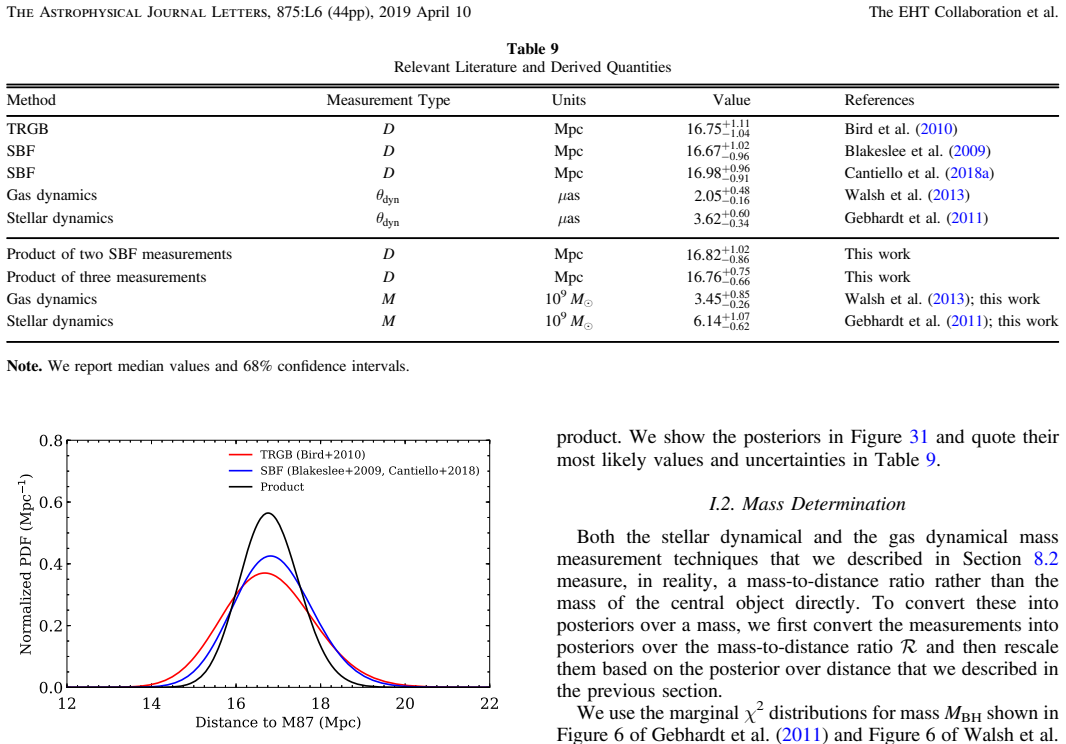
We present measurements of the properties of the central radio source in M87 using Event Horizon Telescope data obtained during the 2017 campaign. We develop and fit geometric crescent models (asymmetric rings with interior brightness depressions) using two independent sampling algorithms that consider distinct representations of the visibility data. We show that the crescent family of models is statistically preferred over other comparably complex geometric models that we explore. We calibrate the geometric model parameters using general relativistic magnetohydrodynamic (GRMHD) models of the emission region and estimate physical properties of the source. We further fit images generated from GRMHD models directly to the data. We compare the derived emission region and black hole parameters from these analyses with those recovered from reconstructed images. There is a remarkable consistency among all methods and data sets. We find that >50% of the total flux at arcsecond scales comes from near the horizon, and that the emission is dramatically suppressed interior to this region by a factor >10, providing direct evidence of the predicted shadow of a black hole. Across all methods, we measure a crescent diameter of 42+/-3 micro-as and constrain its fractional width to be <0.5. Associating the crescent feature with the emission surrounding the black hole shadow, we infer an angular gravitational radius of GM/Dc2 = 3.8+/- 0.4 micro-as. Folding in a distance measurement of 16.8(+0.8,-0.7) Mpc gives a black hole mass of M = 6.5 +/- 0.2(stat) +/-0.7(sys) 10^9 Msun. This measurement from lensed emission near the event horizon is consistent with the presence of a central Kerr black hole, as predicted by the general theory of relativity.
Editorial analysis
A structured set of objections, weighed in public.
Referee Report
Summary. The manuscript presents 2017 Event Horizon Telescope observations of M87, fitting geometric crescent models (asymmetric rings with interior depressions) to visibility data using two independent sampling algorithms, directly fitting GRMHD images, and comparing to reconstructed images. All methods converge on a crescent diameter of 42±3 μas with fractional width <0.5; >50% of arcsecond-scale flux originates near the horizon with interior emission suppressed by >10, yielding an angular gravitational radius of 3.8±0.4 μas and a black-hole mass of 6.5±0.2(stat)±0.7(sys)×10^9 M⊙ when combined with the 16.8 Mpc distance. The result is presented as direct evidence for the black-hole shadow and consistency with a central Kerr black hole.
Significance. If the crescent-to-shadow association holds, this constitutes the first horizon-scale imaging of a black-hole shadow with mass inferred from lensed emission near the event horizon. The convergence of independent pipelines (two visibility samplers, GRMHD image fits, and image reconstructions) together with explicit inclusion of both statistical and systematic uncertainties is a notable strength; the mass is consistent with stellar-dynamical estimates while remaining independent of them.
minor comments (2)
- [Abstract] Abstract and §4: the factor-of->10 interior suppression is stated as a key result; a short quantitative statement on how this factor is extracted from the geometric-model posterior versus the GRMHD fits would improve clarity.
- The distance uncertainty is propagated into the final mass error budget, but the text could explicitly note whether the distance prior is treated as Gaussian or asymmetric in the reported ±0.7(sys) term.
Simulated Author's Rebuttal
We thank the referee for their positive assessment of the manuscript, recognition of the convergence across independent analysis methods, and recommendation to accept. No major comments were raised that require response or revision.
Circularity Check
No significant circularity; derivation grounded in independent EHT data
full rationale
The paper fits geometric crescent models directly to the 2017 EHT visibility data using two independent samplers, measures a statistically preferred crescent diameter of 42±3 μas with fractional width <0.5, and reports >10× interior flux suppression. GRMHD simulations are used solely to calibrate the conversion factor associating the observed crescent with the angular gravitational radius (yielding 3.8±0.4 μas); mass follows from multiplication by an external distance (16.8 Mpc). Direct GRMHD image fitting and image reconstruction are performed on the same dataset and yield consistent results. No equation or step reduces the reported mass or shadow identification to a fitted input by construction, and no load-bearing premise rests on an unverified self-citation chain. The central claims remain externally falsifiable against the raw visibility data and independent distance measurement.
Axiom & Free-Parameter Ledger
free parameters (1)
- distance to M87
axioms (2)
- domain assumption Spacetime around the central object is described by the Kerr metric of general relativity
- domain assumption The fitted crescent corresponds to emission surrounding the black hole shadow
Lean theorems connected to this paper
-
IndisputableMonolith/Foundation/AlexanderDuality.leanalexander_duality_circle_linking unclear?
unclearRelation between the paper passage and the cited Recognition theorem.
We calibrate the geometric model parameters using general relativistic magnetohydrodynamic (GRMHD) models... crescent diameter of 42±3 μas... angular gravitational radius of GM/Dc² = 3.8±0.4 μas
-
IndisputableMonolith/Foundation/RealityFromDistinction.leanreality_from_one_distinction unclear?
unclearRelation between the paper passage and the cited Recognition theorem.
consistent with the presence of a central Kerr black hole, as predicted by the general theory of relativity
What do these tags mean?
- matches
- The paper's claim is directly supported by a theorem in the formal canon.
- supports
- The theorem supports part of the paper's argument, but the paper may add assumptions or extra steps.
- extends
- The paper goes beyond the formal theorem; the theorem is a base layer rather than the whole result.
- uses
- The paper appears to rely on the theorem as machinery.
- contradicts
- The paper's claim conflicts with a theorem or certificate in the canon.
- unclear
- Pith found a possible connection, but the passage is too broad, indirect, or ambiguous to say the theorem truly supports the claim.
Forward citations
Cited by 33 Pith papers
-
A New Timing Signature of Black Hole Spin: Time-Delay Asymmetry in Kerr Accretion Flows
A mirror-paired asymmetry in photon arrival times from opposite sides of the projected spin axis provides a direct general-relativistic timing signature of black hole spin.
-
GRMHD accretion beyond the black hole paradigm: Light from within the shadow
3D GRMHD simulations of accretion onto a JMN-1 horizonless singularity produce a magnetically arrested disk with an accretion rate of ~3e-6 Eddington matching M87* observations and EHT-consistent images, plus central ...
-
Charged Superradiant Instability of Spherically Symmetric Regular Black Holes in de Sitter Spacetime: Time- and Frequency-Domain Analysis
ABG-dS black holes show charged superradiant instability exclusively for the spherically symmetric ℓ=0 mode, with growth rates that peak at intermediate Λ and q and rise with Q, differing from RN-dS due to nonlinear e...
-
Constraining interacting dark energy models with black hole superradiance
Black hole superradiance constrains the coupling strength in interacting dark energy-dark matter models through modifications to the effective mass of ultralight bosons in two scenarios.
-
Topological charge and black hole photon spheres in massive gravity
In dRGT massive gravity, static spherically symmetric black holes exhibit zero, one, or two photon spheres whose topological charges and stability patterns differ from Einstein gravity and from horizonless compact objects.
-
Spin-Hair Induced Chaos of Spinning Test Particles in Rotating Hairy Black Holes
Spinning test particles around rotating hairy black holes show finite-time instability in localized regions of the (spin, hair-parameter) plane that reorganize the strong-field phase space compared to Kerr.
-
A New Timing Signature of Black Hole Spin: Time-Delay Asymmetry in Kerr Accretion Flows
A mirror-paired time-delay asymmetry At vanishes for non-spinning black holes but is nonzero and increases with spin for Kerr black holes, depending on inclination and emission radius.
-
Adaptive ray tracing, image diagnostics, and photon ring signatures of rotating dark-matter-dressed black holes
Rotating black holes dressed with cored-NFW dark matter produce larger image shifts, brightness asymmetries, and ring-scale changes than Kerr or Einasto-dressed cases, with partial degeneracy to spin and inclination.
-
Magnetic reconnection in five-dimensional Kerr black hole
Magnetic reconnection enables higher energy extraction efficiency from singly-rotating five-dimensional Kerr black holes than from doubly-rotating ones and can exceed the Blandford-Znajek process in the single-rotation case.
-
Photon rings and shadows of black holes with non-minimal couplings between curvature and electromagnetic field
Three distinct non-minimal curvature-EM couplings produce different enlargements or reductions of black hole shadows and alter photon ring separations in characteristic ways.
-
Cosmological coupled black holes immersed in dark sector
Derives an exact solution for a black hole in anisotropic dark sector FLRW background with mass co-evolving via radius-dependent coupling governed by the dark halo profile.
-
Dimming of Photon Ring due to Photon-Axion Conversion around Kerr Black Holes
Photon-axion conversion near Kerr black holes produces dimming of photon spectral luminosity that increases with black hole spin, magnetic field strength, and photon-axion coupling, most efficiently at high frequencies.
-
Constraints on Schwarzschild Black Hole in a Generalized Dehnen-Type $(1,4,\gamma)$ Dark Matter Halo via the S2 Star Orbit around Sgr A$^\star$
Derives perihelion shift equations for S2 star in generalized Schwarzschild-Dehnen BH-DM spacetime and constrains gamma, rho_s, rs via MCMC on Do et al. and Gillessen et al. datasets.
-
Effective null geodesics and black hole images in Kruglov nonlinear electrodynamics
In Kruglov nonlinear electrodynamics, small positive values of the parameter q produce stable photon orbits outside the event horizon and modify black hole shadows and relativistic images even when the spacetime metri...
-
Effective null geodesics and black hole images in Kruglov nonlinear electrodynamics
In Kruglov's Born-Infeld-type nonlinear electrodynamics, the effective photon geometry around a charged black hole produces q-dependent shifts in light deflection, shadow radius, and accretion disk images, including s...
-
From Ringdown to Lensing: Analytic Eikonal Modes of Quasi-Topological Regular Black Holes
Analytic quasinormal-mode expressions and explicit QNM-shadow-lensing correspondence for four-dimensional quasi-topological regular black holes.
-
Observational constraints on nonlocal black holes via gravitational lensing
Nonlocal black holes remain consistent with general relativity at the 1.13-sigma level after joint lensing and quasinormal-mode constraints.
-
Cosmological coupled black holes immersed in dark sector
Exact solution for a black hole whose mass co-evolves with Hubble expansion via radius-dependent coupling to an anisotropic dark halo in FLRW spacetime.
-
Finite Curvature Construction of Regular Black Holes and Quasinormal Mode Analysis
Regular black holes are built by prescribing finite Ricci or Weyl scalars with Gaussian, sech, and rational profiles to ensure regularity and energy conditions, with stability shown to depend on the peak-to-valley rat...
-
Finite Curvature Construction of Regular Black Holes and Quasinormal Mode Analysis
Regular black holes are constructed by prescribing finite curvature invariants with analytic profiles, yielding singularity-free geometries whose quasinormal mode stability depends on the effective potential's peak-to...
-
Adaptive ray tracing, image diagnostics, and photon ring signatures of rotating dark-matter-dressed black holes
Ray-tracing simulations indicate that cored-NFW dark matter halos around rotating black holes yield larger apparent images and stronger deviations in higher-order lensed structures than Einasto profiles, which remain ...
-
Scalar-Electromagnetic Couplings as Source of Deformed Black Hole: From Shadows to Thermodynamic Topology
A scalar-NED coupled black hole metric is reconstructed from an effective geometry, yielding EHT bounds on magnetic charge, Hawking-Page transition, and topological equivalence to the Reissner-Nordström solution.
-
Photon Spheres and shadow of modified black-hole entropies
Modified black hole entropies alter photon sphere radii and shadow sizes, with parameters constrained by Event Horizon Telescope observations of Sgr A*.
-
Photon Spheres and shadow of modified black-hole entropies
Corrected black hole entropies produce distinct shifts in photon sphere radius and shadow size that are constrained by Event Horizon Telescope data on Sagittarius A*.
-
Photon Spheres and shadow of modified black-hole entropies
Entropy corrections to black holes produce modified metrics whose photon-sphere and shadow sizes can be constrained by Sgr A* observations.
-
A First-Order Eikonal Framework for Quasinormal Modes, Shadows, Strong Lensing, and Grey-Body Factors in a Scalarized Black-Hole Metric
First-order eikonal formulas connect a scalarized black-hole metric to quasinormal modes, shadows, strong lensing, and grey-body factors via photon-sphere invariants in the weak-hair limit.
-
A First-Order Eikonal Framework for Quasinormal Modes, Shadows, Strong Lensing, and Grey-Body Factors in a Scalarized Black-Hole Metric
Derives closed first-order eikonal expressions that connect a scalarized black-hole metric to quasinormal frequencies, shadows, strong deflection, and transmission probabilities.
-
Observational Signatures of Rotating Ay\'{o}n-Beato-Garc\'{i}a Black Holes: Shadows, Accretion Disks and Images
Rotating Ayón-Beato-García black holes produce smaller and sometimes D-shaped shadows whose size constrains the charge parameter ζ to the range 0.132811M–0.213607M when matched to EHT observations of M87* and Sgr A*.
-
Redshifted civilizations, galactic empires, and the Fermi paradox
Civilizations can achieve galaxy-spanning reach within biological lifetimes via time-dilated orbits near black hole photon spheres using classical general relativity, with a Type II civilization enabling 10^4 dilation...
-
Bright ring features and polarization structures in Kerr-Sen black hole images illuminated by radiatively inefficient accretion flows
GRRT simulations show that raising the dilaton parameter shrinks the bright ring while increasing its width and brightness, disk thickness reduces diameter and width with weaker brightness impact, and both affect allo...
-
Probing Kalb-Ramond gravity with charged rotating black holes: constraints from EHT observations
EHT shadow observations constrain the Lorentz-violating parameter ℓ in Kalb-Ramond gravity for charged rotating black holes to roughly |ℓ| ≲ 0.1-0.2, with an upper bound ℓ ≲ 0.19 from Sgr A*.
-
Review of strongly coupled regimes in gravity with Dyson-Schwinger approach
Dyson-Schwinger methods applied to gravity theories produce conformally flat metrics and a sequence of cosmological phase transitions from conformal symmetry breaking that non-minimal scalar couplings can suppress.
-
The Science of the Einstein Telescope
The paper provides state-of-the-art predictions for the Einstein Telescope's impact on fundamental physics, cosmology, compact-object astrophysics, and multi-messenger astronomy across its proposed configurations.
Reference graph
Works this paper leans on
-
[1]
Reconstruction of Static Black Hole Images Using Simple Geometric Forms
Akiyama, K., Ikeda, S., Pleau, M., et al. 2017a, AJ, 153, 159 Akiyama, K., Kuramochi, K., Ikeda, S., et al. 2017b, ApJ, 838, 1 Akiyama, K., Lu, R.-S., Fish, V. L., et al. 2015, ApJ, 807, 150 Asada, K., & Nakamura, M. 2012, ApJL, 745, L28 Bambi, C., & Freese, K. 2009, PhRvD, 79, 043002 Bardeen, J. M. 1973, in Black Holes (Les Astres Occlus ), ed. C. Dewitt...
work page internal anchor Pith review Pith/arXiv arXiv doi:10.5281/zenodo.2614016 2015
-
[2]
Die allgemeine Relativitätstheorie und Einsteins Lehre von der Schwerkraft (Braunschweig: Vieweg ) Vousden, W. D., Farr, W. M., & Mandel, I. 2016, MNRAS, 455, 1919 Walker, R. C., Hardee, P. E., Davies, F. B., Ly, C., & Junor, W. 2018, ApJ, 855, 128 Walsh, J. L., Barth, A. J., Ho, L. C., & Sarzi, M. 2013, ApJ, 770, 86 Young, P. J., Westphal, J. A., Kristia...
work page 2016
discussion (0)
Sign in with ORCID, Apple, or X to comment. Anyone can read and Pith papers without signing in.