The Dark Energy Survey Supernova Program: A Reanalysis Of Cosmology Results And Evidence For Evolving Dark Energy With An Updated Type Ia Supernova Calibration
Pith reviewed 2026-05-17 23:20 UTC · model grok-4.3
The pith
Re-calibrated DES Type Ia supernovae data yield w0 = -0.803 and wa = -0.72, showing 3.2 sigma preference for evolving dark energy.
A machine-rendered reading of the paper's core claim, the machinery that carries it, and where it could break.
Core claim
The authors introduce the DES-Dovekie supernova sample and report that, in combination with CMB and DESI DR2 data, it prefers a time-varying dark energy equation of state at 3.2 sigma significance in flat w0 wa CDM, with the specific best-fit values w0 = -0.803 plus or minus 0.054 and wa = -0.72 plus or minus 0.21, reduced from the 4.2 sigma preference found in the original DES-SN5YR analysis.
What carries the argument
The DES-Dovekie sample, which incorporates improved photometric cross-calibration, white dwarf linking for low-redshift calibration, retraining of the SALT3 light curve model, and correction of the host galaxy colour law numerical approximation.
If this is right
- Omega_m shifts downward by 0.022 relative to the previous DES-SN5YR result in flat Lambda CDM.
- The statistical significance of rejecting a cosmological constant drops from 4.2 sigma to 3.2 sigma.
- The data produce only a weak Bayesian model preference of roughly 5 to 1 in favour of the evolving dark energy model.
- The updated calibration changes the central values of w0 and wa enough to move the result into the regime of weak rather than moderate model preference.
Where Pith is reading between the lines
- Calibration details between high- and low-redshift supernova surveys remain a dominant source of uncertainty that can shift the inferred strength of dark energy evolution signals.
- The reduction in significance suggests that next-generation surveys with larger samples and independent calibration methods could either confirm or remove the current hint of evolution.
- The result is consistent with the possibility that apparent tensions between supernova and other cosmological probes partly reflect differences in how each dataset is anchored to absolute brightness.
Load-bearing premise
The new photometric cross-calibration, white dwarf linking, SALT3 retraining, and host galaxy colour law fix introduce no residual systematic biases capable of altering the apparent preference for evolving dark energy.
What would settle it
An independent analysis of the same or a larger supernova sample using alternative calibration anchors that recovers w0 within 0.05 of -1 and wa within 0.1 of 0 at greater than 3 sigma would falsify the reported 3.2 sigma preference.
Figures




read the original abstract
We present improved cosmological constraints from a re-analysis of the Dark Energy Survey (DES) 5-year sample of Type Ia supernovae (DES-SN5YR). This re-analysis includes an improved photometric cross-calibration, recent white dwarf observations to cross-calibrate between DES and low redshift surveys, retraining the SALT3 light curve model and fixing a numerical approximation in the host galaxy colour law. Our fully recalibrated sample, which we call DES-Dovekie, comprises $\sim$1600 likely Type Ia SNe from DES and $\sim$200 low-redshift SNe from other surveys. With DES-Dovekie, we obtain $\Omega_{\rm m} = 0.330 \pm 0.015$ in Flat $\Lambda$CDM which changes $\Omega_{\rm m}$ by $-0.022$ compared to DES-SN5YR. Combining DES-Dovekie with CMB data from Planck, ACT and SPT and the DESI DR2 measurements in a Flat $w_0 w_a$CDM cosmology, we find $w_0 = -0.803 \pm 0.054$, $w_a = -0.72 \pm 0.21$. Our results hold a significance of $3.2\sigma$, reduced from $4.2\sigma$ for DES-SN5YR, to reject the null hypothesis that the data are compatible with the cosmological constant. This significance is equivalent to a Bayesian model preference odds of approximately 5:1 in favour of the Flat $w_0 w_a$CDM model. Using generally accepted thresholds for model preference, our updated data exhibits only a weak preference for evolving dark energy.
Editorial analysis
A structured set of objections, weighed in public.
Referee Report
Summary. The paper reanalyzes the DES 5-year Type Ia supernova sample (DES-SN5YR) with four calibration updates: improved photometric cross-calibration, white-dwarf observations to link DES to low-redshift surveys, retraining of the SALT3 light-curve model, and a fix to a numerical approximation in the host-galaxy colour law. The resulting DES-Dovekie sample (~1600 DES SNe plus ~200 low-z SNe) yields Ω_m = 0.330 ± 0.015 in flat ΛCDM, a shift of −0.022 relative to the prior analysis. Combined with Planck+ACT+SPT CMB and DESI DR2 BAO data in flat w0waCDM, the fit gives w0 = −0.803 ± 0.054, wa = −0.72 ± 0.21, corresponding to a 3.2σ preference over ΛCDM (down from 4.2σ) and a Bayesian odds ratio of ~5:1 in favor of evolving dark energy.
Significance. If the new calibrations are shown to introduce no unaccounted redshift-dependent residuals, the work supplies a valuable update to supernova cosmology constraints and quantifies how calibration choices affect the apparent evidence for wa < 0. The transparent reporting of the drop in significance and the weak model preference (5:1 odds) is a strength. The multi-probe combination with independent CMB and DESI anchors adds robustness to the central parameter values.
major comments (2)
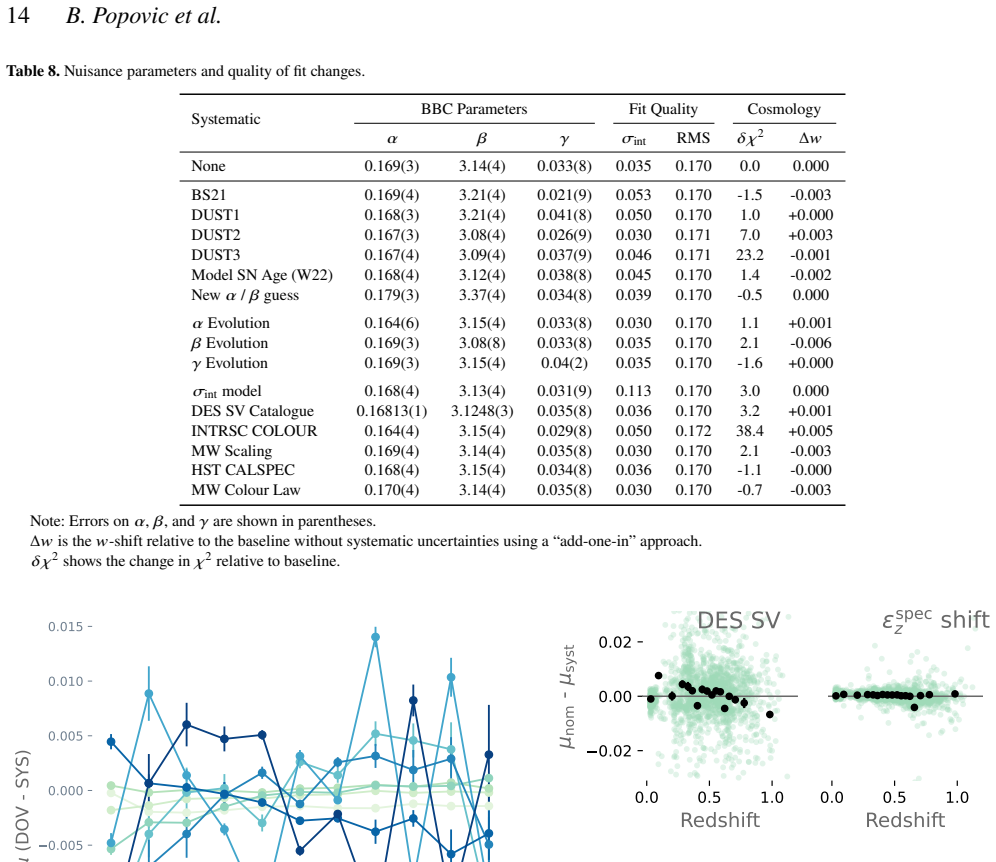
- [Abstract and cosmological results section] Abstract and the section presenting the combined cosmological constraints: the headline 3.2σ preference and the reduction from 4.2σ are stated, yet the text does not isolate the contribution of each individual update (photometric cross-calibration, white-dwarf linking, SALT3 retraining, host-galaxy colour-law fix) to the final covariance matrix or to Δχ² relative to w0 = −1, wa = 0. Because each change can alter redshift-dependent colour and stretch corrections, this omission is load-bearing for the claim that the wa constraint is robust.
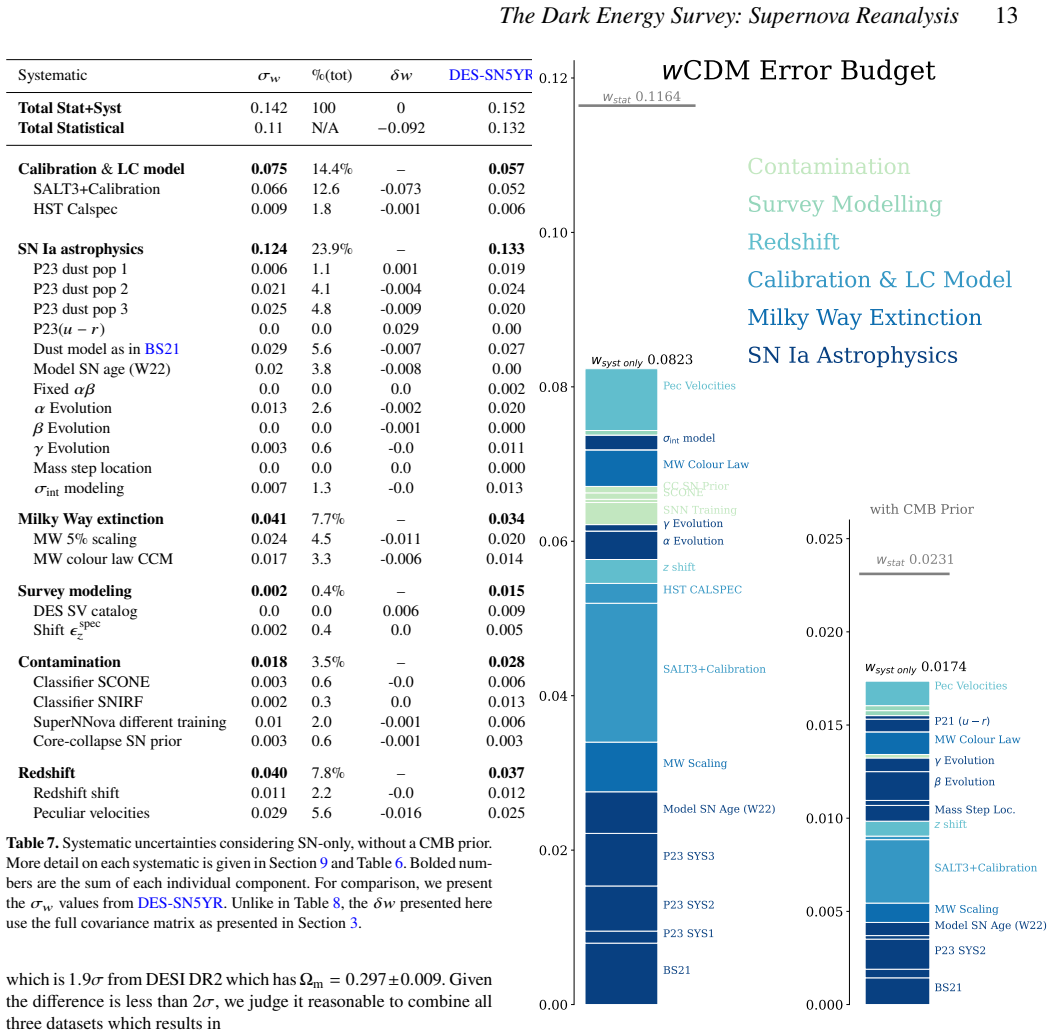
- [Systematic error budget section] Section describing the systematic error budget and covariance construction: it is not shown that the new white-dwarf cross-calibration and host-galaxy colour-law fix have been propagated such that any residual redshift-dependent biases in the light-curve parameters are fully captured by the reported covariance. An incomplete propagation would directly affect the apparent preference for wa < 0.
minor comments (2)
- [Abstract] The phrase 'generally accepted thresholds for model preference' is used without specifying the numerical criteria (e.g., Jeffreys scale or ΔlnZ thresholds) applied to the 5:1 odds ratio.
- Comparison plots or tables contrasting DES-Dovekie distance moduli and parameter shifts with the original DES-SN5YR results would improve clarity.
Simulated Author's Rebuttal
We thank the referee for their constructive and detailed review of our reanalysis of the DES-SN5YR sample. We have carefully considered the two major comments and agree that additional transparency on the individual calibration updates and systematic propagation will strengthen the manuscript. We outline our responses below and the revisions we will implement.
read point-by-point responses
-
Referee: [Abstract and cosmological results section] Abstract and the section presenting the combined cosmological constraints: the headline 3.2σ preference and the reduction from 4.2σ are stated, yet the text does not isolate the contribution of each individual update (photometric cross-calibration, white-dwarf linking, SALT3 retraining, host-galaxy colour-law fix) to the final covariance matrix or to Δχ² relative to w0 = −1, wa = 0. Because each change can alter redshift-dependent colour and stretch corrections, this omission is load-bearing for the claim that the wa constraint is robust.
Authors: We agree that isolating the contribution of each calibration update is important for demonstrating robustness. In the revised manuscript we will add a dedicated subsection (or supplementary table) in the cosmological results section that applies the four updates sequentially. For each step we will report the resulting shifts in w0, wa, the relevant covariance-matrix elements, and the change in Δχ² relative to the w0 = −1, wa = 0 point. These intermediate results have already been computed internally and will be presented transparently so that readers can evaluate the impact of each change on the apparent preference for evolving dark energy. revision: yes
-
Referee: [Systematic error budget section] Section describing the systematic error budget and covariance construction: it is not shown that the new white-dwarf cross-calibration and host-galaxy colour-law fix have been propagated such that any residual redshift-dependent biases in the light-curve parameters are fully captured by the reported covariance. An incomplete propagation would directly affect the apparent preference for wa < 0.
Authors: We have incorporated both the white-dwarf cross-calibration and the host-galaxy colour-law fix into the final covariance matrix used for the cosmological fits. To make this propagation explicit, we will expand the systematic error budget section with additional text and, where appropriate, a supplementary figure that traces how these two updates enter the covariance. We will also report the results of explicit checks for residual redshift-dependent biases in the light-curve parameters (stretch and colour) after applying the corrections, and will either confirm that any such residuals are already captured or add a corresponding systematic term if needed. revision: yes
Circularity Check
No significant circularity; cosmological parameters are direct fits to recalibrated supernova data anchored by external datasets
full rationale
The paper describes a reanalysis of DES-SN5YR data with updates to photometric cross-calibration, white dwarf linking, SALT3 retraining, and host galaxy colour law, producing the DES-Dovekie sample. Cosmological constraints (Ωm in Flat ΛCDM; w0 and wa in Flat w0 wa CDM) are obtained via standard likelihood fitting that combines the supernova distance moduli with independent CMB data (Planck, ACT, SPT) and DESI DR2 BAO measurements. No equation or step in the provided derivation chain reduces the reported w0 = -0.803 ± 0.054 or wa = -0.72 ± 0.21 to a quantity defined by the fit itself. External datasets supply independent anchors, and the significance reduction from 4.2σ to 3.2σ is presented as an empirical outcome of the recalibration rather than a constructed result. Self-citations to prior DES work exist but are not load-bearing for the central claim, which rests on the new data processing and external constraints.
Axiom & Free-Parameter Ledger
free parameters (2)
- w0 =
-0.803
- wa =
-0.72
axioms (2)
- domain assumption Flat geometry in both ΛCDM and w0waCDM models.
- domain assumption Type Ia supernovae remain standardizable candles after the applied corrections.
Lean theorems connected to this paper
-
IndisputableMonolith/Foundation/RealityFromDistinction.leanreality_from_one_distinction unclear?
unclearRelation between the paper passage and the cited Recognition theorem.
Combining DES-Dovekie with CMB data from Planck, ACT and SPT and the DESI DR2 measurements in a Flat w0 wa CDM cosmology, we find w0 = −0.803 ± 0.054, wa = −0.72 ± 0.21.
What do these tags mean?
- matches
- The paper's claim is directly supported by a theorem in the formal canon.
- supports
- The theorem supports part of the paper's argument, but the paper may add assumptions or extra steps.
- extends
- The paper goes beyond the formal theorem; the theorem is a base layer rather than the whole result.
- uses
- The paper appears to rely on the theorem as machinery.
- contradicts
- The paper's claim conflicts with a theorem or certificate in the canon.
- unclear
- Pith found a possible connection, but the passage is too broad, indirect, or ambiguous to say the theorem truly supports the claim.
Forward citations
Cited by 35 Pith papers
-
Kinematic Lensing Ratio: Reviving Weak Lensing Cosmography as a Geometric Dark Energy Probe
KiLeR combines shear ratios with kinematic intrinsic shapes to mitigate first-order lensing systematics and forecasts a 192% improvement in dark energy constraints from the Roman telescope.
-
Lossless Compression of Cosmological Information from Type Ia Supernova Distance Measurements
Compressing SN Ia distance-redshift data to eleven Gaussian log r_p(z) points with covariance is shown to be operationally lossless for cosmological inference across multiple models and datasets.
-
Prospects for multi-messenger discovery of the gravitational-wave background anisotropies via cross-correlation with galaxies
New simulations show that cross-correlating gravitational wave background anisotropies with galaxy distributions can enable discovery at angular scales of 4-6 degrees with next-generation observatories.
-
On the origin of the environmental step: A BayeSN view of the ZTF SN Ia DR2
BayeSN analysis of ZTF SN Ia DR2 data shows a persistent ~0.1 mag environmental step that is intrinsic to the supernovae, not explained by differing dust properties.
-
Axion dark matter from extended misalignment with a constant-$\omega_\phi$ pre-oscillatory phase and dark radiation
The extended misalignment model with constant-ω_φ pre-oscillatory phase and dark radiation coupling is constrained by cosmological data to favor negative ω_φ and f_φ in [80, 1.5×10^10] TeV without resolving H0 or S8 tensions.
-
Axion dark matter from extended misalignment with a constant-$\omega_\phi$ pre-oscillatory phase and dark radiation
Extended misalignment for axion-like particles with constant-ω_ϕ pre-oscillation and dark radiation coupling yields data-driven constraints favoring negative ω_ϕ and f_ϕ in [80, 1.5×10^10] TeV but does not ease cosmol...
-
Saturation Mechanisms in the Interacting Dark Sector
Nonlinear dark-sector interaction models with a half-saturation sparseness scale are observationally preferred over their linear counterparts at >95% confidence for two of three cases.
-
Old Universe, Young SNe Ia: A Statistical Analysis of Type Ia Supernova Progenitor Age from 6,983 TITAN Host Galaxies, and Implications for Cosmology
Large sample of SN Ia hosts shows young mean progenitor age of 3.5 Gyr and only 1.5 Gyr evolution, leading to negligible cosmological bias of 0.007 mag.
-
Non-minimally coupled quintessence with sign-switching interaction
A new quintessence model with non-minimal coupling produces an effective sign-switching interaction that fits current data better than LambdaCDM or w0waCDM and accounts for late-time dark energy weakening without phan...
-
Evidence for deviation in gravitational light deflection from general relativity at cosmological scales with KiDS-Legacy and CMB lensing
KiDS-Legacy weak lensing plus CMB data yields a 3 sigma deviation in light deflection from GR in a Lambda CDM background, with the signal driven by large-scale CMB lensing amplitudes.
-
Signatures of Modified Gravity Below $\mathcal{O}(10)$ Mpc in a Dynamical Dark Energy Background
Modified gravity below O(10) Mpc in a CPL dynamical dark energy background is required to suppress structure growth at low redshifts while satisfying CMB constraints from ISW and lensing.
-
Negative neutrino mass or negative dark energy?
A sign-switching dark energy model (Λ_s CDM) recovers positive effective neutrino masses (0.055 ± 0.050 eV) consistent with oscillation data, unlike ΛCDM which prefers negative values (-0.075 eV), for DESI DR2 + CMB +...
-
On the origin of the environmental step: A BayeSN view of the ZTF SN Ia DR2
BayeSN analysis of ZTF Type Ia supernovae confirms a ~0.1 mag intrinsic environmental step in standardized brightness that is not explained by differences in dust extinction properties.
-
Testing $\Lambda$CDM versus dynamical dark energy in one year: A DESI spectroscopic follow-up program for Rubin supernovae
A coordinated Rubin-DESI supernova survey could distinguish dynamical dark energy from Lambda CDM at over 5 sigma in one year using 2300 spectroscopically confirmed SNe Ia at low redshift.
-
Do equation of state parametrizations of dark energy faithfully capture the dynamics of the late universe?
Node-based reconstruction of cosmic expansion prefers stronger deceleration at z≈1.7 than smooth DE EoS parametrizations, isolating z~1.5-2 as a window where the latter may compress localized kinematic features permit...
-
Model-Independent Analysis of Type Ia Supernova Datasets and Implications for Dark Energy
Apparent dynamical dark energy signals from SNe Ia with DESI data are consistent with LambdaCDM when accounting for dataset-specific Omega_m inconsistencies rather than requiring evolving dark energy.
-
Disentangling cosmic distance tensions with early and late dark energy
Early dark energy resolves CMB-BAO tension and, combined with thawing quintessence, reduces overall cosmological tensions without phantom crossing.
-
Joint Curvature and Growth Rate measurements with Supernova Peculiar Velocities and the CMB
SN peculiar velocities plus Planck CMB data give joint constraints on σ8, γ, and Ωk, with hints of positive curvature (Ωk ≈ -0.01) at 2-3σ and γ values consistent with GR.
-
Exploring the interplay of late-time dynamical dark energy and new physics before recombination
Model-independent reconstruction finds 96.7-98.5% probability of phantom crossing if recombination is standard, but early new physics to ease Hubble tension weakens this preference while requiring unrealistically high...
-
The Bayesian view of DESI DR2 with unimpeded: Evidence and tension in a combined analysis with CMB and supernovae across cosmological models
Bayesian evidence computation on DESI DR2 plus Planck and supernovae eliminates the frequentist 3.1 sigma preference for w0waCDM over LambdaCDM when using the DES-Dovekie recalibration, yielding ln B = -0.30 favoring ...
-
Probing Dynamical Dark Energy with Late-Time Data: Evidence, Tensions, and the Limits of the $w_0w_a$CDM Framework
Evidence for dynamical dark energy in the w0waCDM framework is strongly dataset-dependent, driven by mismatches in low-redshift BAO distance ratios that produce divergent expansion histories and inconsistent Hubble te...
-
A new magnitude--redshift relation based on Type Ia supernovae
A new two-parameter empirical magnitude-redshift relation for Type Ia supernovae fits observations comparably or better than LambdaCDM and indicates uniform cosmic acceleration.
-
Thawing Quintessence: Priors, evidence, and likely trajectories
Bayesian evidence from DESI DR2 BAO, Planck+ACT CMB, and multiple supernova samples favors thawing quintessence over a cosmological constant.
-
Reanalyzing DESI DR1: 2. Constraints on Dark Energy, Spatial Curvature, and Neutrino Masses
Reanalysis of DESI full-shape clustering data tightens constraints on neutrino mass, spatial curvature, and dark energy equation-of-state parameters relative to BAO-only results.
-
Impact of Calibration Systematics on Dark Energy Constraints from LSST Type Ia Supernovae
Linear passband tilts shift best-fit w0 and wa by ~0.025 sigma and enlarge the w0-wa contour area by ~5% per 1%/100nm increase; quadratic tilts yield less conclusive results.
-
Testing Scale-Dependent Modified Gravity with DESI DR1
DESI DR1 constrains the modified gravity parameter to log10 |f_R0| < -4.59 at 95% CL, implying no detectable fifth force on scales below about 18 Mpc.
-
The open-Universe signal: A model artifact rather than genuine curvature
The mild open-universe signal in late-Universe data is an artifact of assuming the basic ΛCDM model rather than evidence for genuine spatial curvature.
-
Constraints on Coupled Dark Energy in the DESI Era
New cosmological data mildly favor a small coupling between dark matter and a scalar dark energy field at |β| ≈ 0.03 while allowing an effective phantom-crossing equation of state.
-
Cosmology-Independent Constraints on the Etherington Relation and SNeIa Absolute Magnitude Evolution from DESI-DR2
DESI-DR2 angular diameter distances and SNeIa luminosity distances are statistically consistent with the Etherington relation, yielding a constraint on SNeIa absolute magnitude evolution of dM/dz = 0.07 ± 0.07.
-
Gamma-Ray Bursts as an Independent High-Redshift Probe of Dark Energy
Forecasts show that ~66 optical GRBs can achieve σ_w ≈ 0.47 in wCDM using Dainotti relations, matching Planck precision and enabling independent high-redshift tests of dark energy.
-
No evidence for phantom crossing: local goodness-of-fit improvements do not persist under global Bayesian model comparison
Local goodness-of-fit gains for w0wa and phantom crossing vanish under global Bayesian evidence, showing no statistically robust evidence for dynamical dark energy across datasets.
-
No evidence for phantom crossing: local goodness-of-fit improvements do not persist under global Bayesian model comparison
Global Bayesian evidence shows no statistically significant support for dynamical dark energy or phantom crossing despite limited local fit improvements in the w0wa parametrization.
-
Dark Energy After DESI DR2: Observational Status, Reconstructions, and Physical Models
DESI DR2 data reveals a mild mismatch for flat LambdaCDM in CMB-calibrated fits, with evolving dark energy models like CPL improving the fit in a dataset-dependent manner sensitive to supernova calibration residuals a...
-
Breaking Free from the Swampland of Impossible Universes through the DESI Portal
DESI data indicating evolving dark energy may allow string theory to describe observed universes without violating swampland constraints on constant dark energy.
-
Viaggiu holographic dark energy in light of DESI DR2
The Viaggiu holographic dark energy model fits late-time data similarly to Lambda CDM, yielding Omega_m0 around 0.24 and a model parameter of 0.27-0.33, with AIC showing statistical indistinguishability.
Reference graph
Works this paper leans on
-
[1]
Abbott T. M. C., et al., 2019, ApJ, 872, L30 Abbott T. M. C., et al., 2024, Phys. Rev. D, 110, 063515 Acevedo M., et al., 2025, arXiv e-prints, p. arXiv:2508.10877 Alam S., et al., 2021, Phys. Rev. D, 103, 083533 Axelrod T., et al., 2023, ApJ, 951, 78 Babusiaux C., et al., 2023, A&A, 674, A32 Balkenhol L., Trendafilova C., Benabed K., Galli S., 2024, A&A,...
-
[2]
Calibration, Retrained SALT2 Light Curve Model, and Calibration Sys- tematic Uncertainty (arXiv:2112.03864) Brout D., et al., 2022, ApJ, 938, 110 Calcino J., Davis T., 2017, J. Cosmology Astropart. Phys., 1, 038 Camilleri R., et al., 2024, MNRAS, 533, 2615 Camphuis E., et al., 2025, arXiv e-prints, p. arXiv:2506.20707 Cardelli J. A., Clayton G. C., Mathis...
discussion (0)
Sign in with ORCID, Apple, or X to comment. Anyone can read and Pith papers without signing in.